
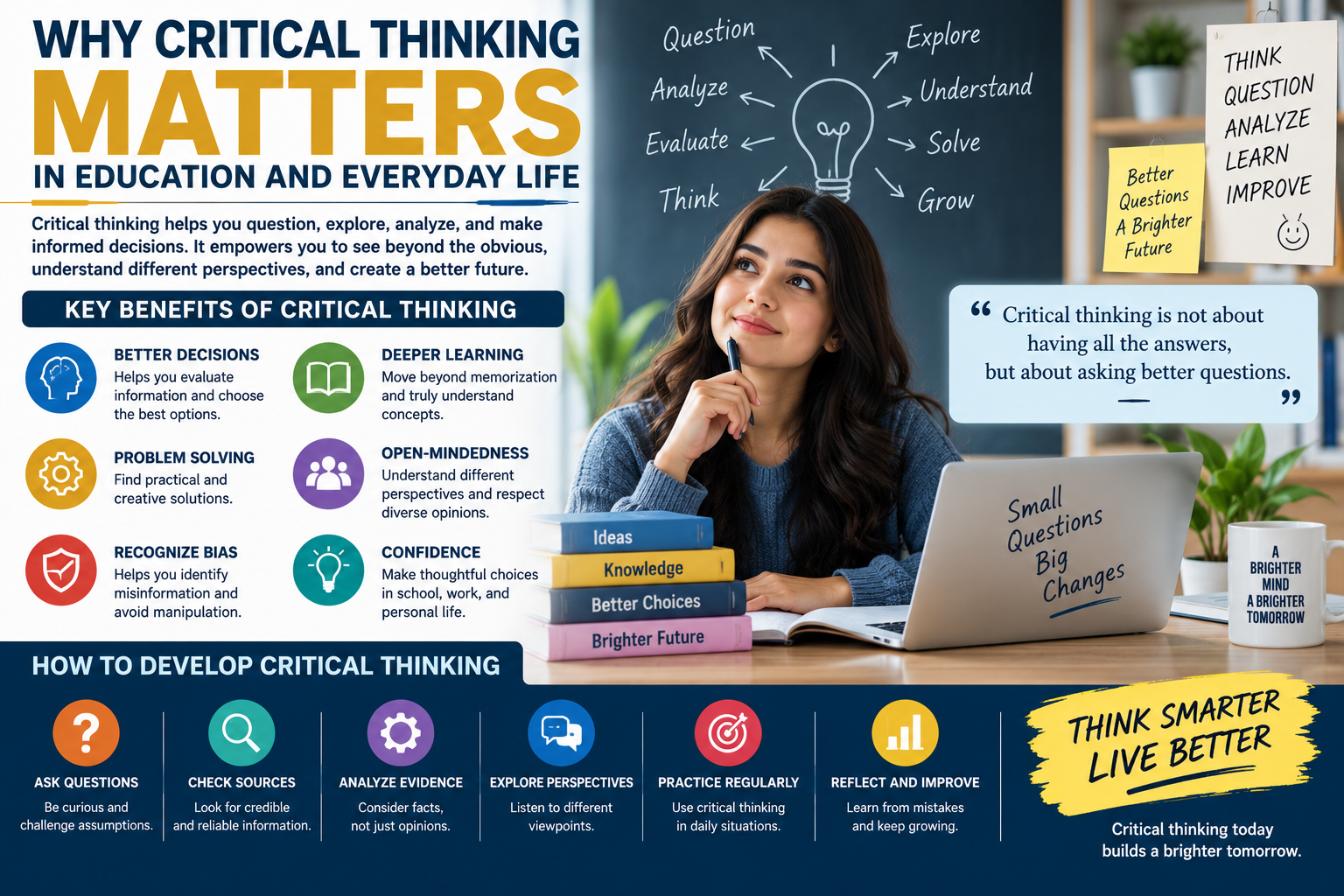
In a world filled with information, opinions, headlines, advertisements, social media posts, and rapidly changing technology, knowing how to think carefully has become an increasingly valuable skill.
Every day, people make decisions based on information. Students decide which sources to trust. Professionals evaluate business proposals. Consumers compare products and services. Families make financial decisions. Leaders consider competing ideas before choosing a direction.
Critical thinking helps people approach these situations thoughtfully rather than accepting every claim at face value.
Critical thinking is not about being negative, questioning everything, or assuming that other people are wrong. It is the ability to examine information objectively, identify assumptions, consider evidence, recognize different perspectives, and reach reasonable conclusions.
Education plays an important role in developing these abilities, but critical thinking is not limited to classrooms. It is a practical skill that can improve decision-making, communication, problem-solving, learning, and everyday life.
What Is Critical Thinking?
Critical thinking is the process of carefully analyzing information, ideas, arguments, and situations before reaching a conclusion.
It involves asking questions such as:
What evidence supports this claim?
Is the information reliable?
Are there other explanations?
What assumptions are being made?
Is the conclusion supported by the evidence?
Could personal bias be influencing the decision?
What information might be missing?
A critical thinker does not automatically accept or reject an idea.
Instead, they examine it.
This distinction is important.
Critical thinking is about better reasoning, not simply criticism.
Why Critical Thinking Matters
People encounter an enormous amount of information every day.
Some information is accurate.
Some is incomplete.
Some is misleading.
Some is based primarily on opinion.
Some may be intentionally designed to influence people's decisions.
Critical thinking provides a framework for navigating this environment.
It can help people:
Make better decisions
Evaluate information
Solve problems
Recognize weak arguments
Avoid unnecessary assumptions
Understand different perspectives
Communicate more effectively
Become independent learners
Evaluate risks
Make thoughtful choices
These benefits apply to education, careers, business, relationships, finance, technology, and everyday decision-making.
Critical Thinking in Education
Education should not only provide students with information.
It should also teach them how to use information.
A student may memorize a large amount of material and still struggle when faced with an unfamiliar problem.
Critical thinking helps students move beyond memorization.
Instead of only asking:
“What is the answer?”
Students can learn to ask:
“How do we know this is the answer?”
That shift encourages deeper learning.
Moving Beyond Memorization
Memorization has value.
Students need to remember facts, concepts, vocabulary, formulas, historical events, and other foundational information.
But memorization alone does not teach students how to evaluate new situations.
Critical thinking helps students apply what they know.
For example, a student studying science should not only remember scientific concepts. They should also understand how evidence supports conclusions and how scientific claims can be evaluated.
Similarly, a history student can learn dates and events while also examining causes, consequences, different perspectives, and the reliability of historical sources.
Asking Better Questions
Questions are at the heart of critical thinking.
A good question can reveal assumptions, uncover missing information, and lead to deeper understanding.
Students can develop critical-thinking skills by asking:
Why did this happen?
What caused it?
What evidence supports this explanation?
What information is missing?
Who benefits from this argument?
What would happen if circumstances changed?
Is there another way to interpret the situation?
Teachers can encourage these questions through classroom discussions, debates, research assignments, case studies, and problem-solving exercises.
Evaluating Sources
One of the most important critical-thinking skills is evaluating sources.
Not every source deserves the same level of trust.
When reading information online or in print, consider:
Who Created the Information?
Identify the author, organization, publication, or institution.
Understanding who produced information can provide useful context.
What Evidence Is Provided?
Strong claims should generally have appropriate evidence behind them.
Look for data, references, examples, documentation, or other forms of support.
When Was It Published?
Information can become outdated.
This is particularly important in fields such as technology, business, science, law, finance, and current affairs.
What Is the Purpose?
Consider whether the content is designed to:
Inform
Educate
Sell
Persuade
Entertain
Promote a particular viewpoint
Understanding the purpose can help readers interpret information more carefully.
Critical Thinking and Online Information
The internet provides enormous access to knowledge.
It also makes it easier for inaccurate or misleading information to spread.
A headline may be designed to attract attention rather than provide complete context.
A short social media post may leave out important details.
A photograph may be presented without its original context.
A statistic may be technically accurate but used in a misleading way.
Critical thinking helps people slow down before accepting or sharing information.
Before sharing an important claim, ask:
Where did this information come from?
Can the original source be found?
Does other reliable evidence support it?
Is the headline consistent with the actual content?
These simple questions can significantly improve digital information habits.
Recognizing Bias
Everyone has biases.
Bias does not necessarily mean that someone is intentionally dishonest.
People naturally interpret information through their experiences, beliefs, preferences, and expectations.
Critical thinking encourages people to recognize these influences.
For example, if you strongly support an idea, you may naturally pay more attention to information that supports it and overlook information that challenges it.
Recognizing this tendency can make reasoning more balanced.
Confirmation Bias
Confirmation bias occurs when people favor information that supports what they already believe.
Imagine someone strongly believes that a particular business strategy always works.
They may search for examples of companies that succeeded using that strategy while ignoring businesses that tried it and failed.
Critical thinking encourages people to look for evidence on both sides.
A useful question is:
“What evidence would change my mind?”
If the answer is “nothing,” the person may not be evaluating the issue objectively.
Understanding Different Perspectives
Critical thinking does not require agreeing with everyone.
It does require being willing to understand different perspectives.
When evaluating an issue, consider:
What does the other side believe?
What evidence supports their position?
What experiences shaped their perspective?
What assumptions are different?
Is there any part of their argument that is reasonable?
This can make discussions more productive.
It also helps people avoid reducing complicated issues to simple disagreements.
Critical Thinking Improves Problem-Solving
Problems rarely come with perfect instructions.
Whether the problem involves school, work, business, technology, or personal life, people often need to determine what is actually causing the issue.
Critical thinking can help separate symptoms from causes.
For example, if a business is experiencing declining sales, simply reducing prices may not solve the underlying problem.
The real issue could involve:
Changing customer preferences
Increased competition
Poor customer service
Weak marketing
Product quality
Distribution problems
Critical thinking encourages decision-makers to investigate before choosing a solution.
The Difference Between Symptoms and Causes
One of the most useful problem-solving habits is asking:
“What is causing this problem?”
Consider a student who receives lower grades.
The immediate assumption might be that the student needs to study more.
But the underlying issue could be:
Poor time management
Difficulty understanding the material
Lack of sleep
Unclear instructions
Weak study methods
Distractions
Anxiety about exams
Finding the actual cause leads to better solutions.
Critical Thinking and Decision-Making
Every decision involves some level of uncertainty.
Critical thinking helps people make decisions using available evidence rather than relying entirely on emotion or impulse.
A simple decision-making process can involve:
Define the decision.
Gather relevant information.
Identify available options.
Consider advantages and disadvantages.
Evaluate potential risks.
Consider long-term consequences.
Make a decision.
Review the result.
This approach does not guarantee a perfect outcome.
It improves the quality of the reasoning behind the decision.
Critical Thinking in the Workplace
Employers value people who can analyze problems and make thoughtful decisions.
Workplace situations frequently require employees to interpret information, prioritize tasks, solve problems, and respond to unexpected circumstances.
Critical thinking can help professionals:
Identify inefficiencies
Evaluate proposals
Analyze customer feedback
Understand business data
Improve processes
Manage risks
Resolve conflicts
Make recommendations
Employees who can explain not only what they recommend but also why can provide greater value to their organizations.
Critical Thinking and Leadership
Leadership requires decision-making under uncertainty.
Business leaders often need to consider incomplete information, competing priorities, financial constraints, customer expectations, and potential risks.
Critical thinking helps leaders avoid making decisions based solely on assumptions.
A strong leader can ask:
What do we know?
What do we not know?
What assumptions are we making?
What alternatives exist?
What are the potential consequences?
This approach can improve strategic thinking.
Critical Thinking and Communication
Critical thinking also improves communication.
Before presenting an argument, a thoughtful communicator considers:
What is the main point?
What evidence supports it?
What does the audience already know?
What questions might they have?
Are there reasonable objections?
Is the explanation clear?
This can make communication more persuasive without becoming aggressive or confrontational.
Critical Thinking Does Not Mean Overthinking
There is an important difference between critical thinking and overthinking.
Critical thinking involves structured analysis.
Overthinking can involve repeatedly analyzing the same decision without reaching a conclusion.
The goal is not to investigate every minor decision endlessly.
For important decisions, careful analysis can be valuable.
For routine decisions, a simple approach may be sufficient.
Good judgment includes knowing how much analysis a situation actually requires.
How Students Can Develop Critical Thinking Skills
Students can practice critical thinking in many ways.
Ask Questions
Do not be afraid to ask why, how, and what evidence supports an idea.
Compare Sources
Read more than one reliable source when researching important topics.
Explain Your Reasoning
When reaching a conclusion, explain how you arrived there.
Challenge Your Assumptions
Consider whether your first interpretation is necessarily correct.
Participate in Discussions
Listen to different perspectives and explain your own reasoning.
Solve Problems
Work on problems where the answer is not immediately obvious.
Reflect on Mistakes
Ask what went wrong and what could be done differently.
These habits can gradually strengthen analytical thinking.
How Teachers Can Encourage Critical Thinking
Teachers play an important role in creating environments where students can think independently.
Instead of always giving students answers, educators can sometimes guide them toward discovering answers themselves.
Useful classroom approaches include:
Open-ended questions
Debates
Group discussions
Research projects
Case studies
Problem-solving activities
Comparative analysis
Real-world examples
Student presentations
The goal is to encourage students to explain their reasoning rather than simply provide an answer.
Critical Thinking and Creativity
Critical thinking and creativity may seem like opposite skills, but they complement each other.
Creativity generates possibilities.
Critical thinking evaluates them.
For example, an entrepreneur may generate ten possible solutions to a business problem.
Critical thinking can then help determine which solutions are realistic, valuable, affordable, and appropriate.
Innovation often requires both abilities.
Critical Thinking and Artificial Intelligence
AI tools can provide answers, summaries, ideas, and explanations quickly.
This creates new opportunities for learning and productivity.
It also creates a greater need for critical thinking.
AI-generated information may require verification, especially when accuracy matters.
Instead of accepting an AI response automatically, users can ask:
Is the information accurate?
Is the reasoning sound?
Is important context missing?
Can the claims be independently verified?
Is the answer appropriate for the specific situation?
AI can support thinking, but users still need to evaluate its output.
Critical Thinking and Consumer Decisions
Consumers make decisions about products, services, subscriptions, financial choices, and purchases every day.
Advertising is designed to influence decisions.
Critical thinking can help consumers distinguish between useful information and persuasive marketing.
Before purchasing something, consider:
Do I actually need it?
What problem does it solve?
Are the claims supported?
Are there alternatives?
What are the total costs?
What do reliable reviews say?
Are there important limitations?
This can reduce impulsive decisions.
Critical Thinking and Financial Decisions
Financial decisions can have long-term consequences.
People may encounter claims about investments, loans, savings products, businesses, and financial opportunities.
Critical thinking encourages people to examine:
Potential benefits
Potential risks
Fees
Assumptions
Time horizons
Alternatives
Reliability of information
A claim that something is “guaranteed” or “risk-free” should immediately encourage careful examination.
Good financial decisions require more than following trends or recommendations.
Critical Thinking in Everyday Relationships
Critical thinking can also improve personal relationships.
Disagreements often arise because people interpret situations differently.
Before assuming that someone intended to be disrespectful, dishonest, or careless, consider whether there could be another explanation.
For example:
What actually happened?
What did I assume happened?
Could there be information I do not know?
This does not mean ignoring genuine problems.
It means separating facts from assumptions before reacting.
Emotional Intelligence and Critical Thinking
Emotions influence decision-making.
Fear can encourage avoidance.
Anger can encourage impulsive reactions.
Excitement can cause people to overlook risks.
Critical thinking does not require eliminating emotions.
Instead, it encourages people to recognize when emotions may be influencing their reasoning.
A useful habit is to pause before making an important decision when emotions are particularly strong.
Common Obstacles to Critical Thinking
Several habits can interfere with good reasoning.
Assuming You Are Always Right
Confidence is useful, but refusing to reconsider your position can prevent learning.
Relying on the First Answer
The first explanation is not always the best explanation.
Following the Crowd
Popular opinions can still be incorrect.
Ignoring Contradictory Evidence
Evidence that challenges your beliefs may be especially valuable.
Making Decisions Too Quickly
Some decisions require more information than others.
Confusing Confidence With Accuracy
Someone can sound extremely confident and still be wrong.
Accepting Information Because It Feels True
An idea can feel convincing without being supported by strong evidence.
A Simple Critical Thinking Framework
A practical framework can make critical thinking easier.
Step 1: Identify the Claim
What exactly is being said?
Step 2: Examine the Evidence
What supports the claim?
Step 3: Check the Source
Who provided the information, and what is their purpose?
Step 4: Identify Assumptions
What must be true for the argument to work?
Step 5: Consider Alternatives
Are there other possible explanations?
Step 6: Look for Missing Information
What important facts are not being considered?
Step 7: Reach a Provisional Conclusion
Make the best judgment based on the available evidence.
Step 8: Stay Open to New Information
Be willing to update your conclusion when credible evidence changes.
This final step is especially important.
Critical thinking is not about finding one permanent answer.
It is about improving your understanding as better information becomes available.
How to Make Critical Thinking a Daily Habit
You do not need a formal course to practice critical thinking.
Start with everyday situations.
When you see an interesting claim online, pause before sharing it.
When someone gives you advice, ask what evidence supports it.
When you disagree with someone, try to understand their reasoning.
When you make a mistake, analyze what caused it.
When you make an important purchase, compare alternatives.
When you receive a recommendation, consider whether it actually fits your circumstances.
Small habits can gradually strengthen your reasoning skills.
The Long-Term Benefits of Critical Thinking
Critical thinking is a transferable skill.
Unlike knowledge about one specific subject, it can be applied across many areas of life.
A person who develops strong critical-thinking abilities can use them when:
Studying
Working
Managing money
Evaluating technology
Making purchases
Solving problems
Leading teams
Communicating
Planning a career
Evaluating online information
As circumstances change, the ability to reason effectively remains useful.
Final Thoughts
Critical thinking is one of the most valuable skills people can develop because it helps transform information into better understanding and better decisions.
In education, it encourages students to move beyond memorization and examine evidence, ask questions, solve problems, and understand different perspectives.
In everyday life, it helps people evaluate online information, make thoughtful purchases, consider financial decisions, communicate more effectively, and avoid unnecessary assumptions.
Critical thinking does not mean questioning everything or refusing to trust anyone.
It means developing the habit of thinking carefully before reaching conclusions.
The world will continue to produce more information, new technologies, competing opinions, and complex decisions.
The ability to determine what deserves attention, what requires further investigation, and what conclusions are supported by evidence will remain valuable.
Ultimately, critical thinking is not simply an academic skill.
It is a life skill.
Frequently Asked Questions
1. What is critical thinking?
Critical thinking is the ability to analyze information, evaluate evidence, recognize assumptions, consider different perspectives, and reach reasonable conclusions.
2. Why is critical thinking important in education?
Critical thinking helps students move beyond memorization by teaching them how to analyze information, solve unfamiliar problems, evaluate evidence, and explain their reasoning.
3. Is critical thinking the same as criticism?
No. Criticism focuses on identifying problems or weaknesses, while critical thinking involves objectively evaluating information and reasoning before reaching a conclusion.
4. Can critical thinking be learned?
Yes. Critical thinking can be developed through practice, questioning, research, problem-solving, discussion, reflection, and careful evaluation of information.
5. How does critical thinking help in everyday life?
It can help people make better decisions, evaluate information, solve problems, compare options, recognize misleading claims, and understand different perspectives.
6. Why is critical thinking important in the digital age?
People encounter enormous amounts of online information, and not all of it is accurate or complete. Critical thinking helps individuals evaluate sources and claims before accepting or sharing them.
7. How can students improve critical thinking?
Students can ask questions, compare sources, explain their reasoning, participate in discussions, solve problems, challenge assumptions, and learn from mistakes.
8. How can teachers encourage critical thinking?
Teachers can use open-ended questions, debates, research projects, case studies, discussions, and problem-solving exercises that require students to explain their reasoning.
9. What is confirmation bias?
Confirmation bias is the tendency to favor information that supports existing beliefs while giving less attention to information that challenges them.
10. How can I avoid confirmation bias?
Consider evidence from multiple perspectives and actively look for credible information that challenges your existing assumptions.
11. Does critical thinking improve decision-making?
Yes. Critical thinking encourages people to consider evidence, alternatives, risks, assumptions, and potential consequences before making decisions.
12. Does critical thinking help with problem-solving?
Yes. It can help people identify the underlying cause of a problem, compare possible solutions, and choose an approach based on evidence and reasoning.
13. How does critical thinking help at work?
It can help professionals analyze information, solve problems, evaluate proposals, identify risks, improve processes, and make informed recommendations.
14. Can critical thinking help business leaders?
Yes. Leaders can use critical thinking to evaluate strategies, understand risks, examine assumptions, interpret information, and make decisions under uncertainty.
15. Is critical thinking important when using AI?
Yes. AI-generated information should be evaluated carefully, especially when accuracy is important. Users should verify important claims and consider whether context or information is missing.
16. Can critical thinking improve communication?
Yes. It helps people organize arguments, evaluate evidence, understand opposing perspectives, and communicate their ideas more clearly.
17. Is critical thinking the same as intelligence?
No. Intelligence and critical thinking are related but different. Critical thinking involves specific habits and methods for evaluating information and reasoning.
18. Can emotions affect critical thinking?
Yes. Strong emotions can influence how people interpret information and make decisions. Recognizing emotional influences can support more balanced reasoning.
19. What is the most important critical-thinking habit?
One of the most valuable habits is being willing to question your assumptions and change your conclusion when credible evidence supports a different interpretation.
20. How can I practice critical thinking every day?
Pause before accepting important claims, check sources, ask questions, compare perspectives, identify assumptions, evaluate evidence, and reflect on the results of your decisions.