
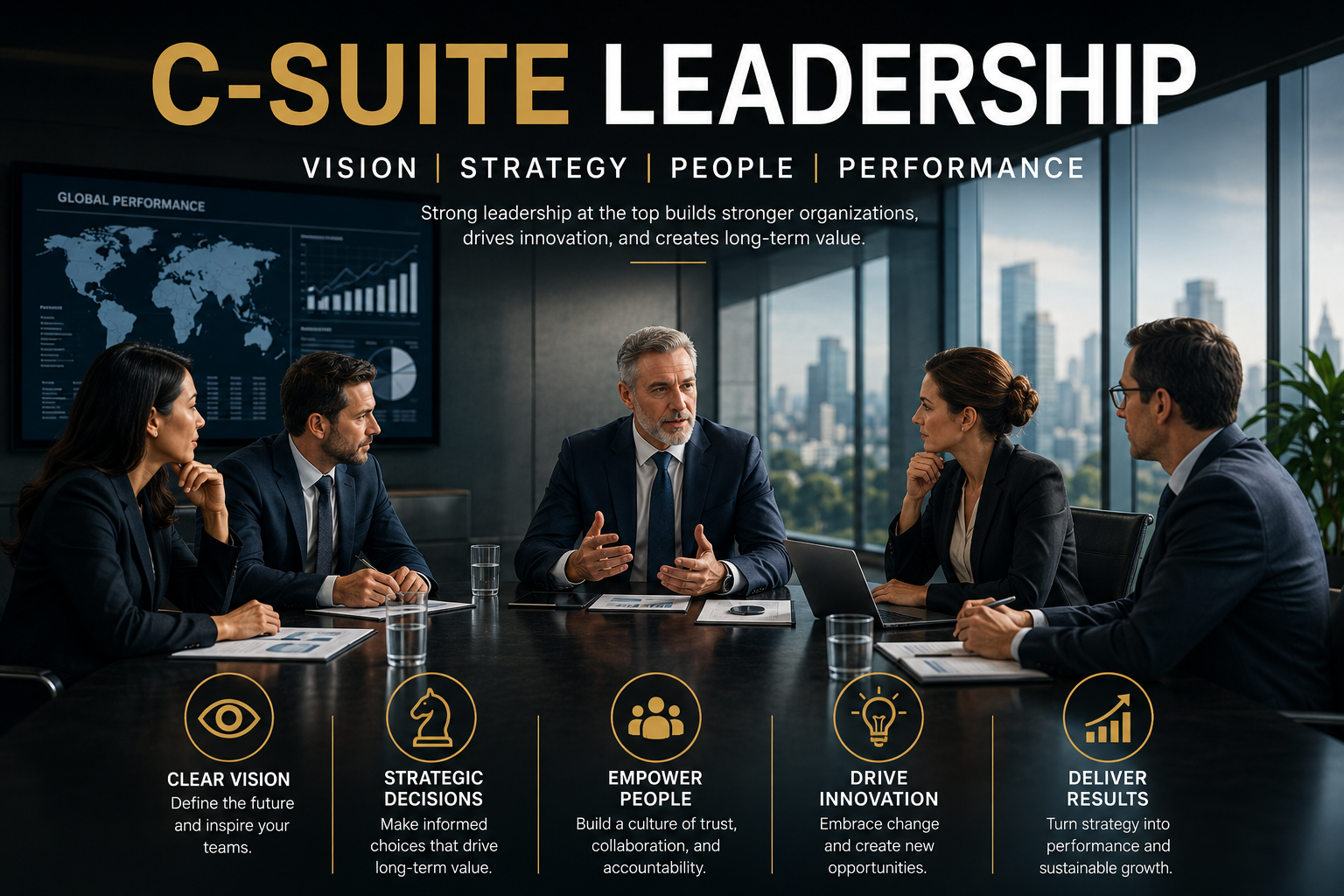
The Changing Role of C-Suite Leadership
C-suite leadership has become increasingly complex as businesses operate in a rapidly changing global environment. Chief Executive Officers (CEOs), Chief Financial Officers (CFOs), Chief Operating Officers (COOs), Chief Marketing Officers (CMOs), Chief Technology Officers (CTOs), and other senior executives are responsible for much more than their individual departments.
Modern C-suite leaders must understand how different areas of an organization work together. Financial performance, employee engagement, customer experience, technology, innovation, and corporate strategy are increasingly interconnected.
The most effective executives therefore focus on the bigger picture. They create a clear direction for the organization while ensuring that teams have the resources, confidence, and guidance needed to achieve strategic objectives.
Creating a Clear Vision
A strong organizational vision is one of the foundations of effective C-suite leadership. Employees need to understand where the organization is heading and why its goals matter.
Senior executives are responsible for translating their vision into practical objectives. Instead of simply announcing ambitious targets, effective leaders explain how those targets connect to the company's broader purpose.
A clear vision can also help organizations remain focused during periods of uncertainty. When market conditions change, employees who understand the organization's priorities can make better decisions without waiting for constant direction from senior management.
Strategic Decision-Making
C-suite executives regularly make decisions that can affect an organization's future. These decisions may involve investments, expansion, technology, hiring, partnerships, marketing strategies, or operational changes.
Effective strategic decision-making requires more than intuition. Leaders need to evaluate data, understand risks, consider different perspectives, and assess potential long-term consequences.
At the same time, executives cannot always wait for perfect information. Business environments can change quickly, making timely decisions essential. Strong leaders learn to balance analysis with decisive action.
The goal is not to eliminate risk completely but to understand and manage it intelligently.
Building a Culture of Accountability
Organizational culture often begins at the top. Employees observe how executives communicate, respond to challenges, recognize success, and handle mistakes.
C-suite leaders who demonstrate accountability can encourage the same behavior throughout the organization. Clear expectations, measurable objectives, and transparent communication help employees understand their responsibilities.
However, accountability should not create a culture where employees are afraid to make mistakes. Organizations need an environment where people can identify problems, discuss failures constructively, and learn from experience.
When accountability is combined with trust, employees are more likely to take ownership of their work and contribute ideas.
Empowering Employees
Leadership is not about making every decision personally. Effective C-suite executives understand the importance of empowering people throughout the organization.
Employees who are trusted with meaningful responsibilities can respond more quickly to challenges and opportunities. Empowerment can also improve engagement because people feel that their contributions have a genuine impact.
Senior leaders can support empowerment by giving teams clear objectives while allowing them sufficient flexibility to determine how those objectives should be achieved.
This approach creates a stronger organization because leadership becomes a shared responsibility rather than something limited to the executive level.
Embracing Innovation and Technology
Technology continues to transform how organizations operate. Artificial intelligence, automation, data analytics, cloud computing, and digital platforms are creating new opportunities while also introducing new challenges.
C-suite leaders do not need to become technology specialists, but they must understand the strategic implications of technological change.
Executives should consider how technology can improve efficiency, enhance customer experiences, strengthen decision-making, and create new sources of value.
Successful innovation also requires discipline. Not every emerging technology will provide meaningful business benefits. Leaders need to evaluate investments based on clear objectives and measurable outcomes.
A culture that encourages experimentation while maintaining strategic focus can help organizations innovate without losing sight of business priorities.
Leading Through Uncertainty
Economic changes, evolving customer expectations, geopolitical developments, technological disruption, and competitive pressures can create significant uncertainty for businesses.
During challenging periods, employees often look to senior leaders for clarity and stability. Effective C-suite leadership does not mean pretending that every situation is predictable. Instead, strong leaders acknowledge uncertainty while communicating what the organization can control.
Frequent and transparent communication can help prevent confusion and maintain employee confidence.
Leaders should also be prepared to adapt strategies when circumstances change. Flexibility is increasingly becoming a core leadership capability.
Developing Future Leaders
Successful organizations need leadership beyond the current executive team. Developing future leaders is therefore an important responsibility for C-suite executives.
Mentorship, professional development, leadership training, and opportunities for greater responsibility can help employees build the skills required for future roles.
Succession planning is another important component of long-term organizational resilience. Companies that identify and develop potential leaders early can reduce disruption when senior executives eventually move into new roles or leave the organization.
Investing in people today can create a stronger leadership pipeline for tomorrow.
The Importance of Emotional Intelligence
While business knowledge and strategic thinking remain essential, emotional intelligence is becoming increasingly important for C-suite leaders.
Executives regularly communicate with employees, customers, investors, partners, and other stakeholders. The ability to listen, understand different perspectives, manage difficult conversations, and communicate with empathy can significantly influence organizational performance.
Emotional intelligence does not mean avoiding difficult decisions. Rather, it allows leaders to make and communicate those decisions thoughtfully.
Executives who combine strong business judgment with effective interpersonal skills can build greater trust across their organizations.
Measuring Leadership Success
C-suite leadership should ultimately contribute to measurable organizational outcomes. Financial performance remains important, but modern organizations must also consider employee retention, customer satisfaction, innovation, operational efficiency, and long-term resilience.
Leaders should establish meaningful performance indicators that connect daily activities with strategic goals.
Regularly reviewing these indicators can help executives identify what is working, where improvements are needed, and whether the organization remains aligned with its long-term vision.
The Future of C-Suite Leadership
The future of C-suite leadership will require executives to combine strategic thinking with adaptability, technological awareness, communication, and a strong understanding of people.
Organizations will continue to face rapid change, making traditional leadership models less effective on their own. Executives who can anticipate trends, make informed decisions, empower teams, and create cultures of innovation will be better prepared for the future.
Ultimately, effective C-suite leadership is about creating sustainable value. The strongest leaders do not focus only on today's results. They build organizations that can continue to learn, adapt, innovate, and perform in the years ahead.
By combining a clear vision with strategic decision-making, employee empowerment, innovation, accountability, and resilience, C-suite executives can help their organizations navigate uncertainty and achieve sustainable long-term growth