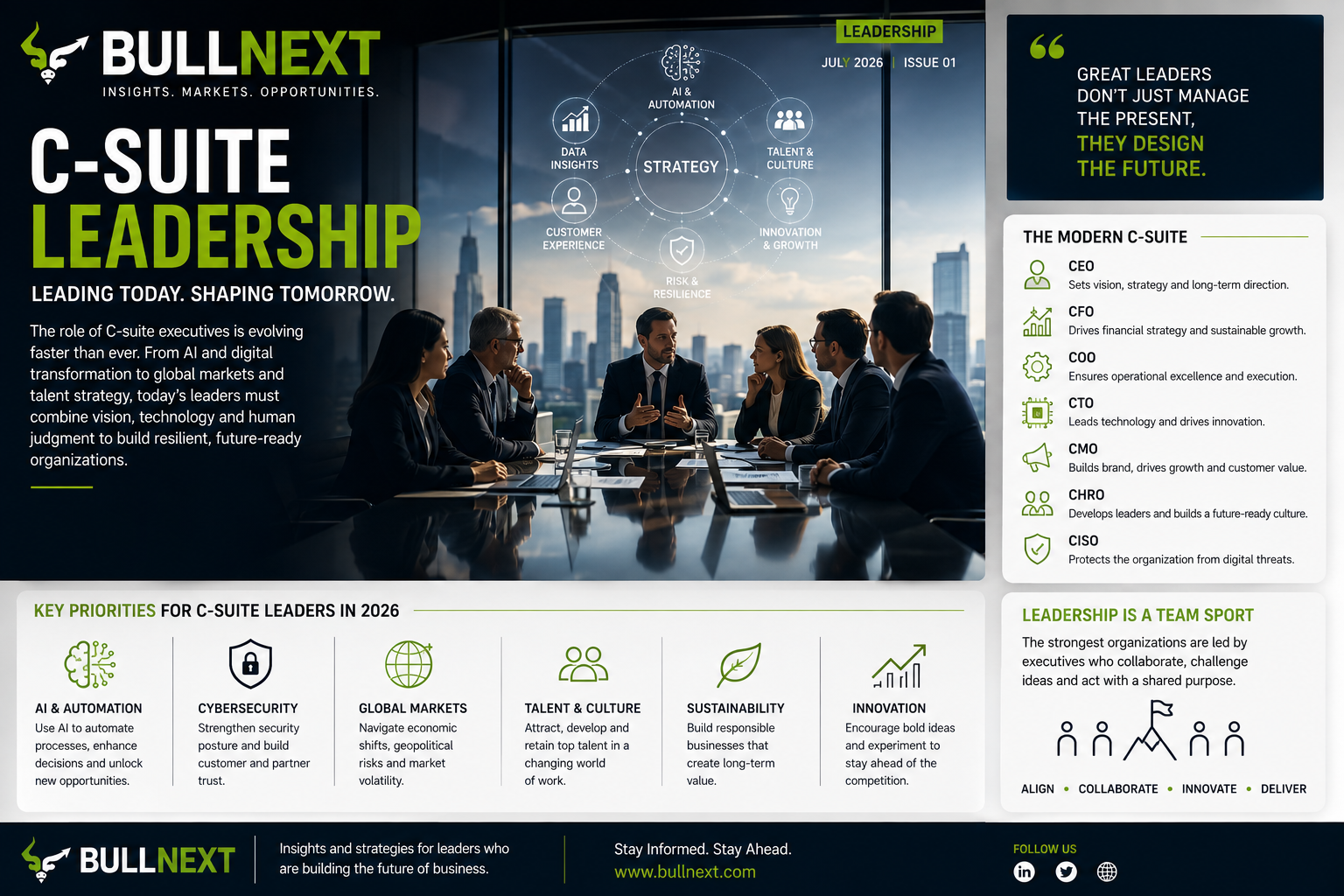
The role of the C-suite is changing rapidly. Chief executives are no longer responsible only for financial performance and traditional business strategy. Today's leaders must navigate artificial intelligence, digital transformation, cybersecurity, changing customer expectations, workforce challenges, global competition, and economic uncertainty.
From the CEO and CFO to the COO, CTO, CMO, and CHRO, modern C-suite executives need to work together to build organizations that are innovative, resilient, and prepared for change.
In 2026, successful leadership is increasingly about combining human judgment, technology, data, and long-term strategy.
What Is the C-Suite?
The term C-suite refers to the highest-ranking executives within an organization. The "C" generally stands for Chief.
Common C-suite positions include:
CEO — Chief Executive Officer: Leads the organization and sets overall strategy.
CFO — Chief Financial Officer: Oversees finance, investment, budgeting, and financial risk.
COO — Chief Operating Officer: Manages business operations and execution.
CTO — Chief Technology Officer: Leads technology strategy and innovation.
CIO — Chief Information Officer: Oversees information systems and digital infrastructure.
CMO — Chief Marketing Officer: Leads marketing, brand strategy, and customer acquisition.
CHRO — Chief Human Resources Officer: Oversees talent, culture, and workforce strategy.
CISO — Chief Information Security Officer: Leads cybersecurity and information-security strategy.
Not every organization has all these roles. The structure depends on the company's size, industry, priorities, and stage of growth.
The Changing Role of the CEO
The CEO remains the central strategic leader of most organizations.
Traditionally, CEOs concentrated heavily on revenue, profitability, shareholders, and long-term growth. Those responsibilities remain essential, but the modern CEO must understand a much broader range of issues.
Today's CEOs may need to make strategic decisions about AI investment, cybersecurity, digital transformation, workforce development, sustainability, supply chains, and international expansion.
This doesn't mean the CEO needs to become an expert programmer, economist, or cybersecurity engineer.
Instead, effective CEOs need enough understanding to ask the right questions, evaluate risks, and bring the right experts into major decisions.
AI Is Entering the C-Suite
Artificial intelligence has become one of the biggest strategic questions facing executive teams.
Organizations are exploring AI for:
Customer service
Data analysis
Marketing
Software development
Sales
Financial forecasting
Supply-chain management
Workflow automation
Fraud detection
Employee productivity
For the C-suite, however, AI adoption isn't simply a technology decision.
The CEO may evaluate its strategic importance.
The CFO considers investment and return.
The CTO determines the technical requirements.
The CISO evaluates security risks.
The CHRO considers how AI changes jobs and skills.
The COO determines how automation fits into operations.
Successful AI adoption therefore requires collaboration across leadership functions.
The Modern CFO
The CFO's responsibilities have also expanded.
Financial reporting, budgeting, cash flow, and cost management remain fundamental. But modern CFOs increasingly participate in broader strategic decisions.
They may evaluate:
Technology investments
AI spending
Acquisitions
International expansion
Capital allocation
Operational efficiency
Economic risks
New business models
Data analytics and automation can provide finance teams with faster information, but executives still need to interpret what that information means.
A dashboard can show that revenue is declining.
Leadership must determine why it is declining and what the company should do next.
The COO and Intelligent Operations
The Chief Operating Officer is responsible for turning strategy into execution.
This makes the COO particularly important as companies introduce automation.
AI and software can potentially automate repetitive tasks, but implementing automation successfully requires understanding the entire workflow.
A poorly designed process doesn't automatically become better because AI is added to it.
The COO must ask:
Which tasks should be automated?
Which require human judgment?
Where are the biggest bottlenecks?
What happens when the automated system encounters an exception?
Effective operational leadership focuses on measurable business improvements rather than adopting technology simply because it is fashionable.
Technology Leadership Moves to the Center
The CTO and CIO have become increasingly influential members of executive leadership.
Technology now affects almost every business function.
Sales teams depend on software.
Marketing depends on data.
Finance uses automated systems.
Customer service increasingly uses AI.
Operations depend on connected platforms.
This means technology strategy and business strategy can no longer operate independently.
The strongest technology leaders understand both.
Instead of asking only:
"What technology should we buy?"
they ask:
"What business outcome are we trying to achieve?"
Cybersecurity Becomes a Leadership Issue
Cybersecurity is no longer simply an IT department responsibility.
A significant cyber incident can affect customers, employees, revenue, operations, reputation, and regulatory obligations.
That makes cybersecurity a C-suite and board-level concern.
The CISO plays an important role in helping executives understand threats and prepare appropriate defenses.
Leadership teams should think about cybersecurity before an incident occurs.
That includes preparation around:
Data protection
Employee access
Vendor security
Cloud infrastructure
AI security
Incident response
Business continuity
Employee training
Executives don't need to understand every technical detail, but they should understand the organization's most important risks.
The CMO and the New Customer Journey
Marketing leadership has changed dramatically.
Customers now discover brands through search engines, social media, creators, online marketplaces, AI-powered discovery tools, email, advertisements, and recommendations.
The CMO must connect these different channels into a consistent customer experience.
AI is also changing marketing through personalization, content generation, predictive analytics, audience analysis, and campaign optimization.
However, automation creates a new challenge.
As producing content becomes easier, trust and differentiation become more valuable.
Brands still need a clear identity and a reason for customers to choose them.
The CHRO and the Future Workforce
The CHRO is becoming increasingly important as AI changes how employees work.
Companies face difficult questions:
Which tasks will become automated?
Which new skills will employees need?
How should companies retrain workers?
How can productivity increase without damaging workplace culture?
What skills will remain uniquely valuable?
The best approach isn't necessarily choosing between humans and technology.
In many cases, the opportunity is to determine how technology can make employees more capable.
AI may handle repetitive analysis while people focus on creativity, negotiation, relationships, leadership, and complex judgment.
Data-Driven Leadership
Modern executives have access to enormous amounts of information.
Sales dashboards, customer analytics, financial forecasts, market intelligence, and operational data can provide executives with insights that previous generations of leaders couldn't access as easily.
But more data doesn't automatically create better decisions.
Executives need to distinguish between:
Data → Information → Insight → Decision → Action
A company can have excellent analytics and still make poor strategic decisions.
Leadership requires understanding context, uncertainty, and consequences.
Collaboration Across the C-Suite
One of the biggest mistakes organizations can make is allowing executive departments to operate as isolated silos.
Consider launching a major AI platform.
The CTO understands the technology.
The CFO understands the economics.
The CISO understands security.
The CHRO understands workforce implications.
The CMO understands customer impact.
The COO understands operational integration.
The CEO understands overall strategy.
None of these perspectives is sufficient alone.
Strong C-suite leadership brings them together around shared business objectives.
Leading Through Uncertainty
Executives rarely have perfect information.
Interest rates can change.
Competitors can introduce new products.
Consumer preferences can shift.
New technology can disrupt existing business models.
Geopolitical events can affect supply chains.
Strong leadership therefore requires the ability to make decisions despite uncertainty.
That doesn't mean making reckless bets.
Instead, leaders can create several scenarios:
What happens if growth accelerates?
What happens if demand falls?
What happens if costs increase?
What happens if a competitor introduces disruptive technology?
Scenario planning allows companies to prepare rather than simply react.
The Importance of Communication
Leadership isn't only about making good decisions.
Employees, customers, investors, and partners need to understand those decisions.
Executives should be able to explain:
Where the company is going.
Why it is going there.
What needs to change.
What employees should prioritize.
Complex strategies become much harder to execute when people don't understand them.
Clear communication can therefore become a competitive advantage.
What Makes an Effective C-Suite Leader?
Successful executives can have very different personalities and management styles, but several qualities remain particularly valuable.
Strategic Thinking
Leaders must understand today's problems while preparing for tomorrow.
Adaptability
Executives need to change direction when evidence shows that the current strategy isn't working.
Decision-Making
Leadership requires making difficult choices rather than endlessly analyzing possibilities.
Accountability
Executives should take responsibility for outcomes and create clear ownership across their teams.
Curiosity
Technology and markets change quickly. Leaders who stop learning risk falling behind.
Emotional Intelligence
Understanding employees, customers, partners, and other stakeholders remains essential.
Integrity
Trust takes years to build and can disappear quickly. Ethical leadership remains fundamental to sustainable business success.
C-Suite Leadership in the Age of AI
AI may become one of the most important tests of modern executive leadership.
Companies face two opposite risks.
Moving too slowly could allow competitors to gain advantages through automation and improved productivity.
Moving too quickly without governance could introduce security, accuracy, financial, and reputational risks.
The goal should therefore be responsible acceleration.
Executives can identify high-value opportunities, test them carefully, measure results, establish safeguards, and expand successful implementations.
The Future of Executive Leadership
The future C-suite is likely to become increasingly interdisciplinary.
A CFO will need greater technology understanding.
A CTO will need stronger commercial awareness.
A CMO will need deeper data expertise.
A CHRO will need to understand automation.
And the CEO will need to connect all these areas into one coherent strategy.
Technology may provide increasingly powerful tools, but leadership will remain fundamentally human.
Machines can analyze millions of data points.
They cannot independently define what an organization should stand for, what risks it should accept, or what future it should pursue.
Those remain leadership decisions.
Final Thoughts
C-suite leadership in 2026 is about much more than managing individual departments. Executives must work together to navigate AI, technology, markets, cybersecurity, talent, customers, and economic uncertainty.
The strongest leadership teams combine data with judgment, innovation with risk management, and technology with human capability.
AI may help companies analyze information faster and automate more work, but technology alone doesn't create a successful organization.
People still determine the strategy.
People establish the culture.
People decide which risks are worth taking.
And ultimately, leadership determines whether technology becomes simply another expense—or a genuine competitive advantage.