
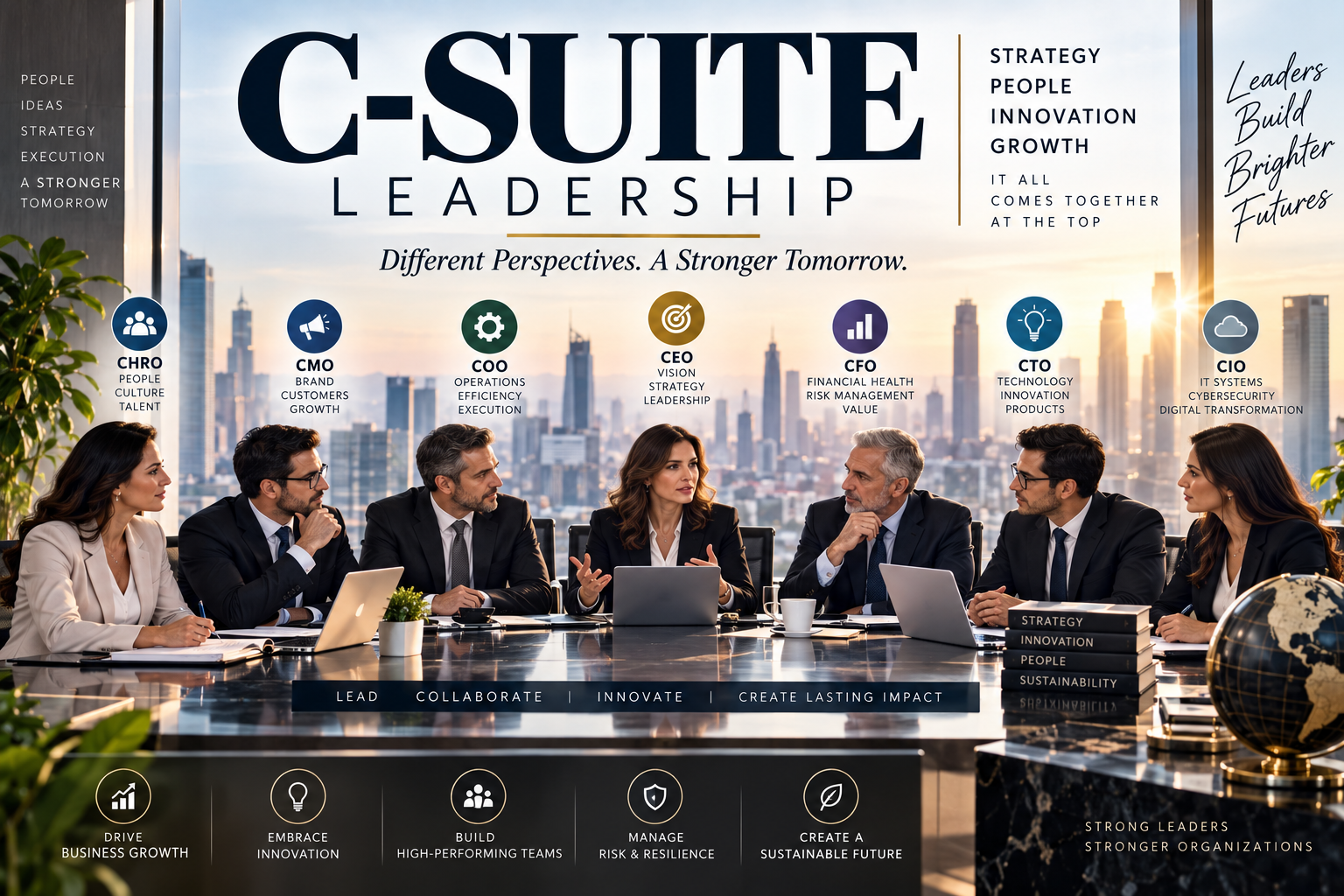
The modern business world is changing faster than ever. Technology is transforming industries, customer expectations are evolving, markets are becoming increasingly competitive, and organizations are navigating economic uncertainty. At the center of these changes are the executives responsible for making the decisions that determine where companies go next: the C-suite.
The term C-suite refers to a company's senior-most executives whose titles typically begin with the word "Chief." These leaders are responsible for setting strategy, managing critical functions, developing organizational culture, allocating resources, and guiding companies toward long-term growth.
While the responsibilities of each executive differ, successful C-suite leadership depends on collaboration. A chief executive cannot build a successful organization alone. CEOs, CFOs, COOs, CIOs, CTOs, CMOs, CHROs, and other senior executives must work together to balance financial performance, operational efficiency, technology, people, innovation, and customer relationships.
What Is the C-Suite?
The C-suite represents the highest level of executive leadership within an organization. The exact structure varies depending on the company's size, industry, and business model.
The Chief Executive Officer (CEO) is generally responsible for the overall direction and performance of the company. The CEO establishes the organization's vision, works with the board, makes major strategic decisions, and represents the company to investors, employees, customers, and other stakeholders.
The Chief Financial Officer (CFO) oversees the company's financial health. This includes financial planning, budgeting, reporting, risk management, capital allocation, and communicating financial performance to stakeholders.
The Chief Operating Officer (COO) focuses on execution and operational performance. The COO may oversee processes, supply chains, customer operations, production, or other activities required to turn strategy into measurable results.
Technology has also become central to executive leadership. The Chief Information Officer (CIO) typically focuses on information technology, digital systems, cybersecurity, and technology infrastructure, while the Chief Technology Officer (CTO) often concentrates on technology strategy, product development, engineering, and innovation.
Meanwhile, the Chief Marketing Officer (CMO) manages brand strategy, marketing, customer engagement, and market positioning. The Chief Human Resources Officer (CHRO) focuses on people strategy, talent, organizational development, leadership, and workplace culture.
As businesses evolve, new executive roles continue to emerge, including Chief Data Officers, Chief Information Security Officers, Chief Sustainability Officers, and Chief Customer Officers.
Why C-Suite Leadership Matters
C-suite executives have an enormous influence on organizational success. Their decisions can affect thousands of employees, millions of customers, and significant amounts of capital.
One of their most important responsibilities is creating a clear strategic direction.
Organizations can become inefficient when different departments pursue conflicting priorities. Finance may focus on cost reduction, marketing may prioritize customer acquisition, technology may seek larger investments, and operations may focus on efficiency. Without alignment, these objectives can work against one another.
Effective C-suite leadership connects these priorities to a common business strategy.
A strong executive team asks fundamental questions: Where should the company compete? Which customers should it serve? What capabilities will create competitive advantage? Where should capital be invested? Which risks require immediate attention? And what should the organization look like several years from now?
The answers provide a framework for decision-making across the organization.
The CEO: Setting the Vision
The CEO is often viewed as the face of the organization, but the role goes far beyond public representation.
A successful CEO must balance short-term performance with long-term opportunity. Investors may expect strong quarterly results, while management must simultaneously invest in products, technology, employees, and infrastructure that may not generate immediate returns.
CEOs must also build confidence. During periods of uncertainty, employees and investors look to senior leadership for clarity.
Great CEOs do not necessarily have all the answers. Instead, they build teams capable of finding answers, encourage constructive disagreement, and make decisions when uncertainty cannot be eliminated.
The best CEOs understand that leadership is not about controlling every detail. It is about creating the conditions in which talented people can perform at their highest level.
The CFO: Protecting and Allocating Capital
Financial leadership has become increasingly strategic.
The CFO's role is no longer limited to preparing financial statements. Modern CFOs increasingly participate in decisions involving technology, acquisitions, pricing, expansion, workforce planning, and business transformation.
Capital allocation is one of the CFO's most important responsibilities.
Every organization has limited resources. Executives must determine whether money should be invested in new products, technology, marketing, acquisitions, hiring, debt reduction, or shareholder returns.
A strong CFO combines financial discipline with strategic thinking. Rather than simply asking, "How much will this cost?" an effective CFO asks, "What value can this investment create, what risks does it introduce, and what alternatives do we have?"
The COO: Turning Strategy Into Execution
A brilliant strategy has little value if an organization cannot execute it.
This is where the COO can play a critical role.
COOs frequently focus on operational systems, processes, productivity, quality, supply chains, and execution. Their work connects strategic objectives with day-to-day operations.
The COO must identify inefficiencies and remove obstacles that prevent teams from delivering results.
In rapidly growing organizations, operational leadership becomes especially important. A business model that works with 50 employees may not work effectively with 5,000. Processes, communication structures, technology systems, and accountability mechanisms must evolve as the organization grows.
Technology Leadership at the C-Suite
Technology is no longer simply an IT department issue. It has become a strategic business issue.
Cloud computing, artificial intelligence, automation, data analytics, cybersecurity, and digital platforms are reshaping how companies compete.
This has elevated the importance of CIOs and CTOs.
Technology executives must understand both technology and business objectives. Implementing sophisticated technology does not automatically create value. The technology must solve a meaningful business problem, improve customer experience, increase productivity, reduce risk, or create a new competitive advantage.
Artificial intelligence is a particularly important example. C-suite executives must consider where AI can generate measurable value while also addressing issues such as data governance, cybersecurity, workforce transformation, and responsible implementation.
The CMO and the Customer
A company can have excellent products and efficient operations but still struggle if it fails to understand its customers.
The CMO plays an important role in connecting the organization with the market.
Modern marketing leadership increasingly involves customer data, digital channels, brand positioning, personalization, content, social media, and customer experience.
The CMO must understand not only how to attract customers but also why customers choose, remain loyal to, or leave a company.
The strongest marketing leaders bring customer insights into broader strategic conversations. Customer behavior can influence product development, pricing, expansion strategies, and investment decisions.
The CHRO: Building the Organization Behind the Strategy
People remain one of the most important assets of any organization.
The CHRO is responsible for helping the company attract, develop, retain, and engage talent. But modern people leadership extends beyond recruitment and compensation.
Culture, leadership development, employee experience, organizational design, succession planning, and workforce strategy can all influence business performance.
A company may have a strong strategy, but if it lacks the talent required to execute that strategy, results will suffer.
C-suite leaders therefore need to view human capital as a strategic investment rather than simply an operating expense.
Collaboration Is the Secret to Effective C-Suite Leadership
Individual executive performance is important, but the effectiveness of the entire leadership team can be even more important.
C-suite executives must be willing to challenge each other while remaining aligned around organizational goals.
Healthy disagreement can improve decisions. A CFO may identify financial risks that others overlook. A CTO may highlight technological opportunities. A CMO may provide customer insights that challenge assumptions. A CHRO may identify workforce implications that could affect execution.
The goal is not to eliminate disagreement. The goal is to turn different perspectives into better decisions.
Trust is essential. Executives must be able to discuss problems openly without creating political competition between departments.
C-Suite Leadership During Crisis
Leadership becomes especially important during a crisis.
Economic downturns, cybersecurity incidents, supply-chain disruptions, reputational challenges, and unexpected market changes can test an executive team's ability to respond.
During these situations, communication is critical.
Employees need to know what is happening, what the organization is doing about it, and what is expected from them. Investors and customers also expect transparency and accountability.
Effective C-suite teams avoid panic while recognizing reality. They establish priorities, make decisions quickly when necessary, communicate consistently, and adjust strategies as new information becomes available.
A crisis can also reveal weaknesses that were hidden during stable periods. Organizations often discover whether their leadership structure, technology systems, communication channels, and decision-making processes are truly resilient.
The Future of the C-Suite
The C-suite of the future will likely be more interconnected than ever.
Traditional boundaries between departments are becoming less meaningful. Technology affects marketing. Data affects finance. Employee experience affects productivity. Cybersecurity affects reputation. Sustainability affects capital allocation and customer expectations.
This means executives must increasingly understand functions outside their own areas of expertise.
Future C-suite leaders will need a combination of strategic thinking, technological awareness, financial discipline, communication skills, adaptability, and emotional intelligence.
They will also need to make decisions in environments where uncertainty is unavoidable.
The most successful leaders will not simply react to change. They will anticipate it.
Conclusion
C-suite leadership is ultimately about more than titles, authority, or organizational hierarchy. It is about responsibility.
Executives are responsible for setting direction, allocating resources, developing people, managing risk, and creating sustainable value. Their decisions influence the culture and performance of the entire organization.
As businesses face technological disruption, economic uncertainty, changing customer behavior, and increasing competition, effective executive leadership will become even more important.
The organizations most likely to succeed will be those whose C-suite leaders can work together, think beyond departmental boundaries, embrace innovation, and keep people focused on a shared purpose.
The future belongs not simply to companies with the most resources, but to companies with leaders capable of turning resources, ideas, and talent into meaningful results.
Frequently Asked Questions About C-Suite Leadership
1. What does C-suite mean?
C-suite refers to an organization's highest-ranking executives whose titles commonly begin with "Chief." Examples include CEO, CFO, COO, CIO, CTO, CMO, and CHRO.
2. What is the role of a CEO?
The CEO is generally responsible for the organization's overall strategy, performance, vision, and direction. The CEO also works closely with the board and other senior executives.
3. What is the difference between a CEO and a COO?
The CEO typically focuses on the overall direction and strategy of the organization, while the COO generally focuses on operational execution and turning strategic plans into results.
4. Why is the CFO important to a company?
The CFO manages key areas of financial leadership, including financial planning, budgeting, reporting, risk management, and capital allocation. Modern CFOs also frequently contribute to broader strategic decisions.
5. What does a CTO do?
A CTO typically leads technology strategy, product technology, engineering, and innovation. The exact responsibilities vary depending on the company's structure and industry.
6. What is the role of a CIO?
A CIO generally oversees information technology, enterprise systems, digital infrastructure, information management, and aspects of cybersecurity and digital transformation.
7. Why is the CHRO important?
The CHRO develops and implements people strategy, including talent acquisition, leadership development, organizational culture, workforce planning, and employee experience.
8. What skills do C-suite executives need?
Important C-suite skills include strategic thinking, communication, decision-making, financial understanding, adaptability, emotional intelligence, leadership, risk management, and the ability to collaborate across departments.
9. How does technology affect C-suite leadership?
Technology increasingly influences nearly every business function. C-suite executives must understand technologies such as artificial intelligence, cloud computing, automation, cybersecurity, and data analytics to make informed strategic decisions.
10. How can someone become a C-suite executive?
There is no single path to the C-suite. Many executives build expertise through progressive leadership roles, strong business results, industry knowledge, strategic experience, networking, and continuous professional development.
11. Why is collaboration important among C-suite executives?
Different executives bring different perspectives. Collaboration allows organizations to combine financial, operational, technological, customer, and people-related insights to make more balanced strategic decisions.
12. What makes a successful C-suite team?
A successful C-suite team typically has a shared vision, clear accountability, open communication, mutual trust, constructive disagreement, strong execution, and a willingness to prioritize organizational goals over individual departmental interests.