Carbon markets are becoming an increasingly important part of the global financial system. Governments and companies are putting greater emphasis on the cost of greenhouse-gas emissions, while carbon pricing systems are expanding across different regions.
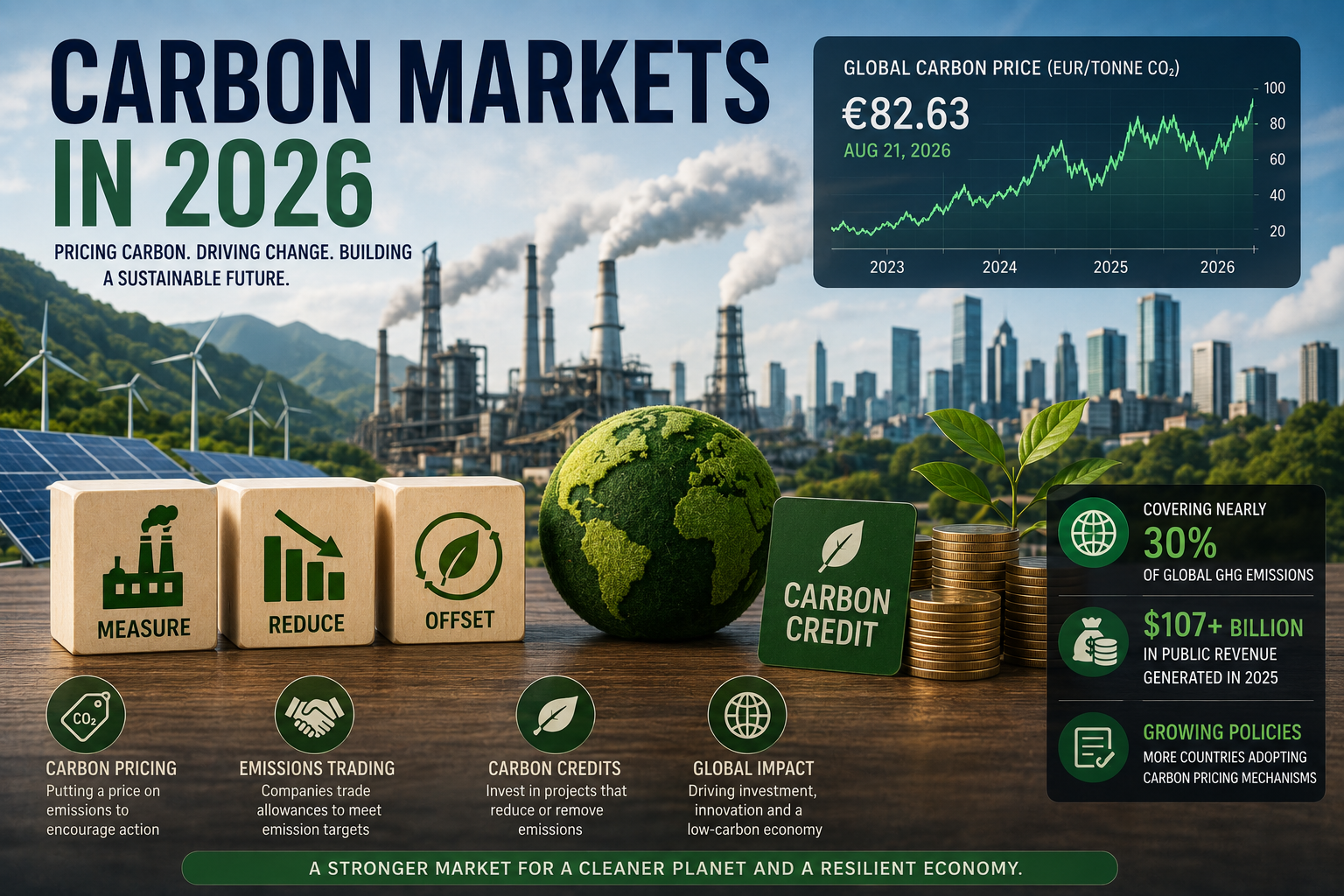
In 2026, carbon pricing mechanisms now cover nearly 30% of global greenhouse-gas emissions, according to the World Bank. These systems generated more than $107 billion in public revenue during 2025, showing that carbon pricing is becoming both an environmental policy tool and an important economic mechanism.
For businesses and investors, the carbon market is no longer simply about environmental targets. Carbon prices can affect production costs, international trade, investment decisions and the competitiveness of energy-intensive industries.
What Is a Carbon Market?
A carbon market allows emissions to have a financial value.
There are two broad approaches.
Compliance carbon markets are created by governments or regulators. Companies covered by an emissions-trading system may need to hold allowances for the emissions they produce.
Voluntary carbon markets allow companies and other organizations to purchase carbon credits, generally to support emissions-reduction or removal projects.
The basic idea is to create an economic incentive to reduce emissions. The World Bank describes direct carbon pricing as mechanisms such as carbon taxes and emissions-trading systems that put an explicit price on greenhouse-gas emissions.
Carbon Pricing Is Expanding
The global carbon-pricing landscape has expanded considerably.
The World Bank's 2026 report says carbon pricing now covers nearly 30% of global greenhouse-gas emissions. It also reports that all large middle-income economies now have either implemented or are planning direct carbon-pricing instruments.
This expansion means carbon costs are becoming increasingly relevant for companies operating in industries such as:
Steel
Cement
Aluminum
Chemicals
Electricity
Oil and gas
Aviation
Manufacturing
Transportation
Companies in these industries may increasingly need to consider carbon costs when planning production and investment.
The European Union Remains a Major Carbon Market
The European Union operates one of the world's most important emissions-trading systems, known as the EU ETS.
Under the system, companies covered by the program need emissions allowances to account for their regulated greenhouse-gas emissions.
The EU carbon market has become an important benchmark for global carbon pricing.
In 2026, EU carbon prices have been trading around the €80-per-tonne area. Recent market data showed EU carbon permits at about €82.63 per tonne on August 21, 2026.
Prices can move significantly depending on energy markets, industrial demand, weather, policy changes and expectations about future emissions.
Carbon Prices and Business Costs
A higher carbon price can increase costs for companies with high emissions.
For example, a steel producer using carbon-intensive production methods may face greater costs than a company using lower-emission technology.
This creates an economic incentive to invest in:
Renewable energy
Energy efficiency
Electrification
Cleaner industrial processes
Carbon capture
Low-carbon fuels
Emissions monitoring
Over time, carbon pricing can therefore influence corporate investment decisions.
The EU's Carbon Border Adjustment Mechanism
One of the biggest developments in global carbon markets in 2026 is the EU's Carbon Border Adjustment Mechanism (CBAM).
CBAM entered its definitive regime in 2026 after a transitional period from 2023 to 2025.
The mechanism is designed to address carbon leakage by putting a carbon-related cost on certain imported goods entering the European Union.
The initial sectors include carbon-intensive products such as:
Cement
Iron and steel
Aluminum
Fertilizers
Electricity
Hydrogen
This means exporters selling covered products into the European market increasingly need to understand carbon emissions associated with their products.
CBAM Creates New Challenges for Exporters
For companies outside Europe, carbon markets are becoming part of international trade.
An exporter may previously have focused primarily on:
Production costs
Labor
Transportation
Currency exchange rates
Tariffs
Carbon intensity is now becoming another factor.
Companies with higher emissions may face higher carbon-related costs when selling covered goods into Europe.
This could encourage exporters to invest in cleaner production technologies.
The European Commission calculates CBAM certificate prices quarterly in 2026 using publicly available information related to EU ETS auctions.
Carbon Markets and Asia
Asia is becoming increasingly important to global carbon markets.
Large manufacturing economies are developing their own carbon-pricing systems while exporters are also responding to international requirements.
This is particularly important for industries such as steel, aluminum, chemicals and manufacturing.
Asian companies competing internationally may increasingly need to measure their emissions and demonstrate the carbon intensity of their products.
The development of carbon markets could therefore influence investment across Asia's industrial supply chains.
India Is Expanding Its Carbon Market
India is one of the major emerging markets in the global carbon-pricing landscape.
The World Bank's 2026 carbon-pricing report identifies India among the large middle-income economies developing direct carbon-pricing instruments.
India's growing industrial base means the development of carbon markets could have a significant impact on manufacturers and exporters.
The country's carbon market could eventually influence investment decisions in areas such as energy efficiency, renewable energy and industrial modernization.
Voluntary Carbon Markets Are Changing
Voluntary carbon markets are also evolving.
Companies can purchase carbon credits associated with projects designed to reduce or remove greenhouse-gas emissions.
Examples include:
Reforestation
Renewable-energy projects
Methane reduction
Clean cooking
Agricultural projects
Carbon removal
Forest conservation
However, buyers are becoming more concerned about the quality and credibility of carbon credits.
Recent market research indicates that buyers are increasingly focused on project quality, biodiversity benefits and community outcomes rather than simply purchasing the largest possible number of credits.
Carbon Credit Quality Matters
Not all carbon credits have the same environmental value.
Investors and companies increasingly want evidence that a project actually delivers the emissions reductions it claims.
Questions can include:
Was the emissions reduction real?
Can it be independently verified?
Would the project have happened without carbon-credit revenue?
Is the reduction permanent?
Are local communities benefiting?
Are emissions being shifted somewhere else?
These questions are contributing to a greater focus on market integrity.
Carbon Removal Is Becoming More Important
Carbon removal is another growing area.
Instead of only preventing future emissions, carbon-removal technologies and projects attempt to remove carbon dioxide from the atmosphere.
Examples include:
Direct air capture
Biochar
Reforestation
Soil carbon
Enhanced weathering
Some carbon-market frameworks are increasingly considering how removals can be integrated into climate strategies.
However, carbon removal can be expensive, and investors continue to debate which technologies can eventually operate at large scale.
Carbon Markets and Investment
Carbon pricing can influence investment decisions across many industries.
An investor evaluating a company may increasingly consider its:
Carbon intensity
Energy consumption
Exposure to carbon pricing
Emissions-reduction strategy
Regulatory risk
Access to clean energy
Companies that reduce emissions efficiently may have an advantage if carbon prices increase.
On the other hand, companies with high emissions and limited ability to modernize may face increasing costs.
Carbon Markets and Energy Prices
Energy prices and carbon prices are closely connected.
When natural gas, coal or oil prices change, companies may alter their energy consumption.
Higher carbon prices can further encourage businesses to shift toward lower-emission energy sources.
The interaction between energy markets and carbon markets therefore creates new considerations for investors.
Recent analysis of European energy markets has also highlighted the growing importance of renewable power, grid investment and energy infrastructure as electricity demand increases.
The Role of Technology
Technology is becoming increasingly important in carbon markets.
Companies need better systems to measure and report emissions.
New technologies can help with:
Emissions monitoring
Satellite verification
Supply-chain tracking
Carbon accounting
Project verification
Digital reporting
Artificial intelligence could also help companies analyze large amounts of environmental and operational data.
Better measurement could improve confidence in carbon markets and reduce the risk of inaccurate reporting.
What Could Drive Carbon Markets Next?
Several trends could shape carbon markets during the remainder of 2026 and beyond.
More Carbon Pricing Systems
More countries are considering carbon taxes or emissions-trading systems.
Stronger International Trade Rules
Mechanisms such as CBAM are connecting carbon policy with international trade.
Higher Demand for Quality Credits
Companies increasingly want credits with stronger environmental and social credibility.
Industrial Decarbonization
Heavy industries are investing in cleaner technologies to reduce future carbon costs.
Carbon Removal
Investment in carbon-removal technologies could increase as companies look for ways to address difficult-to-eliminate emissions.
Risks for the Carbon Market
Carbon markets also face challenges.
One risk is price volatility.
Carbon prices can move quickly as expectations change about economic growth, energy demand and government policy.
Another challenge is market complexity. Different countries use different rules and systems, making international carbon trading complicated.
There are also concerns about carbon-credit quality in voluntary markets.
Finally, businesses may face significant costs when governments tighten emissions regulations faster than companies can adapt.
Why Carbon Markets Matter to Investors
Carbon markets are becoming increasingly relevant to investors because climate policy is becoming a financial issue.
A carbon price can affect:
Company profits
Manufacturing costs
Commodity prices
International trade
Capital expenditure
Energy choices
Corporate valuations
Investors who understand carbon markets may therefore be better positioned to evaluate companies operating in carbon-intensive industries.
Final Thoughts
Carbon markets are moving from a specialized environmental policy area toward a broader financial and economic market.
In 2026, carbon pricing covers nearly 30% of global greenhouse-gas emissions, while governments are increasingly connecting carbon costs with industrial policy and international trade.
The European Union's CBAM is an especially important development because it makes carbon intensity increasingly relevant to companies exporting certain products into Europe.
At the same time, voluntary carbon markets are becoming more focused on quality, verification and measurable environmental impact.
For businesses, the message is clear: carbon emissions are increasingly becoming a financial consideration.
For investors, carbon markets provide another lens through which to evaluate companies, industries and long-term economic trends.
As governments, businesses and investors continue adapting to a lower-carbon economy, carbon pricing could become one of the most important market signals of the next decade.
FAQs
What is a carbon market?
A carbon market is a system in which greenhouse-gas emissions or emissions allowances have a financial value and can be traded or priced.
What is carbon pricing?
Carbon pricing puts a financial cost on greenhouse-gas emissions, usually through a carbon tax or an emissions-trading system.
How large are carbon markets in 2026?
Carbon pricing systems cover nearly 30% of global greenhouse-gas emissions and generated more than $107 billion in public revenue during 2025.
What is the EU ETS?
The EU Emissions Trading System is Europe's major compliance carbon market, requiring covered companies to account for regulated emissions through allowances.
What is CBAM?
The Carbon Border Adjustment Mechanism is an EU system that applies a carbon-related cost to certain imported goods. Its definitive regime began in 2026.
What are carbon credits?
Carbon credits generally represent a verified unit of emissions reduction or removal and can be purchased by organizations participating in voluntary carbon markets.
Why does carbon-credit quality matter?
High-quality credits are intended to represent genuine, measurable and credible emissions reductions or removals. Buyers increasingly want stronger evidence of environmental and social benefits.
Can carbon prices affect companies?
Yes. Higher carbon prices can increase costs for carbon-intensive businesses and encourage investment in cleaner production.
Are carbon markets an investment opportunity?
Carbon markets can create opportunities across emissions allowances, carbon-credit projects, clean technology and companies helping businesses reduce emissions, but prices and regulatory conditions can be volatile.
What is the future of carbon markets?
The market is likely to expand as more countries introduce carbon-pricing systems, international trade becomes more connected to emissions, and demand grows for high-quality carbon reductions and removals.