Solana (SOL) is beginning September near the $102–$103 level, after one of its strongest monthly recoveries of 2026. The cryptocurrency rallied sharply during August as institutional demand increased, Solana exchange-traded funds attracted fresh capital, network activity reached record levels and major protocol developments strengthened the blockchain's long-term outlook.
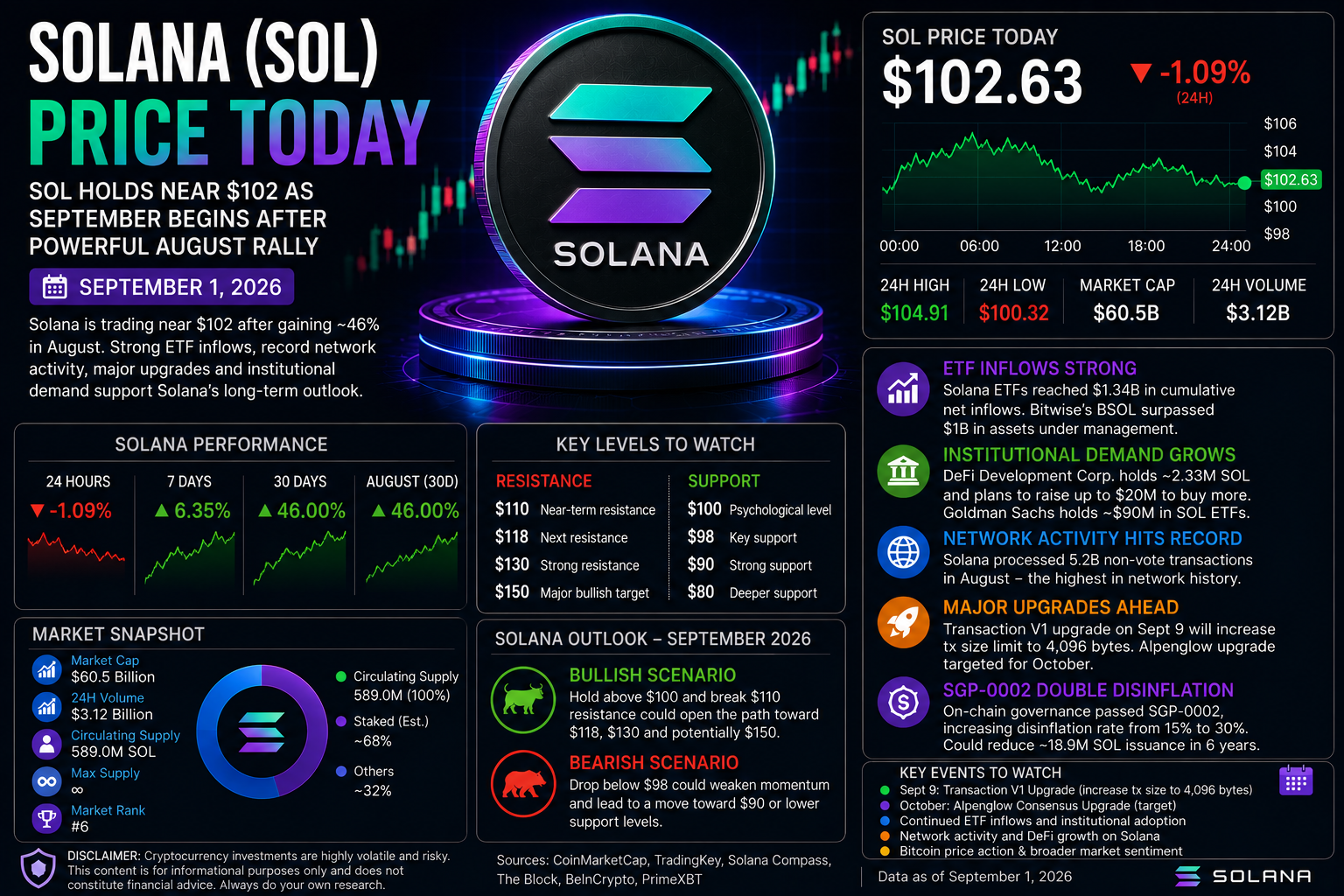
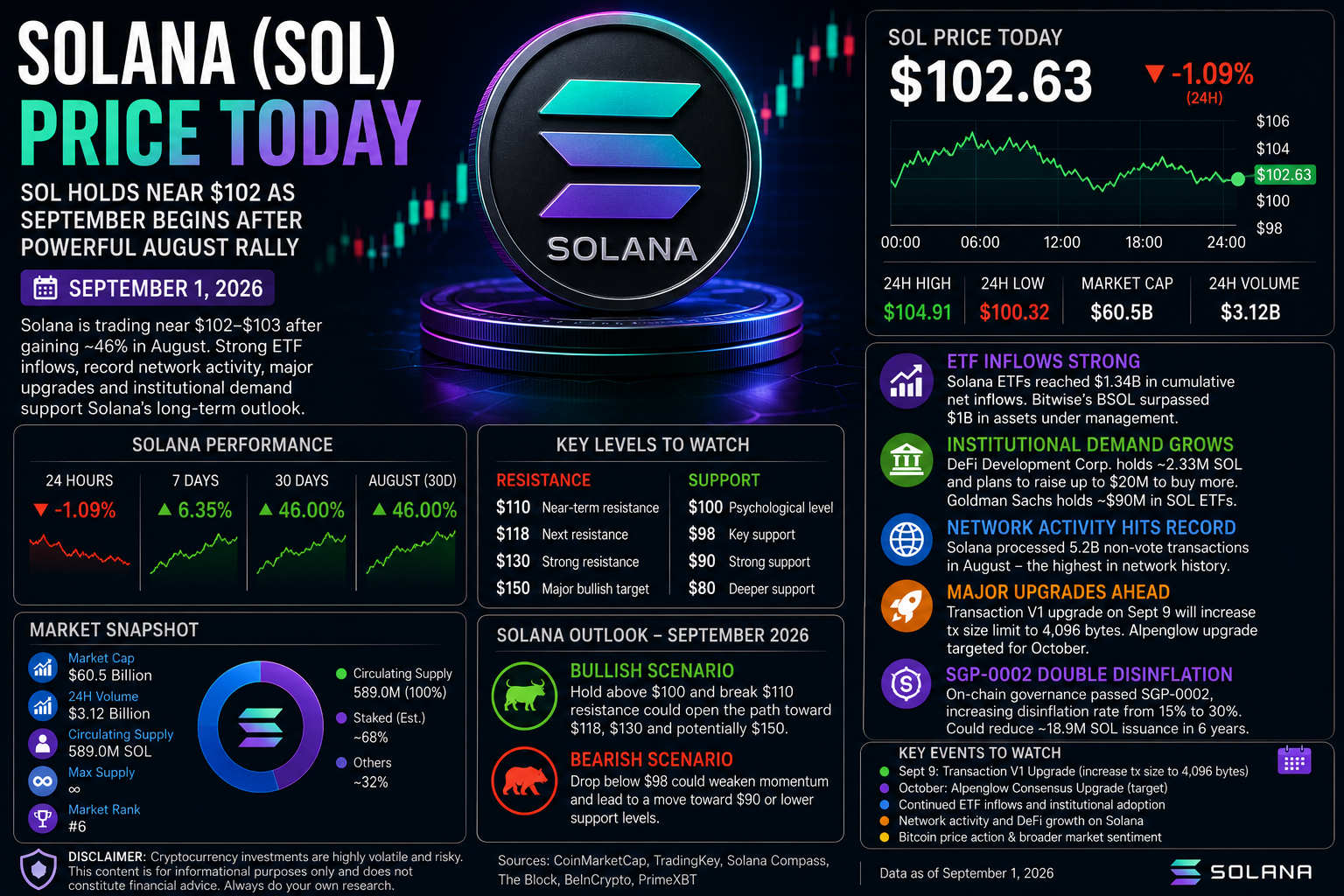
Solana closed August with an approximately 46% monthly gain, according to Solana Compass, ending a streak of 10 consecutive monthly declines. SOL reached an August 27 high of around $110.38 before finishing the month near $106.
The start of September has brought some profit-taking. TradingKey reported that SOL was around $101.63 early on September 1, down about 1.09% over 24 hours but still up more than 6% over seven days.
Other market data placed Solana around $103.44, showing the normal differences between exchanges and market-data providers. At that level, Solana's market capitalization was approximately $60.5 billion.
The current market is therefore showing a familiar pattern following a major rally: the long-term trend has improved, but short-term traders are taking profits while investors watch whether SOL can remain above the important $100 area.
Solana Price Today
The latest market snapshot puts Solana around the following levels:
SOL Market Metric | Approximate Level |
|---|---|
SOL Price | $102–$103 |
Market Cap | ~$60.5 billion |
24-Hour Trend | Slightly negative/mixed |
7-Day Trend | Positive |
August Performance | ~+46% |
August High | ~$110.38 |
Key Support | $98–$100 |
Near-Term Resistance | $110–$118 |
Potential Bullish Target | $150 |
Solana's exact price changes continuously because the cryptocurrency trades around the clock on global exchanges. Current sources show SOL in the low-$100s, with the market remaining significantly stronger than it was earlier in August.
Solana's Powerful August Rally
August was a major turning point for Solana.
According to Solana Compass, SOL gained approximately 46% during August, marking its first positive monthly close after 10 consecutive monthly declines.
That recovery is particularly significant because Solana had spent much of 2026 under considerable selling pressure.
The August rally pushed SOL from levels below $80 toward $110, bringing the cryptocurrency back into the spotlight among traders and institutional investors.
The rally was not driven by a single event.
Instead, several developments occurred at roughly the same time:
Strong Solana ETF inflows
Growing institutional interest
Record network transaction activity
Major protocol upgrades
Changes to SOL's inflation schedule
Increased whale activity
Improving broader cryptocurrency sentiment
The combination helped transform Solana's market narrative from one focused primarily on price weakness into one centered on renewed institutional and network growth.
Why Solana Is Holding Above $100
The $100 level is one of the most important psychological levels for SOL.
After breaking above $100 during August, Solana has so far managed to remain close to that threshold despite the beginning-of-month pullback.
TradingKey reported that SOL's September 1 weakness was partly related to profit-taking after the multi-week rally, while derivatives liquidations and leveraged long unwinding increased intraday volatility.
This is important because large rallies often create crowded leveraged positions.
When prices begin to fall, traders using leverage can be forced to close positions, accelerating the decline.
For now, however, SOL remains near $102–$103 rather than falling decisively below $100.
Solana's $110 Resistance
The $110 area is currently one of the most important resistance zones.
Solana reached approximately $110.38 on August 27, its strongest price since late January, before pulling back.
A sustained breakout above $110 could therefore signal that buyers are ready to push SOL toward the next major target.
The next important level discussed by market analysts is around $118.
A move from approximately $103 to $118 would represent a gain of roughly 15%.
Bullish Scenario
If SOL holds above $98–$100 and successfully breaks $110, traders could begin targeting approximately $118.
A sustained move above $118 could then open the possibility of a move toward $130–$150 if broader market conditions remain supportive.
Bearish Scenario
If SOL loses $98 and begins trading below the $100 psychological level, the recent rally could lose momentum.
A deeper correction could then bring lower support areas into focus.
Consolidation Scenario
Solana could also trade sideways between approximately $98 and $110.
Such consolidation would not necessarily be bearish.
After a 46% monthly rally, a period of sideways trading could allow the market to absorb gains and establish a new base.
Solana ETF Inflows Reach Important Milestones
One of the biggest developments behind Solana's August rally was institutional demand through exchange-traded funds.
Solana Compass reported that U.S. spot Solana ETFs had accumulated approximately $1.34 billion in cumulative net inflows by the end of August. August itself produced the strongest monthly inflows of 2026, with weekly inflows reaching approximately $153 million.
The most important milestone came from Bitwise's Solana Staking ETF, known as BSOL.
The fund became the first U.S. Solana ETF to surpass $1 billion in assets under management. The Block reported that BSOL accounted for more than half of total Solana ETF assets.
This is a significant development for SOL.
It shows that institutional investors are increasingly using regulated investment products to gain exposure to Solana.
Why Solana ETF Demand Matters
ETF demand can potentially provide a more consistent source of buying pressure than speculative retail activity.
Traditional investors who may not want to purchase and custody SOL directly can gain exposure through ETFs.
The growth of Solana ETFs therefore expands the potential investor base.
The Block reported that cumulative trading volume across spot Solana ETFs had surpassed $13 billion since their launch, while total category assets were around $1.49 billion at the end of August.
The report also noted that major financial institutions were becoming increasingly involved, with Goldman Sachs identified as the largest known holder of spot Solana ETFs at nearly $90 million.
Solana Institutional Adoption Expands
Institutional exposure is not limited to ETFs.
Solana treasury companies are also accumulating SOL.
BeInCrypto reported that DeFi Development Corp. resumed Solana purchases and had expanded its treasury holdings to approximately 2.33 million SOL. The company is also planning to raise up to $20 million through a preferred-stock offering, with proceeds potentially being used to purchase additional SOL.
This strategy is similar to the corporate treasury approach that has become popular with Bitcoin.
The idea is for a company to hold cryptocurrency as a treasury asset rather than simply trade it.
Although such strategies can increase institutional demand, they also introduce additional risks because corporate crypto purchases can depend on financing conditions and market prices.
Solana Network Activity Reaches Record Levels
The bullish story surrounding Solana is not limited to financial markets.
The blockchain itself experienced record activity during August.
PrimeXBT reported that Solana processed approximately 5.2 billion non-vote transactions during August, making it the busiest month in the network's history.
Non-vote transactions provide a useful measure of actual network activity because they exclude validator votes used to maintain consensus.
The increase suggests that Solana's network was processing substantial activity during the same period in which its price was recovering.
This combination is important.
A price rally accompanied by increasing network activity can provide a stronger fundamental narrative than a rally driven entirely by speculation.
Solana's Compute Upgrade
One of the catalysts behind the increase in network activity was a major compute-capacity upgrade.
PrimeXBT reported that the SIMD-0286 upgrade, activated on July 29, increased the maximum compute limit per block from 60 million to 100 million compute units without increasing block-production time.
Higher compute capacity allows Solana to process more complex workloads within each block.
This is important for applications that require substantial on-chain computation.
As blockchain usage grows, network capacity becomes increasingly important.
Solana's ability to increase throughput while maintaining fast transaction times remains one of the network's main competitive advantages.
Solana's 300ms Slot Times
Another major development was the activation of faster block times.
Solana Compass reported that 300-millisecond slot times activated during August alongside the network's governance developments.
Faster block production can improve the user experience and potentially make the network more attractive to applications requiring rapid settlement.
The change is part of Solana's broader effort to increase performance as adoption grows.
Solana's SGP-0002 Supply Proposal
One of the most significant long-term developments for SOL was the approval of SGP-0002, also known as the "Double Disinflation" proposal.
Solana Compass reported that SGP-0002 became Solana's first binding on-chain governance decision.
The proposal changes how quickly Solana's inflation rate declines.
Under the new schedule, the annual disinflation rate increases from 15% to 30%, while Solana's long-term inflation floor remains at approximately 1.5%.
This means the network could reach its long-term inflation target significantly faster.
What Does Lower SOL Inflation Mean?
Lower issuance can potentially benefit existing SOL holders because fewer new tokens enter circulation.
Solana Compass estimates that the revised schedule could reduce new issuance by approximately 18.9 million SOL over six years compared with the previous schedule.
Lower issuance can reduce dilution for existing holders.
However, there is a trade-off.
Validators and delegators may receive lower staking rewards as inflation decreases.
Therefore, the proposal creates both potential benefits and costs for different participants in the Solana ecosystem.
For investors, the important point is that Solana's monetary policy is moving toward lower token issuance faster than previously expected.
Upcoming Solana Upgrades
The Solana development roadmap remains another important factor for September.
Solana Compass reported that Transaction V1 is scheduled for mainnet on September 9. The upgrade would increase the maximum transaction size from 1,232 bytes to 4,096 bytes, allowing developers to include more information in a single on-chain transaction.
Another proposal, SIMD-0437, would potentially reduce developer storage costs by as much as 90%.
The network is also targeting the Alpenglow consensus upgrade for October.
These developments could become important catalysts if they improve Solana's performance and developer experience.
Solana and DeFi
Solana has developed into one of the major blockchain ecosystems for decentralized finance.
Its high throughput and relatively low transaction costs have made it attractive for decentralized exchanges, lending platforms, stablecoins and other applications.
Increasing network activity during August suggests that demand for Solana infrastructure remains strong.
However, DeFi activity also carries risks.
Smart-contract vulnerabilities, liquidity issues and market volatility can create losses for users.
Network growth therefore does not automatically guarantee higher SOL prices.
Solana and Stablecoins
Stablecoins are another important part of the Solana ecosystem.
They provide digital representations of fiat currencies and are widely used for trading, payments and decentralized finance.
As stablecoin usage grows, blockchain networks can benefit from increased transaction activity.
Solana's high-speed infrastructure makes it particularly attractive for applications requiring frequent transfers.
Greater stablecoin activity could therefore support continued ecosystem development.
Solana Compared With Ethereum
Solana is frequently compared with Ethereum because both networks support smart contracts and decentralized applications.
Ethereum has a much larger established ecosystem, while Solana has focused heavily on speed, throughput and low-cost transactions.
Solana's recent institutional adoption has strengthened its position as one of Ethereum's major competitors in the smart-contract blockchain sector.
However, the two networks can also coexist.
Many applications and investors use multiple blockchains rather than choosing only one.
The long-term competition will likely depend on developer activity, network reliability, transaction costs, liquidity and institutional adoption.
Solana and Bitcoin
SOL remains highly influenced by Bitcoin.
When Bitcoin rallies, investors often increase exposure to major altcoins such as Solana.
When Bitcoin falls sharply, SOL can experience larger percentage declines.
This relationship is particularly important after Solana's August rally.
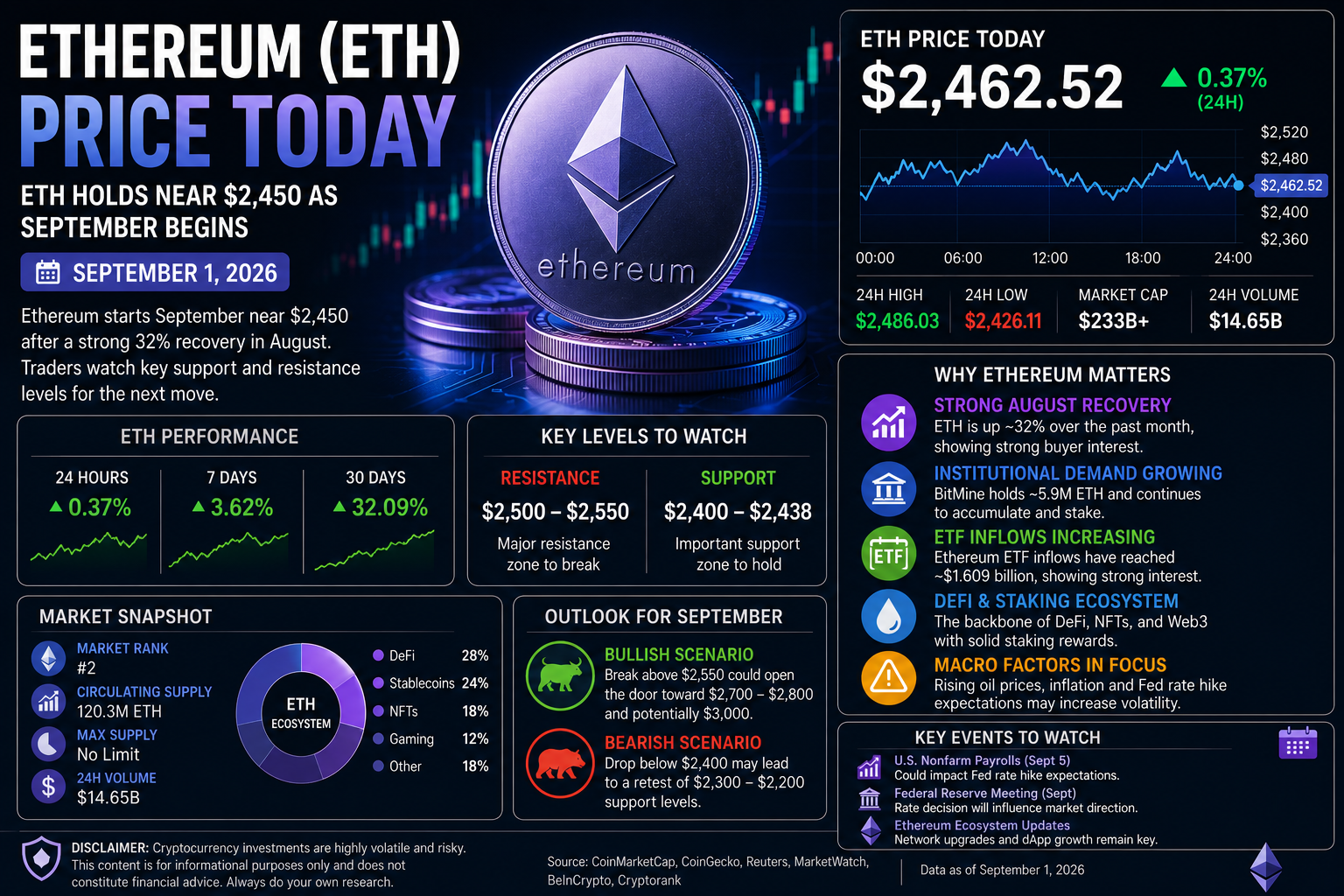
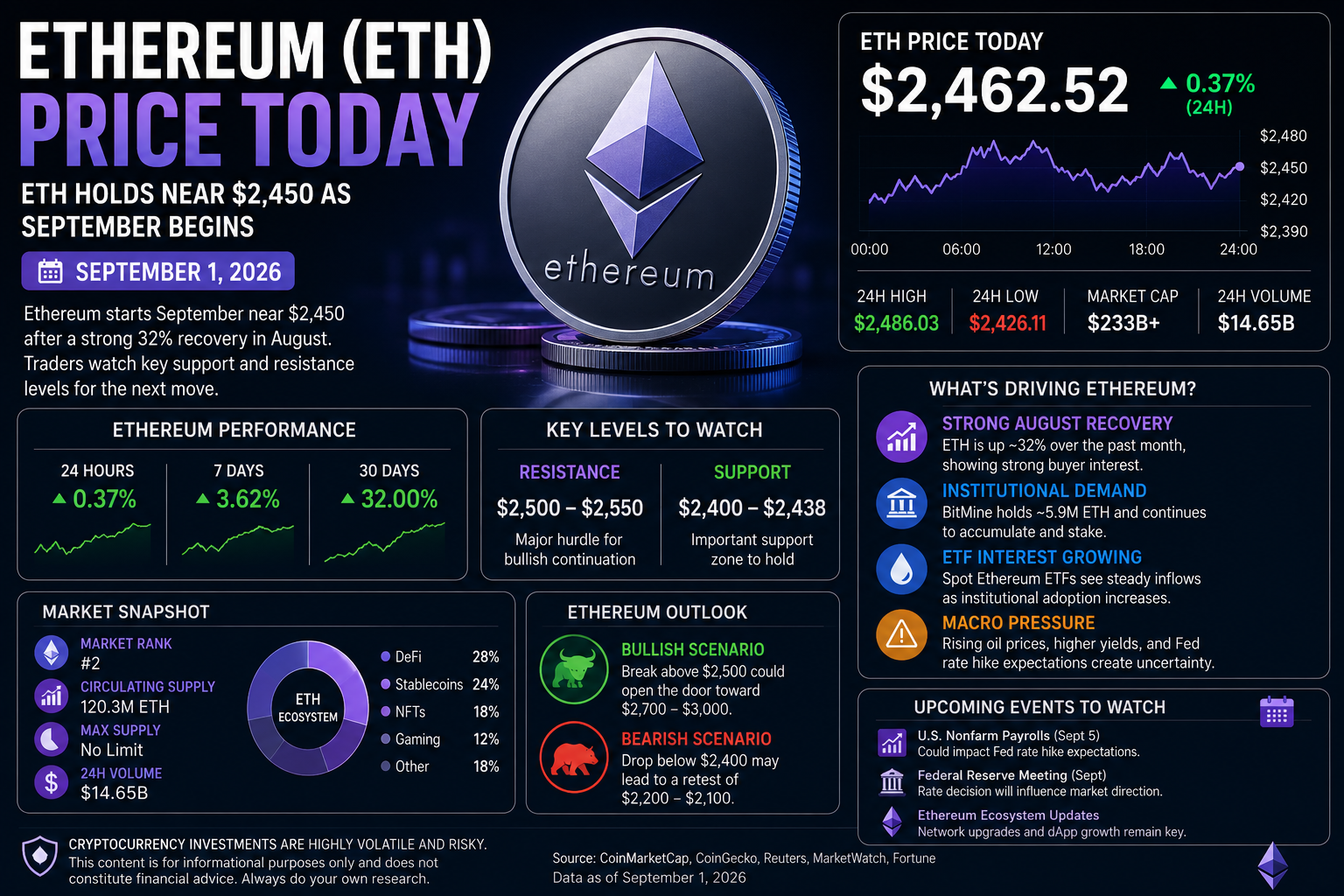
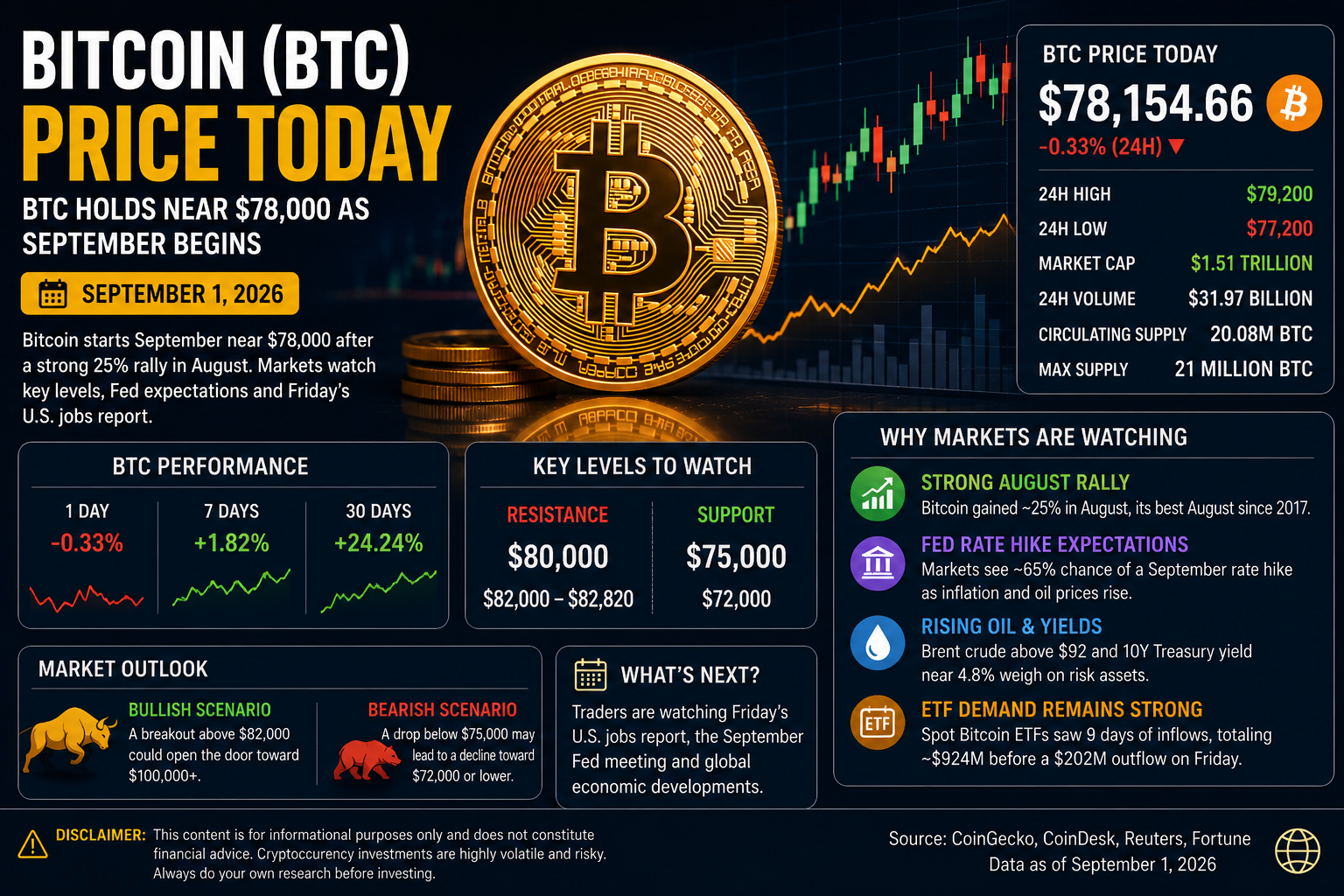
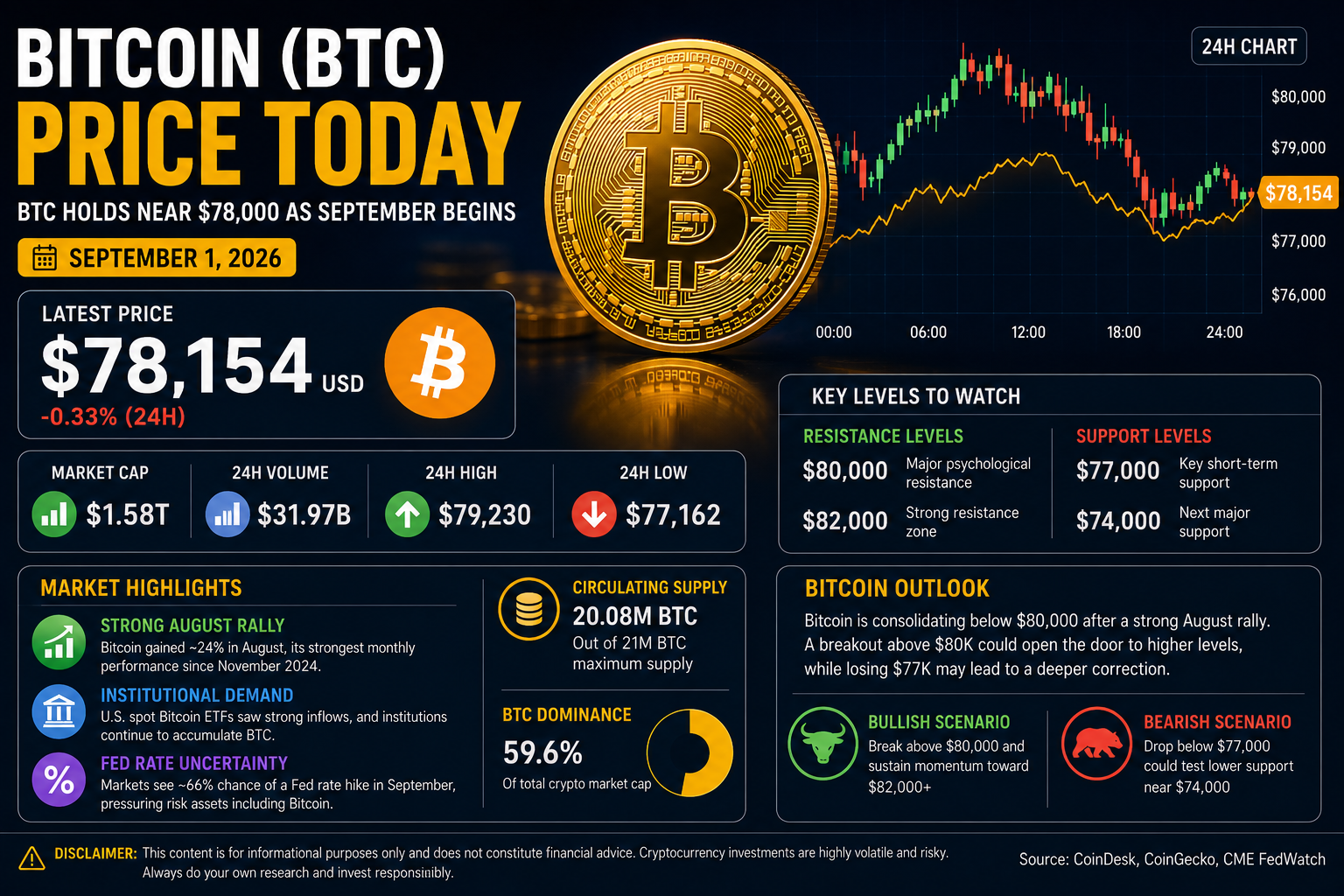
Bitcoin is currently near the upper-$70,000 range, while Ethereum is around $2,450 and SOL is around $102–$103.
If Bitcoin breaks decisively above $80,000, the resulting increase in market-wide risk appetite could provide another boost to SOL.
If BTC instead experiences a significant correction, Solana could face additional selling pressure.
Solana's September Price Outlook
Solana enters September with a significantly improved technical structure compared with the beginning of August.
The cryptocurrency has already gained approximately 46% during the month, and institutional ETF inflows have accelerated.
The immediate question is whether SOL can remain above the $98–$100 support area.
If it does, the next major target is approximately $110–$118.
A sustained move above $118 could strengthen the possibility of a larger recovery toward $130 and potentially $150.
However, the market should not ignore the risks.
The beginning of September has already seen some profit-taking and leveraged-position unwinding. TradingKey reported that derivatives liquidations contributed to SOL's intraday weakness.
This means that even if the long-term structure remains positive, SOL could experience sharp short-term moves.
Could Solana Reach $150?
A move toward $150 is one of the more optimistic scenarios for SOL.
From approximately $103, Solana would need to gain around 46% to reach $150.
That would require a continuation of the strong August trend.
Several factors could support such a move:
Continued Solana ETF inflows
Strong Bitcoin performance
Increased institutional adoption
Record network activity
Successful protocol upgrades
Reduced SOL inflation
Continued whale accumulation
However, $150 should be viewed as a potential scenario rather than a guaranteed target.
A major deterioration in global risk sentiment could prevent such a move.
Solana Risks Investors Should Watch
Despite its strong August rally, SOL remains a volatile cryptocurrency.
Market Volatility
SOL can experience large percentage movements within hours.
Leverage Risk
High futures open interest can amplify both rallies and declines.
Competition
Solana competes with Ethereum and other smart-contract networks.
Regulatory Risk
Changes in cryptocurrency regulation can affect institutional access and investment products.
Network Risk
Although Solana has significantly improved its infrastructure, blockchain networks can still face technical and operational challenges.
Macro Risk
Higher interest rates and rising bond yields can reduce investor appetite for speculative assets.
Reuters reported that global markets entered September under pressure from higher oil prices and bond yields, with the U.S. 10-year Treasury yield around 4.8%.
What to Watch for Solana in September
Several developments could determine SOL's next major move.
$100 support: The ability to remain above this psychological level will be important.
$110 resistance: A breakout above the August high could strengthen momentum.
$118 target: This is the next major upside area discussed in recent market analysis.
ETF inflows: Continued institutional demand would provide an important source of support.
September 9 upgrade: Transaction V1 could become a key network-development catalyst.
Alpenglow: The planned October consensus upgrade could continue attracting investor attention.
SOL issuance: The Double Disinflation proposal changes the network's future supply trajectory.
Bitcoin: BTC's direction will remain one of the strongest external influences on SOL.
Final Thoughts
Solana begins September 2026 near $102–$103, after recording an impressive 46% gain during August. The rally ended a 10-month streak of monthly declines and pushed SOL to an August high of approximately $110.38.
The recovery has been supported by more than price speculation.
U.S. Solana ETFs have accumulated approximately $1.34 billion in net inflows, while Bitwise's BSOL became the first Solana ETF to surpass $1 billion in assets under management.
At the same time, Solana's blockchain processed approximately 5.2 billion non-vote transactions during August, its busiest month on record.
The network is also moving through major protocol changes.
SGP-0002 accelerated Solana's disinflation schedule, potentially reducing new SOL issuance by approximately 18.9 million tokens over six years compared with the previous schedule. Transaction V1 is scheduled for September 9, while the Alpenglow consensus upgrade is targeted for October.
These developments give Solana a strong fundamental narrative entering September.
However, the cryptocurrency is not without risks.
SOL has already rallied approximately 46% in one month, meaning profit-taking and leveraged liquidations could produce sharp pullbacks.
The key short-term level is around $98–$100.
If SOL holds this region and breaks above $110, the next major area could be around $118.
A sustained move above $118 could potentially put $150 into focus if institutional demand and broader crypto-market momentum remain strong.
If SOL loses $98 with significant selling volume, however, the market could enter a deeper correction.
For now, Solana enters September as one of the most closely watched large-cap altcoins, with institutional ETF demand, record network activity, changing token economics and upcoming upgrades all giving investors reasons to monitor SOL closely.
Disclaimer: This article is for informational and educational purposes only and does not constitute financial, investment or trading advice. Solana and other cryptocurrencies are highly volatile assets, and investors can lose some or all of their capital. Always verify live market prices and conduct independent research before making financial decisions.