
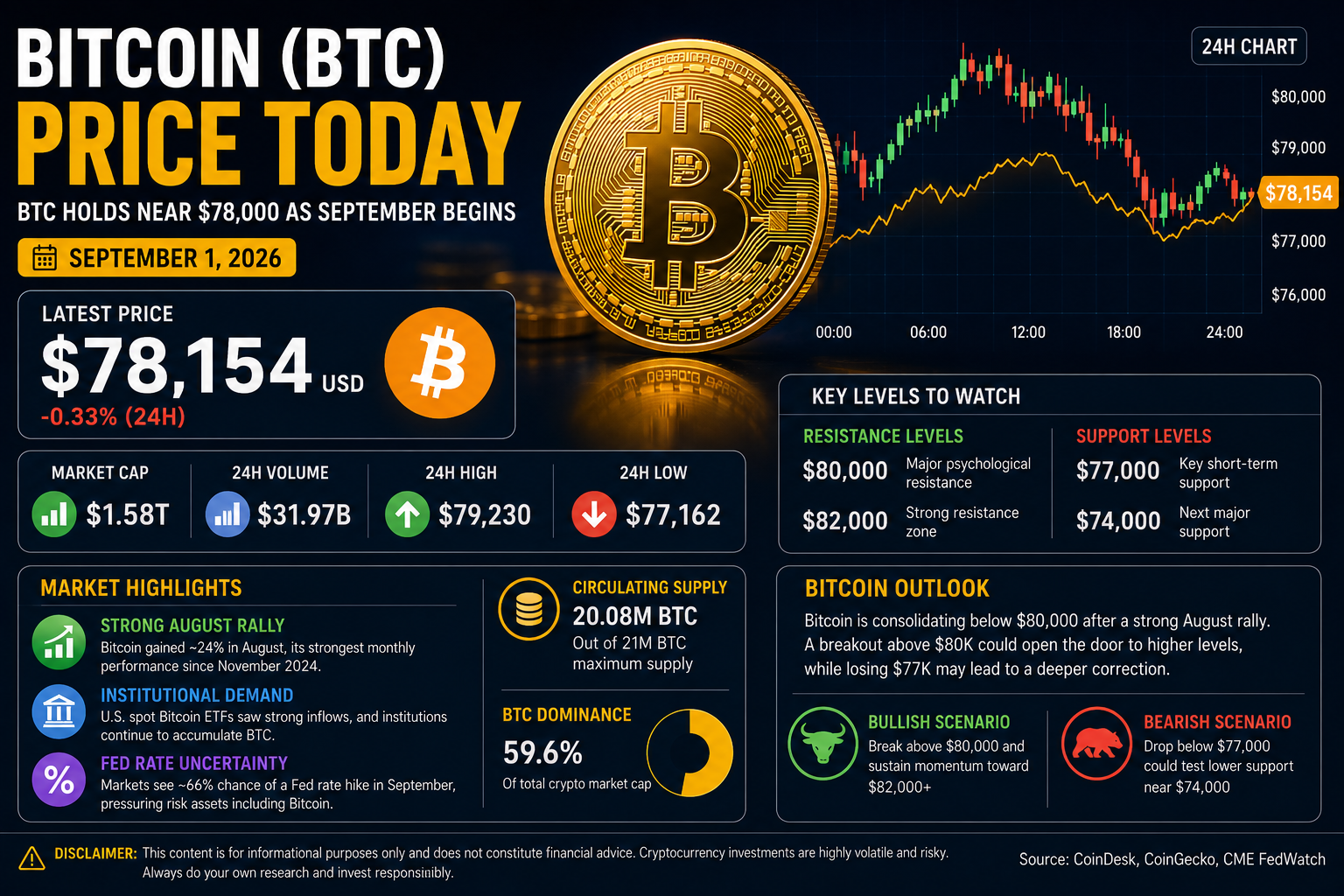
Bitcoin (BTC) is beginning September near the $78,000 level, as traders assess whether the world's largest cryptocurrency can regain the important $80,000 mark after recording one of its strongest monthly performances in recent years.
Bitcoin entered September following a powerful August rally. The cryptocurrency gained roughly 24% during August, according to CoinDesk, making it Bitcoin's strongest monthly performance since November 2024. Despite that rally, BTC has started the new month with some pressure as rising oil prices, higher Treasury yields and growing expectations for a Federal Reserve rate increase weigh on risk assets.
At the time of the latest market observations on September 1, Bitcoin was trading in a range around $77,000–$79,000. CoinDesk reported BTC near $78,400, while other market sources placed the price between approximately $77,900 and $78,800.
Because Bitcoin trades continuously around the world, its price can change significantly within minutes. The prices and market conditions discussed in this article represent a snapshot of the market on September 1, 2026.
Bitcoin Price Today
Bitcoin is currently trading around $78,000, remaining below the psychologically important $80,000 level.
According to Bybit's market data sourced from CoinGecko, BTC was trading around $78,839 on September 1, with a 24-hour high near $79,230 and a low around $77,162. The same data put Bitcoin's market capitalization at approximately $1.58 trillion, with 24-hour trading volume of around $31.97 billion.
Fortune's September 1 market snapshot placed Bitcoin at $78,154.66 at 8 a.m. Eastern Time, down approximately 0.33% from the previous morning. The report also showed that Bitcoin remained substantially higher than its level one month earlier, when it was around $62,906.
This highlights an important feature of the current Bitcoin market: although BTC has pulled back from its recent highs, the cryptocurrency remains significantly above its early-August price.
Bitcoin's Strong August Rally
August was a major month for Bitcoin.
BTC began the month around the low-$60,000 area and subsequently climbed toward and above $80,000. By the end of August, Bitcoin had recorded a gain of approximately 24%, according to CoinDesk.
The rally was significant because Bitcoin had spent much of the earlier period struggling to establish sustained upward momentum.
The move higher helped improve sentiment throughout the cryptocurrency market. Ethereum, Solana, XRP and other major digital assets also attracted increased attention as traders became more optimistic about the possibility of another broader crypto rally.
However, Bitcoin's move above $80,000 did not immediately develop into a sustained breakout.
Instead, BTC returned toward the upper-$70,000 range, creating a new battle between buyers attempting to maintain the August rally and sellers taking profits after the strong move.
Why Bitcoin Is Struggling Below $80,000
The $80,000 level has become one of the most important psychological areas for Bitcoin.
BTC recently moved above this level but has struggled to remain decisively higher.
CoinDesk reported that Bitcoin traded between approximately $77,200 and $79,200 during the latest session, while noting that the $82,000 area had repeatedly acted as resistance.
A sustained move above $80,000 could improve market sentiment and potentially encourage additional buying.
However, repeated rejection around the area could encourage traders who bought during August to take profits.
This creates an important short-term battle.
Bullish Bitcoin Scenario
If BTC continues to hold above approximately $77,000–$78,000 and successfully breaks through $80,000, traders could begin watching higher resistance zones.
A convincing breakout would suggest that buyers remain willing to enter the market at higher prices.
Bearish Bitcoin Scenario
If Bitcoin loses the $77,000 area and selling pressure increases, the cryptocurrency could enter a deeper correction.
The market would then likely focus on lower support zones as traders assess whether the August rally remains intact.
Consolidation Scenario
Bitcoin could also simply move sideways.
A range between approximately $77,000 and $80,000 would allow the market to digest August's large gains while investors wait for new economic data and market catalysts.
Federal Reserve Expectations Are Affecting Bitcoin
One of the biggest issues affecting Bitcoin as September begins is monetary policy in the United States.
Rising inflation concerns have increased expectations that the Federal Reserve could raise interest rates at its September meeting.
Yahoo Finance reported that the CME FedWatch tool showed approximately a 66.4% probability of a 25-basis-point rate increase later in September, compared with a 33.6% probability of no change.
CoinDesk also reported that traders were assigning roughly 64% odds to a September rate hike, up substantially from earlier expectations.
Higher interest rates can create pressure for Bitcoin because they may make traditional yield-producing assets more attractive relative to speculative investments.
When bond yields rise, investors may become more cautious about holding volatile assets.
This does not necessarily mean Bitcoin must fall when rates rise, but monetary tightening can create a more difficult environment for cryptocurrencies.
Rising Oil Prices Add to Market Pressure
Another factor affecting Bitcoin is the recent increase in oil prices.
Reports on September 1 indicated that Brent crude was trading around $91 per barrel, while the U.S. 10-year Treasury yield had climbed toward 4.78%.
Higher oil prices can increase inflation concerns.
If investors believe inflation will remain elevated, they may expect central banks to maintain restrictive monetary policies for longer.
This can affect cryptocurrency markets because Bitcoin increasingly trades alongside other risk assets during periods of macroeconomic uncertainty.
Bitcoin's ability to remain near $78,000 despite these pressures is therefore notable.
Bitcoin ETF Demand Remains Important
Institutional demand continues to be one of the most important factors in the Bitcoin market.
CoinDesk reported that U.S. spot Bitcoin ETFs recently experienced their strongest week of demand since October 2025. The report also noted that Bitcoin ETF inflows reached nine consecutive positive sessions before a $202 million outflow ended the streak.
ETF activity is important because it provides traditional investors with a regulated market vehicle for gaining exposure to Bitcoin.
Instead of directly purchasing BTC and managing cryptocurrency wallets, investors can gain exposure through financial products that trade through traditional markets.
This has helped connect Bitcoin with the broader financial system.
Continued ETF inflows could provide support for BTC if institutional demand remains strong.
However, ETF outflows can also contribute to selling pressure when investors become more cautious.
Institutional Bitcoin Purchases
Institutional activity has also contributed to the recent Bitcoin rally.
CoinDesk reported that Strategy resumed Bitcoin purchases during the final week of August, buying approximately $370 million worth of BTC after a period of around two months without purchases.
Large corporate purchases can influence market sentiment because they demonstrate continued institutional willingness to allocate capital to Bitcoin.
However, investors should not assume that institutional purchases guarantee higher prices.
Bitcoin remains a highly liquid global asset, and short-term market movements can be driven by derivatives, ETF flows, macroeconomic events, whale activity and retail trading.
Bitcoin Market Capitalization
Bitcoin remains by far the largest cryptocurrency by market capitalization.
Current data places BTC's market value around $1.58 trillion.
Bitcoin's circulating supply is approximately 20.08 million BTC, compared with a maximum supply of 21 million coins.
This limited supply is one of Bitcoin's defining characteristics.
Unlike traditional currencies, Bitcoin's monetary policy is built into its protocol, with the maximum supply capped at 21 million BTC.
The scarcity narrative is one of the reasons Bitcoin is often compared with gold by investors and analysts.
Bitcoin's Limited Supply
Only a limited number of new bitcoins are created through the mining process.
The Bitcoin network periodically reduces the amount of BTC awarded to miners through an event known as the halving.
The most recent halving occurred in 2024.
The reduced rate of new Bitcoin issuance means that the supply entering the market becomes increasingly limited over time.
However, limited supply alone does not guarantee a higher price.
Bitcoin's value also depends on demand.
If demand increases faster than available supply, prices can rise. If demand weakens, Bitcoin can still fall significantly despite its limited supply.
Bitcoin and Market Sentiment
Investor sentiment remains an important part of the current BTC market.
The August rally significantly improved sentiment, but the beginning of September has brought some caution.
Bitcoin's inability to remain above $80,000 has encouraged traders to watch support levels more closely.
At the same time, the cryptocurrency has not experienced an aggressive sell-off despite pressure from broader financial markets.
The resilience of Bitcoin around $78,000 is therefore one of the most important characteristics of the current market.
The Economic Times reported that Bitcoin remained near $79,000 despite weakness across broader risk assets, suggesting that traders were not engaging in aggressive profit-taking following the recent rally.
Bitcoin Technical Levels to Watch
Traders are currently watching several price zones.
$80,000 Resistance
The first major level is $80,000.
A sustained move above this level could signal that buyers are regaining control after the recent consolidation.
$82,000 Resistance
Bitcoin has also faced resistance around the $82,000 area.
CoinDesk reported that BTC had been rejected around $82,000 multiple times.
A breakout above that area could strengthen the bullish outlook.
$77,000 Support
The $77,000 area is becoming an important short-term support zone.
Bitcoin recently traded as low as approximately $77,200 during the latest session.
If BTC remains above this area, buyers could continue attempting to push the cryptocurrency higher.
Lower Support Levels
A sustained break below the current range would shift market attention toward lower support zones.
However, exact support and resistance levels can change as new trading data develops.
Bitcoin's September Outlook
The September outlook for Bitcoin remains mixed but highly important.
The cryptocurrency enters the month after a strong August rally, but the market is now facing several challenges.
These include:
Higher oil prices
Rising Treasury yields
Increased expectations for a Fed rate hike
Inflation concerns
Profit-taking after August's rally
Resistance around $80,000–$82,000
At the same time, Bitcoin has several positive factors supporting the market.
These include:
Strong August performance
Continued institutional interest
Bitcoin ETF demand
Limited supply
Corporate Bitcoin purchases
Continued long-term adoption
This creates a market where both bulls and bears have significant arguments.
Could Bitcoin Reach $100,000?
Bitcoin reaching $100,000 remains one of the major long-term questions for the cryptocurrency market.
At the current price near $78,000, BTC would need to rise by roughly 28% to reach $100,000.
Such a move is possible in percentage terms because Bitcoin has historically experienced substantial rallies.
However, there is no guarantee that BTC will reach $100,000 within a particular timeframe.
A move toward that level would likely require a combination of strong demand, favorable macroeconomic conditions, continued institutional participation and positive market sentiment.
Bitcoin would first need to overcome the resistance zones above $80,000.
A sustained breakout could potentially change market expectations and encourage traders to target higher levels.
Risks Facing Bitcoin Investors
Despite the positive performance seen in August, Bitcoin remains a highly volatile asset.
Price Volatility
Bitcoin can move thousands of dollars in a relatively short period.
Investors who enter the market during strong rallies can face significant losses if prices suddenly reverse.
Interest-Rate Risk
Higher interest rates can reduce demand for speculative assets.
If inflation remains elevated and central banks maintain restrictive policies, Bitcoin could face additional pressure.
Regulatory Risk
Government regulation can influence cryptocurrency exchanges, custody services, institutional products and market access.
Changes in regulation can sometimes create significant short-term volatility.
Security Risk
Bitcoin itself operates on a decentralized blockchain, but investors can still face risks when using exchanges, wallets and third-party services.
Loss of private keys can result in permanent loss of access to funds.
Emotional Trading
Fear of missing out can cause investors to buy after prices have already risen significantly.
Similarly, panic selling can lead investors to exit positions during temporary corrections.
For this reason, risk management remains essential when dealing with Bitcoin.
What to Watch for Bitcoin This Week
Several developments could influence BTC during the first week of September.
U.S. Jobs Report
CoinDesk identified Friday's August jobs report as a key upcoming event for markets.
A stronger-than-expected jobs report could reinforce expectations for higher rates and potentially increase pressure on risk assets.
A weaker report could have the opposite effect if traders interpret it as reducing the need for aggressive monetary tightening.
Federal Reserve Rate Expectations
Any change in expectations for the September Fed meeting could quickly affect Bitcoin.
ETF Flows
Investors will continue monitoring whether Bitcoin ETFs experience net inflows or outflows.
$80,000 Breakout
The most obvious technical question remains whether BTC can reclaim and hold $80,000.
Bitcoin vs. Traditional Assets
Bitcoin has increasingly become part of mainstream financial-market discussions.
The cryptocurrency is often compared with gold because both are viewed by some investors as alternative stores of value.
However, Bitcoin remains considerably more volatile than gold.
Traditional currencies and government bonds also behave differently from Bitcoin because they are backed by government institutions and established financial systems.
Bitcoin instead operates through a decentralized blockchain network.
This gives BTC a unique position in global finance but also creates different risks.
Why Bitcoin Remains Important
Bitcoin remains important not only because of its price but also because it established the foundation for the broader cryptocurrency industry.
Thousands of cryptocurrencies and blockchain projects have emerged since Bitcoin was introduced.
However, BTC remains the largest digital asset by market capitalization and continues to influence the direction of the entire crypto market.
When Bitcoin rises strongly, other cryptocurrencies frequently benefit.
When Bitcoin experiences a major correction, altcoins often face even greater pressure.
This makes BTC one of the most important indicators for anyone following the cryptocurrency market.
Bitcoin Price Outlook for September 2026
The first major test for Bitcoin in September will be whether it can hold the $77,000–$78,000 area.
If buyers defend this zone and BTC moves back above $80,000, sentiment could improve.
A move above $82,000 would represent another important development because that area has recently acted as resistance.
On the other hand, a sustained move below the recent lows could indicate that the market needs a deeper correction after August's large rally.
The macroeconomic environment will also remain critical.
Higher oil prices, rising Treasury yields and changing Federal Reserve expectations could create additional volatility.
At the same time, continued ETF demand and institutional purchases could provide support.
Therefore, September could become a month of significant price movement for Bitcoin.
Final Thoughts
Bitcoin begins September 2026 near $78,000, following an impressive August rally of approximately 24%.
The cryptocurrency is currently consolidating below the important $80,000 level while investors monitor macroeconomic developments, Federal Reserve policy expectations and institutional demand.
Bitcoin's current market capitalization is around $1.58 trillion, with approximately 20.08 million BTC in circulation.
The key levels to watch are approximately $77,000 on the downside and $80,000–$82,000 on the upside.
A breakout above resistance could strengthen bullish sentiment, while a break below support could trigger a deeper correction.
For now, Bitcoin remains resilient despite pressure from higher oil prices, Treasury yields and increased expectations for a Federal Reserve rate hike.
The next few trading sessions could therefore be particularly important for determining whether Bitcoin continues its August momentum or enters a period of consolidation.
As always, Bitcoin prices can change rapidly because the cryptocurrency market operates 24 hours a day. Investors should check current market data before making any financial decision.
Disclaimer: This article is for informational and educational purposes only and does not constitute financial, investment or trading advice. Bitcoin and other cryptocurrencies are highly volatile assets, and investors can lose some or all of their capital. Always conduct independent research and consider your own financial circumstances before investing.