Ethereum is beginning September near the $2,450–$2,470 level, as traders assess whether the world's second-largest cryptocurrency can regain the important $2,500 area after a strong recovery during August.
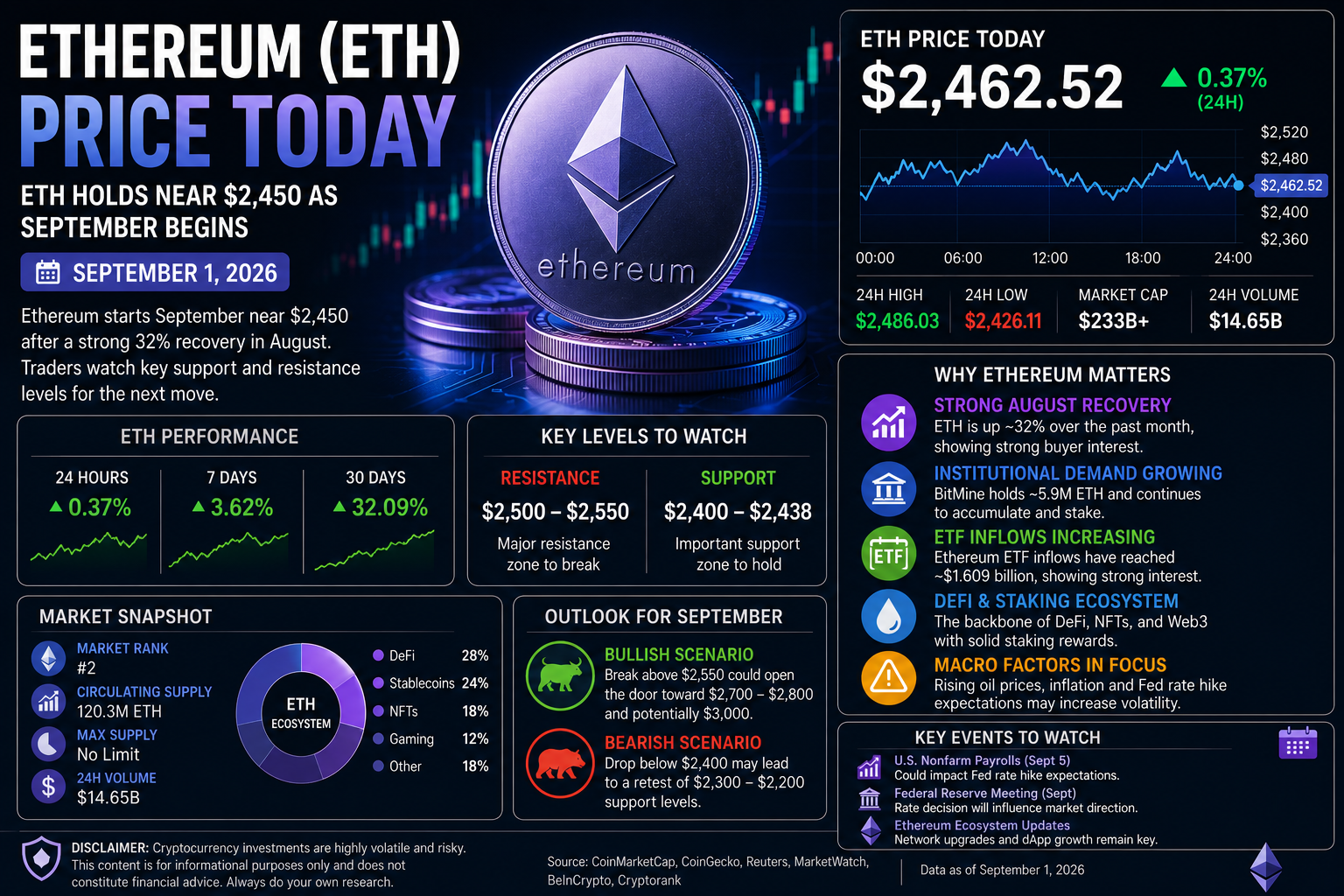
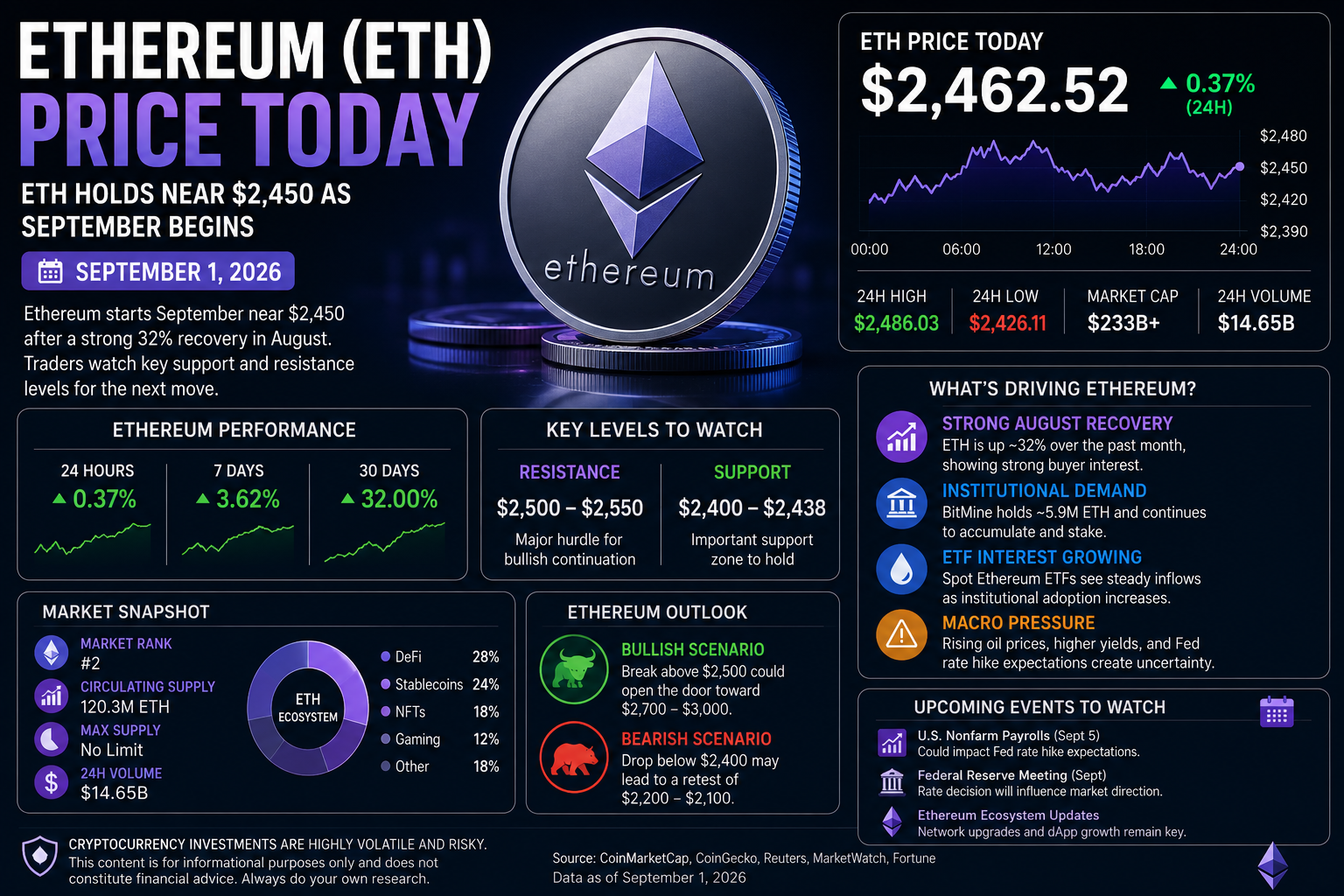
At 8 a.m. Eastern Time on September 1, Ethereum was priced at approximately $2,462.52, according to Fortune. That represented a 0.37% increase from the previous morning and placed ETH about 32% higher than its level one month earlier. However, Ethereum remained substantially below its price from a year earlier.
Other market data showed ETH trading around the mid-$2,400s during the day. A September 1 technical analysis placed Ethereum at approximately $2,453.36, describing the market as caught between a broader bullish structure and weakening short-term momentum.
Ethereum is also facing the same broader macroeconomic pressures affecting Bitcoin and other risk assets. Rising oil prices, higher Treasury yields and increasing expectations for Federal Reserve rate hikes have created a more cautious environment for cryptocurrencies. Reuters reported that the U.S. 10-year Treasury yield reached around 4.8% on September 1, while Brent crude rose to approximately $92.10 per barrel.
Despite these challenges, Ethereum remains one of the most important assets in the cryptocurrency market.
Ethereum Price Today
The latest market snapshot puts Ethereum around the following levels:
Ethereum Metric | Approximate Value |
|---|---|
ETH Price | $2,450–$2,470 |
Market Cap | Around $233B+ |
24-Hour Trend | Slightly positive/mixed |
Key Resistance | $2,500–$2,550 |
Key Support | $2,400–$2,438 |
1-Month Change | Around +32% |
Market Rank | #2 |
Fortune reported ETH at $2,462.52 on September 1, while Ethereum-focused market analysis put the cryptocurrency at approximately $2,453.36.
The exact ETH price can vary between exchanges because cryptocurrency markets operate continuously and prices are aggregated from different trading platforms.
Ethereum's Strong August Recovery
Ethereum enters September after a significant recovery.
Fortune's September 1 data shows ETH around 32% higher than one month earlier, when the cryptocurrency was trading near $1,864.19.
This represents a substantial improvement from the weaker levels seen earlier in the summer.
Ethereum's recovery has also occurred alongside a broader cryptocurrency rally.
Bitcoin moved back toward $80,000 during August, while major altcoins also attracted renewed interest.
Ethereum's ability to recover toward $2,500 has been particularly important because ETH often acts as a key indicator of broader altcoin sentiment.
When Ethereum strengthens, investors frequently become more willing to take exposure to other blockchain assets.
However, Ethereum's recent gains have also created the possibility of profit-taking.
After a cryptocurrency rises more than 30% in a month, some investors may choose to lock in gains, particularly if broader market conditions become less favorable.
Why $2,500 Matters for Ethereum
The $2,500 level is currently one of the most important psychological areas for ETH.
Ethereum has recently approached or traded around this level but has struggled to establish a sustained breakout.
Market analysis published September 1 described ETH as being in a short-term momentum stall while its broader structure remained constructive.
A sustained move above $2,500 could therefore be important for Ethereum's next stage.
If buyers successfully push ETH through $2,500 and maintain momentum, the market could begin watching higher resistance levels.
However, repeated rejection below $2,500 could result in another period of consolidation.
Bullish Scenario
A bullish scenario would involve Ethereum holding above approximately $2,400 and breaking decisively through $2,500.
Such a move could improve investor confidence and potentially encourage additional buying.
Ethereum could also benefit if Bitcoin returns above $80,000 and the wider cryptocurrency market enters another risk-on phase.
Bearish Scenario
A bearish scenario would develop if ETH loses the $2,400 region and selling pressure accelerates.
A deeper correction would become more likely if Ethereum fails to maintain the support zones created during its recent rally.
Consolidation Scenario
Ethereum could also remain within a relatively narrow range between approximately $2,400 and $2,500.
This would allow the market to absorb August's gains while traders wait for new economic data and Federal Reserve signals.
Ethereum Support Levels to Watch
Several price levels are important for ETH traders entering September.
$2,400 Support
The $2,400 region is an important psychological and technical area.
Holding above this level could help maintain the broader recovery structure.
$2,438 Area
Recent technical analysis has highlighted the $2,400–$2,438 area as an important support region.
A sustained break below this zone could weaken short-term momentum.
$2,500 Resistance
Ethereum's first major upside challenge is $2,500.
A successful breakout could improve market sentiment.
$2,550 Resistance
If ETH moves above $2,500, traders could begin watching the $2,550 region as another important level.
Technical levels can change as new price data develops, so they should be treated as areas of interest rather than guaranteed turning points.
Institutional Interest in Ethereum
Institutional activity has become one of the most important developments for Ethereum.
One notable development entering September is the continued accumulation of ETH by BitMine.
Recent reports said BitMine purchased another 53,501 ETH, bringing its total holdings close to 5.9 million ETH, equivalent to approximately 4.9% of circulating supply. The company has also reportedly staked a large portion of its holdings to generate staking rewards.
This type of institutional accumulation is significant because it demonstrates growing interest in Ethereum as a long-term digital asset.
The strategy is different from simply trading ETH for short-term gains.
Instead, large holders can accumulate ETH and potentially earn additional returns through staking.
Institutional activity does not guarantee that Ethereum's price will rise, but it can contribute to market demand and liquidity.
Ethereum ETFs and Institutional Demand
Ethereum exchange-traded funds have also become an important part of the market.
Spot Ethereum ETFs provide traditional investors with exposure to ETH without requiring them to directly manage cryptocurrency wallets.
Institutional flows into Ethereum investment products can therefore influence market sentiment.
Strong inflows can provide additional demand, while significant outflows can increase selling pressure.
The development of Ethereum-related financial products also demonstrates how digital assets are becoming increasingly integrated with traditional financial markets.
Ethereum and Staking
One of Ethereum's most important differences from Bitcoin is its proof-of-stake consensus mechanism.
Ethereum transitioned away from proof-of-work and now relies on validators to help secure the network.
ETH holders can participate in staking, either directly or through various services and financial products.
Staking can create additional demand for ETH because investors may choose to hold their coins for the opportunity to earn rewards.
However, staking also involves risks, including market volatility and the specific risks associated with staking services.
The price of ETH can decline significantly even while staking rewards are being generated.
Why Ethereum Is Important
Ethereum is more than simply a cryptocurrency.
The Ethereum blockchain serves as infrastructure for a wide range of decentralized applications and digital assets.
The network supports:
Smart contracts
Decentralized finance
Stablecoins
NFTs
Tokenized assets
Decentralized applications
Blockchain-based financial services
Web3 applications
This utility distinguishes Ethereum from Bitcoin.
Bitcoin is primarily known as a decentralized monetary asset, while Ethereum provides a programmable blockchain platform.
Because of this broader functionality, Ethereum's long-term value proposition is closely connected to the activity taking place across its network.
Ethereum and DeFi
Decentralized finance, commonly known as DeFi, remains one of Ethereum's most important use cases.
DeFi applications allow users to access financial services through blockchain-based protocols rather than traditional intermediaries.
These applications can include lending, borrowing, decentralized exchanges and asset management.
Ethereum has historically been one of the central networks for the DeFi ecosystem.
As blockchain-based financial applications develop, demand for Ethereum's infrastructure could potentially increase.
However, DeFi also carries significant risks, including smart-contract vulnerabilities, liquidity risks and market volatility.
Ethereum and Stablecoins
Stablecoins are another major part of the Ethereum ecosystem.
Many stablecoins operate on Ethereum and are used for payments, trading, decentralized finance and transferring value.
Stablecoin activity can therefore contribute to demand for Ethereum's network.
The growing role of stablecoins has also attracted regulatory attention around the world.
Governments are increasingly examining how stablecoins should be regulated, particularly because of their connection to payments and financial markets.
Ethereum and the Broader Crypto Market
Ethereum's price remains strongly connected to Bitcoin.
When Bitcoin rises, Ethereum often benefits from increased investor confidence.
When Bitcoin falls sharply, Ethereum can experience even larger percentage declines.
This relationship is particularly important because Ethereum is one of the largest cryptocurrencies but remains more volatile than Bitcoin.
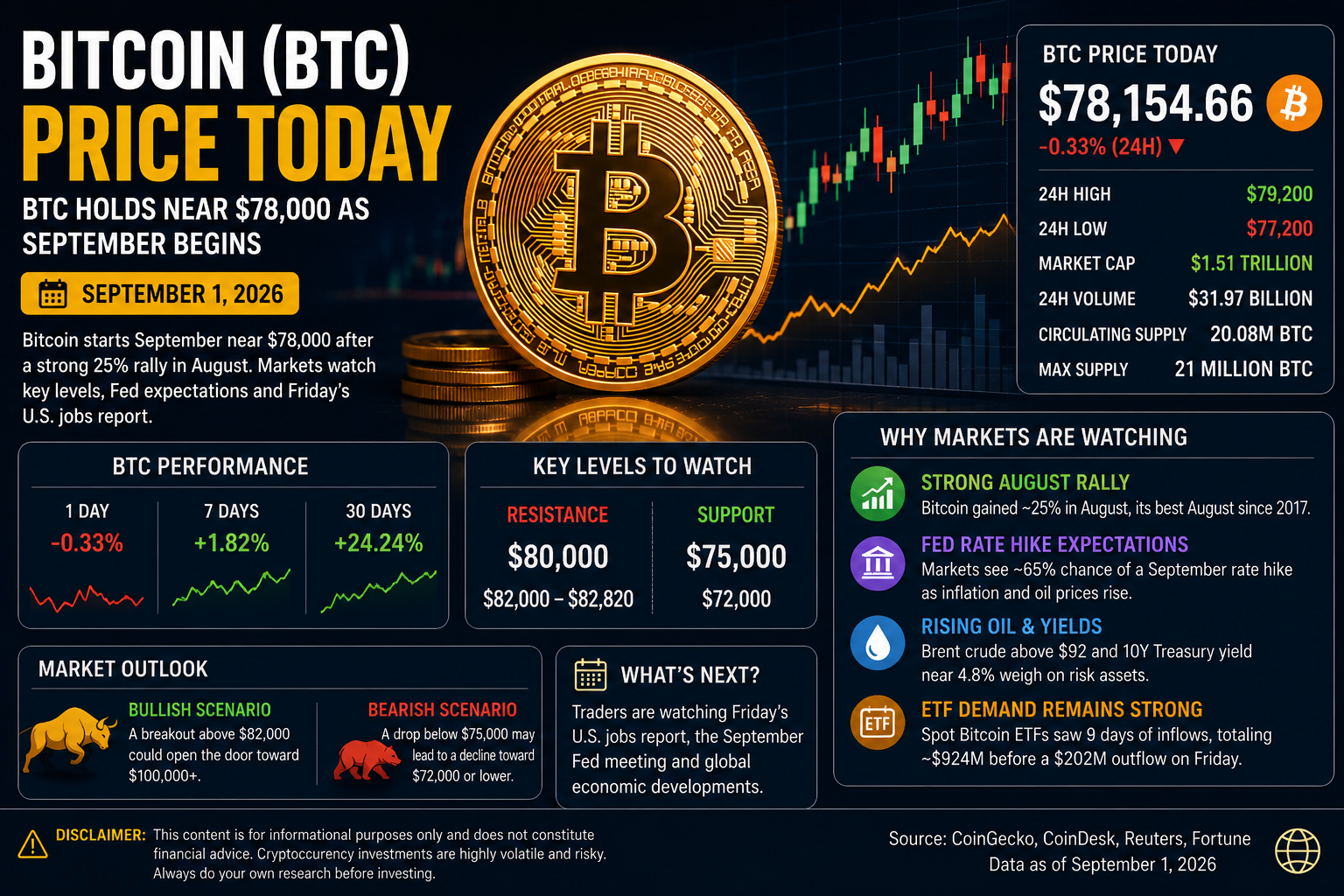
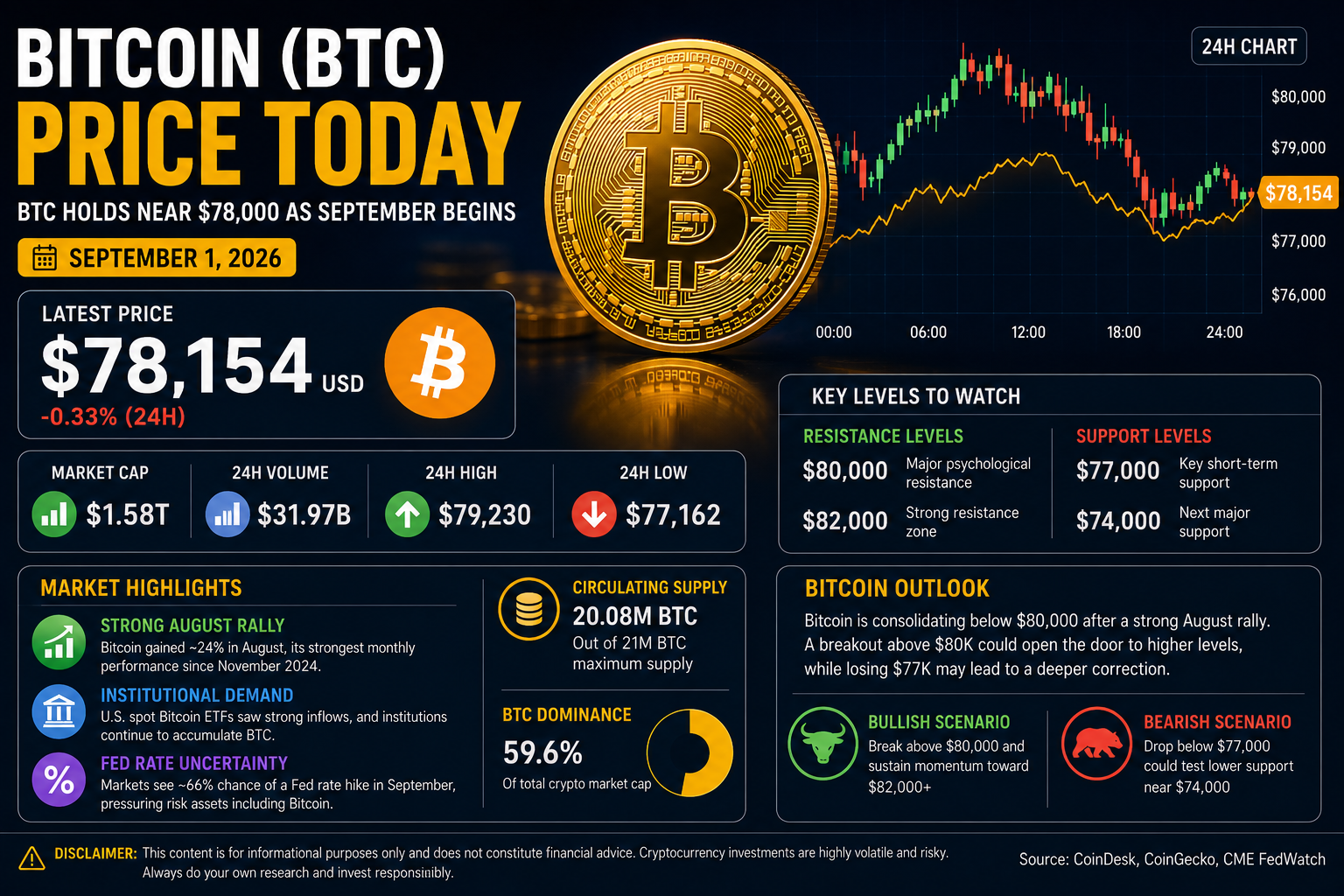
At the beginning of September, Bitcoin was trading around $78,000 while Ethereum was near $2,450. Both assets were experiencing pressure as broader financial markets reacted to rising oil prices and higher bond yields.
Federal Reserve Expectations and ETH
Macroeconomic conditions could have a major influence on Ethereum during September.
Markets are increasingly concerned about inflation and the possibility of higher U.S. interest rates.
Reuters reported on September 1 that markets were pricing in approximately a 65% probability of a U.S. rate hike in September.
Higher rates can pressure cryptocurrencies because investors may prefer safer yield-producing assets when bond yields rise.
This can reduce demand for riskier assets such as ETH.
However, Ethereum's recent recovery demonstrates that cryptocurrency demand remains strong enough to absorb some macroeconomic pressure.
Rising Oil Prices Could Affect Ethereum
Oil prices have also become an important market factor.
Brent crude rose to approximately $92.10 per barrel on September 1, according to Reuters.
Higher energy prices can increase inflation expectations.
If inflation remains elevated, central banks may be more cautious about reducing rates.
This creates a difficult environment for risk assets.
Ethereum's reaction to these developments will therefore be closely watched throughout September.
Ethereum's September 2026 Outlook
Ethereum enters September from a stronger position than it held at the beginning of August.
The cryptocurrency is approximately 32% higher than one month ago, according to Fortune's September 1 data.
However, ETH now needs to overcome resistance near $2,500.
The most important short-term scenarios are relatively straightforward.
If ETH Breaks Above $2,500
A sustained breakout could strengthen bullish momentum.
Traders could begin targeting higher resistance levels as confidence improves.
If ETH Remains Below $2,500
Ethereum could continue moving sideways while investors wait for additional catalysts.
If ETH Falls Below $2,400
A break below important support could lead to a deeper correction and weaken the recent bullish structure.
Could Ethereum Reach $3,000?
The possibility of Ethereum returning to $3,000 remains an important topic for investors.
At approximately $2,460, ETH would need to rise around 22% to reach $3,000.
Ethereum has demonstrated that such percentage moves are possible during strong crypto market rallies.
However, ETH would first need to establish stronger momentum above $2,500 and overcome additional resistance levels.
A continued Bitcoin rally could also make a move toward $3,000 more plausible.
On the other hand, a major Bitcoin correction or significant deterioration in global risk sentiment could delay such a move.
Price targets should therefore be viewed as scenarios rather than guarantees.
Risks for Ethereum Investors
Ethereum remains a high-risk asset, and investors should consider several factors before buying ETH.
High Volatility
Ethereum can experience large percentage moves within hours or days.
Regulatory Risk
Changes in cryptocurrency regulations can affect exchanges, staking services, ETFs and decentralized applications.
Network Risks
Although Ethereum is one of the largest blockchain networks, decentralized applications operating on it can still face technical or security risks.
Competition
Ethereum competes with other blockchain networks, including Solana and several emerging smart-contract platforms.
Market Risk
ETH remains highly correlated with the broader cryptocurrency market.
A major Bitcoin decline could put significant pressure on Ethereum.
What to Watch for Ethereum in September
Several developments could influence ETH during the coming weeks.
Ethereum's $2,500 Breakout
This remains the most obvious short-term technical event.
Bitcoin's Direction
BTC's ability to reclaim $80,000 could have a major influence on ETH.
ETF Flows
Investors will continue monitoring institutional demand for Ethereum investment products.
Institutional Accumulation
Large ETH purchases by companies such as BitMine are another important market signal.
Federal Reserve Policy
Interest-rate expectations could significantly affect cryptocurrency sentiment.
Inflation and Employment Data
New U.S. economic data could change expectations for monetary policy.
Ethereum vs. Bitcoin
Bitcoin and Ethereum are often discussed together, but they serve different purposes.
Bitcoin is primarily viewed as a decentralized digital monetary asset with a maximum supply of 21 million coins.
Ethereum is a programmable blockchain designed to support applications, smart contracts and digital assets.
Bitcoin therefore focuses heavily on scarcity and monetary value, while Ethereum's investment case also depends on blockchain usage and network activity.
Both assets can play important roles in a diversified cryptocurrency portfolio, although both remain highly volatile.
Ethereum Market Outlook
Ethereum's market outlook for September is cautiously optimistic but highly dependent on price action around $2,400 and $2,500.
The cryptocurrency has already recorded a significant recovery from its August levels.
At the same time, the broader financial environment has become more challenging.
Higher oil prices, rising bond yields and increased expectations of Federal Reserve rate hikes could limit risk appetite.
Institutional accumulation and Ethereum's expanding ecosystem provide potential sources of support.
The balance between these positive and negative factors could determine whether ETH continues higher or enters another period of consolidation.
Final Thoughts
Ethereum begins September 2026 near $2,450–$2,470, after gaining roughly 32% over the previous month. Fortune's September 1 snapshot placed ETH at $2,462.52, compared with approximately $1,864 one month earlier.
The cryptocurrency is now approaching an important technical decision point.
The $2,500 level remains the key resistance area, while $2,400–$2,438 represents an important support region highlighted by recent market analysis.
A sustained move above $2,500 could strengthen the bullish outlook and potentially bring higher targets into focus.
A break below $2,400, however, could weaken momentum and increase the possibility of a deeper correction.
Beyond price charts, Ethereum's long-term story continues to involve institutional adoption, staking, decentralized finance, stablecoins and the continued development of its blockchain ecosystem.
The broader financial environment will also remain important.
With markets increasingly focused on inflation, oil prices and Federal Reserve policy, Ethereum could experience significant volatility throughout September.
For now, ETH remains one of the most closely watched cryptocurrencies in the world, and its performance could provide an important signal about the direction of the broader altcoin market.
Disclaimer: This article is for informational and educational purposes only and does not constitute financial, investment or trading advice. Ethereum and other cryptocurrencies are highly volatile assets, and investors can lose some or all of their capital. Always verify live prices and conduct independent research before making financial decisions.