
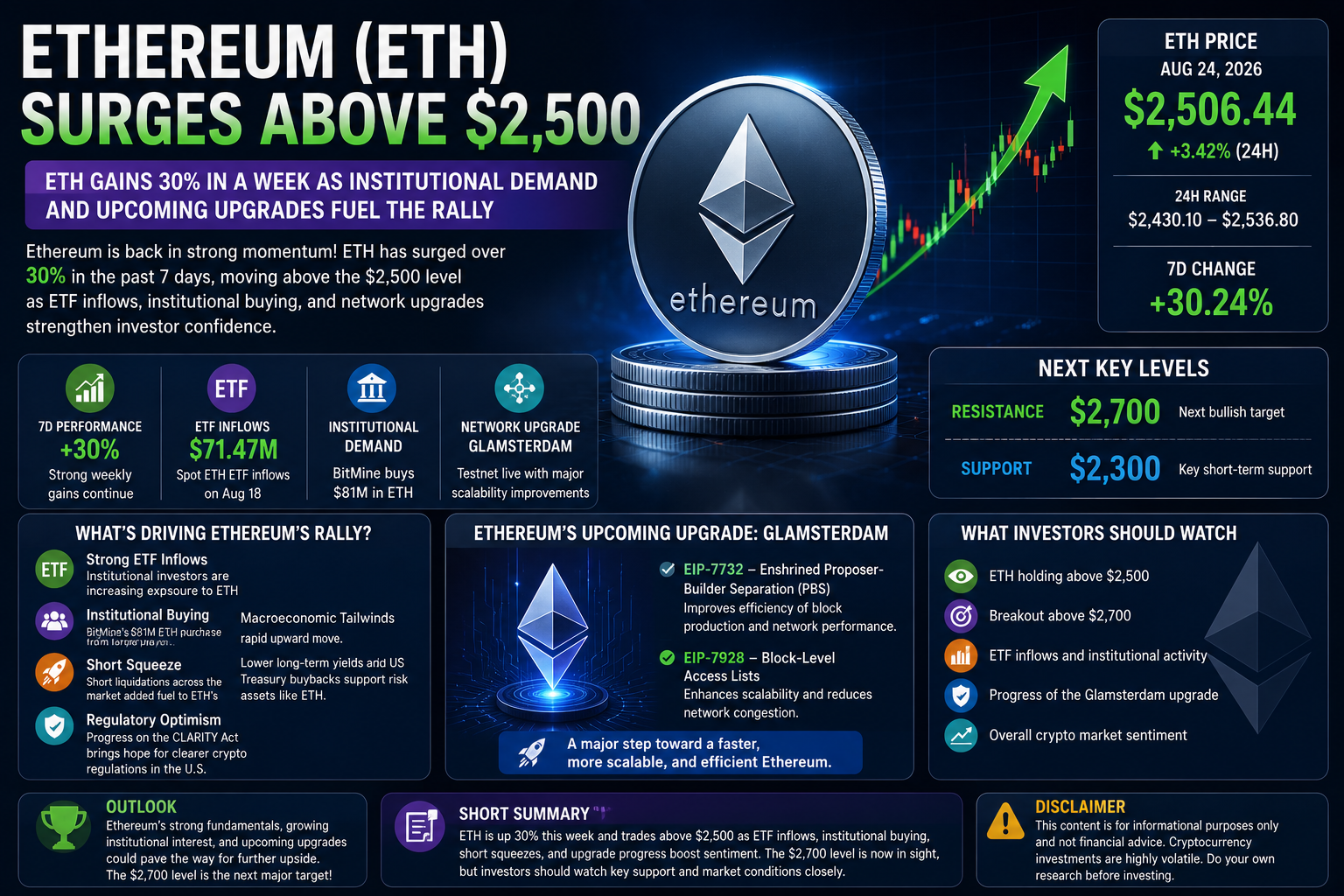
Ethereum (ETH) is making a strong comeback in August 2026, with the cryptocurrency climbing sharply over the past week and attracting renewed attention from investors, institutions, and developers. ETH recently moved above the $2,500 level after gaining roughly 30% in seven days, making Ethereum one of the strongest-performing major cryptocurrencies during the latest market recovery.
The latest rally comes as institutional investors increase their exposure to ETH, Ethereum's upcoming network upgrades progress, and demand for Ethereum-based investment products remains an important theme in the market.
At the same time, Ethereum remains well below its previous all-time high of approximately $4,953.73, reached in August 2025. This means the latest rally represents a significant recovery but does not yet put ETH close to its previous peak.
Ethereum Price Moves Above $2,500
Ethereum has experienced a dramatic price recovery during the latest crypto market rally.
On August 24, ETH was trading around $2,500, with Fortune reporting a price of approximately $2,506.44 at 9 a.m. Eastern Time. That represented an increase of more than 3% from the previous day's price and a gain of more than 34% over the previous month.
Other live market sources showed ETH trading around the same level, although cryptocurrency prices can change rapidly throughout the day.
The move above $2,500 is important because Ethereum had spent much of the previous period trading significantly lower. The recent recovery has therefore changed market sentiment and encouraged investors to look for additional upside.
Some analysts are now watching the $2,700 level as a potential next target if ETH can maintain its momentum above $2,500.
ETH Gains Approximately 30% in One Week
Ethereum's recent performance has been particularly strong.
Market analysis published on August 24 indicated that ETH had gained roughly 30% over seven days, while the broader crypto market also experienced a major recovery. The Crypto Fear and Greed Index was reported at 79, reflecting strong investor optimism.
A rapid increase of this size can attract additional buyers, but it can also increase the risk of short-term profit-taking.
For Ethereum to maintain its upward momentum, investors will likely watch whether ETH can remain above important support levels after the initial rally.
Institutional Demand for Ethereum Increases
Institutional interest is becoming one of the most important stories surrounding Ethereum.
Tom Lee's BitMine has recently increased its ETH purchases, with CoinDesk reporting that the company bought approximately $81 million worth of Ethereum, its largest weekly ETH purchase since early July.
Large corporate purchases can influence market sentiment because they demonstrate that some institutions are treating Ethereum as a long-term digital-asset holding rather than simply a short-term trading opportunity.
Institutional demand is particularly significant for Ethereum because ETH has a different investment proposition from Bitcoin. Ethereum is not only a cryptocurrency but also the native asset of a blockchain ecosystem used for decentralized applications, stablecoins, tokenized assets, and decentralized finance.
Ethereum ETFs Remain an Important Catalyst
Ethereum exchange-traded funds are another major factor investors are watching.
Spot Ethereum ETFs provide traditional investors with exposure to ETH through conventional brokerage accounts without requiring them to directly manage cryptocurrency wallets or custody. BlackRock's iShares Ethereum Trust, for example, is designed to provide exposure to the price performance of ether.
Recent reports have also highlighted strong ETH ETF activity. One market report noted approximately $71.47 million in spot ETH ETF inflows on August 18, adding to the broader institutional demand narrative.
If Ethereum ETF inflows continue to strengthen, they could provide an additional source of demand for ETH.
Investors are also paying attention to the possibility of staking-related benefits becoming increasingly important for Ethereum investment products. Staking can potentially provide additional yield to ETH holders, although regulatory treatment and product structures vary.
Ethereum's Glamsterdam Upgrade
Ethereum's technological development remains another important part of the ETH investment story.
Developers are working toward the Glamsterdam upgrade, which is expected to focus on improving Ethereum's scalability, efficiency, and network performance.
Recent reporting indicates that Ethereum's Platåberget testnet has launched as part of the development process for Glamsterdam.
The upgrade includes proposals aimed at improving how Ethereum processes transactions and builds blocks.
One major proposal, EIP-7732, focuses on Enshrined Proposer-Builder Separation, while EIP-7928 introduces Block-Level Access Lists. Together, these proposals are intended to improve Ethereum's ability to process transactions and support greater scalability.
For Ethereum users and developers, upgrades like Glamsterdam are important because the long-term value of the network depends partly on its ability to handle growing demand efficiently.
Why Ethereum's Technology Matters
Unlike cryptocurrencies that primarily focus on being digital money or a store of value, Ethereum operates as a programmable blockchain.
Developers can build decentralized applications and smart contracts on Ethereum. The network also plays a major role in decentralized finance, stablecoins, tokenized assets, and other blockchain-based applications.
This gives ETH multiple potential sources of demand.
Users need ETH to interact with the Ethereum network, while investors may hold ETH as a digital asset or stake it to participate in network security.
The development of Ethereum's infrastructure could therefore influence the cryptocurrency's long-term investment narrative.
Ethereum and Staking
Staking remains an important part of Ethereum's ecosystem.
Ethereum uses a proof-of-stake consensus system, meaning validators help secure the network by staking ETH.
Staking can provide rewards, but it also comes with risks and technical requirements. Investors should understand that staking is not equivalent to a guaranteed return, and the specific risks depend on how ETH is staked.
Ethereum-related investment products are also increasingly focusing on staking. Grayscale's Ethereum Trust, for example, reports staking-related information for its ETH product.
The development of staking-enabled investment products could potentially make Ethereum more attractive to institutional investors seeking exposure to both ETH price movements and staking rewards.
Ethereum's $2,700 Target
With ETH trading above $2,500, the next major level being discussed by some analysts is approximately $2,700.
A move above $2,500 that remains supported by strong trading volume and institutional demand could strengthen the bullish outlook.
However, cryptocurrency markets can reverse quickly.
If traders begin taking profits after the recent 30% rally, ETH could experience a short-term correction before attempting another move higher.
Therefore, investors should distinguish between a short-term price target and a guaranteed future price.
Risks Facing Ethereum
Despite the positive momentum, Ethereum still faces several risks.
Market Volatility
ETH remains a highly volatile asset. A strong rally can be followed by significant corrections.
Regulatory Uncertainty
Changes in cryptocurrency regulations can affect institutional participation and investment products.
ETF Outflows
If Ethereum ETFs experience sustained outflows, institutional buying pressure could weaken.
Competition
Ethereum faces competition from other blockchain networks that are attempting to offer faster or cheaper transaction processing.
Network Development
Major upgrades can introduce technical risks or delays. Investors should monitor official Ethereum development announcements rather than relying solely on price predictions.
What Ethereum Investors Should Watch
As ETH continues its recovery, several factors are worth monitoring:
ETH's ability to remain above $2,500
Potential movement toward $2,700
Ethereum ETF inflows and outflows
Institutional ETH purchases
Progress of the Glamsterdam upgrade
Ethereum staking developments
Bitcoin's overall market direction
U.S. cryptocurrency regulation
Federal Reserve policy and liquidity conditions
Ethereum network activity
These factors could determine whether the latest ETH rally develops into a longer-term trend.
Ethereum vs. Bitcoin
Ethereum and Bitcoin remain the two largest cryptocurrency networks by market capitalization, but they serve different purposes.
Bitcoin is primarily viewed as a decentralized digital asset and store of value.
Ethereum is a programmable blockchain designed to support smart contracts and decentralized applications.
Because of these differences, Ethereum can respond differently to market developments than Bitcoin.
The recent ETH rally has been particularly notable because Ethereum has gained strongly even as Bitcoin also recovered toward the $80,000 area.
Final Thoughts
Ethereum is experiencing one of its strongest rallies of 2026, with ETH gaining roughly 30% in a week and moving above the $2,500 level. Institutional purchases, ETF demand, staking developments, and progress toward the Glamsterdam upgrade are giving investors several reasons to pay attention to Ethereum.
The $2,500 level is now an important area for ETH, while $2,700 has emerged as a potential next target among some market analysts.
However, Ethereum remains a volatile cryptocurrency, and rapid gains can be followed by sharp corrections. Investors should monitor actual market data, ETF flows, network developments, and broader economic conditions rather than relying on a single price prediction.
If Ethereum's institutional adoption continues to grow and its upcoming technical upgrades successfully improve the network, ETH could remain one of the most closely watched digital assets for the remainder of 2026.
Frequently Asked Questions
1. What is the latest Ethereum news?
Ethereum has rallied strongly in August 2026, gaining roughly 30% over the latest seven-day period and trading around the $2,500 level.
2. Why is Ethereum price rising?
The recent rally has been supported by broader crypto-market strength, institutional demand, Ethereum ETF activity, and optimism surrounding upcoming network upgrades.
3. What is the current price of ETH?
ETH has been trading around $2,500 on August 24, 2026, although the exact price changes continuously with the cryptocurrency market.
4. Can Ethereum reach $2,700?
Some market analysts are watching $2,700 as a potential next target after ETH's recent rally, but this is a market outlook rather than a guaranteed price.
5. What is the Glamsterdam Ethereum upgrade?
Glamsterdam is an upcoming Ethereum network upgrade focused on improving scalability, efficiency, and network performance. Development work includes proposals such as EIP-7732 and EIP-7928.
6. Are institutions buying Ethereum?
Yes. Recent reporting showed BitMine purchasing approximately $81 million worth of ETH in its largest weekly Ethereum purchase since early July.
7. Are Ethereum ETFs important?
Yes. Ethereum ETFs provide traditional investors with a way to gain exposure to ETH through brokerage accounts, and ETF inflows are closely watched as an indicator of institutional demand.
8. Can Ethereum staking provide rewards?
Ethereum staking can generate rewards for participants who help secure the network, but staking involves risks and is not a guaranteed investment return.
9. Is Ethereum a good investment?
Ethereum is a highly volatile digital asset. Whether it is appropriate for an investor depends on their financial situation, risk tolerance, and investment objectives.
10. What price level should ETH investors watch?
The $2,500 area is currently important, while $2,700 is being watched as a possible next upside target by some analysts.