
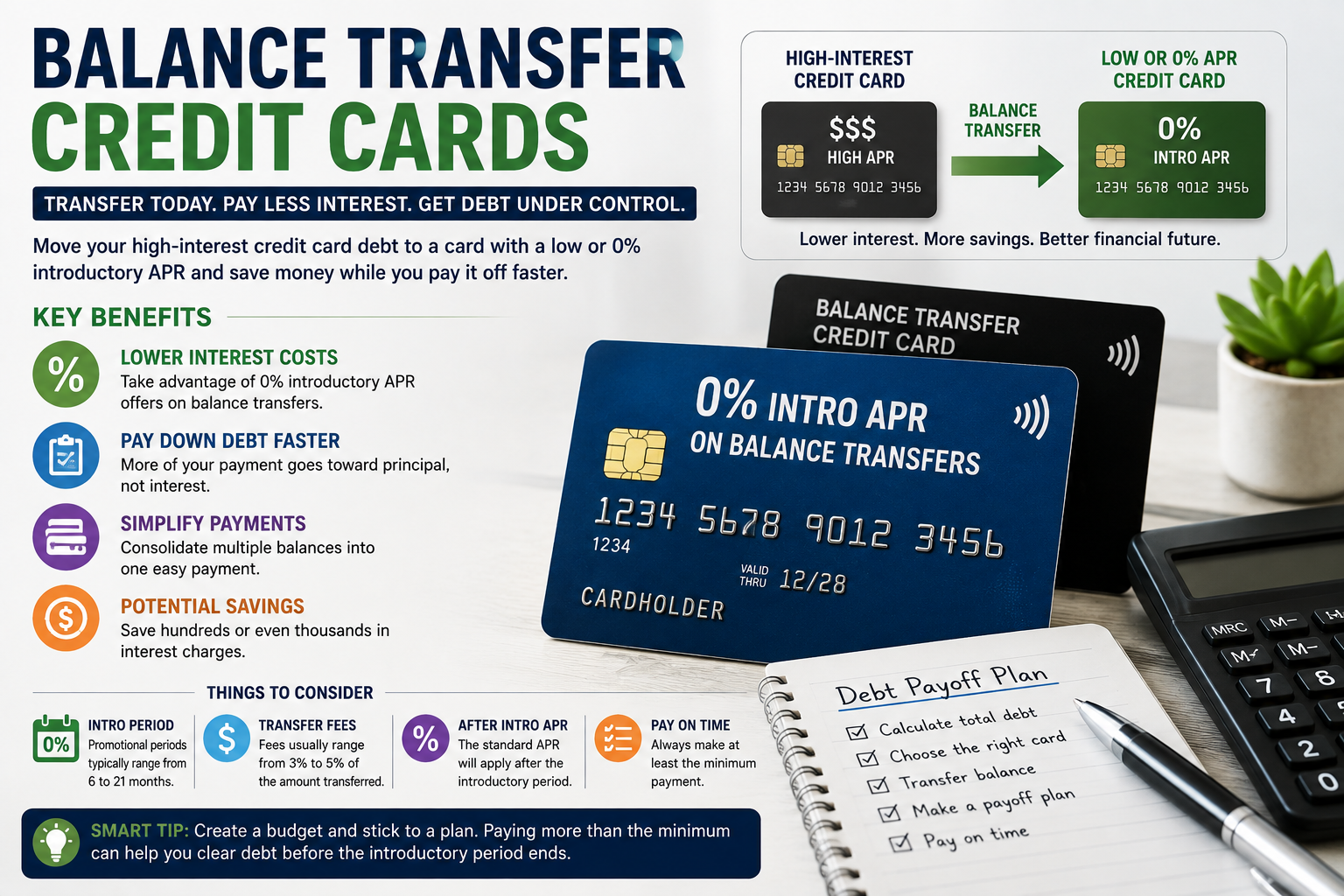
Balance transfer credit cards can be a useful financial tool for people who are carrying high-interest credit card debt. Instead of continuing to pay a high interest rate on an existing balance, a cardholder may be able to move that debt to another credit card with a lower or promotional interest rate.
Many balance transfer cards offer a temporary 0% APR period. This can give borrowers more time to reduce their debt because qualifying transferred balances may not accrue interest during the promotional period. However, balance transfers are not automatically free. Transfer fees, promotional deadlines, regular APRs, and payment requirements all need to be considered before applying.
What Is a Balance Transfer Credit Card?
A balance transfer credit card allows you to move an existing credit card balance to another credit card. The purpose is generally to reduce interest costs or consolidate debt into one account.
For example, imagine you have $5,000 on a credit card with a high APR. If you qualify for another card offering a promotional 0% APR balance-transfer period, you could potentially move some or all of that eligible debt to the new account.
Instead of continuing to pay the original card's higher interest rate, you can focus on reducing the transferred balance during the promotional period.
The exact terms depend on the card issuer, including the transfer fee, promotional period, transfer limit, and regular APR after the promotion ends.
How Do Balance Transfers Work?
The process is generally straightforward.
First, you apply for a credit card that offers a balance-transfer promotion. If approved, you provide information about the account or accounts whose balances you want to transfer.
The new card issuer then processes the transfer and sends the appropriate amount to the existing creditor. Once completed, the transferred debt appears on your new credit card.
You then make payments to the new card instead of the original card.
Balance transfers can take time to process, so borrowers should continue monitoring their original account and making required payments until the transfer is confirmed.
Why Consider a Balance Transfer?
The main reason people consider balance transfers is to reduce the amount of interest they pay.
If an existing credit card has a high APR, a promotional balance-transfer offer may temporarily reduce the interest cost. This can allow more of each payment to go toward reducing the principal balance.
Balance transfers can also simplify debt management. Instead of managing several credit card balances, you may be able to consolidate eligible balances onto one card.
However, consolidation only helps if you also have a realistic plan for paying down the debt.
0% Balance Transfer Offers
Some balance transfer credit cards offer a 0% introductory APR for a limited period.
Current 2026 balance-transfer cards include promotional periods that can extend to 18 months or longer, although offers vary by card and eligibility.
A promotional period can be useful because it provides a defined window for paying down debt without the normal purchase or balance-transfer interest, depending on the offer.
However, 0% APR does not mean there are no costs.
Balance Transfer Fees
One of the most important costs to check is the balance-transfer fee.
A card issuer may charge a percentage of the amount transferred. The Consumer Financial Protection Bureau confirms that a balance-transfer fee can be charged even when the promotional interest rate is 0%.
For example, if a card charges a 3% transfer fee and you transfer $5,000:
$5,000 × 3% = $150
That means your cost for the transfer could be $150, subject to the card's terms.
Some cards may use different fee structures, so always check the current offer before transferring a balance.
How Much Can You Save?
The potential savings depend on your existing APR, balance, transfer fee, promotional period, and repayment schedule.
For example, someone with a $5,000 balance at a high interest rate could potentially save a significant amount by moving the debt to a promotional balance-transfer card.
However, the transfer fee reduces those savings.
A useful comparison is:
Potential savings = Interest avoided − Balance transfer fee
This calculation is only an estimate because actual interest depends on the issuer's calculation method and your payment behavior.
What Happens When the Promotional Period Ends?
The 0% or reduced APR period does not last forever.
When the promotional period ends, the card's regular APR can apply according to the card agreement. The CFPB notes that promotional balance-transfer rates are generally limited-time offers and may rise afterward.
For this reason, you should determine how much you need to pay each month to eliminate the transferred balance before the promotional period expires.
For example, if you transfer $3,600 and have 18 months to repay it, you would need to pay approximately:
$3,600 ÷ 18 = $200 per month
This does not include transfer fees or other charges.
Creating this type of repayment plan before transferring the balance can help you avoid being surprised by the regular APR later.
Can You Make New Purchases on a Balance Transfer Card?
You may be able to make new purchases, but caution is important.
A balance-transfer promotion does not necessarily mean new purchases receive the same promotional rate.
The CFPB warns that purchases made while carrying a promotional balance can accrue interest depending on the card's terms and whether you maintain a grace period.
Therefore, it is important to read the purchase APR and balance-transfer APR separately.
If your main goal is paying off transferred debt, avoiding unnecessary new purchases can make your repayment strategy easier.
Benefits of Balance Transfer Credit Cards
Lower Interest Costs
A promotional rate can reduce or temporarily eliminate interest on qualifying transferred debt.
Faster Debt Repayment
With less money going toward interest, more of your payment can potentially reduce the balance.
Debt Consolidation
Multiple eligible balances may be combined into one account, making monthly payments easier to track.
Predictable Repayment Period
A promotional period gives you a specific timeframe for creating a debt-payoff plan.
Potential Financial Savings
If the interest savings are greater than the transfer fee and other costs, a balance transfer may reduce the overall cost of the debt.
Disadvantages of Balance Transfer Cards
Balance transfers also have potential drawbacks.
Transfer Fees
A percentage-based transfer fee can add to the amount you owe.
Promotional Periods End
The introductory APR is temporary.
Regular APR Can Be High
If you still have a balance after the promotion ends, the regular APR may be significantly higher.
Credit Requirements
The most attractive balance-transfer offers may require stronger credit profiles.
New Debt Risk
Moving debt does not eliminate it. You still have to repay the balance.
How to Choose a Balance Transfer Credit Card
Before applying, compare several important factors.
Promotional Period
Look for a promotional period that gives you enough time to realistically pay down the balance.
Transfer Fee
Calculate the fee based on the amount you plan to transfer.
Regular APR
Check the APR that will apply after the introductory period.
Transfer Limit
Your approved credit limit may not be high enough to transfer your entire existing balance.
Annual Fee
Some cards charge an annual fee, so include it when calculating the total cost.
Purchase APR
If you plan to use the card for new purchases, check whether they receive a promotional rate.
Steps to Make a Balance Transfer
A simple approach is:
Calculate your existing credit card debt.
Check the APRs on your current cards.
Compare balance-transfer offers.
Review the transfer fee.
Check the promotional period.
Review the regular APR.
Apply for a suitable card.
Request the balance transfer.
Continue making required payments until the transfer is confirmed.
Create a monthly payoff plan.
Avoid unnecessary new debt.
Aim to repay the transferred balance before the promotional period ends.
Balance Transfer vs. Debt Consolidation Loan
A balance transfer is only one option for managing credit card debt.
A debt consolidation loan may provide a fixed interest rate and fixed repayment schedule, while a balance transfer card typically provides a promotional rate for a limited period.
The better option depends on the interest rate, fees, repayment period, credit profile, and your ability to make payments.
Compare the total cost rather than focusing only on the advertised interest rate.
Does a Balance Transfer Hurt Your Credit Score?
Applying for a new credit card can result in a hard inquiry, depending on the application process. Opening a new account can also change the age and utilization of your credit accounts.
However, the effect varies by individual.
A balance transfer may also change your credit utilization because the new card adds available credit while the old balance may be reduced.
The important point is that a balance transfer should be viewed primarily as a debt-management strategy, not simply as a way to obtain more available credit.
Common Balance Transfer Mistakes
Avoid these common mistakes:
Ignoring the transfer fee: Always calculate the fee before transferring debt.
Missing payments: Keep making required payments according to the card terms.
Waiting too long: Start paying down the balance early instead of waiting until the promotional period is almost over.
Adding new debt: Avoid using the transfer card as an excuse to increase spending.
Ignoring the regular APR: Know what rate could apply after the promotional period.
Transferring without a plan: A balance transfer works best when combined with a realistic repayment strategy.
Final Thoughts
Balance transfer credit cards can provide an opportunity to reduce interest costs and organize high-interest credit card debt. Promotional 0% APR offers can give borrowers a temporary window to focus on paying down their balances.
However, a balance transfer does not erase debt. Transfer fees, promotional deadlines, credit limits, regular APRs, and payment requirements all need to be considered.
The most effective strategy is to calculate the total cost, create a monthly repayment plan, avoid unnecessary new purchases, and aim to eliminate the transferred balance before the promotional rate expires.
Used responsibly, a balance transfer can be a useful part of a broader debt-management strategy.
Frequently Asked Questions
1. What is a balance transfer credit card?
It is a credit card that allows you to move eligible debt from an existing credit card to a new card, often with a lower or promotional APR.
2. Are balance transfers really 0% interest?
Some cards offer 0% introductory APR on balance transfers for a limited period. However, a transfer fee may still apply.
3. How long does a 0% balance transfer last?
The promotional period varies by card. Some current offers provide 18 months or longer, but terms and eligibility differ.
4. Is there a fee for transferring a balance?
Often, yes. The fee is commonly calculated as a percentage of the transferred amount, although some offers may have different terms.
5. Can I transfer balances from multiple credit cards?
Some cards allow transfers from multiple eligible accounts, subject to the issuer's rules and your available credit limit.
6. What happens after the 0% APR period?
The regular APR specified in the card agreement can apply to the remaining balance after the promotional period ends.
7. Can I use a balance transfer card for new purchases?
You may be able to, but check the purchase APR carefully. New purchases may not receive the same promotional rate as transferred balances.
8. How can I make a balance transfer worthwhile?
Calculate the transfer fee, compare it with the interest you could avoid, and create a plan to repay the balance before the promotional period ends.
9. Can a balance transfer help consolidate debt?
Yes. Moving eligible balances to one card can simplify payments and potentially reduce interest costs.
10. Should I transfer my entire credit card balance?
Not necessarily. Your available credit limit, transfer fee, promotional period, and repayment ability should all be considered before deciding how much to transfer.
11. Is a balance transfer the same as paying off debt?
No. It moves the debt from one account to another. You still owe the transferred amount and must repay it.
12. What is the biggest mistake to avoid?
The biggest mistake is transferring a balance without a repayment plan. If you still have a large balance when the promotional period ends, the regular APR may make the remaining debt expensive