
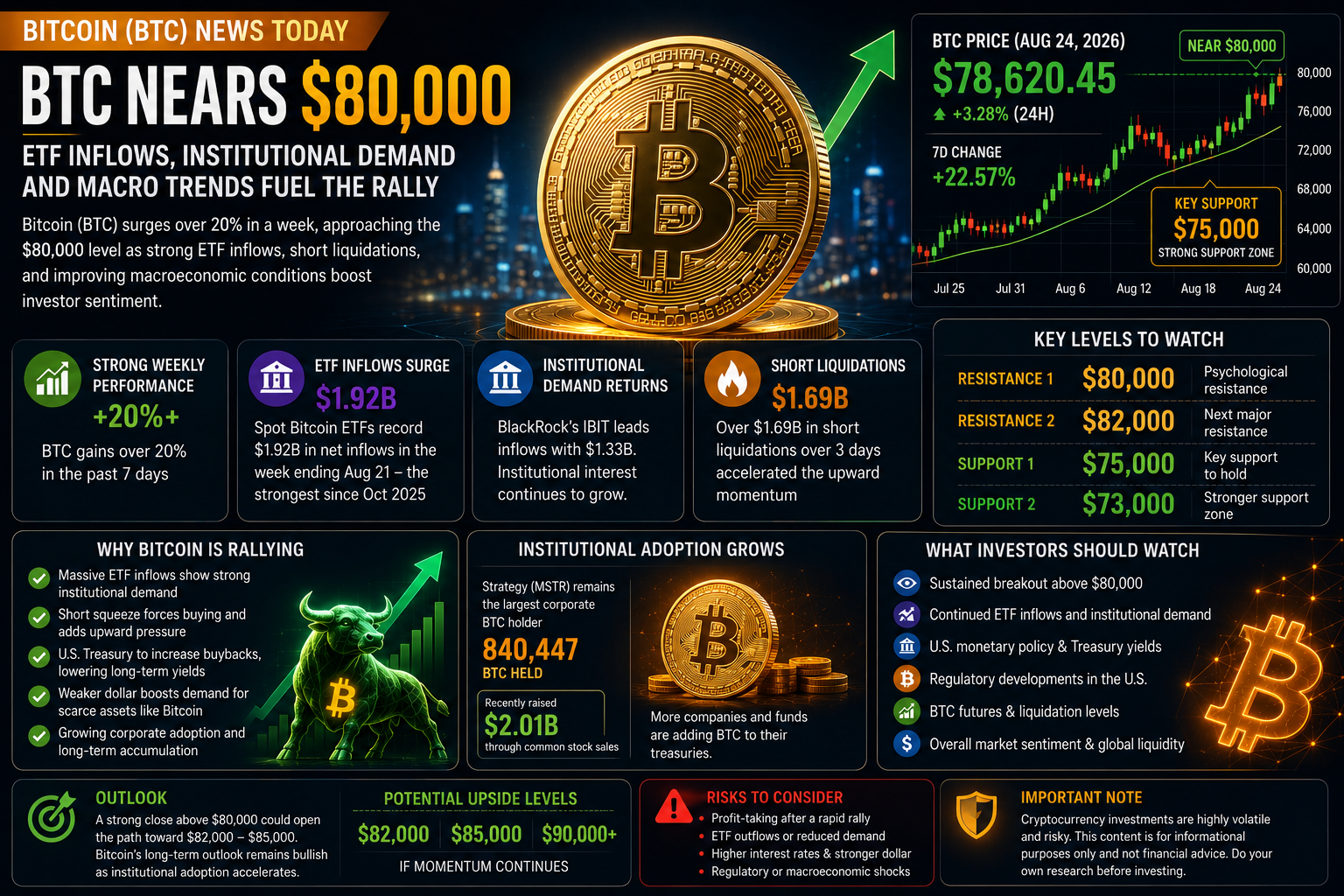
Bitcoin (BTC) is back in the spotlight after a powerful August rally pushed the cryptocurrency toward the $80,000 level. Bitcoin briefly climbed above $79,000 on August 24, 2026, after gaining more than 20% over the previous week. The recovery has been supported by renewed demand for U.S. spot Bitcoin ETFs, improving liquidity expectations, institutional buying, and a broader return of bullish sentiment across cryptocurrency markets.
The latest move is significant because Bitcoin had spent much of the summer trading considerably lower. The rapid recovery has now made the $80,000 area one of the most important psychological levels for BTC traders and investors.
Bitcoin's Latest Rally
Bitcoin started the latest rally near the low-$60,000s and subsequently climbed through several major levels, including $70,000, $75,000 and $79,000.
On August 21, BTC reached approximately $79,455, its highest level in about three months. By August 24, Bitcoin remained elevated around the upper-$70,000 range after a small pullback.
The speed of the move has attracted considerable attention. MarketWatch reported that Bitcoin was on track for its sixth consecutive daily gain and had risen approximately 25% during the winning streak.
This type of rapid increase can be a sign of strong buying demand, but it can also increase the possibility of short-term profit-taking.
Bitcoin ETF Inflows Surge
One of the biggest stories behind the latest BTC rally is the return of strong institutional demand through spot Bitcoin ETFs.
U.S. spot Bitcoin ETFs recorded approximately $1.92 billion in net inflows during the week ending August 21, making it their strongest weekly performance since October 2025.
The inflows are particularly important because Bitcoin ETFs provide traditional investors with exposure to BTC through conventional investment accounts.
BlackRock's iShares Bitcoin Trust, known as IBIT, accounted for approximately $1.33 billion of the latest weekly inflows, according to data cited in recent market coverage.
The return of ETF demand represents a major change from earlier periods of 2026 when Bitcoin investment products experienced significant outflows.
However, the broader 2026 picture remains mixed. Despite the latest surge, Bitcoin ETFs were still approximately $2.91 billion in net outflows for the year overall as of the latest reporting.
Why ETF Demand Matters
ETF inflows matter because they can represent direct spot-market demand for Bitcoin.
When investors purchase shares of a spot Bitcoin ETF, the fund structure generally requires exposure to the underlying asset. As demand for the products increases, this can contribute to additional buying pressure in the Bitcoin market.
Strong ETF flows can therefore provide a more meaningful signal than short-term futures trading alone.
The key question now is whether the recent $1.92 billion inflow week represents the beginning of a sustained institutional trend or simply a temporary reaction to Bitcoin's sharp price recovery.
Short Squeeze Adds Momentum
Bitcoin's rally has also been supported by a major shift in derivatives positioning.
As BTC moved higher, traders who had bet on declining prices were forced to close short positions. Closing a short position typically requires buying the underlying asset, which can add further upward pressure.
This creates what is commonly called a short squeeze.
Recent reports have linked billions of dollars in short liquidations to the latest crypto rally. The effect can be powerful because forced buying can accelerate a move that has already begun.
However, short squeezes are generally considered a short-term catalyst. For Bitcoin to maintain higher prices after the initial squeeze, sustained spot demand is more important.
Treasury Policy Gives Bitcoin Another Boost
Macroeconomic developments have also contributed to Bitcoin's recovery.
The U.S. Treasury has announced plans to increase purchases of longer-term government securities, with the size of certain buyback operations increasing from approximately $2 billion to around $4 billion.
The move contributed to lower long-term yields and helped improve sentiment toward risk assets. Bitcoin and gold both benefited as investors focused on concerns surrounding government debt, liquidity and the value of fiat currencies.
This has revived discussion around Bitcoin as a potential digital alternative to traditional stores of value.
Bitcoin's fixed maximum supply of 21 million coins is particularly relevant to this narrative.
However, Bitcoin still behaves partly like a risk asset and remains sensitive to interest rates, liquidity, stock-market conditions and investor sentiment.
A Weaker Dollar Supports Bitcoin
The U.S. dollar has also become an important part of the current market story.
A weaker dollar can make scarce assets such as gold and Bitcoin more attractive to some investors.
Recent market coverage has linked dollar weakness, Treasury-market concerns and the return of the so-called "debasement trade" with Bitcoin's latest rally.
The idea behind the debasement trade is that investors seek assets that may retain value when concerns about government debt, currency purchasing power or monetary policy increase.
Bitcoin's fixed supply makes it particularly attractive to investors who view scarcity as an important investment characteristic.
Institutional Adoption Continues
Institutional involvement in Bitcoin extends beyond ETFs.
Corporate Bitcoin treasury strategies have also become an important part of the cryptocurrency market.
Strategy, one of the world's largest corporate Bitcoin holders, recently raised approximately $2.01 billion through common-stock sales. The company did not purchase additional Bitcoin during the latest reporting period and continued to hold approximately 840,447 BTC.
The company's decision to maintain its Bitcoin holdings rather than sell them has contributed to positive sentiment.
Corporate treasury strategies can influence Bitcoin because large companies holding BTC potentially reduce the amount of Bitcoin available for immediate sale.
Bitcoin's Next Major Test: $80,000
The biggest near-term question is whether Bitcoin can break decisively above $80,000.
BTC has already approached this level, reaching approximately $79,455. A sustained move above $80,000 could strengthen bullish sentiment and attract additional momentum traders.
Some technical analysts are watching approximately $79,300 as a key breakout area, followed by potential levels around $82,000 and $85,000 if BTC establishes a new higher high.
On the other hand, Bitcoin's rapid rally means the market may be vulnerable to profit-taking.
Recent market analysis has identified approximately $75,000 and $73,000 as important areas to monitor if the cryptocurrency begins to pull back.
What Could Push Bitcoin Higher?
Several factors could support another move higher.
Continued ETF Inflows
If spot Bitcoin ETFs continue attracting billions of dollars in capital, institutional demand could provide additional support.
Institutional Adoption
Further corporate and institutional purchases could strengthen long-term demand.
Favorable Liquidity
Lower yields and improving liquidity conditions could benefit risk assets such as Bitcoin.
Regulatory Progress
Greater regulatory clarity in the United States could encourage more financial institutions to participate in cryptocurrency markets.
Break Above $80,000
A sustained move above $80,000 could become an important technical and psychological signal.
What Could Cause Bitcoin to Fall?
Bitcoin remains highly volatile despite the current bullish environment.
A reversal in ETF inflows could reduce buying pressure. Investors who purchased BTC during the recent rally could also take profits.
Higher Treasury yields, a stronger dollar, disappointing regulatory developments or a more hawkish Federal Reserve could also pressure Bitcoin.
Another risk is leverage.
After a major short squeeze, traders may begin building leveraged long positions. If BTC then falls sharply, those positions can be liquidated and potentially accelerate a decline.
Jackson Hole Becomes an Important Macro Event
Markets are also watching the Jackson Hole Economic Policy Symposium this week.
Comments from Federal Reserve officials can influence expectations about interest rates and liquidity.
A more supportive monetary-policy outlook could potentially benefit Bitcoin and other risk assets, while a more hawkish outlook could strengthen the dollar and put pressure on cryptocurrencies.
This makes the event an important macroeconomic catalyst for BTC traders.
What Bitcoin Investors Should Watch
As BTC approaches $80,000, investors should monitor:
Spot Bitcoin ETF inflows and outflows
BTC trading volume
The $80,000 resistance level
Support around $75,000
Institutional Bitcoin purchases
U.S. Treasury yields
Federal Reserve policy expectations
U.S. cryptocurrency legislation
Bitcoin futures open interest
Short and long liquidations
The U.S. dollar
Overall cryptocurrency-market sentiment
These indicators can help investors understand whether the current rally is becoming a sustainable trend.
Bitcoin Outlook for the Rest of 2026
Bitcoin enters the remainder of August with considerably stronger momentum than it had earlier in the summer.
The combination of renewed ETF demand, institutional interest, improving liquidity expectations and macroeconomic concerns has created a favorable environment for BTC.
However, the cryptocurrency still faces significant uncertainty.
The strongest signal would be continued ETF inflows combined with sustained spot-market demand. If institutional capital continues entering Bitcoin while BTC holds above important support levels, the recovery could potentially develop further.
If ETF flows weaken and leverage becomes excessive, Bitcoin could experience a significant correction even within a broader bullish trend.
Final Thoughts
Bitcoin has staged one of its strongest rallies of 2026, climbing more than 20% over the past week and approaching the $80,000 mark.
The latest move has been supported by approximately $1.92 billion in weekly spot Bitcoin ETF inflows, institutional demand, short liquidations, Treasury-market developments and renewed optimism around cryptocurrency regulation.
The next major challenge is whether BTC can break above $80,000 and hold the level.
While the current market environment is encouraging for Bitcoin bulls, the cryptocurrency remains highly volatile. Investors should focus on actual ETF flows, market liquidity, institutional activity and macroeconomic developments rather than relying on short-term price predictions.
Frequently Asked Questions
1. What is the latest Bitcoin news?
Bitcoin has rallied strongly in August 2026 and recently approached $80,000 after gaining more than 20% in a week.
2. Why is Bitcoin rising?
The latest rally has been supported by strong spot Bitcoin ETF inflows, institutional demand, short covering, Treasury-market developments, dollar weakness and improving regulatory expectations.
3. How much money flowed into Bitcoin ETFs?
U.S. spot Bitcoin ETFs recorded approximately $1.92 billion in net inflows during the week ending August 21, their strongest weekly inflow since October 2025.
4. Is Bitcoin above $80,000?
Bitcoin briefly approached and moved around the $79,000 area on August 24 but had not established a sustained move above $80,000 at the time of the latest reports.
5. What is the next Bitcoin resistance level?
The $80,000 area is the key psychological resistance. Some technical analysis also identifies approximately $82,000 and $85,000 as potential levels if BTC breaks higher.
6. What could cause Bitcoin to fall?
ETF outflows, profit-taking, higher interest-rate expectations, a stronger dollar, regulatory setbacks and excessive leverage could pressure BTC.
7. Is Bitcoin entering another bull market?
The recent rally has significantly improved market sentiment, but it is too early to say with certainty that a sustained new bull market has begun. Continued institutional demand will be an important factor.
8. Is Bitcoin a safe investment?
Bitcoin is a highly volatile digital asset. Its price can rise or fall substantially, so investors should consider their financial circumstances and risk tolerance before investing.
9. Why are Bitcoin ETFs important?
Spot Bitcoin ETFs give traditional investors an easier way to gain exposure to BTC and can create additional demand for the underlying asset.
10. What should Bitcoin investors watch next?
ETF flows, the $80,000 price level, institutional purchases, Federal Reserve policy, Treasury yields, the U.S. dollar and Bitcoin derivatives positioning are among the most important factors to watch.