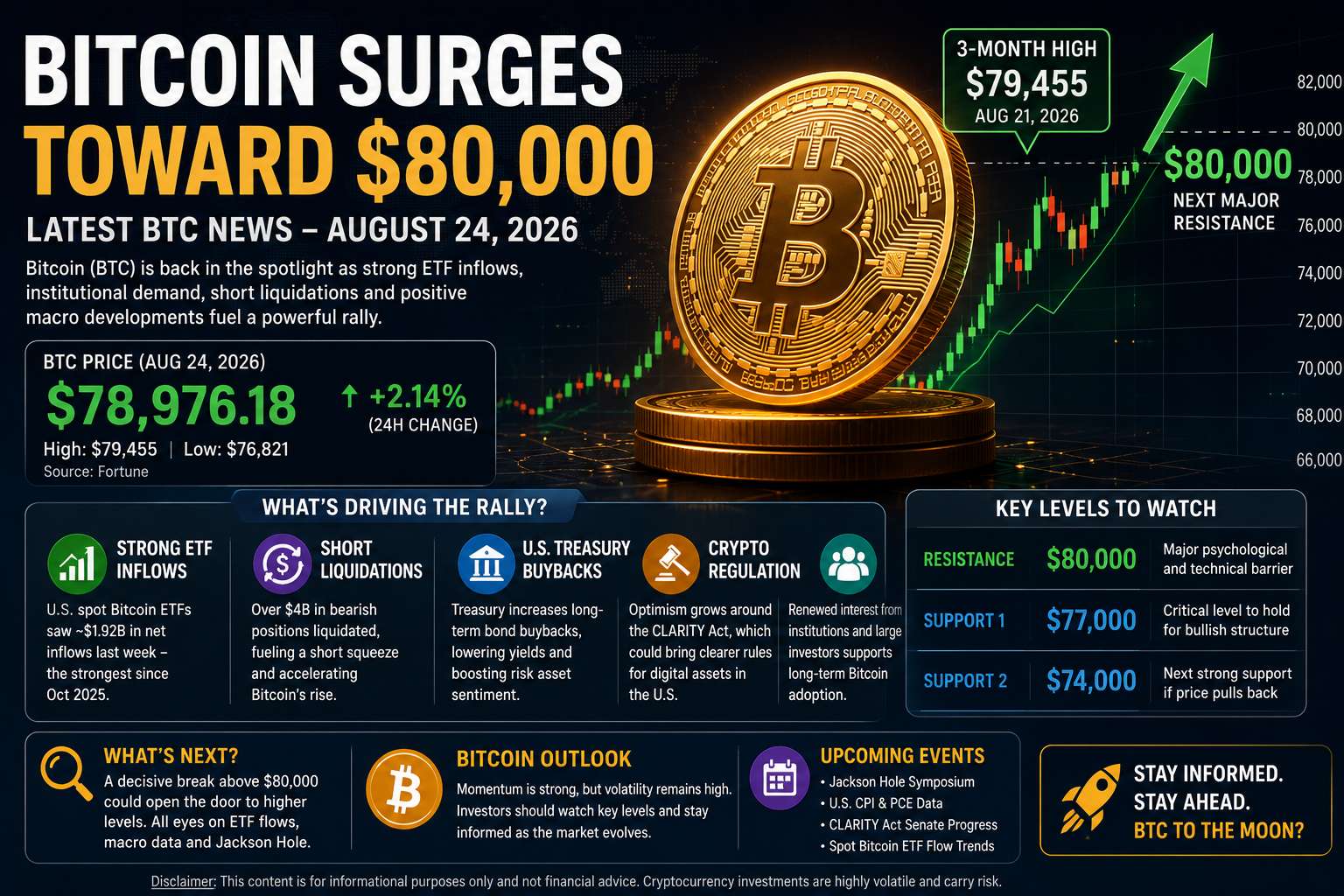
Bitcoin (BTC) is back in the spotlight after a powerful rally pushed the cryptocurrency toward the $80,000 mark. On August 24, 2026, Bitcoin was trading around the upper-$70,000 range after briefly moving above $79,000 earlier in the day. The latest rally has renewed optimism across the cryptocurrency market and made $80,000 one of the most closely watched levels for Bitcoin traders.
The move comes after Bitcoin gained more than 20% over the previous week. Strong spot Bitcoin ETF inflows, short-position liquidations, improving liquidity expectations, and renewed institutional interest have all contributed to the recent recovery.
With BTC approaching an important psychological resistance level, investors are now watching whether Bitcoin can break above $80,000 and maintain the momentum.
Bitcoin Reaches a Three-Month High
Bitcoin's recent rally has been one of its strongest moves in months.
BTC reached approximately $79,455 on August 21, its highest level in about three months. The cryptocurrency then consolidated in the upper-$70,000 range as traders took profits and evaluated whether the rally could continue.
Bitcoin's recovery is particularly notable because the cryptocurrency spent much of the summer struggling below $70,000. The recent move therefore represents a significant change in market sentiment.
On August 24, Bitcoin briefly traded above $79,000 before pulling back toward approximately $77,000. The price action shows that buyers remain active, but the $80,000 area is proving to be an important resistance zone.
Bitcoin ETF Inflows Strengthen
One of the biggest developments behind Bitcoin's latest rally is renewed demand for U.S. spot Bitcoin exchange-traded funds.
Recent reports indicate that U.S. spot Bitcoin ETFs attracted approximately $1.92 billion in net inflows during the previous week, making it the strongest weekly inflow period since October 2025.
ETF inflows are important because they provide traditional investors with exposure to Bitcoin without requiring them to directly purchase and store the cryptocurrency.
When ETF demand increases, it can provide additional buying pressure in the Bitcoin market. Continued inflows could therefore become an important factor if BTC attempts to move decisively above $80,000.
However, investors should also watch whether these inflows remain consistent. A short period of strong buying does not necessarily guarantee a long-term trend.
Short Liquidations Add Momentum
Bitcoin's rapid price increase has also been supported by liquidations of bearish positions.
When traders bet that Bitcoin will fall, they may open short positions. If Bitcoin rises sharply instead, some of those positions can be forcibly closed. Closing a short position generally involves buying Bitcoin, which can create additional upward pressure.
This can produce a short squeeze, where rising prices trigger forced buying and help accelerate the rally.
Recent market coverage has identified short covering as one of the factors contributing to Bitcoin's latest move toward $80,000.
While short squeezes can produce rapid price increases, they can also be temporary. For Bitcoin to maintain its gains, sustained spot demand will likely be more important than short-term leverage activity.
Institutional Demand Returns
Institutional participation remains another important factor in the current Bitcoin market.
The recent rise in ETF inflows suggests that traditional-market investors are becoming more willing to gain exposure to Bitcoin after a weaker period earlier in the year.
Bitcoin had previously experienced a difficult period, with U.S. spot Bitcoin ETFs recording significant outflows during the second quarter. Research from NYDIG noted approximately $4.9 billion in U.S. spot Bitcoin ETF net outflows during Q2 2026.
The return of positive ETF flows therefore represents a meaningful change.
If institutional demand continues to strengthen, Bitcoin could potentially receive a more stable source of buying pressure. If flows weaken again, however, the cryptocurrency could become more vulnerable to profit-taking.
U.S. Treasury Actions Affect Market Sentiment
Bitcoin's rally is also occurring alongside important developments in the U.S. Treasury market.
The Treasury's plans to increase purchases of longer-term government securities have contributed to lower long-term yields and improved sentiment toward risk assets.
Bitcoin often responds to changes in liquidity, bond yields, the U.S. dollar, and broader investor risk appetite. Recent market analysis has linked the Treasury's actions with improved conditions for assets such as Bitcoin.
A weaker U.S. dollar has also helped support Bitcoin and other alternative assets. However, macroeconomic conditions can change quickly, meaning traders will continue watching bond yields and Federal Reserve policy expectations.
Crypto Regulation Remains a Key Catalyst
Regulation is another important theme for the cryptocurrency market.
Investors continue to monitor the proposed U.S. CLARITY Act, which aims to provide greater clarity around the regulatory treatment of digital assets and the responsibilities of federal regulators.
Although the legislation has not yet become law, expectations surrounding clearer cryptocurrency rules have contributed to positive sentiment among some investors.
Regulatory clarity could potentially make it easier for financial institutions and businesses to participate in the digital-asset market.
At the same time, investors should remember that legislation can face delays and political uncertainty. The Senate's consideration of the CLARITY Act has already been delayed, with further action expected later in 2026.
Strategy Holds Its Bitcoin
Corporate Bitcoin treasury activity is another factor worth watching.
Strategy, one of the largest corporate holders of Bitcoin, recently raised approximately $2.01 billion through common stock sales. However, the company did not purchase additional Bitcoin during the latest reporting period and maintained holdings of approximately 840,447 BTC.
Strategy's decision not to purchase additional Bitcoin is notable because the company has previously been one of the most aggressive corporate buyers of BTC.
The company also established a cash reserve, which may give it greater flexibility for future financial obligations or potential Bitcoin purchases.
For the broader market, Strategy's Bitcoin holdings remain significant because changes in its buying activity can influence investor sentiment surrounding corporate Bitcoin adoption.
$80,000 Becomes Bitcoin's Next Major Test
The $80,000 level has become the most important near-term psychological target for Bitcoin.
BTC has already approached this level several times during the latest rally. A sustained break above $80,000 could strengthen bullish sentiment and potentially attract additional momentum traders.
On the other hand, repeated rejection around $80,000 could encourage profit-taking.
Current market analysis identifies the $77,000 area as an important level for Bitcoin to hold. Maintaining prices above this zone could help preserve the current bullish structure, while a significant decline below recent support could weaken momentum.
What Could Push Bitcoin Higher?
Several factors could support Bitcoin's next move.
Continued ETF Inflows
If spot Bitcoin ETFs continue receiving strong inflows, institutional demand could provide additional support.
Strong Institutional Adoption
Additional corporate and institutional purchases could strengthen long-term demand.
Regulatory Progress
Greater regulatory clarity could encourage more financial institutions to participate in cryptocurrency markets.
Favorable Liquidity Conditions
Lower yields and improving liquidity conditions could support risk assets such as Bitcoin.
Break Above $80,000
A decisive move above $80,000 could become an important technical and psychological signal for the market.
What Could Cause Bitcoin to Fall?
Despite the bullish momentum, Bitcoin remains highly volatile.
A decline in ETF inflows could reduce buying pressure. Traders who purchased Bitcoin during the recent rally may also take profits.
Other risks include higher Treasury yields, a stronger U.S. dollar, disappointing regulatory developments, changing Federal Reserve expectations, and a broader decline in risk appetite.
Investors should also remember that short squeezes can create rapid rallies that are not always sustainable.
What Bitcoin Investors Should Watch
As Bitcoin approaches $80,000, several indicators deserve attention:
Spot Bitcoin ETF inflows and outflows
BTC trading volume
The $80,000 resistance level
Support around the upper-$70,000 range
Institutional Bitcoin purchases
U.S. Treasury yields
Federal Reserve policy expectations
U.S. cryptocurrency legislation
Short and long-position liquidations
Overall cryptocurrency market sentiment
These factors can help investors understand whether Bitcoin's latest rally is developing into a broader trend or simply a short-term recovery.
Final Thoughts
Bitcoin has made a strong comeback in August 2026, rising more than 20% over the past week and moving close to $80,000. Renewed spot Bitcoin ETF demand, institutional interest, short covering, improving liquidity expectations, and optimism around U.S. crypto regulation have helped strengthen the market.
The next major challenge for BTC is whether it can break through and hold above $80,000.
While the current momentum is encouraging for Bitcoin bulls, cryptocurrency markets remain unpredictable. Continued ETF inflows and sustained demand will be particularly important if Bitcoin is to maintain its recent gains.
For investors and crypto enthusiasts, the coming days could be important as Bitcoin tests a major psychological level and the broader market waits for additional economic and regulatory developments.
Frequently Asked Questions
1. What is the latest Bitcoin news?
Bitcoin has rallied sharply in August 2026 and is currently trading in the upper-$70,000 range after recently reaching approximately $79,455.
2. Why is Bitcoin rising?
The latest rally has been supported by strong spot Bitcoin ETF inflows, institutional demand, short covering, improving liquidity expectations, and optimism surrounding U.S. crypto regulation.
3. Is Bitcoin close to $80,000?
Yes. Bitcoin recently traded above $79,000, making $80,000 the key psychological level currently being watched by traders.
4. Are Bitcoin ETFs still attracting money?
Yes. Recent reports indicate that U.S. spot Bitcoin ETFs attracted approximately $1.92 billion in net inflows during the previous week.
5. What is a Bitcoin short squeeze?
A short squeeze happens when traders who bet on falling Bitcoin prices are forced to close their positions by buying BTC, potentially accelerating a price increase.
6. What is the next important Bitcoin price level?
The $80,000 level is currently one of the most important psychological and technical thresholds for Bitcoin.
7. Could Bitcoin continue rising?
It could, particularly if ETF inflows, institutional demand, and favorable liquidity conditions continue. However, cryptocurrency prices remain highly volatile.
8. What could cause Bitcoin to decline?
Profit-taking, weaker ETF inflows, higher bond yields, stronger dollar conditions, regulatory setbacks, or reduced investor risk appetite could pressure BTC.
9. Why are Bitcoin ETF inflows important?
ETF inflows can indicate demand from traditional investors and may create additional buying pressure for Bitcoin.
10. Is Bitcoin a safe investment?
Bitcoin is a highly volatile asset and can experience significant price fluctuations. Investors should consider their risk tolerance and financial circumstances before making investment decisions.