
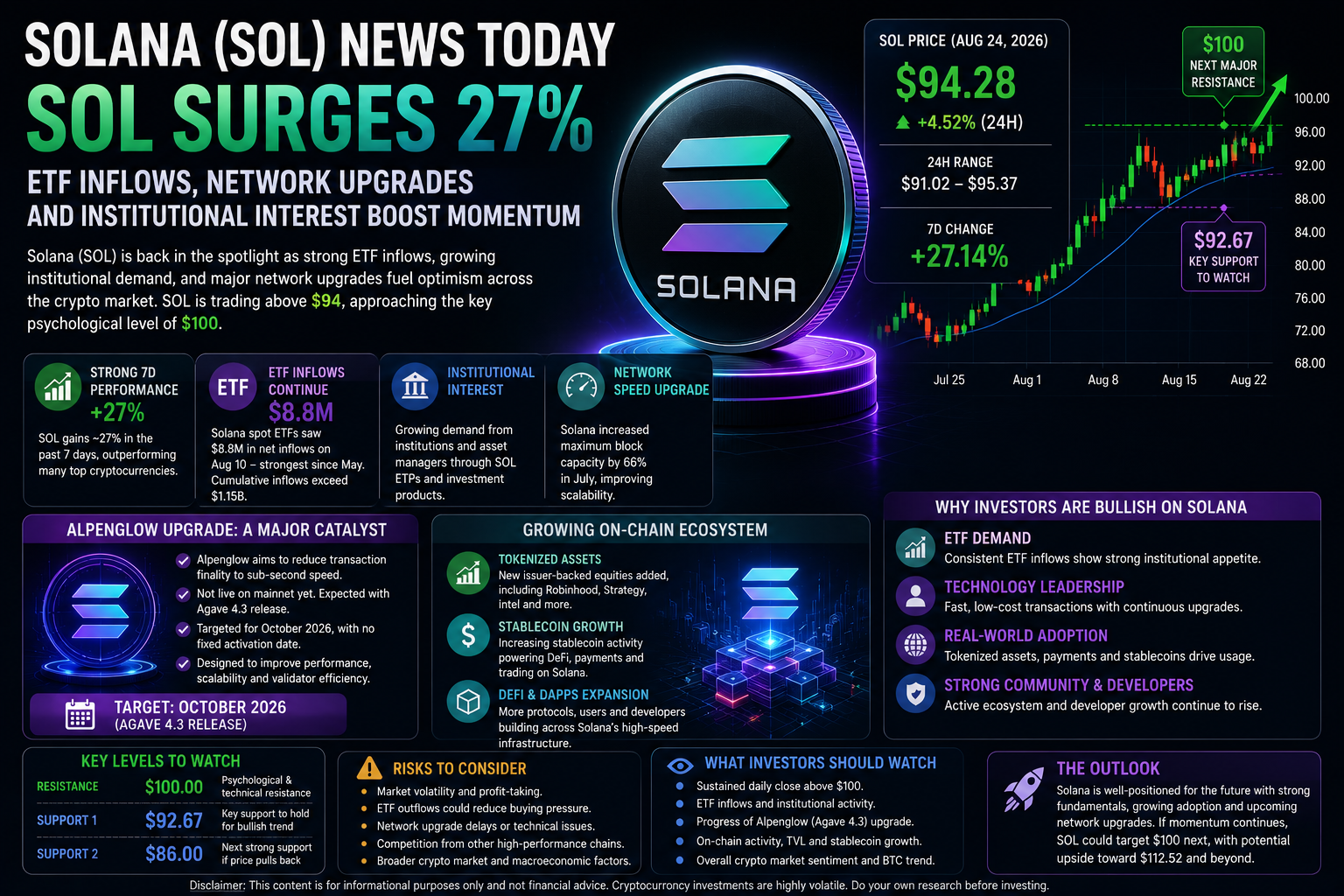
Solana (SOL) is once again attracting significant attention across the cryptocurrency market as renewed ETF demand, network improvements, and growing institutional interest strengthen the blockchain's long-term investment narrative.
Recent market activity has shown SOL outperforming several major cryptocurrencies during periods of renewed risk appetite. On August 22, Solana rose about 4.5% in roughly 19 hours as spot ETF inflows, a recent network speed upgrade, and a broader crypto-market short squeeze supported the move.
At the same time, Solana's ecosystem continues to expand beyond traditional cryptocurrency trading. The network has been adding tokenized equities, stablecoin activity, decentralized finance applications, and other real-world use cases. The Solana Foundation reported that the network increased maximum block capacity by 66% in July while its on-chain equity market added new issuer-backed shares and around-the-clock trading.
Solana ETF Inflows Attract Investors
One of the most important developments for SOL is the continued interest in spot Solana exchange-traded funds.
Solana ETFs have attracted significant cumulative inflows since launching, providing traditional investors with an easier way to gain exposure to SOL without directly managing cryptocurrency wallets.
Recent activity has remained encouraging. Solana spot ETFs recorded $8.8 million in net inflows on August 10, their strongest single-day inflow since May. Cumulative inflows had already exceeded $1.15 billion, according to recent market reporting.
ETF flows are important because they provide a window into institutional and traditional-market demand.
If investors continue allocating money to Solana ETFs, that could create an additional source of demand for SOL. However, ETF inflows can change quickly, so investors should watch the trend over multiple weeks rather than relying on a single day's data.
Why Institutional Interest Matters
Institutional adoption has become an increasingly important part of Solana's growth story.
Traditional financial institutions and investment managers are increasingly exploring cryptocurrency products beyond Bitcoin and Ethereum. Solana's position as one of the largest smart-contract blockchains makes it a natural candidate for institutional exposure.
The growing availability of SOL investment products can potentially broaden the investor base and make Solana more accessible to investors who prefer traditional brokerage accounts.
Institutional demand is also important because it can provide a different source of market activity from retail speculation.
However, institutional participation does not guarantee higher prices. ETF flows can reverse, and broader economic conditions can influence how much capital investors allocate to cryptocurrency.
Alpenglow Remains a Major Solana Catalyst
Solana's technology roadmap is another major factor investors are watching.
The Alpenglow upgrade is designed to improve Solana's consensus mechanism and significantly reduce transaction-finality times. The upgrade aims to make the network more responsive and efficient for applications that require rapid settlement.
However, there is an important update regarding its timing.
Alpenglow did not launch on Solana mainnet in August 2026. The August 17 release was Agave 4.2, while the new consensus system is expected with Agave 4.3. Current reporting identifies October 2026 as the target period for activation, although there is no fixed activation day or block height yet.
This distinction is important for anyone writing about Solana because some earlier reports suggested a faster launch timeline.
What Is the Alpenglow Upgrade?
Alpenglow is one of Solana's most ambitious technical upgrades.
The proposal is designed to change how validators coordinate consensus and how quickly transactions reach finality. The upgrade introduces new components intended to improve the network's performance and reduce confirmation times.
The broader goal is to make Solana more suitable for high-speed financial applications, payments, trading platforms, and other applications where rapid settlement is important.
Solana co-founder Anatoly Yakovenko previously described Alpenglow as an important step in the evolution of the protocol, with the upgrade intended to improve speed, reliability, and transaction finality.
The eventual mainnet deployment will therefore be closely watched by developers, validators, investors, and institutions.
Solana's Network Is Expanding
Solana's investment story is not based only on the SOL token.
The underlying blockchain has developed a broad ecosystem covering decentralized finance, stablecoins, tokenized assets, decentralized exchanges, payments, and consumer applications.
One particularly interesting development is the growth of tokenized real-world assets.
The Solana Foundation reported that its on-chain equity market added new issuer-backed shares and around-the-clock trading during July. It also highlighted the availability of tokenized shares associated with companies including Robinhood, Strategy, and Intel through platforms operating on the network.
If tokenized securities and other real-world assets continue moving onto public blockchains, Solana could potentially benefit from increased network activity.
Solana and Stablecoins
Stablecoins are another important part of the Solana ecosystem.
Stablecoins allow users to hold digital assets designed to track the value of traditional currencies, most commonly the U.S. dollar.
They are widely used for trading, payments, decentralized finance, and transferring value between platforms.
A blockchain that can process large numbers of transactions quickly and at relatively low costs can be attractive for stablecoin applications.
Solana's ongoing focus on speed and scalability therefore gives the network an opportunity to compete for stablecoin activity alongside Ethereum and other blockchain networks.
Solana's Speed Advantage
One of Solana's biggest selling points is its focus on high transaction throughput and relatively low transaction costs.
This differentiates Solana from older blockchain networks that can experience congestion and higher fees during periods of heavy demand.
The network's development roadmap is focused on improving these characteristics even further.
Recent upgrades have already reduced slot times, while future upgrades such as Alpenglow are designed to improve finality and validator coordination. Recent reporting linked a speed upgrade, ETF inflows, and a broader crypto short squeeze to Solana's strong market performance in August.
For investors, the important question is whether these technical improvements translate into sustainable user and developer growth.
The Importance of Network Activity
Price alone does not tell the entire Solana story.
Investors should also look at metrics such as:
Transaction activity
Stablecoin supply
DeFi usage
Total value locked
Developer activity
Tokenized asset activity
ETF inflows
Validator participation
Network fees
Active applications
Strong network activity can provide evidence that people are actually using the blockchain.
However, speculative activity can also temporarily increase transaction numbers, so investors should consider multiple metrics rather than relying on a single indicator.
Solana vs. Ethereum
Solana is often compared with Ethereum because both support smart contracts and decentralized applications.
Ethereum has a larger and more established ecosystem, while Solana emphasizes high throughput and lower transaction costs.
The two networks can therefore compete in areas such as decentralized finance, stablecoins, tokenization, and blockchain-based applications.
However, they can also coexist.
The growth of tokenized assets and stablecoins could potentially create opportunities for multiple blockchain networks rather than requiring a single winner.
What Could Push SOL Higher?
Several factors could support Solana's long-term market outlook.
Stronger ETF Inflows
Continued investment through Solana ETFs could provide additional demand for SOL.
Institutional Adoption
More traditional financial institutions offering Solana-related products could broaden the market.
Alpenglow Deployment
Successful activation of Alpenglow could strengthen Solana's technical proposition.
Growing Tokenization
More stocks, financial products, and real-world assets moving onto Solana could increase network activity.
Stablecoin Growth
Increasing stablecoin usage could create additional demand for Solana infrastructure.
Broader Crypto Market Strength
SOL tends to remain highly sensitive to Bitcoin and overall cryptocurrency-market sentiment.
Risks Facing Solana
Despite its potential, Solana remains a high-risk and highly volatile cryptocurrency.
Market Volatility
SOL can experience significant price movements within short periods.
ETF Outflows
Strong inflows can reverse, reducing institutional buying pressure.
Competition
Ethereum and other high-performance blockchains continue developing their own scaling solutions.
Network Upgrade Risks
Major technical upgrades can experience delays, bugs, or unexpected implementation challenges.
Speculative Activity
Some Solana activity can be driven by speculative trading. A reduction in speculative demand could affect transaction activity and market sentiment.
What Solana Investors Should Watch
Investors following SOL should pay attention to several indicators over the coming months:
Solana ETF inflows and outflows
Progress toward the Alpenglow mainnet activation
Agave 4.3 development
Stablecoin activity
Tokenized asset growth
DeFi activity
Developer adoption
Network transaction activity
Bitcoin's overall direction
Global liquidity and interest-rate expectations
These indicators can provide a more complete picture of Solana than price alone.
Solana's Outlook for the Rest of 2026
Solana enters the second half of 2026 with several major catalysts developing at the same time.
ETF adoption is creating a new channel for institutional exposure. Meanwhile, the network continues expanding into tokenized equities, stablecoins, DeFi, and other applications.
The upcoming Alpenglow upgrade could become one of the most important technical milestones for Solana. If successfully deployed, it could further strengthen the blockchain's position as a high-performance network for financial and consumer applications.
However, investors should not assume that positive fundamentals automatically mean SOL will rise. Cryptocurrency prices remain heavily influenced by Bitcoin, liquidity, investor sentiment, regulation, and broader economic conditions.
Final Thoughts
Solana remains one of the most closely watched blockchain projects in the cryptocurrency market.
Recent ETF inflows, institutional interest, expanding tokenized-asset activity, and continuing network improvements are strengthening the long-term Solana story. The ecosystem is also becoming increasingly diverse, with applications extending beyond trading and speculation.
The upcoming Alpenglow upgrade could be another major milestone. While it has not yet launched on mainnet, current reporting points toward an Agave 4.3 deployment targeted for October 2026.
For investors and crypto enthusiasts, the most important question is whether Solana can convert its technological advantages and growing institutional interest into sustained real-world adoption.
As always, SOL remains a volatile digital asset, and investors should conduct their own research and consider their risk tolerance before making financial decisions.
Frequently Asked Questions
1. What is Solana?
Solana is a high-performance blockchain designed to support smart contracts, decentralized applications, payments, DeFi, stablecoins, and tokenized assets. Its native cryptocurrency is SOL.
2. What is SOL used for?
SOL is used to pay network transaction fees, participate in staking, and interact with applications built on the Solana blockchain.
3. Why is Solana attracting institutional interest?
The availability of Solana ETFs and other investment products has made it easier for traditional investors to gain exposure to SOL. Continued ETF inflows indicate ongoing interest from investors.
4. What is the Alpenglow upgrade?
Alpenglow is a major Solana consensus upgrade designed to improve transaction finality and network performance.
5. Has Alpenglow launched on Solana mainnet?
No. Recent reporting states that Alpenglow was not included in the August Agave 4.2 release. It is expected with Agave 4.3, with October 2026 currently targeted for activation.
6. Are Solana ETFs attracting money?
Yes. Solana ETFs have recorded significant inflows, including an $8.8 million single-day inflow on August 10.
7. Why is Solana important for tokenized assets?
Solana's high-throughput infrastructure makes it suitable for applications that require frequent transactions, including tokenized equities and other real-world assets.
8. Is Solana better than Ethereum?
Neither is universally better. Ethereum has a larger established ecosystem, while Solana focuses heavily on speed, throughput, and low transaction costs.
9. Can SOL rise in 2026?
SOL could rise if institutional demand, network activity, ETF inflows, and broader cryptocurrency-market conditions remain favorable. However, no price increase is guaranteed.
10. Is Solana a safe investment?
Solana is a highly volatile cryptocurrency. It can experience substantial price gains and losses, so investors should consider their financial situation and risk tolerance before investing.