
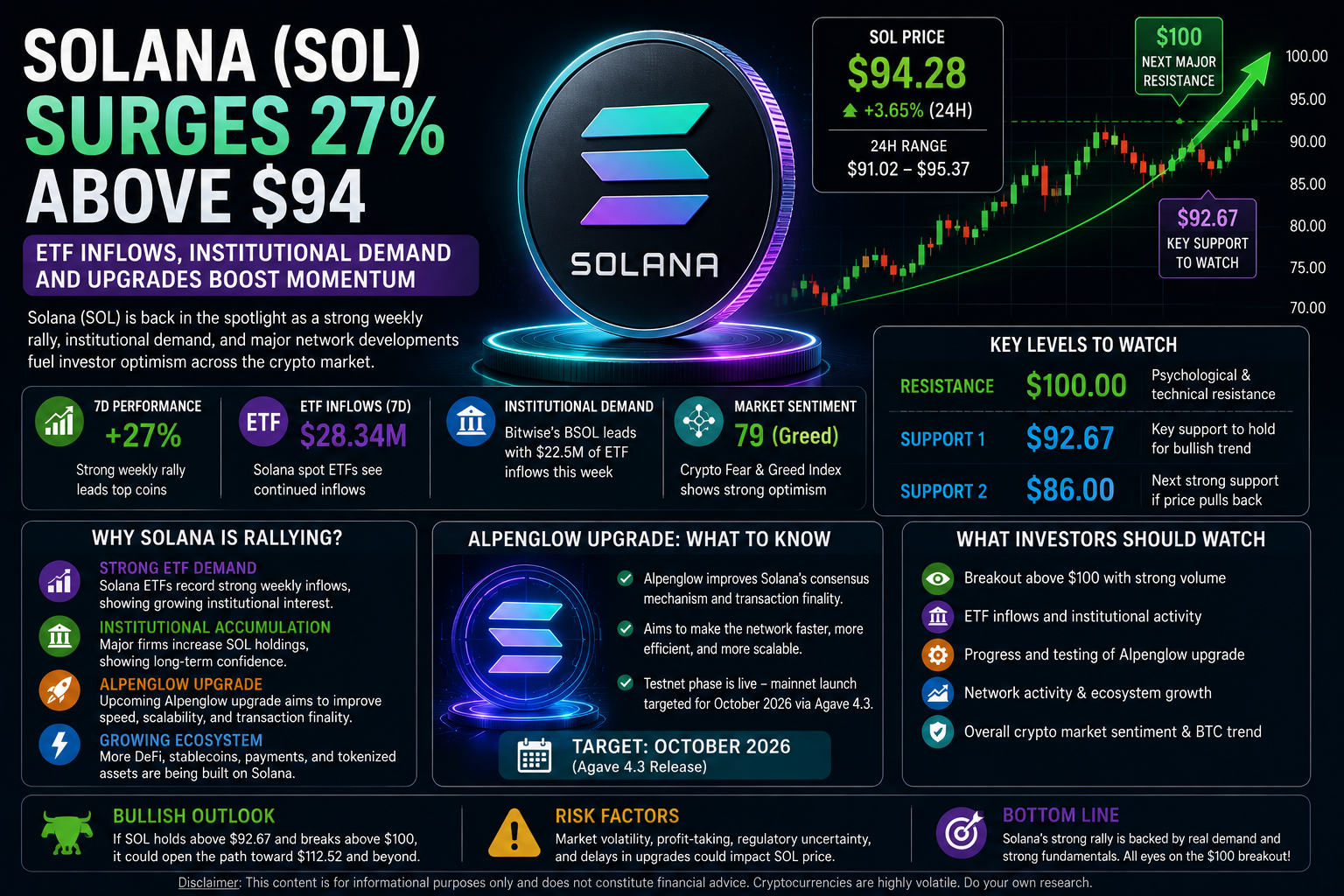
Solana (SOL) is attracting renewed attention in the cryptocurrency market after a strong weekly rally pushed the token above $94 on August 24, 2026. SOL has gained roughly 27% over the past week, while renewed institutional demand, positive ETF flows, and progress on major network proposals have strengthened market sentiment.
The latest rally comes as Solana continues developing its network infrastructure and attracting institutional interest. Investors are now watching whether SOL can break through the psychologically important $100 level and maintain its recent momentum.
Solana Price Rallies Above $94
Solana has experienced a significant recovery in recent days. On August 24, SOL was trading above $94 after gaining approximately 27% over the previous week. The move represents Solana's strongest performance in several weeks and places the cryptocurrency near its highest level in roughly two months.
The rally has also brought SOL closer to the $100 level, which is now an important psychological and technical threshold.
According to recent market analysis, a sustained daily close above $100 could potentially open the door toward the $112.52 area, while a decline below approximately $92.67 could weaken the current bullish structure. These are market-analysis levels rather than guaranteed future prices.
Solana ETF Inflows Strengthen
One of the biggest developments surrounding SOL is renewed demand from Solana-focused exchange-traded funds.
Recent data shows that Solana spot ETFs recorded approximately $28.34 million in net inflows during the latest week, representing continued institutional accumulation. Bitwise's BSOL accounted for approximately $22.5 million of those inflows.
Earlier in August, Solana ETFs also recorded an $8.8 million single-day inflow, their strongest daily inflow since May.
ETF flows are important because they provide an indication of demand from investors using regulated investment products rather than directly purchasing SOL through cryptocurrency exchanges.
If these inflows continue, they could provide additional support for the Solana market.
Institutional Interest in Solana
Institutional adoption has become an increasingly important part of Solana's investment story.
Several investment firms have introduced or expanded Solana-related products, providing traditional investors with easier access to SOL.
Solana's ETF structure has also attracted attention because some products incorporate staking-related features. Staking allows eligible participants to earn rewards for helping secure the network, although the specific structure and risks depend on the investment product.
Recent reports indicate that Solana's combined spot ETF assets have grown significantly since the products launched, although the overall market remains considerably smaller than the Bitcoin ETF market.
The continued flow of institutional capital suggests that Solana is increasingly being considered alongside Bitcoin and Ethereum as a major cryptocurrency investment.
Alpenglow Upgrade Draws Attention
Solana's technology is another major reason investors are watching the network.
The Alpenglow upgrade is designed to improve Solana's consensus mechanism and transaction finality. The upgrade is intended to make the network more responsive and potentially strengthen its position for applications requiring fast settlement.
However, it is important to distinguish between testing and a mainnet launch. Recent reporting says Alpenglow has not yet gone live on Solana's mainnet as of August 2026. The Solana Foundation has targeted October 2026 through the Agave 4.3 release, but there is currently no fixed activation date.
The upgrade is therefore an important upcoming catalyst rather than a completed mainnet change.
Faster Transactions Could Strengthen Solana
Solana has built its reputation around fast and relatively low-cost transactions.
This makes the blockchain attractive for applications involving high transaction volumes, including decentralized exchanges, stablecoins, payments, tokenized assets, and other blockchain applications.
Alpenglow aims to improve transaction finality, potentially making Solana more attractive for applications where speed and predictable settlement are particularly important.
The upgrade could therefore have implications beyond the SOL token itself because improvements to the underlying network can influence developer activity and user adoption.
Solana's Growing On-Chain Ecosystem
Solana's ecosystem continues to expand across several areas.
The blockchain has become an important platform for decentralized finance, stablecoins, tokenized assets, decentralized exchanges, and consumer-focused applications.
Recent reports have highlighted increasing activity in real-world assets and tokenized financial products on Solana. CoinMarketCap's latest Solana update also pointed to a South Korean asset manager testing a tokenized won fund on the network.
This type of activity could become increasingly important if traditional financial institutions continue moving assets onto blockchain networks.
Solana ETFs vs. Bitcoin and Ethereum ETFs
Solana's investment-product market has a potentially important difference from Bitcoin.
Bitcoin does not use staking, while Solana uses proof-of-stake. Some Solana ETF products have been structured to pass staking-related rewards to investors.
This can create an additional source of potential return for investors, although staking involves risks and the exact treatment depends on the specific product.
The staking component has become part of the argument for institutional exposure to SOL, particularly for investors looking for both price exposure and potential network-related yield.
The $100 SOL Level
With SOL now trading above $94, the next major psychological target is $100.
Breaking above $100 could strengthen bullish sentiment, particularly if the move occurs alongside strong trading volume and continued ETF inflows.
However, simply touching $100 would not necessarily confirm a long-term breakout.
Investors may look for SOL to remain above the level rather than briefly move through it and then fall back.
Recent market analysis identifies the $92–$93 area as an important short-term support zone. A sustained move below that area could weaken the current bullish setup.
What Could Push Solana Higher?
Several factors could support SOL's continued recovery.
Continued ETF Inflows
Persistent institutional inflows could provide additional demand for SOL.
Alpenglow Progress
Successful testing and eventual mainnet deployment could strengthen confidence in Solana's technical roadmap.
Growing Network Activity
More stablecoin transactions, decentralized-finance activity, tokenized assets, and consumer applications could increase demand for the network.
Institutional Adoption
Additional investment products and corporate exposure could expand Solana's investor base.
Break Above $100
A sustained move above $100 could attract additional market attention and momentum traders.
Risks Facing Solana
Despite the positive momentum, SOL remains a highly volatile cryptocurrency.
Market Volatility
A rapid 27% weekly increase can be followed by profit-taking or a short-term correction.
Broader Crypto Market Risk
Solana remains closely connected to the overall cryptocurrency market. A major Bitcoin decline could pressure SOL as well.
Upgrade Risk
Major network upgrades can face technical delays or unexpected issues.
Institutional Flow Changes
ETF inflows can change quickly. A reversal in institutional demand could weaken the current bullish momentum.
Speculative Activity
Some Solana activity is connected to highly speculative trading. If speculative demand declines, network activity and transaction fees could also fall.
What Solana Investors Should Watch
As SOL approaches $100, investors and traders may want to monitor:
SOL's ability to remain above $92–$93
A potential breakout above $100
ETF inflows and outflows
Institutional Solana purchases
Alpenglow development
Agave 4.3 progress
Solana network activity
Stablecoin and tokenized-asset growth
Bitcoin's overall direction
Broader cryptocurrency market sentiment
These indicators can help provide context for SOL's price movement, although they cannot predict future prices with certainty.
Final Thoughts
Solana has emerged as one of the strongest-performing major cryptocurrencies in the latest market recovery. SOL has gained roughly 27% over the past week and moved above $94, while ETF inflows and institutional demand have strengthened the investment narrative.
At the same time, Solana's technology roadmap remains an important catalyst. The upcoming Alpenglow upgrade is designed to improve transaction finality and network performance, with mainnet activation currently targeted for October 2026 through the Agave 4.3 release.
The next major test for SOL is the $100 level. A sustained breakout could strengthen bullish sentiment, while a rejection could lead to consolidation or a correction.
As with all cryptocurrencies, Solana remains highly volatile. Investors should evaluate market data, network developments, institutional flows, and their own risk tolerance rather than relying on short-term price predictions.
Frequently Asked Questions
1. What is the latest Solana news?
Solana has rallied approximately 27% over the latest week and is trading above $94, supported by ETF inflows, institutional demand, and positive network developments.
2. Why is Solana price rising?
Recent momentum has been supported by renewed Solana ETF inflows, institutional interest, broader cryptocurrency-market strength, and expectations surrounding upcoming network upgrades.
3. Can Solana reach $100?
SOL is already approaching the $100 psychological level. A sustained move above $100 could strengthen the bullish market structure, but future prices are uncertain.
4. What is the Alpenglow upgrade?
Alpenglow is a major Solana consensus upgrade designed to improve transaction finality and network performance. It is currently being developed and tested rather than being fully live on mainnet.
5. When could Alpenglow launch?
The Solana Foundation has targeted October 2026 through the Agave 4.3 release, although no specific activation date has been fixed.
6. Are Solana ETFs attracting investors?
Yes. Recent Solana spot ETFs recorded approximately $28.34 million in weekly net inflows, indicating continued institutional demand.
7. What is the next important SOL price level?
The $100 level is the major psychological threshold currently being watched. Around $92–$93 is also an important short-term support area according to recent market analysis.
8. Is Solana a good investment?
Solana is a high-volatility digital asset. Whether it is appropriate depends on an investor's objectives, financial circumstances, and risk tolerance.
9. What makes Solana different from Bitcoin?
Bitcoin primarily functions as a decentralized digital asset and store of value, while Solana is a programmable blockchain designed for high-speed applications, smart contracts, decentralized finance, payments, and tokenized assets.
10. What could cause SOL to fall?
A broader crypto-market correction, declining ETF inflows, profit-taking, weaker network activity, or delays with major upgrades could negatively affect SOL.
Short Summary
Solana (SOL) News Today: SOL Surges 27% as ETF Inflows and Network Upgrades Boost Momentum
Solana (SOL) is attracting renewed attention in the cryptocurrency market after a strong weekly rally pushed the token above $94 on August 24, 2026. SOL has gained roughly 27% over the past week, while renewed institutional demand, positive ETF flows, and progress on major network proposals have strengthened market sentiment.
The latest rally comes as Solana continues developing its network infrastructure and attracting institutional interest. Investors are now watching whether SOL can break through the psychologically important $100 level and maintain its recent momentum.
Solana Price Rallies Above $94
Solana has experienced a significant recovery in recent days. On August 24, SOL was trading above $94 after gaining approximately 27% over the previous week. The move represents Solana's strongest performance in several weeks and places the cryptocurrency near its highest level in roughly two months.
The rally has also brought SOL closer to the $100 level, which is now an important psychological and technical threshold.
According to recent market analysis, a sustained daily close above $100 could potentially open the door toward the $112.52 area, while a decline below approximately $92.67 could weaken the current bullish structure. These are market-analysis levels rather than guaranteed future prices.
Solana ETF Inflows Strengthen
One of the biggest developments surrounding SOL is renewed demand from Solana-focused exchange-traded funds.
Recent data shows that Solana spot ETFs recorded approximately $28.34 million in net inflows during the latest week, representing continued institutional accumulation. Bitwise's BSOL accounted for approximately $22.5 million of those inflows.
Earlier in August, Solana ETFs also recorded an $8.8 million single-day inflow, their strongest daily inflow since May.
ETF flows are important because they provide an indication of demand from investors using regulated investment products rather than directly purchasing SOL through cryptocurrency exchanges.
If these inflows continue, they could provide additional support for the Solana market.
Institutional Interest in Solana
Institutional adoption has become an increasingly important part of Solana's investment story.
Several investment firms have introduced or expanded Solana-related products, providing traditional investors with easier access to SOL.
Solana's ETF structure has also attracted attention because some products incorporate staking-related features. Staking allows eligible participants to earn rewards for helping secure the network, although the specific structure and risks depend on the investment product.
Recent reports indicate that Solana's combined spot ETF assets have grown significantly since the products launched, although the overall market remains considerably smaller than the Bitcoin ETF market.
The continued flow of institutional capital suggests that Solana is increasingly being considered alongside Bitcoin and Ethereum as a major cryptocurrency investment.
Alpenglow Upgrade Draws Attention
Solana's technology is another major reason investors are watching the network.
The Alpenglow upgrade is designed to improve Solana's consensus mechanism and transaction finality. The upgrade is intended to make the network more responsive and potentially strengthen its position for applications requiring fast settlement.
However, it is important to distinguish between testing and a mainnet launch. Recent reporting says Alpenglow has not yet gone live on Solana's mainnet as of August 2026. The Solana Foundation has targeted October 2026 through the Agave 4.3 release, but there is currently no fixed activation date.
The upgrade is therefore an important upcoming catalyst rather than a completed mainnet change.
Faster Transactions Could Strengthen Solana
Solana has built its reputation around fast and relatively low-cost transactions.
This makes the blockchain attractive for applications involving high transaction volumes, including decentralized exchanges, stablecoins, payments, tokenized assets, and other blockchain applications.
Alpenglow aims to improve transaction finality, potentially making Solana more attractive for applications where speed and predictable settlement are particularly important.
The upgrade could therefore have implications beyond the SOL token itself because improvements to the underlying network can influence developer activity and user adoption.
Solana's Growing On-Chain Ecosystem
Solana's ecosystem continues to expand across several areas.
The blockchain has become an important platform for decentralized finance, stablecoins, tokenized assets, decentralized exchanges, and consumer-focused applications.
Recent reports have highlighted increasing activity in real-world assets and tokenized financial products on Solana. CoinMarketCap's latest Solana update also pointed to a South Korean asset manager testing a tokenized won fund on the network.
This type of activity could become increasingly important if traditional financial institutions continue moving assets onto blockchain networks.
Solana ETFs vs. Bitcoin and Ethereum ETFs
Solana's investment-product market has a potentially important difference from Bitcoin.
Bitcoin does not use staking, while Solana uses proof-of-stake. Some Solana ETF products have been structured to pass staking-related rewards to investors.
This can create an additional source of potential return for investors, although staking involves risks and the exact treatment depends on the specific product.
The staking component has become part of the argument for institutional exposure to SOL, particularly for investors looking for both price exposure and potential network-related yield.
The $100 SOL Level
With SOL now trading above $94, the next major psychological target is $100.
Breaking above $100 could strengthen bullish sentiment, particularly if the move occurs alongside strong trading volume and continued ETF inflows.
However, simply touching $100 would not necessarily confirm a long-term breakout.
Investors may look for SOL to remain above the level rather than briefly move through it and then fall back.
Recent market analysis identifies the $92–$93 area as an important short-term support zone. A sustained move below that area could weaken the current bullish setup.
What Could Push Solana Higher?
Several factors could support SOL's continued recovery.
Continued ETF Inflows
Persistent institutional inflows could provide additional demand for SOL.
Alpenglow Progress
Successful testing and eventual mainnet deployment could strengthen confidence in Solana's technical roadmap.
Growing Network Activity
More stablecoin transactions, decentralized-finance activity, tokenized assets, and consumer applications could increase demand for the network.
Institutional Adoption
Additional investment products and corporate exposure could expand Solana's investor base.
Break Above $100
A sustained move above $100 could attract additional market attention and momentum traders.
Risks Facing Solana
Despite the positive momentum, SOL remains a highly volatile cryptocurrency.
Market Volatility
A rapid 27% weekly increase can be followed by profit-taking or a short-term correction.
Broader Crypto Market Risk
Solana remains closely connected to the overall cryptocurrency market. A major Bitcoin decline could pressure SOL as well.
Upgrade Risk
Major network upgrades can face technical delays or unexpected issues.
Institutional Flow Changes
ETF inflows can change quickly. A reversal in institutional demand could weaken the current bullish momentum.
Speculative Activity
Some Solana activity is connected to highly speculative trading. If speculative demand declines, network activity and transaction fees could also fall.
What Solana Investors Should Watch
As SOL approaches $100, investors and traders may want to monitor:
SOL's ability to remain above $92–$93
A potential breakout above $100
ETF inflows and outflows
Institutional Solana purchases
Alpenglow development
Agave 4.3 progress
Solana network activity
Stablecoin and tokenized-asset growth
Bitcoin's overall direction
Broader cryptocurrency market sentiment
These indicators can help provide context for SOL's price movement, although they cannot predict future prices with certainty.
Final Thoughts
Solana has emerged as one of the strongest-performing major cryptocurrencies in the latest market recovery. SOL has gained roughly 27% over the past week and moved above $94, while ETF inflows and institutional demand have strengthened the investment narrative.
At the same time, Solana's technology roadmap remains an important catalyst. The upcoming Alpenglow upgrade is designed to improve transaction finality and network performance, with mainnet activation currently targeted for October 2026 through the Agave 4.3 release.
The next major test for SOL is the $100 level. A sustained breakout could strengthen bullish sentiment, while a rejection could lead to consolidation or a correction.
As with all cryptocurrencies, Solana remains highly volatile. Investors should evaluate market data, network developments, institutional flows, and their own risk tolerance rather than relying on short-term price predictions.
Frequently Asked Questions
1. What is the latest Solana news?
Solana has rallied approximately 27% over the latest week and is trading above $94, supported by ETF inflows, institutional demand, and positive network developments.
2. Why is Solana price rising?
Recent momentum has been supported by renewed Solana ETF inflows, institutional interest, broader cryptocurrency-market strength, and expectations surrounding upcoming network upgrades.
3. Can Solana reach $100?
SOL is already approaching the $100 psychological level. A sustained move above $100 could strengthen the bullish market structure, but future prices are uncertain.
4. What is the Alpenglow upgrade?
Alpenglow is a major Solana consensus upgrade designed to improve transaction finality and network performance. It is currently being developed and tested rather than being fully live on mainnet.
5. When could Alpenglow launch?
The Solana Foundation has targeted October 2026 through the Agave 4.3 release, although no specific activation date has been fixed.
6. Are Solana ETFs attracting investors?
Yes. Recent Solana spot ETFs recorded approximately $28.34 million in weekly net inflows, indicating continued institutional demand.
7. What is the next important SOL price level?
The $100 level is the major psychological threshold currently being watched. Around $92–$93 is also an important short-term support area according to recent market analysis.
8. Is Solana a good investment?
Solana is a high-volatility digital asset. Whether it is appropriate depends on an investor's objectives, financial circumstances, and risk tolerance.
9. What makes Solana different from Bitcoin?
Bitcoin primarily functions as a decentralized digital asset and store of value, while Solana is a programmable blockchain designed for high-speed applications, smart contracts, decentralized finance, payments, and tokenized assets.
10. What could cause SOL to fall?
A broader crypto-market correction, declining ETF inflows, profit-taking, weaker network activity, or delays with major upgrades could negatively affect SOL.