
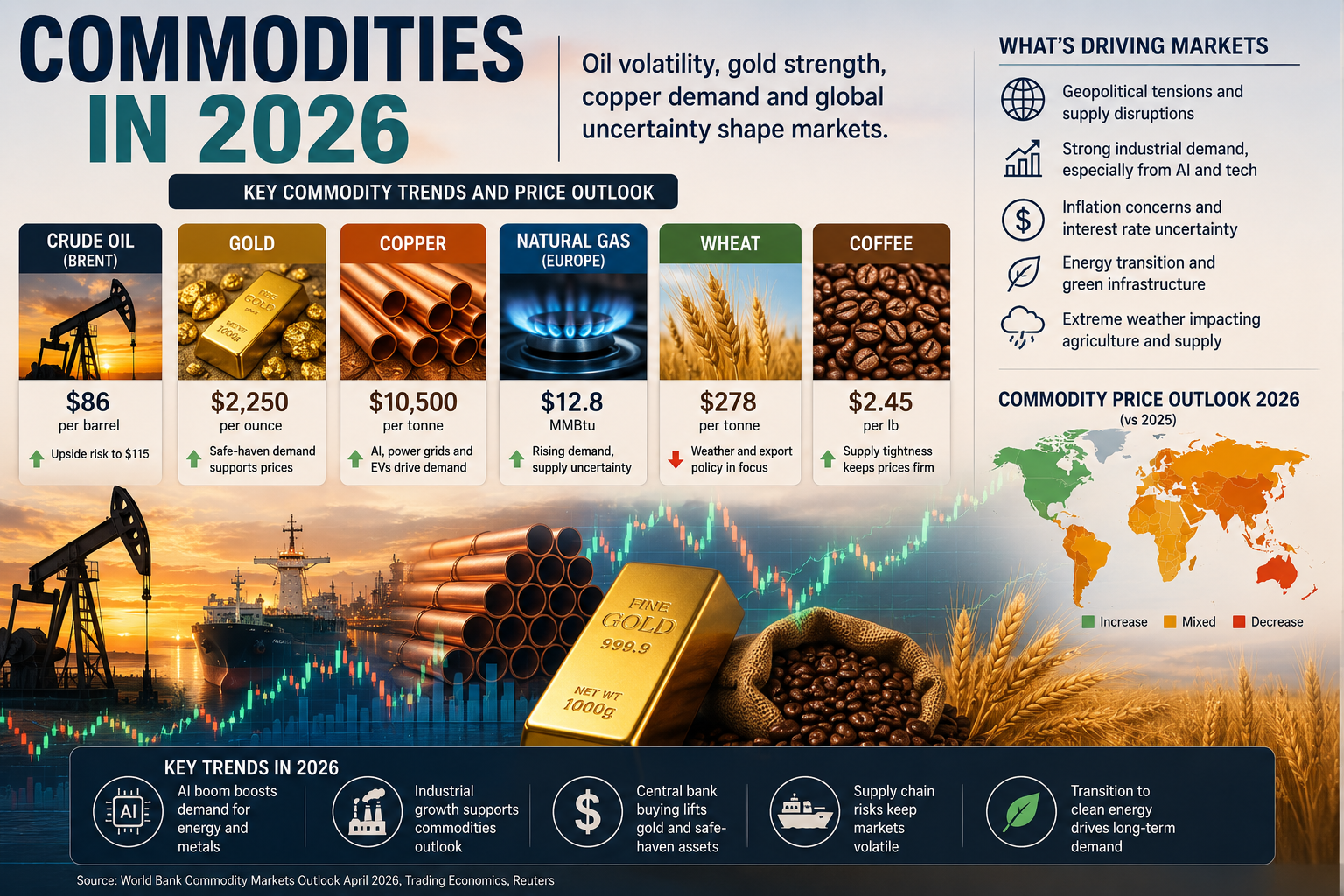
Commodity markets are playing an increasingly important role in the global economy in 2026. Oil, gold, copper, natural gas, agricultural products and other raw materials are responding to a combination of supply disruptions, geopolitical tensions, industrial demand and changing investment trends.
The outlook has changed significantly during the year. The World Bank's April 2026 Commodity Markets Outlook projected overall commodity prices to rise 16% in 2026, largely because of higher energy and fertilizer prices and record prices for several metals.
For investors and businesses, the commodity market matters because changes in raw-material prices can affect inflation, manufacturing costs, transportation, corporate profits and consumer prices.
Oil Remains the Most Closely Watched Commodity
Oil continues to be one of the most important commodities for the global economy.
Crude oil prices can influence transportation, manufacturing, electricity generation and household costs. When oil becomes more expensive, businesses often face higher operating expenses, which can eventually affect prices for consumers.
The World Bank's April outlook projected Brent crude to average around $86 a barrel in 2026, although it warned that a prolonged disruption could push the annual average as high as $115.
Recent market developments have shown just how sensitive oil remains to geopolitical events and disruptions to major shipping routes.
Gold Remains a Major Safe-Haven Asset
Gold has become one of the most closely watched commodities in 2026.
Investors often turn to gold during periods of economic uncertainty, geopolitical tension or financial-market volatility.
The World Bank's April 2026 outlook projected precious-metals prices to increase significantly during the year, supported by continued demand for safe-haven assets.
Gold also benefits from demand from central banks and investors looking for diversification.
However, gold prices can be volatile. Changes in interest rates, bond yields, the U.S. dollar and investor sentiment can all influence demand.
Copper Is Becoming a Strategic Commodity
Copper is increasingly important because of its role in electrification, renewable energy, power networks and artificial intelligence infrastructure.
The metal is used in:
Data centers
Electric vehicles
Power grids
Renewable-energy systems
Construction
Electronics
Industrial machinery
Recent market developments have highlighted tight copper supply. Reuters reported that BHP's latest results were strongly supported by copper, with copper becoming a larger contributor to its earnings than iron ore. The company also expects substantial growth in copper production over the coming decade.
Copper's importance could increase further as data centers and electricity infrastructure expand.
AI Is Changing Commodity Demand
Artificial intelligence is not just a technology story. It is increasingly becoming a commodities story.
AI data centers require enormous amounts of electricity and infrastructure. Building this infrastructure requires metals such as copper and aluminum, as well as large quantities of energy.
The World Bank has specifically highlighted growing AI-related electricity demand as a factor that could support prices for energy and base metals such as aluminum and copper.
This creates an unusual connection between technology companies and commodity markets.
A surge in AI investment can eventually increase demand for physical resources.
Natural Gas Faces Changing Demand
Natural gas markets are also experiencing major changes.
Gas is used for electricity generation, heating and industrial production. Demand can increase when power consumption rises or when countries need backup generation for renewable energy.
The World Bank's latest commodity data showed European natural-gas prices rising sharply in July even as the broader energy index declined.
This highlights how different commodities can move in opposite directions at the same time.
Agricultural Commodities Remain Important
Food commodities are another major part of the global commodity market.
Prices for wheat, corn, soybeans, coffee, cocoa and other agricultural products depend on:
Weather
Crop yields
Fertilizer costs
Energy prices
Trade policies
Transportation
Global demand
Agricultural markets can be particularly sensitive to extreme weather.
A poor harvest in one major producing region can quickly affect global supply and prices.
Fertilizer Prices Affect Food Markets
Fertilizers are closely connected to both commodity and agricultural markets.
Farmers need fertilizer to maintain crop yields, but fertilizer production itself depends on energy and raw materials.
The World Bank projected fertilizer prices to rise sharply in 2026, particularly because of higher input costs and supply disruptions.
Higher fertilizer prices can increase farmers' production costs and potentially contribute to higher food prices.
Geopolitics Can Move Commodity Prices Quickly
Commodity markets are particularly sensitive to geopolitical events because physical supply chains can be disrupted.
Oil is the clearest example.
When important production facilities or shipping routes face disruptions, traders immediately reassess global supply.
This can cause prices to move rapidly even before a physical shortage becomes apparent.
The same principle can apply to metals, agricultural products and natural gas.
Commodity Supply Is a Major Investment Theme
Investors are increasingly paying attention to the difference between commodity demand and future supply.
Some commodities require years of investment before new production can come online.
Mining projects, for example, can take many years to develop because companies need to obtain permits, build infrastructure and invest billions of dollars.
This creates potential supply constraints when demand grows faster than new production.
Copper is a good example because electrification and AI infrastructure are increasing demand while new mine development remains challenging.
Commodities and Inflation
Commodity prices are closely connected to inflation.
Higher energy and food prices can increase the cost of living for households.
Businesses can also face higher costs for transportation, electricity, raw materials and manufacturing.
This can create a chain reaction:
Higher commodity prices → higher production costs → higher consumer prices → greater inflation pressure.
Central banks therefore pay close attention to commodity-price movements when assessing inflation.
Commodity Markets and Interest Rates
Interest rates can also influence commodities.
When interest rates and bond yields rise, some investors may move money toward interest-bearing assets.
Higher rates can therefore reduce the attractiveness of commodities that do not generate interest income.
However, commodities can also benefit from inflation concerns or geopolitical uncertainty.
This means the relationship between interest rates and commodity prices is not always straightforward.
The Role of the U.S. Dollar
Most major commodities are priced internationally in U.S. dollars.
As a result, changes in the dollar can affect commodity prices.
A stronger dollar can make commodities more expensive for buyers using other currencies, potentially reducing demand.
A weaker dollar can have the opposite effect.
For investors outside the United States, currency movements therefore become another factor when evaluating commodity investments.
Commodity-Linked Stocks Are Getting Attention
Investors who want exposure to commodities do not necessarily need to buy physical raw materials.
They can also gain exposure through companies involved in:
Mining
Oil production
Natural gas
Agriculture
Metals processing
Energy infrastructure
Recent strength in copper has already benefited major mining companies. BHP's 2026 results showed how powerful commodity prices can be for corporate earnings.
However, commodity-linked stocks also carry company-specific risks, including debt, operating costs, management decisions and production problems.
Commodities Are Becoming More Connected
One of the biggest trends in 2026 is that commodity markets are becoming increasingly interconnected.
For example:
AI → more data centers → more electricity demand → more infrastructure investment → more copper and aluminum demand.
Another chain can be:
Higher oil prices → higher transportation costs → higher production costs → inflation pressure.
And:
Higher fertilizer prices → higher farming costs → potential food-price pressure.
Understanding these connections is becoming increasingly important for investors.
What Investors Should Watch
Several factors could influence commodity markets during the rest of 2026.
Oil Supply
Production levels and shipping disruptions will remain important.
Copper Demand
AI, electrification and renewable-energy investment could support long-term copper demand.
Gold Investment
Central-bank purchases, geopolitical uncertainty and interest-rate expectations could influence gold.
Agricultural Supply
Weather and crop conditions remain major risks.
Energy Prices
Oil, natural gas and electricity costs can affect the entire global economy.
Global Growth
A slowdown in economic activity could reduce demand for industrial commodities.
The Outlook for Commodities
Commodity markets could remain volatile through the remainder of 2026.
The World Bank's latest commodity outlook highlights a major shift from its earlier forecasts. Its October 2025 outlook had projected overall commodity prices to decline in 2026, but its April 2026 outlook subsequently projected a 16% increase because of the energy shock and other supply disruptions.
This demonstrates how quickly commodity forecasts can change.
Supply disruptions, geopolitical developments and unexpected changes in demand can dramatically alter market conditions.
Final Thoughts
Commodities remain at the center of the global economy in 2026.
Oil influences transportation and inflation. Gold remains a major safe-haven asset. Copper is becoming increasingly important for AI, electricity networks and electrification. Agricultural commodities remain essential for global food supplies.
For investors, the biggest opportunity may come from understanding the long-term forces behind commodity demand rather than simply following short-term price movements.
Technology, energy transition, infrastructure investment and global economic growth are all changing the commodity landscape.
As these trends continue, commodities are likely to remain one of the most important markets to watch in 2026 and beyond.
FAQs
What are commodities?
Commodities are basic physical goods that can be traded, including oil, natural gas, gold, copper, wheat, coffee and other raw materials.
Which commodities are most important in 2026?
Oil, gold, copper, natural gas, agricultural products and fertilizer are among the commodities receiving significant investor attention.
Why is copper important for AI?
Data centers and electricity infrastructure require large amounts of copper for power systems, wiring and equipment.
Why does oil affect inflation?
Oil is used throughout transportation and industry. Higher oil prices can therefore increase costs across the economy.
Is gold still a safe-haven asset?
Gold remains widely used by investors as a potential store of value during periods of uncertainty, although its price can still be volatile.
What affects commodity prices?
Supply, demand, weather, geopolitical events, economic growth, currencies, interest rates and government policies can all affect commodity prices.
Why are commodity markets volatile?
Commodity supply can be disrupted quickly by weather, geopolitical events, production problems or changes in transportation.
Can investors buy commodities?
Investors can gain commodity exposure through physical assets, futures, ETFs, commodity funds and shares of commodity-producing companies, depending on the market and their risk tolerance.