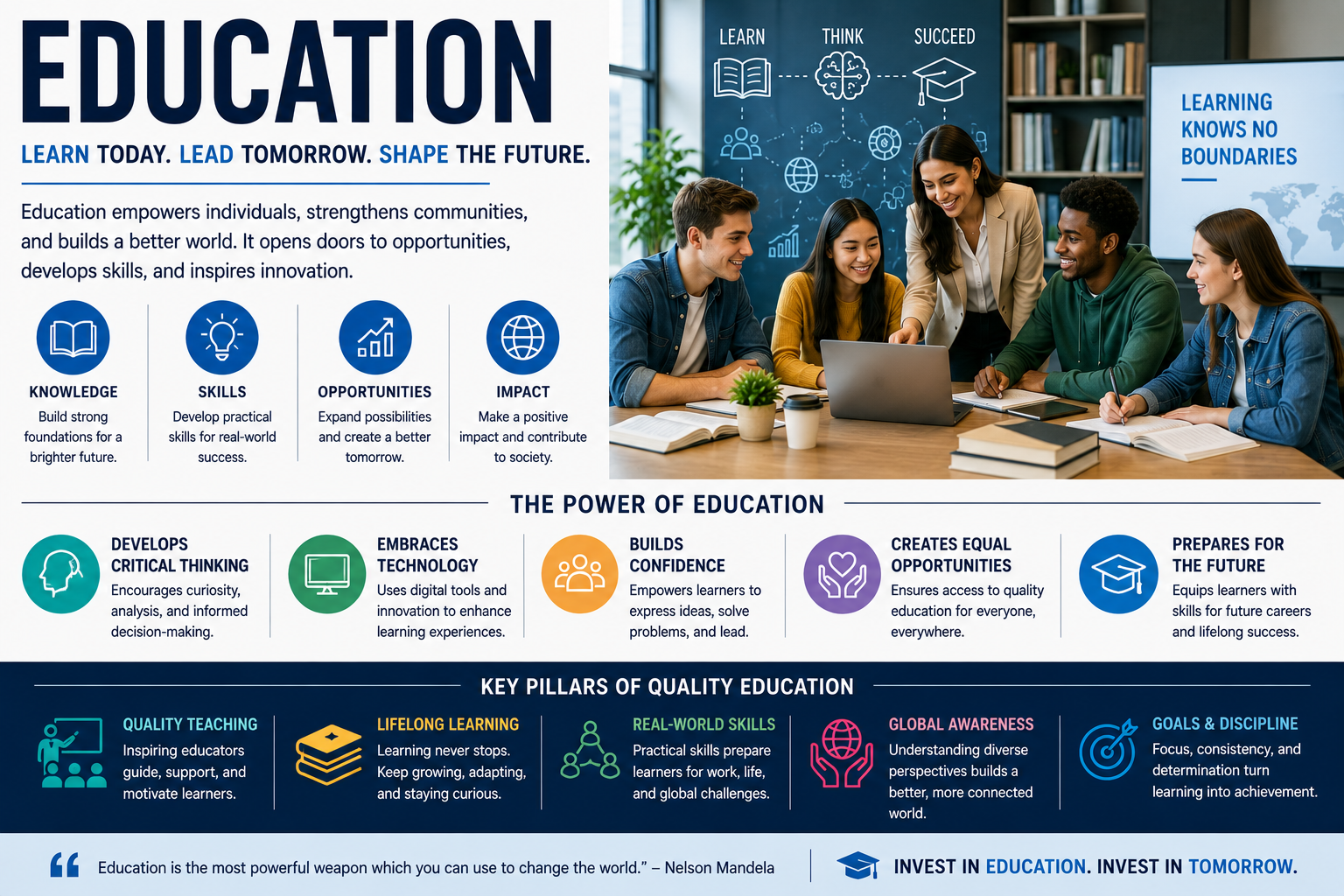
Education has always played an important role in helping people understand the world around them. It provides knowledge, develops skills, and creates opportunities for personal and professional growth.
However, the purpose of education is changing as technology and society evolve.
Students today are preparing for a future in which many jobs, technologies, and industries may look very different from those of previous generations. Artificial intelligence, automation, digital communication, and global connectivity are transforming workplaces and creating demand for new skills.
As a result, education must prepare learners not only to pass examinations but also to think critically, adapt to change, communicate effectively, and continue learning throughout their lives.
Building Strong Foundations
Early education provides the foundation for future learning.
Basic literacy, numeracy, communication, and social skills influence how effectively students progress through later stages of education.
A strong educational foundation helps learners develop confidence and curiosity. When students understand fundamental concepts, they are better prepared to explore more complex subjects and develop specialized knowledge.
Teachers and educational institutions play an important role in creating environments where students feel encouraged to ask questions and explore ideas.
Developing Critical Thinking
One of the most valuable outcomes of education is the ability to think critically.
Critical thinking helps students evaluate information, identify assumptions, compare different perspectives, and make informed decisions.
This skill has become increasingly important in a world filled with information.
Students encounter information through websites, social media, videos, advertisements, and other digital platforms. Education can help them distinguish reliable information from misleading or inaccurate claims.
Rather than simply memorizing information, learners should be encouraged to understand why something is true, how evidence supports an idea, and whether alternative explanations exist.
The Role of Technology in Education
Technology has transformed the educational experience.
Digital classrooms, online courses, educational applications, interactive platforms, and virtual resources can make learning more accessible and flexible.
Students can access educational materials from different locations and learn at different speeds.
Technology can also support teachers by providing tools for collaboration, assessment, research, and personalized learning.
However, technology should support education rather than replace effective teaching.
Human interaction remains important. Teachers provide guidance, encouragement, context, and mentorship that technology alone cannot fully replicate.
The most effective educational environments combine digital tools with strong teaching and meaningful human relationships.
Artificial Intelligence and the Future of Learning
Artificial intelligence is becoming an increasingly important part of education.
AI-powered tools can assist students with research, explanations, language learning, personalized practice, and other educational activities.
Teachers can also use AI-supported tools to assist with lesson planning, administrative tasks, and educational content.
At the same time, AI introduces important questions about academic integrity, privacy, accuracy, and responsible use.
Students need to understand that technology should support learning rather than replace their own thinking.
Education systems will increasingly need to teach students how to use AI responsibly, evaluate its output, and combine technological tools with independent reasoning.
Developing Practical Skills
Academic knowledge is important, but education should also prepare students for practical challenges.
Communication, teamwork, problem-solving, leadership, creativity, digital literacy, and time management can be valuable across many careers.
Students can develop these skills through projects, presentations, group activities, internships, competitions, volunteering, and practical assignments.
Learning by doing can help students understand how theoretical concepts apply to real-world situations.
Lifelong Learning
Education should not end when students graduate.
The rapid pace of technological and economic change means professionals may need to develop new skills throughout their careers.
Lifelong learning can include professional certifications, online courses, workshops, industry training, independent study, and practical experience.
Continuous learning allows people to remain adaptable and discover new opportunities.
It can also provide a pathway for professionals who want to change careers or develop expertise in emerging fields.
Education and Career Opportunities
Education can have a significant influence on career opportunities.
Different professions require different levels and types of education, but employers increasingly value a combination of knowledge, practical skills, adaptability, and experience.
Students should therefore think about how their education connects to their future goals.
Career awareness can help learners understand different industries and identify the skills required for particular professions.
Internships, career counseling, mentorship, and exposure to working professionals can help students make more informed decisions.
The Importance of Teachers
Technology may change how education is delivered, but teachers remain central to the learning process.
Effective teachers do more than present information. They encourage curiosity, identify individual learning needs, provide feedback, and help students develop confidence.
Teachers can also serve as mentors.
A supportive teacher can influence a student's attitude toward learning and help them recognize abilities they may not have recognized themselves.
Investing in teacher training and professional development is therefore essential for improving educational outcomes.
Creating Inclusive Learning Environments
Quality education should provide opportunities for learners with different backgrounds, abilities, learning styles, and circumstances.
Inclusive education recognizes that students do not all learn in the same way.
Some students may benefit from visual resources, others from practical activities, discussion, or additional support.
Educational institutions can create more effective learning environments by providing appropriate resources and ensuring that students feel respected and included.
When learners feel comfortable participating, they are more likely to engage actively in their education.
Education and Personal Development
Education contributes to more than academic and professional development.
Learning can help people develop confidence, discipline, communication skills, creativity, and a broader understanding of society.
Students who are encouraged to explore different subjects and perspectives can develop greater awareness of the world around them.
Education can also teach important values such as responsibility, collaboration, respect, and perseverance.
These qualities can influence both professional success and personal relationships.
The Role of Parents and Communities
Education is not the responsibility of schools alone.
Parents, families, communities, and organizations can all contribute to a student's development.
A supportive home environment can encourage curiosity and consistent learning.
Communities can provide libraries, educational programs, mentorship opportunities, workshops, and extracurricular activities.
When schools, families, and communities work together, students can receive broader support throughout their educational journey.
Preparing Students for the Future
Future education will need to prepare learners for jobs and challenges that may not yet exist.
This requires greater emphasis on adaptability.
Students should learn how to learn.
Instead of focusing exclusively on memorizing information, educational systems can encourage problem-solving, experimentation, creativity, research, collaboration, and independent thinking.
Digital literacy will also remain important as technology becomes increasingly integrated into professional and personal life.
The ability to understand and use technology responsibly will likely become a fundamental component of education.
Education and Innovation
Educational institutions can also become environments for innovation.
Students should be encouraged to ask questions, develop ideas, conduct experiments, and create solutions.
Entrepreneurship programs, technology projects, research initiatives, and creative activities can help learners turn ideas into practical outcomes.
Innovation in education does not necessarily require advanced technology. It can also involve new teaching approaches, collaborative learning, project-based education, and greater connections between classrooms and real-world challenges.
Access to Quality Education
Access remains one of the most important challenges facing education systems around the world.
Economic circumstances, geographic location, infrastructure, technology access, and other factors can influence educational opportunities.
Digital learning has the potential to expand access by allowing students to reach educational resources beyond their immediate communities.
However, access to technology itself is not enough.
Learners also need reliable connectivity, appropriate devices, quality educational content, trained teachers, and supportive learning environments.
Improving access to education requires attention to all of these factors.
Measuring Educational Success
Educational success should not be measured only through examination results.
Grades can provide useful information, but education also aims to develop skills, confidence, creativity, critical thinking, and the ability to apply knowledge.
Schools and educators can consider multiple indicators of learning, including student engagement, practical projects, collaboration, problem-solving, and personal development.
A broader approach can provide a more complete picture of whether students are prepared for future opportunities.
The Future of Education
The future of education will likely combine traditional teaching with increasingly sophisticated digital tools.
Artificial intelligence, personalized learning platforms, virtual resources, online education, and interactive technologies may provide new ways for students to learn.
However, the fundamental purpose of education will remain the same: helping people develop knowledge, skills, confidence, and the ability to contribute meaningfully to society.
The strongest education systems will likely be those that balance technology with human connection, academic knowledge with practical skills, and individual development with broader social responsibility.
Conclusion
Education is one of the most powerful tools for personal and societal development.
It provides knowledge, builds skills, creates opportunities, and helps individuals understand and respond to a changing world.
As technology continues to transform workplaces and society, education must evolve as well. Students need opportunities to develop critical thinking, communication, creativity, digital literacy, and practical problem-solving skills alongside traditional academic knowledge.
Lifelong learning will also become increasingly important as professionals adapt to new technologies and changing career requirements.
Ultimately, education is not simply about preparing students for their next examination or first job. It is about preparing people for a lifetime of learning, adaptation, and opportunity.
By investing in quality teaching, accessible learning, technology, practical skills, and inclusive educational environments, societies can help individuals reach their potential and create a stronger foundation for the future.