
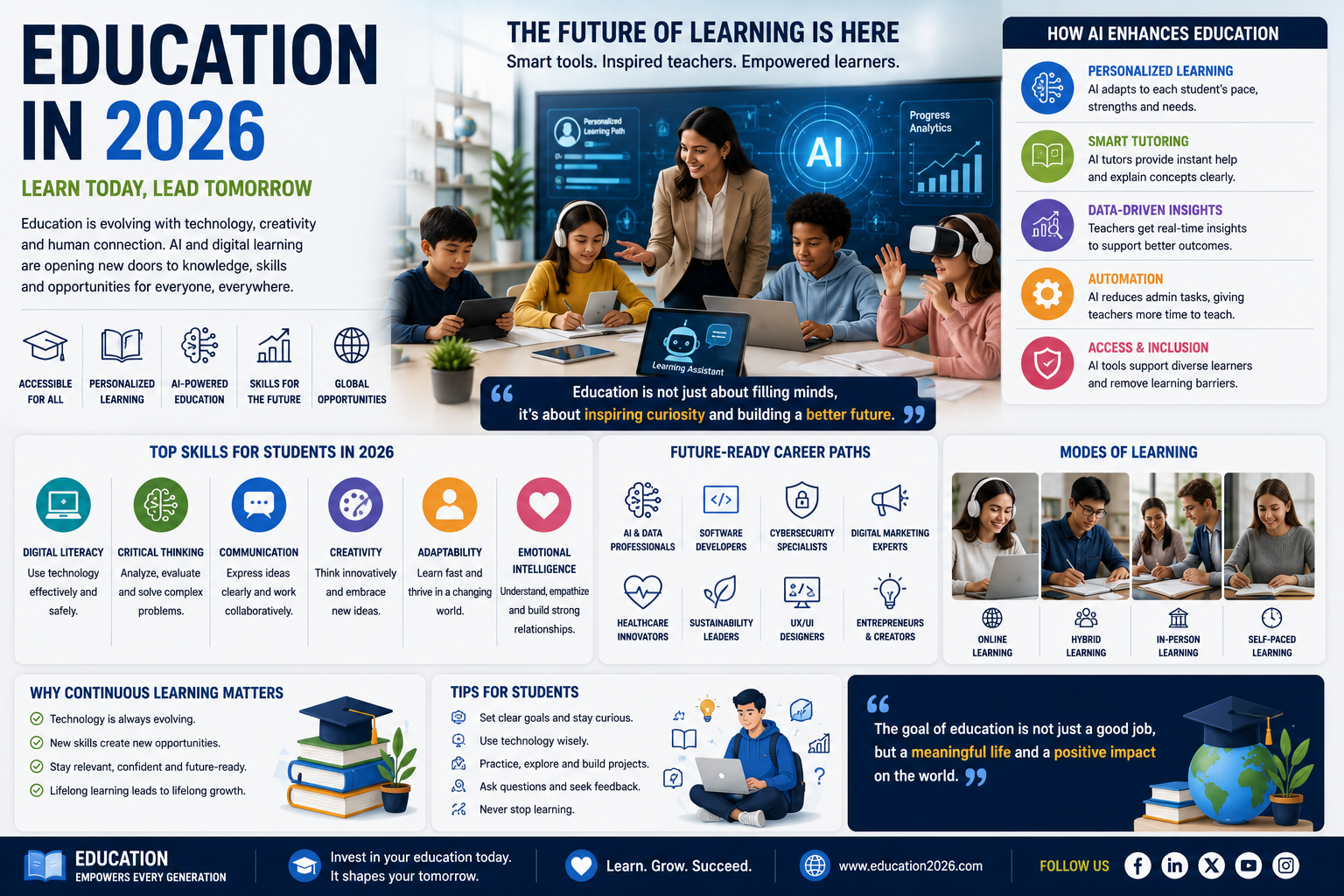
Education is entering a new era. Technology, artificial intelligence, online learning, digital classrooms, and changing workforce requirements are transforming how people learn and how educational institutions operate.
For decades, education followed a relatively traditional model: students attended classes, studied textbooks, completed assignments, and prepared for examinations. While these fundamentals remain important, modern education is becoming more flexible, personalized, technology-driven, and focused on lifelong learning.
In 2026, the biggest question is no longer simply what students should learn. It is also how they can continue learning as technology and careers evolve.
The Changing Education Landscape
Education is no longer limited to a classroom.
Students can now access educational resources through:
Online courses
Digital libraries
Educational applications
Video lessons
Virtual classrooms
Interactive learning platforms
AI-powered learning tools
Professional certification programs
This provides learners with more choices than ever before.
A student can learn a programming language online, study a foreign language through an application, take university courses remotely, or develop professional skills through specialized training.
The result is a more flexible education environment.
Artificial Intelligence in Education
Artificial intelligence is becoming one of the most significant technologies influencing education.
AI can support students and educators in many ways, including:
Personalized learning
Research assistance
Writing support
Language learning
Practice exercises
Feedback
Lesson planning
Educational content creation
Data analysis
One of the biggest opportunities is personalization.
Traditional classrooms often require teachers to deliver the same lesson to many students at the same time.
AI-powered systems can potentially provide additional explanations, practice questions, and learning resources based on an individual student's needs.
However, AI should complement teachers rather than replace them.
Teachers provide mentorship, context, encouragement, classroom management, and human understanding that technology cannot fully reproduce.
Personalized Learning
Students don't all learn at the same speed or in the same way.
Some may understand a concept immediately.
Others may need additional examples or practice.
Personalized learning aims to recognize these differences.
Digital platforms can potentially identify areas where students are struggling and recommend additional exercises.
For example, a student learning mathematics might receive more practice in algebra while progressing faster through topics they already understand.
This can make learning more responsive to individual needs.
The Role of Teachers
Technology is changing education, but teachers remain central to the learning process.
A great teacher does more than deliver information.
Teachers can:
Motivate students
Explain difficult concepts
Encourage curiosity
Provide feedback
Identify learning challenges
Develop confidence
Support collaboration
Guide students toward their goals
AI can provide information quickly, but teachers help students understand how to use that information responsibly.
The future classroom is therefore likely to involve teachers and technology working together.
Digital Literacy Becomes Essential
Digital literacy is increasingly important for students of every age.
Students need to understand how to:
Use digital tools
Search for reliable information
Protect personal data
Evaluate online sources
Communicate professionally
Use AI responsibly
Recognize misinformation
Knowing how to operate a device is no longer enough.
Students need to understand the digital environment around them.
AI Literacy for Students
As AI becomes more common, students will need to understand both its capabilities and limitations.
AI can generate convincing information that may still contain errors.
Students therefore need critical-thinking skills.
They should learn to ask:
Where did this information come from?
Can it be verified?
Is the source reliable?
Does the answer make sense?
How should AI be used ethically?
These skills are becoming increasingly important because access to information is no longer the primary challenge.
The challenge is determining which information can be trusted.
Online Education
Online education has become an important part of modern learning.
It can provide students with access to courses and instructors beyond their geographic location.
Online learning can be particularly useful for:
Working professionals
University students
Career changers
Entrepreneurs
Remote learners
People seeking specialized skills
It also allows learners to study at different times and speeds.
However, online learning requires discipline.
Students need to manage their time, complete assignments, participate actively, and maintain motivation without the physical structure of a traditional classroom.
Hybrid Education
Hybrid education combines online and in-person learning.
Students may attend physical classes while using digital platforms for assignments, resources, discussions, and additional practice.
This model can combine the strengths of both approaches.
In-person education provides social interaction and direct teacher support.
Digital learning provides flexibility and access to additional resources.
The combination can create a more adaptable educational experience.
Skills-Based Education
Employers increasingly value practical skills alongside formal qualifications.
A degree can provide valuable knowledge, but students may also need skills they can demonstrate through real projects.
These can include:
Data analysis
Programming
Digital marketing
Communication
Project management
Design
Financial analysis
AI tools
Cybersecurity
Entrepreneurship
Skills-based education encourages students to demonstrate what they can actually do.
The Importance of Critical Thinking
Critical thinking is one of the most valuable educational skills in the AI era.
Students have access to enormous amounts of information.
They need to learn how to analyze it.
Critical thinking involves:
Questioning assumptions
Comparing evidence
Identifying bias
Evaluating sources
Considering alternatives
Drawing logical conclusions
These skills remain valuable even as technology changes.
Creativity in Education
Education shouldn't focus exclusively on memorization.
Creativity helps students develop new ideas and solve unfamiliar problems.
Creative learning can involve:
Writing
Art
Design
Entrepreneurship
Research
Engineering
Storytelling
Innovation
AI can assist with creative work, but students still need to develop their own ideas and perspectives.
The ability to combine technology with original thinking may become increasingly valuable.
Education and Career Preparation
Education and employment are becoming more closely connected.
Students increasingly want to know how their education will prepare them for future careers.
Educational institutions can help by connecting learning with practical experiences.
This can include:
Internships
Projects
Industry partnerships
Career counseling
Professional certifications
Entrepreneurship programs
Work-based learning
The goal is to help students transition from education into meaningful employment or entrepreneurship.
Lifelong Learning
Education no longer ends when someone graduates.
Technology and industries change too quickly for a single qualification to remain sufficient throughout an entire career.
Professionals may need to learn new skills several times during their working lives.
Lifelong learning can include:
Online courses
Certifications
Workshops
Professional training
Mentorship
Industry conferences
Self-directed study
A commitment to continuous learning can help professionals remain adaptable.
Education and the Future of Work
The relationship between education and employment is becoming particularly important because AI and automation are changing jobs.
Some repetitive tasks may become automated.
New roles may emerge.
Existing jobs may require new skills.
For example, marketers may need AI literacy.
Finance professionals may need stronger data skills.
Designers may use generative tools.
Managers may need to understand digital collaboration.
Education therefore needs to prepare students not only for today's jobs but also for changing career environments.
STEM and Emerging Technologies
Science, technology, engineering, and mathematics remain important areas of education.
Growing technology fields include:
Artificial intelligence
Robotics
Data science
Biotechnology
Renewable energy
Cybersecurity
Advanced computing
Students interested in these areas can develop strong foundations through mathematics, science, programming, and analytical thinking.
At the same time, technology careers require more than technical skills.
Communication, teamwork, creativity, and leadership are also important.
The Value of Soft Skills
Soft skills are sometimes underestimated in education.
Yet employers frequently value abilities such as:
Communication
Teamwork
Leadership
Adaptability
Problem-solving
Time management
Emotional intelligence
These skills can help professionals work effectively with colleagues and customers.
As AI automates more technical and repetitive tasks, uniquely human capabilities may become even more valuable.
Entrepreneurship Education
Education can also prepare students to create opportunities rather than simply search for jobs.
Entrepreneurship programs can teach:
Business planning
Marketing
Finance
Sales
Product development
Customer research
Leadership
Students can learn how to identify problems and develop solutions.
This mindset can be useful even for people who don't become entrepreneurs because many organizations value employees who take initiative and think creatively.
Accessibility and Education
Technology can also help make education more accessible.
Digital resources can reach learners who may have difficulty accessing traditional educational institutions because of location, schedule, or other circumstances.
Online education can connect students with instructors and resources from around the world.
However, digital access itself remains important.
Students need reliable internet connections, appropriate devices, and suitable learning environments to benefit fully from digital education.
The Role of Parents and Families
Education doesn't happen only at school.
Parents and families can support learning by encouraging:
Reading
Curiosity
Healthy study habits
Responsible technology use
Questions
Creativity
Independent thinking
Children who develop curiosity early can become more motivated lifelong learners.
The objective isn't simply achieving good grades.
It is developing the ability to learn independently.
The Future Classroom
The classroom of the future may look very different from the traditional classroom.
Students could use:
AI learning assistants
Interactive digital content
Virtual simulations
Personalized learning platforms
Collaborative online tools
Real-time analytics
However, the classroom will still need human connection.
Teachers and students will continue to communicate, collaborate, discuss ideas, and solve problems together.
Technology can make learning more powerful, but relationships remain an important part of education.
Education and Responsible AI
As schools and universities adopt AI tools, responsible use will become increasingly important.
Students should understand that AI should be used as a learning aid rather than a substitute for thinking.
For example, instead of asking AI to complete an assignment without understanding it, students can use AI to:
Explain difficult concepts
Generate practice questions
Provide alternative examples
Review ideas
Identify areas for further study
This approach can encourage learning while maintaining academic integrity.
The Future of Education
The future of education is likely to become increasingly personalized, flexible, digital, and skills-focused.
AI will continue to influence how students learn and how teachers work.
Online education will provide greater access to specialized knowledge.
Professional training will become increasingly important as careers evolve.
At the same time, foundational skills such as reading, writing, mathematics, critical thinking, communication, and creativity will remain essential.
Technology changes quickly.
Strong learning foundations remain valuable.
Final Thoughts
Education in 2026 is about preparing people for a world that continues to change.
AI and digital technologies are creating new possibilities, but education should not become entirely technology-driven.
The strongest educational systems will combine technology with excellent teachers, personalized learning, critical thinking, creativity, practical skills, and human connection.
Students need more than information.
They need the ability to ask questions, evaluate evidence, solve problems, communicate ideas, collaborate with others, and continue learning throughout their lives.
The future belongs to people who can adapt.
And education's most important role may be to help people develop exactly that ability.
Learn today. Adapt tomorrow. Keep growing for the future.