Artificial intelligence is entering a new phase in 2026. Businesses are no longer using AI only to generate text, summarize documents, or answer customer questions. A more advanced form of artificial intelligence is beginning to take action on behalf of organizations.
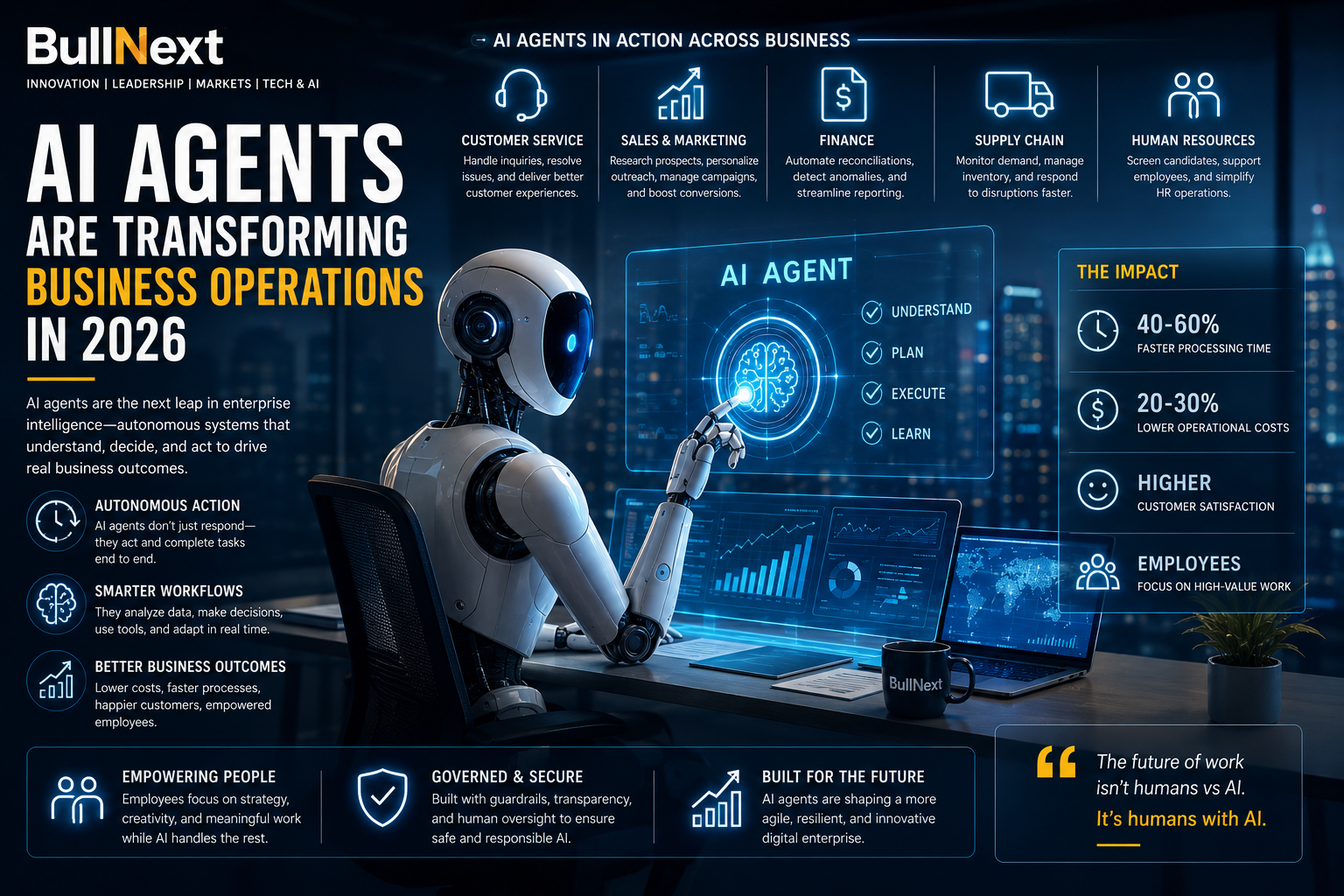
AI agents are emerging as digital systems capable of understanding objectives, analyzing information, making decisions, using software tools, and completing multi-step tasks. Instead of simply responding to instructions, these systems can work through processes from beginning to end with varying levels of human supervision.
This shift could have a major impact on how companies operate. From customer service and sales to finance, marketing, human resources, and supply-chain management, AI agents are creating opportunities to automate complex workflows while allowing employees to focus on higher-value responsibilities.
What Are AI Agents?
Traditional AI applications generally respond to a specific request. A user asks a question, generates content, analyzes data, or performs another defined task.
AI agents operate differently.
An AI agent can receive a broader objective and determine the steps required to achieve it. It can gather information, interact with digital tools, evaluate results, and adjust its approach when necessary.
For example, a traditional AI chatbot might answer a customer's question about an order. An AI agent could potentially check the order status, review shipping information, determine whether a delay has occurred, communicate with the customer, and initiate an approved resolution.
This ability to connect multiple actions makes AI agents particularly valuable for businesses with repetitive and process-heavy operations.
Why Businesses Are Paying Attention
Companies are under constant pressure to increase productivity while controlling costs. At the same time, customers expect faster responses and more personalized experiences.
Traditional automation can solve some of these challenges, but it often depends on predefined rules. When a situation changes, employees may need to intervene manually.
AI agents can introduce greater flexibility.
They can interpret unstructured information, adapt to changing circumstances, and make decisions based on predefined business rules and available data.
This does not mean that every business process should become autonomous. Instead, companies can identify specific workflows where AI agents can safely handle routine tasks while employees remain responsible for important decisions.
The result could be a hybrid operating model in which people and AI systems work together.
AI Agents in Customer Service
Customer service is one of the clearest areas where AI agents could create value.
Businesses receive thousands of customer inquiries involving orders, payments, subscriptions, product information, technical problems, and account management.
A basic chatbot can provide predefined answers. An AI agent can potentially handle a much broader workflow.
For example, if a customer reports a missing shipment, an agent could identify the customer's account, check the order, examine shipping information, determine whether the package qualifies for a replacement, and initiate the appropriate process.
Human employees could then focus on complex complaints, sensitive cases, and situations requiring judgment.
This could reduce response times while allowing customer-service teams to spend more time on issues where human interaction matters most.
Transforming Sales and Marketing
Sales teams spend significant amounts of time researching prospects, updating customer relationship management systems, preparing follow-ups, and analyzing potential opportunities.
AI agents can help automate many of these activities.
A sales agent could research a prospect using approved information sources, summarize relevant business developments, prepare a personalized outreach draft, update internal records, and remind a salesperson about the next step.
Marketing teams can similarly use AI agents to monitor campaign performance, identify unusual changes, analyze audience behavior, and suggest adjustments.
The important difference is that agents can connect multiple tasks rather than simply generating individual pieces of content.
Human marketers and sales professionals can remain responsible for brand strategy, relationships, messaging, and final approvals.
AI Agents in Finance
Finance departments are another potential area of transformation.
Financial teams regularly process invoices, reconcile transactions, monitor expenses, prepare reports, and identify anomalies.
AI agents can assist with these workflows by gathering relevant information from approved systems, comparing records, identifying discrepancies, and preparing reports for human review.
For example, an agent could identify an unusual expense pattern and automatically assemble the relevant transactions and supporting information for a finance professional.
This approach can reduce manual administrative work while improving the speed at which financial teams identify potential problems.
However, financial controls remain essential. Businesses should establish clear approval limits and prevent autonomous systems from making high-impact financial decisions without appropriate oversight.
Supply Chains Become More Responsive
Supply-chain management involves thousands of variables, including inventory, transportation, suppliers, demand, pricing, and delivery schedules.
AI agents can continuously monitor these variables and help organizations respond to changes.
Suppose demand for a product unexpectedly increases. An AI system could identify the change, review inventory levels, evaluate supplier availability, and alert the appropriate team.
More advanced systems could recommend alternative suppliers, adjust forecasts, or prepare purchase orders for approval.
This could make supply chains more responsive and reduce the amount of time employees spend monitoring routine changes.
The real advantage is not simply automation. It is the ability to connect information across multiple systems and turn that information into coordinated action.
Human Employees Will Still Matter
The rise of AI agents does not mean businesses will eliminate human workers.
Instead, the nature of many jobs could change.
Employees may spend less time performing repetitive administrative tasks and more time solving complex problems, building relationships, making strategic decisions, and developing creative ideas.
For managers, this creates a new responsibility: deciding which tasks should be delegated to AI and which should remain firmly under human control.
The best organizations will likely treat AI agents as digital teammates rather than unrestricted replacements for employees.
The Importance of AI Governance
Greater autonomy also creates greater responsibility.
Companies need strong governance frameworks before allowing AI agents to perform important tasks.
Businesses should define what an agent is allowed to access, which actions require approval, what information it can use, and how its decisions are recorded.
Security is equally important. An AI agent connected to business systems could potentially access sensitive information or trigger important actions. Poorly configured permissions could therefore create significant operational and cybersecurity risks.
Organizations should use permission controls, audit logs, monitoring systems, human approval mechanisms, and regular testing.
The objective should be controlled autonomy rather than unlimited autonomy.
Building an AI-Agent Strategy
Businesses do not need to deploy dozens of AI agents immediately.
A better approach is to start with a clearly defined workflow.
Companies can identify repetitive processes that consume significant employee time and have measurable outcomes. Customer inquiries, internal reporting, document processing, sales research, and operational monitoring may provide suitable starting points.
After selecting a workflow, the organization can measure performance before and after implementation.
Important metrics may include time saved, processing speed, error rates, customer satisfaction, employee productivity, and operating costs.
This allows leadership teams to determine whether the technology is actually producing business value.
The New Digital Workforce
AI agents could eventually become a standard part of the digital workforce.
Instead of thinking about AI as a single software product, companies may increasingly manage collections of specialized agents. One could focus on customer service, another on finance, another on sales research, and another on operational monitoring.
These systems could potentially coordinate with one another while employees oversee the broader business strategy.
Such an environment would create a fundamentally different model of enterprise software.
Traditional software waits for employees to use it. AI-agent systems could increasingly work alongside employees, identify tasks, take approved actions, and report results.
That transition could become one of the most significant changes in business technology during the second half of the decade.
What Businesses Should Do Next
The companies most likely to benefit from AI agents will not necessarily be those that adopt the technology fastest. They will be the companies that implement it thoughtfully.
Organizations should begin by identifying real operational problems rather than searching for reasons to use AI.
They should establish strong data foundations, define clear objectives, train employees, introduce appropriate security controls, and maintain human oversight for important decisions.
AI agents should be evaluated based on measurable outcomes rather than excitement around the technology.
When implemented correctly, they can reduce repetitive workloads, improve responsiveness, and help employees focus on activities that require creativity and judgment.
The Future of Business Operations
AI agents represent an important evolution in enterprise technology.
The first wave of business AI focused heavily on generating information. The next wave is increasingly focused on acting on that information.
That distinction could reshape how organizations operate.
Businesses may move from employees manually coordinating hundreds of small tasks toward teams supported by intelligent digital systems capable of handling routine workflows continuously.
Yet technology alone will not determine the outcome. Successful organizations will combine AI capabilities with responsible governance, skilled employees, strong leadership, and clear business objectives.
In 2026, the question is no longer simply whether businesses should use artificial intelligence. The more important question is where AI can safely take action, create measurable value, and help people work more effectively.
The companies that answer that question strategically could gain a significant advantage as the AI-powered business environment continues to evolve.
Artificial intelligence is entering a new phase in 2026. Businesses are no longer using AI only to generate text, summarize documents, or answer customer questions. A more advanced form of artificial intelligence is beginning to take action on behalf of organizations.
AI agents are emerging as digital systems capable of understanding objectives, analyzing information, making decisions, using software tools, and completing multi-step tasks. Instead of simply responding to instructions, these systems can work through processes from beginning to end with varying levels of human supervision.
This shift could have a major impact on how companies operate. From customer service and sales to finance, marketing, human resources, and supply-chain management, AI agents are creating opportunities to automate complex workflows while allowing employees to focus on higher-value responsibilities.
What Are AI Agents?
Traditional AI applications generally respond to a specific request. A user asks a question, generates content, analyzes data, or performs another defined task.
AI agents operate differently.
An AI agent can receive a broader objective and determine the steps required to achieve it. It can gather information, interact with digital tools, evaluate results, and adjust its approach when necessary.
For example, a traditional AI chatbot might answer a customer's question about an order. An AI agent could potentially check the order status, review shipping information, determine whether a delay has occurred, communicate with the customer, and initiate an approved resolution.
This ability to connect multiple actions makes AI agents particularly valuable for businesses with repetitive and process-heavy operations.
Why Businesses Are Paying Attention
Companies are under constant pressure to increase productivity while controlling costs. At the same time, customers expect faster responses and more personalized experiences.
Traditional automation can solve some of these challenges, but it often depends on predefined rules. When a situation changes, employees may need to intervene manually.
AI agents can introduce greater flexibility.
They can interpret unstructured information, adapt to changing circumstances, and make decisions based on predefined business rules and available data.
This does not mean that every business process should become autonomous. Instead, companies can identify specific workflows where AI agents can safely handle routine tasks while employees remain responsible for important decisions.
The result could be a hybrid operating model in which people and AI systems work together.
AI Agents in Customer Service
Customer service is one of the clearest areas where AI agents could create value.
Businesses receive thousands of customer inquiries involving orders, payments, subscriptions, product information, technical problems, and account management.
A basic chatbot can provide predefined answers. An AI agent can potentially handle a much broader workflow.
For example, if a customer reports a missing shipment, an agent could identify the customer's account, check the order, examine shipping information, determine whether the package qualifies for a replacement, and initiate the appropriate process.
Human employees could then focus on complex complaints, sensitive cases, and situations requiring judgment.
This could reduce response times while allowing customer-service teams to spend more time on issues where human interaction matters most.
Transforming Sales and Marketing
Sales teams spend significant amounts of time researching prospects, updating customer relationship management systems, preparing follow-ups, and analyzing potential opportunities.
AI agents can help automate many of these activities.
A sales agent could research a prospect using approved information sources, summarize relevant business developments, prepare a personalized outreach draft, update internal records, and remind a salesperson about the next step.
Marketing teams can similarly use AI agents to monitor campaign performance, identify unusual changes, analyze audience behavior, and suggest adjustments.
The important difference is that agents can connect multiple tasks rather than simply generating individual pieces of content.
Human marketers and sales professionals can remain responsible for brand strategy, relationships, messaging, and final approvals.
AI Agents in Finance
Finance departments are another potential area of transformation.
Financial teams regularly process invoices, reconcile transactions, monitor expenses, prepare reports, and identify anomalies.
AI agents can assist with these workflows by gathering relevant information from approved systems, comparing records, identifying discrepancies, and preparing reports for human review.
For example, an agent could identify an unusual expense pattern and automatically assemble the relevant transactions and supporting information for a finance professional.
This approach can reduce manual administrative work while improving the speed at which financial teams identify potential problems.
However, financial controls remain essential. Businesses should establish clear approval limits and prevent autonomous systems from making high-impact financial decisions without appropriate oversight.
Supply Chains Become More Responsive
Supply-chain management involves thousands of variables, including inventory, transportation, suppliers, demand, pricing, and delivery schedules.
AI agents can continuously monitor these variables and help organizations respond to changes.
Suppose demand for a product unexpectedly increases. An AI system could identify the change, review inventory levels, evaluate supplier availability, and alert the appropriate team.
More advanced systems could recommend alternative suppliers, adjust forecasts, or prepare purchase orders for approval.
This could make supply chains more responsive and reduce the amount of time employees spend monitoring routine changes.
The real advantage is not simply automation. It is the ability to connect information across multiple systems and turn that information into coordinated action.
Human Employees Will Still Matter
The rise of AI agents does not mean businesses will eliminate human workers.
Instead, the nature of many jobs could change.
Employees may spend less time performing repetitive administrative tasks and more time solving complex problems, building relationships, making strategic decisions, and developing creative ideas.
For managers, this creates a new responsibility: deciding which tasks should be delegated to AI and which should remain firmly under human control.
The best organizations will likely treat AI agents as digital teammates rather than unrestricted replacements for employees.
The Importance of AI Governance
Greater autonomy also creates greater responsibility.
Companies need strong governance frameworks before allowing AI agents to perform important tasks.
Businesses should define what an agent is allowed to access, which actions require approval, what information it can use, and how its decisions are recorded.
Security is equally important. An AI agent connected to business systems could potentially access sensitive information or trigger important actions. Poorly configured permissions could therefore create significant operational and cybersecurity risks.
Organizations should use permission controls, audit logs, monitoring systems, human approval mechanisms, and regular testing.
The objective should be controlled autonomy rather than unlimited autonomy.
Building an AI-Agent Strategy
Businesses do not need to deploy dozens of AI agents immediately.
A better approach is to start with a clearly defined workflow.
Companies can identify repetitive processes that consume significant employee time and have measurable outcomes. Customer inquiries, internal reporting, document processing, sales research, and operational monitoring may provide suitable starting points.
After selecting a workflow, the organization can measure performance before and after implementation.
Important metrics may include time saved, processing speed, error rates, customer satisfaction, employee productivity, and operating costs.
This allows leadership teams to determine whether the technology is actually producing business value.
The New Digital Workforce
AI agents could eventually become a standard part of the digital workforce.
Instead of thinking about AI as a single software product, companies may increasingly manage collections of specialized agents. One could focus on customer service, another on finance, another on sales research, and another on operational monitoring.
These systems could potentially coordinate with one another while employees oversee the broader business strategy.
Such an environment would create a fundamentally different model of enterprise software.
Traditional software waits for employees to use it. AI-agent systems could increasingly work alongside employees, identify tasks, take approved actions, and report results.
That transition could become one of the most significant changes in business technology during the second half of the decade.
What Businesses Should Do Next
The companies most likely to benefit from AI agents will not necessarily be those that adopt the technology fastest. They will be the companies that implement it thoughtfully.
Organizations should begin by identifying real operational problems rather than searching for reasons to use AI.
They should establish strong data foundations, define clear objectives, train employees, introduce appropriate security controls, and maintain human oversight for important decisions.
AI agents should be evaluated based on measurable outcomes rather than excitement around the technology.
When implemented correctly, they can reduce repetitive workloads, improve responsiveness, and help employees focus on activities that require creativity and judgment.
The Future of Business Operations
AI agents represent an important evolution in enterprise technology.
The first wave of business AI focused heavily on generating information. The next wave is increasingly focused on acting on that information.
That distinction could reshape how organizations operate.
Businesses may move from employees manually coordinating hundreds of small tasks toward teams supported by intelligent digital systems capable of handling routine workflows continuously.
Yet technology alone will not determine the outcome. Successful organizations will combine AI capabilities with responsible governance, skilled employees, strong leadership, and clear business objectives.
In 2026, the question is no longer simply whether businesses should use artificial intelligence. The more important question is where AI can safely take action, create measurable value, and help people work more effectively.
The companies that answer that question strategically could gain a significant advantage as the AI-powered business environment continues to evolve.