
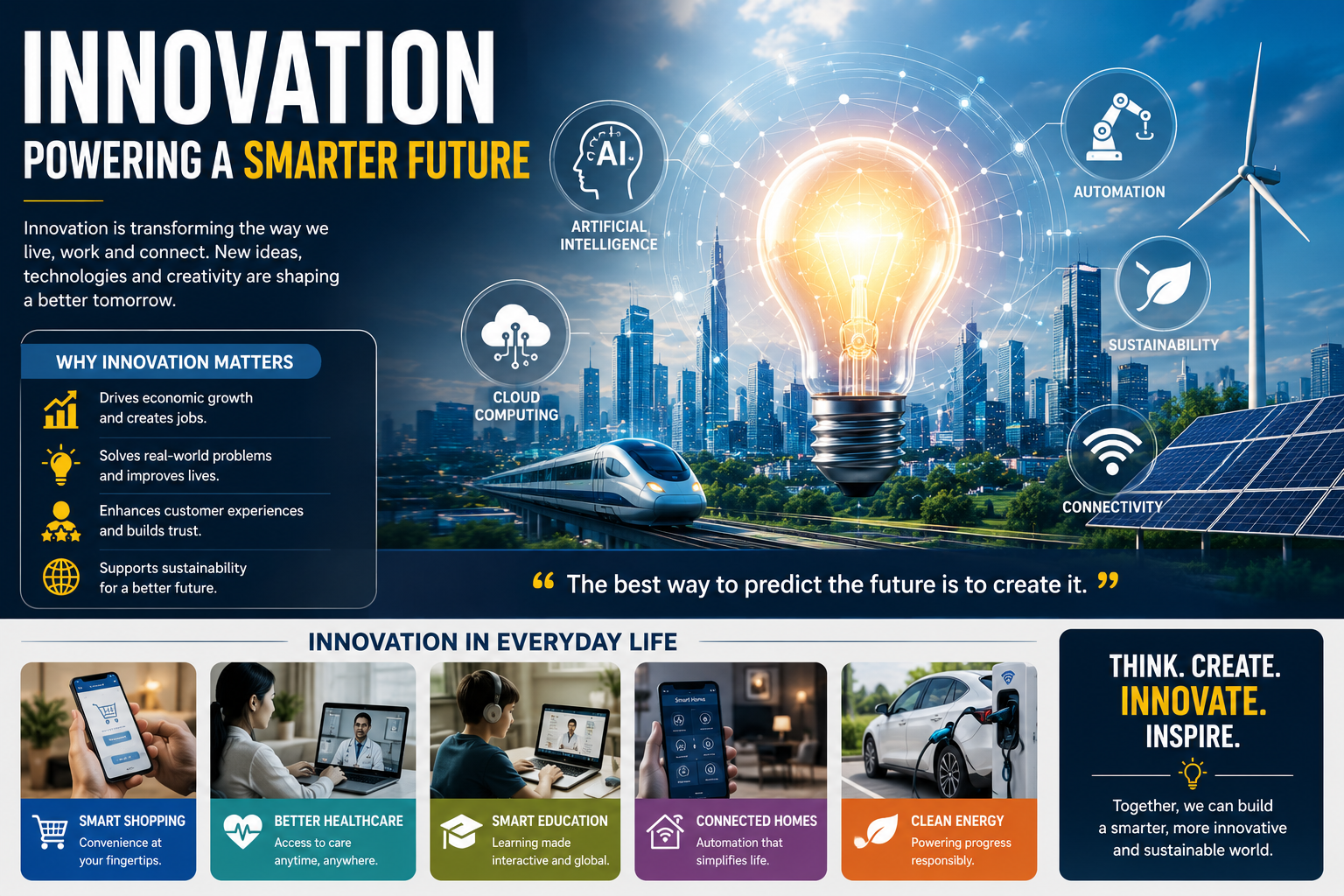
Innovation has always been the driving force behind human progress. From the invention of the internet to the rise of artificial intelligence, every major breakthrough has transformed the way people live, work, and communicate. In 2026, innovation is advancing at an unprecedented pace, creating new opportunities for businesses while improving everyday life across the globe.
Organizations that embrace innovation are becoming more competitive, productive, and adaptable in an increasingly digital economy. At the same time, consumers benefit from smarter technologies, improved healthcare, faster communication, and more sustainable solutions.
This article explores how innovation is shaping industries, the technologies driving change, and why continuous innovation is essential for long-term success.
What Is Innovation?
Innovation is the process of developing new ideas, products, services, or methods that create value. It is not limited to groundbreaking inventions; it also includes improving existing systems to make them more efficient, accessible, and effective.
Innovation can take many forms, including:
New technologies
Improved business models
Digital transformation
Sustainable solutions
Product development
Process optimization
Customer experience improvements
Companies that innovate consistently are often better prepared to respond to changing market demands.
Artificial Intelligence Is Accelerating Innovation
Artificial intelligence (AI) has become one of the most influential drivers of innovation.
Businesses use AI to:
Automate repetitive tasks
Analyze large datasets
Improve customer support
Personalize user experiences
Optimize operations
Enhance cybersecurity
AI-powered tools help organizations make faster decisions while increasing productivity and reducing operational costs.
Digital Transformation Across Industries
Digital transformation continues to reshape industries worldwide.
Organizations are adopting technologies such as:
Cloud computing
Internet of Things (IoT)
Automation
Data analytics
Digital collaboration platforms
These technologies improve efficiency, reduce costs, and enable businesses to serve customers more effectively.
Industries experiencing rapid digital transformation include healthcare, finance, education, manufacturing, and retail.
Innovation in Healthcare
Healthcare innovation is improving patient outcomes while making medical services more accessible.
Recent advancements include:
Telemedicine
Wearable health devices
AI-assisted diagnostics
Robotic surgery
Personalized medicine
Remote patient monitoring
These innovations help healthcare professionals provide faster, more accurate, and more efficient care.
Sustainable Innovation
Sustainability has become a major focus for innovators.
Businesses are investing in environmentally friendly solutions such as:
Renewable energy
Electric vehicles
Sustainable packaging
Energy-efficient buildings
Circular economy initiatives
Sustainable innovation benefits both businesses and the environment by reducing waste and improving resource efficiency.
Innovation in Education
Technology has transformed learning experiences.
Educational innovation includes:
Online learning platforms
Interactive digital classrooms
Virtual reality learning
AI-powered tutoring
Personalized education
Students now have greater access to educational resources regardless of their location.
Improving Customer Experience
Innovation allows businesses to create better customer experiences.
Examples include:
Personalized recommendations
Faster online services
Mobile applications
Self-service technologies
Contactless payments
Meeting customer expectations through innovation helps companies build loyalty and long-term relationships.
Supporting Economic Growth
Innovation plays a significant role in economic development.
It contributes by:
Creating new industries
Generating employment
Increasing productivity
Encouraging entrepreneurship
Attracting investment
Countries that invest in research and development often experience stronger economic growth and greater global competitiveness.
Challenges of Innovation
While innovation offers many benefits, organizations also face challenges.
Common obstacles include:
High development costs
Cybersecurity risks
Resistance to change
Skill shortages
Regulatory compliance
Rapid technological change
Successful organizations overcome these challenges by fostering a culture of continuous learning and adaptability.
Building an Innovative Culture
Innovation thrives in workplaces that encourage creativity and collaboration.
Businesses can promote innovation by:
Encouraging new ideas
Supporting experimentation
Investing in employee development
Embracing diverse perspectives
Leveraging technology
Rewarding problem-solving
A positive innovation culture helps organizations remain competitive in changing markets.
Emerging Technologies Shaping the Future
Several technologies are expected to drive future innovation, including:
Artificial Intelligence
Quantum Computing
Robotics
Biotechnology
5G Connectivity
Autonomous Vehicles
Extended Reality (XR)
Blockchain
Smart Cities
Advanced Robotics
These technologies have the potential to transform industries and create entirely new business opportunities.
Benefits of Innovation
Innovation offers numerous advantages for businesses and society.
These include:
Higher productivity
Better customer experiences
Faster decision-making
Increased profitability
Improved healthcare
Greater sustainability
Enhanced education
Economic growth
Competitive advantage
Improved quality of life
The Future of Innovation
Innovation will continue shaping the future of work, healthcare, education, transportation, and communication.
Businesses that embrace continuous improvement and invest in emerging technologies will be better positioned to adapt to future challenges and capitalize on new opportunities.
As technology evolves, innovation will remain one of the most important drivers of global progress.
Conclusion
Innovation is more than technological advancement—it's the ability to solve problems, improve lives, and create lasting value. From artificial intelligence and digital transformation to healthcare breakthroughs and sustainable solutions, innovation continues to redefine how businesses operate and how people experience the world.
Organizations that encourage creativity, invest in research, and adopt emerging technologies are more likely to succeed in the rapidly changing global economy. For individuals and businesses alike, embracing innovation is essential for long-term growth, resilience, and success.
FAQs
What is innovation?
Innovation is the process of creating or improving products, services, technologies, or processes to deliver greater value and solve problems more effectively.
Why is innovation important for businesses?
Innovation helps businesses improve efficiency, remain competitive, meet changing customer needs, and develop new revenue opportunities.
How does artificial intelligence support innovation?
AI automates repetitive tasks, analyzes data, improves decision-making, enhances customer experiences, and accelerates product development.
Which industries benefit the most from innovation?
Healthcare, finance, education, manufacturing, retail, transportation, and technology are among the industries experiencing significant innovation.
What is the future of innovation?
The future will be driven by technologies such as AI, quantum computing, robotics, biotechnology, blockchain, and sustainable solutions, transforming industries and improving quality of life.