Hearing is one of the most important ways we communicate with the world around us. It helps us understand conversations, enjoy music, stay aware of our surroundings, learn, work, and maintain social connections. Yet hearing health is often overlooked until a noticeable problem develops.
Hearing loss can affect people of all ages. It may develop gradually because of aging or repeated noise exposure, or it can result from ear infections, certain medications, injuries, genetic factors, and other medical conditions. The good news is that many causes of hearing loss can be prevented or managed when identified early.
According to the World Health Organization (WHO), more than 1.5 billion people worldwide currently live with some degree of hearing loss, and this number is projected to approach 2.5 billion by 2050. More than 700 million people could require hearing rehabilitation by then.
Understanding hearing health and developing safe listening habits can help protect your hearing throughout life.
What Is Hearing Health?
Hearing health refers to maintaining the ability of the ears and auditory system to detect, process, and understand sounds effectively.
Hearing involves more than simply the outer ear. Sound travels through the outer and middle ear before reaching the inner ear, where delicate sensory cells in the cochlea convert sound vibrations into signals that travel through the auditory nerve to the brain.
When any part of this system is damaged or affected, hearing can become less effective.
Good hearing health includes:
Protecting your ears from excessive noise
Recognizing early signs of hearing problems
Treating ear infections and other ear conditions appropriately
Having hearing checked when necessary
Using hearing protection in noisy environments
Avoiding unsafe listening habits
Seeking professional care when hearing changes occur
Hearing health is important at every age, from childhood through older adulthood.
Why Is Hearing Health Important?
Hearing allows people to communicate, learn, work, socialize, and interact with their environment.
Unaddressed hearing loss can make conversations difficult, particularly in noisy environments. People may begin avoiding social situations, misunderstand conversations, or have difficulty following conversations over the phone.
WHO reports that hearing loss can affect communication, education, employment, relationships, and quality of life. Early identification and appropriate interventions can help reduce these effects.
Hearing problems can also affect children differently because hearing is closely connected with speech and language development.
For these reasons, hearing health should be treated as an important part of overall health rather than something that only matters in old age.
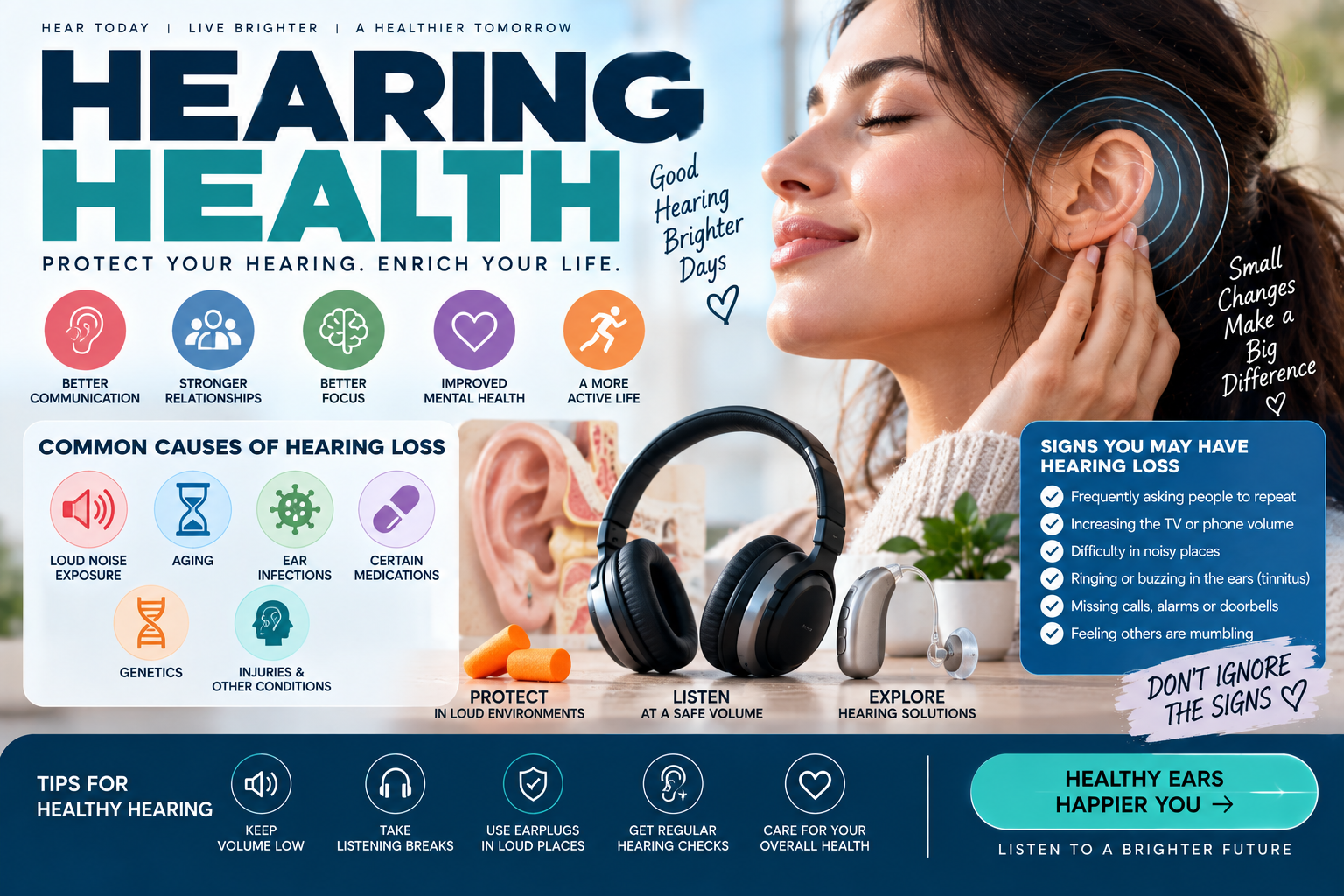
Common Causes of Hearing Loss
Hearing loss can have many different causes. Some are preventable, while others require medical evaluation and treatment.
1. Loud Noise Exposure
Repeated exposure to loud sounds is one of the most important preventable causes of hearing damage.
Noise from concerts, sporting events, fireworks, construction equipment, machinery, motorcycles, and loud personal audio devices can potentially damage sensitive structures in the inner ear.
The National Institute on Deafness and Other Communication Disorders (NIDCD) notes that prolonged or repeated exposure to sounds at or above about 85 dBA can cause hearing damage. The louder the sound, the less exposure time may be needed to cause harm.
2. Aging
Age-related hearing loss, known as presbycusis, commonly develops gradually and often affects both ears.
Because the change may happen slowly, a person may not immediately realize that their hearing has declined. Difficulty understanding speech in noisy environments is a common early complaint.
3. Ear Infections
Some ear infections can temporarily affect hearing, while repeated or untreated infections may contribute to longer-term problems.
Children are particularly affected by certain middle-ear conditions, which is why persistent ear symptoms should be evaluated by a healthcare professional.
4. Earwax Buildup
Excessive earwax can block the ear canal and temporarily reduce hearing.
Although earwax is a normal substance that protects the ear, impacted wax may require professional removal.
5. Certain Medications
Some medicines can damage the sensory structures of the inner ear. These are sometimes called ototoxic medicines.
If you are taking a medication and notice new hearing problems, ringing in the ears, or balance changes, speak with your healthcare professional rather than stopping prescribed medication on your own.
6. Injuries and Medical Conditions
Head injuries, certain infections, genetic conditions, metabolic disorders, and other health problems can affect hearing.
The appropriate treatment depends on the underlying cause.
Signs You May Have Hearing Loss
Hearing loss does not always happen suddenly. In many cases, it develops slowly, making early symptoms easy to overlook.
Possible signs include:
Frequently asking people to repeat themselves
Increasing the volume of the television or phone
Difficulty understanding speech in restaurants or crowded places
Trouble following group conversations
Feeling that people are mumbling
Difficulty hearing on the telephone
Missing doorbells, alarms, or notifications
Speaking louder than usual
Difficulty hearing high-pitched sounds
Experiencing ringing, buzzing, or other sounds in the ears
WHO identifies several of these symptoms as potential indicators of age-related hearing loss and recommends hearing evaluation when such difficulties occur.
What Is Tinnitus?
Tinnitus is the perception of sound when there is no external sound source.
It may sound like:
Ringing
Buzzing
Hissing
Roaring
Clicking
Tinnitus can occur temporarily after loud noise exposure, but persistent tinnitus may be associated with hearing loss or other conditions.
If tinnitus is persistent, bothersome, occurs in only one ear, or appears alongside hearing changes or dizziness, professional evaluation is appropriate.
How Loud Is Too Loud?
One of the simplest ways to protect your hearing is to pay attention to sound intensity and exposure time.
Normal conversation is generally around 60–70 dBA, while concerts, sporting events, motorcycles, and some power equipment can reach substantially higher levels. NIDCD explains that sounds at or below approximately 70 dBA are generally unlikely to cause hearing loss even with prolonged exposure, while long or repeated exposure around 85 dBA and above can increase risk.
Remember three basic principles:
Turn it down.
Move away.
Protect your ears.
The closer you are to a loud source, the greater the sound exposure can be.
How to Protect Your Hearing
Hearing protection does not have to be complicated. Small changes in everyday habits can reduce exposure to damaging noise.
Keep Headphone Volume Reasonable
Listening to music through headphones or earbuds at high volume can expose the ears to potentially damaging sound levels.
Avoid turning up the volume simply to block out background noise. Noise-canceling headphones may help you listen comfortably at lower volumes in some environments.
Taking listening breaks can also reduce the total amount of exposure.
Move Away From Loud Speakers
At concerts, sporting events, clubs, and other loud venues, increasing your distance from speakers or other sound sources can reduce exposure.
If you notice ringing or muffled hearing after an event, treat it as a warning that your ears have been exposed to excessive sound.
Use Earplugs or Earmuffs
If you cannot avoid loud environments, hearing protectors can help.
NIDCD recommends earplugs or protective earmuffs for activities involving potentially hazardous noise, including concerts, fireworks, sporting events, loud workplaces, and certain recreational activities.
Choose protection that fits comfortably and can be worn correctly and consistently.
Give Your Ears Recovery Time
After spending time around loud sounds, moving into a quieter environment gives your auditory system a break.
Temporary muffled hearing or ringing after loud exposure may improve, but repeated exposure can cause lasting damage even when symptoms initially disappear.
Hearing Health and Smartphones
Smartphones and personal audio devices make it easier than ever to listen to music, podcasts, videos, and games for hours.
The problem is not necessarily the device itself. The combination of volume, duration, and frequency of exposure is important.
WHO reports that more than 1 billion young adults are currently at risk of permanent, avoidable hearing loss because of unsafe listening practices.
Consider these habits:
Keep audio volume moderate.
Take regular breaks.
Avoid sleeping with loud audio playing close to your ears.
Use headphones that fit comfortably.
Reduce volume when you are in a quiet environment.
Move away from loud speakers when possible.
Hearing Tests: When Should You Get One?
A professional hearing assessment can determine whether hearing loss is present and identify its type and severity.
A commonly used test is pure-tone audiometry, which measures the quietest sounds a person can hear at different frequencies. WHO explains that a professional assessment is needed to formally diagnose hearing loss.
Consider arranging a hearing evaluation if you:
Frequently ask people to repeat themselves
Struggle to understand speech in noisy settings
Notice persistent ringing in your ears
Regularly increase the television volume
Have difficulty hearing on the phone
Notice hearing loss in one ear
Have been exposed to loud noise regularly
Notice a sudden or rapidly worsening change in hearing
Regular checks can help identify problems earlier, particularly for people with risk factors.
Hearing Health for Older Adults
Age-related hearing changes are common, but hearing difficulties should not simply be dismissed as a normal part of getting older.
WHO recommends hearing checks for people who experience symptoms such as difficulty following conversations, frequently asking others to repeat themselves, turning up the television volume, or experiencing tinnitus.
Protecting against excessive noise throughout life can also help preserve hearing as you age.
Hearing Health for Children
Children need hearing protection too.
Hearing plays an important role in speech, language, learning, and social development. WHO estimates that around 95 million children aged 5–19 worldwide live with hearing loss.
Parents and caregivers can encourage healthy hearing habits by:
Keeping children's headphone volume at a safe level
Limiting prolonged exposure to loud sounds
Using child-appropriate hearing protection at loud events
Paying attention to repeated ear infections
Following recommended childhood health and vaccination practices
Seeking evaluation if a child does not respond normally to sounds or speech
Early identification is particularly important when hearing problems may affect communication or development.
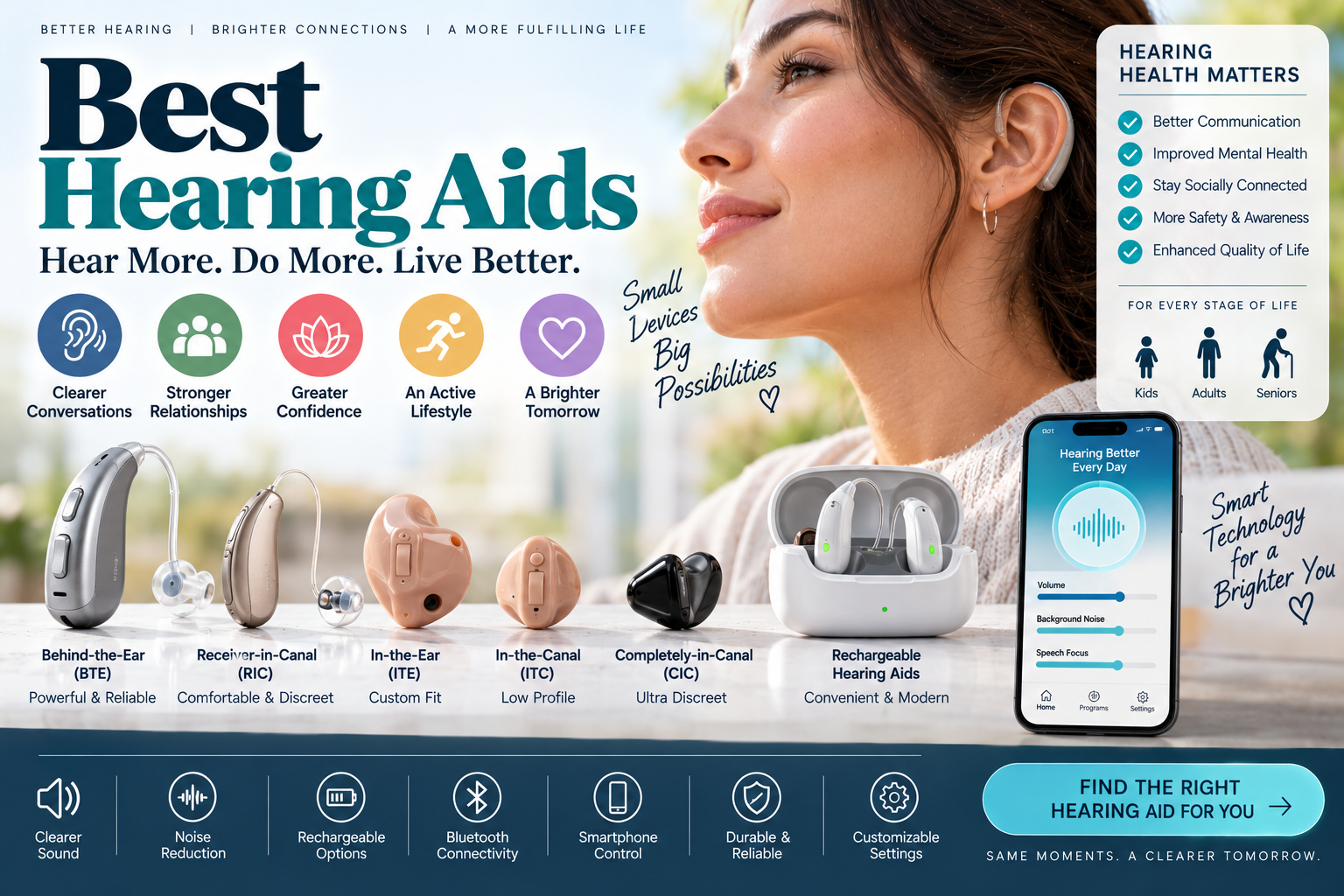
What Are Hearing Aids?
Hearing aids are small electronic devices that make certain sounds louder for people with hearing loss.
They generally contain a microphone, amplifier, and speaker. Modern hearing aids can be programmed to meet individual hearing needs and can provide assistance in different listening environments.
Hearing aids do not restore normal hearing, but they can help many people hear and communicate more effectively.
The appropriate device depends on factors such as the type and degree of hearing loss, lifestyle, communication needs, and personal preferences.
What Are Over-the-Counter Hearing Aids?
In the United States, over-the-counter (OTC) hearing aids are available directly to adults with perceived mild-to-moderate hearing loss.
NIDCD explains that OTC hearing aids are regulated medical devices intended for adults with mild-to-moderate hearing difficulties. More complicated or severe hearing loss may require professional assessment and prescription devices.
A hearing professional can help determine whether an OTC hearing aid is appropriate or whether further medical evaluation is needed.
When Should You See a Doctor or Hearing Professional?
Some hearing symptoms should not be ignored.
Seek professional medical advice if you experience:
Sudden hearing loss
Rapidly worsening hearing
Hearing loss in only one ear
Significant ear pain
Fluid, pus, or blood coming from the ear
Severe dizziness or vertigo with hearing loss
Persistent or concerning tinnitus
A suspected foreign object in the ear
NIDCD specifically advises prompt medical attention for sudden hearing loss, rapidly worsening hearing, ear drainage, pain, vertigo associated with hearing loss, and certain one-sided hearing symptoms.
Sudden hearing loss can require urgent medical evaluation, so it should not be treated as something to simply wait out.
What Does an Audiologist Do?
An audiologist is a hearing professional trained to evaluate hearing and identify the type and degree of hearing loss.
Depending on the situation, an audiologist may:
Perform hearing tests
Identify hearing loss patterns
Recommend hearing devices
Fit and adjust hearing aids
Provide hearing rehabilitation
Discuss hearing protection
Refer patients to an ENT specialist or physician when necessary
An otolaryngologist, commonly called an ENT doctor, provides medical and surgical care for conditions involving the ear, nose, throat, and related structures.
Can Hearing Loss Be Prevented?
Not every form of hearing loss can be prevented. However, many causes are preventable or can be reduced through appropriate care.
WHO reports that many common causes of hearing loss—including exposure to loud sounds and some ear infections—can be prevented or addressed through public health measures and clinical interventions.
The most practical hearing-health habits include:
Reduce exposure to loud sounds.
Keep headphone volume moderate.
Take breaks from prolonged listening.
Wear earplugs or earmuffs around loud machinery.
Move away from loud speakers.
Treat persistent ear problems appropriately.
Have hearing evaluated when symptoms develop.
Protect children's ears from excessive noise.
Do not ignore sudden changes in hearing.
Follow professional advice about medications that may affect hearing.
Hearing Health and Everyday Wellness
Hearing health is connected to everyday communication and participation in life.
Being able to hear conversations can make it easier to stay socially connected, participate at work or school, and enjoy activities. When hearing difficulties develop, assistive technologies, rehabilitation, communication strategies, and appropriate medical care can help people remain engaged.
Hearing loss should not be viewed as something a person simply has to tolerate.
Early recognition gives people more opportunities to understand the cause and explore appropriate options.
Frequently Asked Questions About Hearing Health
What is the best way to protect hearing?
The most effective approach is to reduce exposure to loud sounds, lower volume, move away from loud sources, and use earplugs or earmuffs when necessary.
Can headphones cause hearing loss?
Headphones and earbuds can contribute to noise-induced hearing loss when they are used at excessive volume or for prolonged periods. Safe listening depends on controlling both volume and exposure time.
Is hearing loss only a problem for older people?
No. Hearing loss can affect people of all ages. Loud noise, infections, injuries, genetic factors, certain medicines, and other conditions can affect hearing in younger people as well.
Can hearing loss be reversed?
It depends on the cause. Some hearing problems may improve when the underlying cause is treated, while permanent inner-ear damage may not be reversible. Hearing aids and other assistive technologies can help people manage many types of permanent hearing loss.
How often should I get my hearing checked?
The appropriate frequency depends on age, symptoms, risk factors, and professional advice. If you notice hearing difficulties, tinnitus, or other changes, arrange a professional hearing assessment rather than waiting for the problem to become severe.
What is tinnitus?
Tinnitus is the perception of ringing, buzzing, hissing, or another sound without an external source. It can occur temporarily after loud noise exposure or alongside hearing problems and other conditions.
Are hearing aids effective?
Hearing aids can help many people with hearing loss hear sounds and understand speech more effectively. The appropriate device depends on the type and severity of hearing loss and the individual's needs.
Can children develop hearing loss?
Yes. Children can experience hearing loss because of genetic factors, infections, complications around birth, ear conditions, noise exposure, and other causes. Early identification is important because hearing supports communication and learning.
Final Thoughts
Hearing health deserves attention throughout life, not only after hearing problems become obvious. Loud noise, aging, ear conditions, certain medicines, infections, and other factors can affect hearing, but many risks can be reduced through prevention and early care.
Simple habits—such as lowering headphone volume, taking listening breaks, using hearing protection around loud sounds, and seeking professional evaluation when hearing changes occur—can make a meaningful difference.
With more than 1.5 billion people worldwide living with some degree of hearing loss and the number expected to increase, hearing care is an increasingly important part of lifelong health.
If you notice sudden hearing loss, rapidly worsening hearing, significant ear pain, drainage, severe dizziness, or other concerning symptoms, seek medical attention promptly rather than relying on home remedies.