
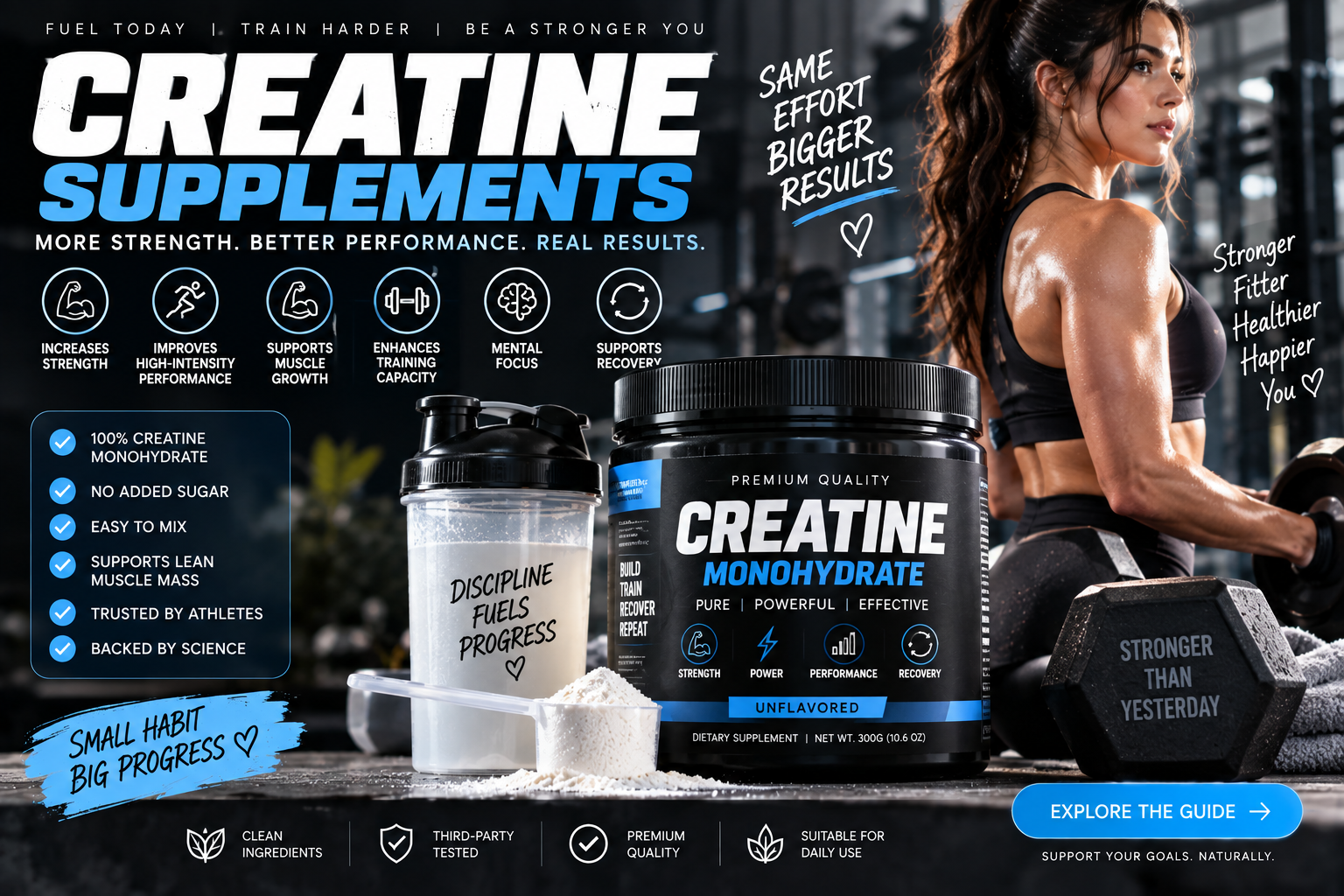
Creatine supplements are among the most widely studied sports and exercise supplements. They are commonly used by people who participate in strength training, sprinting, resistance exercise, and other activities involving short bursts of intense effort.
Unlike many supplements that rely heavily on marketing claims, creatine has a substantial body of research behind it. Studies have found that creatine supplementation can increase strength and power and improve the ability to perform repeated high-intensity efforts. It may also help support training adaptations when combined with a structured exercise program.
The most extensively studied form is creatine monohydrate. It is generally taken consistently rather than only immediately before or after a workout.
However, creatine is not a replacement for proper nutrition, resistance training, recovery, or sleep. Understanding how it works, how much to take, and what side effects to expect can help people use it appropriately.
What Is Creatine?
Creatine is a naturally occurring compound found primarily in skeletal muscle. The body produces creatine from amino acids, and smaller amounts are also obtained from animal-based foods such as meat and fish.
Inside muscles, creatine is stored partly as phosphocreatine. This system helps provide energy for short periods of high-intensity activity by helping regenerate ATP, the body's immediate energy source.
Supplementing with creatine increases the amount of creatine stored in muscles. This can improve the ability to perform repeated high-intensity efforts such as weightlifting, sprinting, jumping, and other activities requiring short bursts of power.
Creatine is therefore different from stimulants such as caffeine. It does not primarily work by making you feel more energetic or alert. Instead, it supports the muscle's energy system.
What Are Creatine Supplements?
Creatine supplements are dietary supplements that provide additional creatine, usually in powdered form.
Common forms include:
Creatine monohydrate
Creatine hydrochloride
Creatine ethyl ester
Buffered creatine
Other specialized formulations
Among these, creatine monohydrate is the most widely studied and used form. NIH guidance notes that other forms have not been shown to be superior to creatine monohydrate for increasing muscle creatine levels, performance, digestibility, or safety.
For most people interested in creatine supplementation, the extensive research behind creatine monohydrate makes it the primary form to consider.
Benefits of Creatine Supplements
1. May Increase Strength
One of the best-established benefits of creatine is improved performance during strength and resistance exercise.
Research summarized by the NIH shows that creatine supplementation can increase strength and power and improve the ability to perform repeated maximal-effort muscle contractions.
This can be particularly useful during activities such as:
Weightlifting
Resistance training
Sprinting
Jumping
Power training
High-intensity interval exercise
The benefit is not simply because creatine makes muscles larger overnight. Instead, better performance can allow a person to complete more high-quality training over time.
2. Supports High-Intensity Exercise
Creatine is particularly useful for repeated short bursts of intense activity.
Examples include lifting heavy weights, repeated sprints, jumping, and other exercises that require rapid energy production.
NIH research summaries report that creatine can enhance performance during repeated short bursts of high-intensity intermittent activity, while providing relatively little benefit for endurance activities such as long-distance running, cycling, or swimming.
3. May Support Training Adaptations
Creatine supplementation over several weeks or months can help people adapt to structured resistance-training programs.
The combination of creatine and resistance exercise has been studied extensively, and creatine may help increase training capacity and support improvements in strength and lean mass over time.
However, creatine does not replace exercise. Someone who does not train consistently should not expect creatine alone to produce major changes in muscle size or strength.
4. Can Increase Muscle Creatine Stores
The body naturally stores creatine in muscle, but supplementation can increase those stores.
Higher muscle creatine availability helps support the phosphocreatine energy system used during intense exercise.
The response can vary between individuals. People who start with lower muscle creatine stores may sometimes experience a larger response to supplementation. Dietary patterns can also influence baseline creatine levels.
5. May Support Repeated Exercise Performance
Creatine is particularly relevant for workouts involving repeated sets.
For example, a resistance-training session may include multiple sets of squats, presses, rows, or other exercises. Having greater creatine availability can support the energy requirements of repeated high-intensity efforts.
This is one reason creatine is commonly used by people participating in resistance and power-based training.
Creatine and Muscle Growth
Creatine is often described as a muscle-building supplement, but the relationship is more nuanced.
Creatine itself does not replace resistance training. Muscle growth requires an appropriate training stimulus along with adequate nutrition and recovery.
Creatine may help by improving the ability to perform high-quality training. Over time, this can contribute to greater training adaptations.
Creatine can also cause an early increase in body weight because it increases water retention within muscle. This increase should not automatically be interpreted as an increase in body fat. NIH sources identify water-related weight gain as the most consistent effect associated with creatine supplementation.
How Much Creatine Should You Take?
A commonly studied approach is:
Loading phase:
Approximately 20 grams per day
Usually divided into four 5-gram servings
For about 5–7 days
Maintenance phase:
Approximately 3–5 grams per day
This approach can increase muscle creatine stores more quickly.
However, a loading phase is not required.
Another approach is simply taking approximately 3–5 grams of creatine monohydrate daily without loading. Muscle creatine stores will increase more gradually.
For many people, the simpler daily approach may be easier to maintain.
Do You Need a Creatine Loading Phase?
No.
Loading is an optional strategy rather than a requirement.
A loading phase can increase muscle creatine stores more quickly, but taking a smaller daily amount can eventually produce similar increases in muscle creatine stores.
Someone who does not want to take several servings per day can simply use a consistent maintenance amount.
When Should You Take Creatine?
Creatine does not need to be taken immediately before a workout to work.
Because the goal is to increase and maintain muscle creatine stores, consistent daily use is more important than choosing a precise workout-time window.
Some people take creatine:
Before exercise
After exercise
With breakfast
With a post-workout meal
At another convenient time
Choosing a time that makes daily use easy can help with consistency.
Creatine Before or After a Workout?
There is no strong reason for most people to worry about an exact pre- or post-workout timing window.
Creatine works differently from caffeine, which is often taken shortly before exercise for an acute stimulant effect.
With creatine, the objective is to maintain adequate muscle stores over time.
Therefore, taking it consistently each day is generally more important than whether it is consumed immediately before or after training.
Creatine Side Effects
Creatine is generally well tolerated by healthy adults, but some people experience unwanted effects.
The most commonly recognized effect is weight gain from increased water retention.
Some people also report:
Stomach discomfort
Nausea
Diarrhea
Muscle stiffness
Muscle cramps
These effects are not experienced by everyone.
Taking very large amounts at once may be more likely to cause gastrointestinal discomfort. Dividing a loading dose into smaller servings can make it easier to tolerate.
Does Creatine Cause Weight Gain?
Creatine can increase body weight, particularly during the first several weeks of supplementation.
This is mainly related to increased water stored in muscle rather than an automatic increase in body fat.
NIH sources note that creatine supplementation can lead to approximately 1–2 kg of additional body weight in some people during a month of strength training, although individual responses vary.
If you are tracking your weight, it is useful to understand that changes on the scale after starting creatine may not represent fat gain.
Does Creatine Cause Dehydration?
Creatine is sometimes associated with concerns about dehydration or muscle cramps.
Current NIH information does not identify dehydration as a consistent adverse effect of creatine. Some reports of muscle cramps and heat intolerance have occurred, but evidence does not establish these as common effects in healthy users.
Maintaining appropriate hydration is still important during exercise, particularly in hot environments or during prolonged training.
Is Creatine Safe?
Creatine is one of the better-studied sports supplements.
NIH sources state that creatine appears safe for healthy adults when used for weeks or months and that available evidence also supports safety with longer-term use over several years.
However, dietary supplements are not automatically appropriate for everyone.
People with medical conditions, those taking medications, pregnant or breastfeeding individuals, and people with specific dietary or health concerns should discuss supplementation with a healthcare professional.
The FDA also notes that dietary supplements can have side effects and may interact with medications or other supplements.
Does Creatine Damage the Kidneys?
Kidney safety is one of the most frequently discussed concerns about creatine.
Research in healthy adults has generally found creatine to be well tolerated, including in studies involving longer-term use. However, people with existing kidney disease or other medical conditions should not assume that evidence from healthy adults applies directly to them.
Anyone with kidney problems or concerns about kidney function should discuss creatine supplementation with a healthcare professional before using it.
It is also important to remember that creatine is metabolized into creatinine, a substance commonly measured in blood tests of kidney function. Supplementation can therefore affect creatinine measurements without necessarily meaning that kidney damage has occurred.
A healthcare professional can interpret laboratory results in the context of supplementation and overall health.
Creatine Monohydrate vs. Other Forms
Creatine monohydrate remains the most extensively studied form.
Other products may be marketed as more advanced or easier to absorb, but NIH guidance notes that alternatives such as creatine ethyl ester and buffered forms have not been demonstrated to be superior to creatine monohydrate for increasing muscle creatine levels, performance, digestibility, or safety.
This makes creatine monohydrate a straightforward option for people who want a form supported by substantial research.
Creatine for Women
Creatine is not exclusively a men's supplement.
Women also naturally produce and store creatine in muscle, and research has investigated creatine supplementation in women participating in different types of exercise.
The basic principles of supplementation are similar: creatine may be particularly useful for activities involving repeated high-intensity efforts.
Individual responses vary, so women should consider their exercise goals, diet, overall health, and tolerance when deciding whether to supplement.
Creatine for Beginners
Beginners do not necessarily need creatine immediately.
A new exerciser can make significant progress simply by establishing:
A consistent training routine
Adequate protein and overall nutrition
Sufficient calories for their goals
Good hydration
Adequate sleep
Proper exercise technique
Once these fundamentals are established, creatine can be considered as an optional supplement.
It is not a substitute for consistent training.
Creatine and Endurance Exercise
Creatine is most strongly associated with short, high-intensity exercise.
For long-duration endurance activities, such as distance running or long-distance swimming, its benefits are less clear and generally smaller. NIH guidance states that creatine appears to have little value for endurance activities.
However, some endurance athletes may still use creatine for other training purposes, especially when their programs include strength training or repeated high-intensity efforts.
How to Choose a Creatine Supplement
When purchasing creatine, simplicity can be useful.
Choose a Transparent Label
Look for a product that clearly states:
Type of creatine
Amount per serving
Serving size
Other ingredients
Manufacturer information
Consider Creatine Monohydrate
Creatine monohydrate is the most widely studied form and has extensive evidence supporting its use for high-intensity exercise.
Avoid Unnecessary Proprietary Blends
Some sports supplements contain numerous ingredients in proprietary blends.
These products can make it difficult to determine exactly how much of each ingredient you are consuming.
A straightforward creatine product can make dosing easier to understand.
Consider Independent Testing
Athletes subject to drug testing may want to look for products certified by an established independent testing organization.
NIH notes that some certification programs test supplements for banned substances and other contaminants.
Creatine and Protein Powder
Creatine and protein powder serve different purposes.
Protein powder provides dietary protein and can help people meet their protein requirements when whole foods are inconvenient.
Creatine supports the muscle energy system used during high-intensity exercise.
They can therefore be used together as part of an overall nutrition and training strategy, although neither is mandatory for everyone.
A person who already obtains enough protein from food may not need protein powder, while creatine can remain an optional performance supplement.
Creatine vs. Pre-Workout
Creatine and pre-workout supplements are also different.
Many pre-workouts contain caffeine and are designed to provide an acute feeling of energy or alertness before exercise.
Creatine does not work primarily as a stimulant. Its purpose is to increase muscle creatine availability over time.
Some pre-workout formulas contain creatine, but people should check the label carefully to avoid accidentally taking multiple sources of the same ingredient.
Frequently Asked Questions
What is creatine used for?
Creatine is primarily used to support performance during short, high-intensity exercise. It can increase strength, power, and the ability to perform repeated maximal-effort contractions.
What is the best type of creatine?
Creatine monohydrate is the most widely studied and used form. Other forms have not been shown to provide clear advantages over creatine monohydrate.
How much creatine should I take daily?
A common maintenance amount is approximately 3–5 grams per day. A loading protocol of about 20 grams daily for 5–7 days, divided into several servings, is another studied approach.
Do I need to load creatine?
No. Loading is optional. Taking 3–5 grams daily without loading can gradually increase muscle creatine stores.
Should I take creatine before or after a workout?
The exact timing is less important than taking it consistently. You can take it at a convenient time that helps you maintain a regular routine.
Does creatine build muscle?
Creatine can support training performance and adaptations, particularly when combined with resistance exercise. It does not build significant muscle by itself.
Does creatine make you gain fat?
Creatine can increase body weight because of increased water retention in muscle. This is different from automatically gaining body fat.
Is creatine safe for women?
Creatine has been studied in women as well as men. Healthy adults generally tolerate creatine well, but individual circumstances should be considered.
Can I take creatine every day?
Creatine is commonly used daily to maintain muscle creatine stores. Healthy adults have generally tolerated long-term supplementation in available research.
Can creatine be taken with protein powder?
Yes. They serve different nutritional purposes and can be consumed as part of the same overall fitness routine.
Does creatine help with weight loss?
Creatine is not a weight-loss supplement. It may increase scale weight because of water retention, even while supporting strength and training performance.
Is creatine suitable for endurance athletes?
Creatine is primarily useful for repeated high-intensity efforts. It generally provides less benefit for purely endurance-based activities such as long-distance running.
Final Thoughts
Creatine is one of the most extensively studied supplements used in sports and exercise. The strongest evidence supports its use for activities involving repeated short bursts of high-intensity effort, including resistance training, sprinting, and power-based exercise.
Creatine monohydrate is the most thoroughly studied form, and a typical maintenance approach is around 3–5 grams per day. A loading phase can be used when someone wants to increase muscle creatine stores more quickly, but it is not essential.
Some weight gain from increased water retention is common, while digestive symptoms can occur in some individuals.
As with any dietary supplement, quality and individual circumstances matter. The FDA does not pre-approve dietary supplements for safety and effectiveness before they are marketed in the same way it approves drugs, so consumers should choose products carefully and discuss supplementation with a healthcare professional when appropriate.
Ultimately, creatine works best as one part of a broader approach that includes progressive exercise, adequate nutrition, hydration, and recovery.