
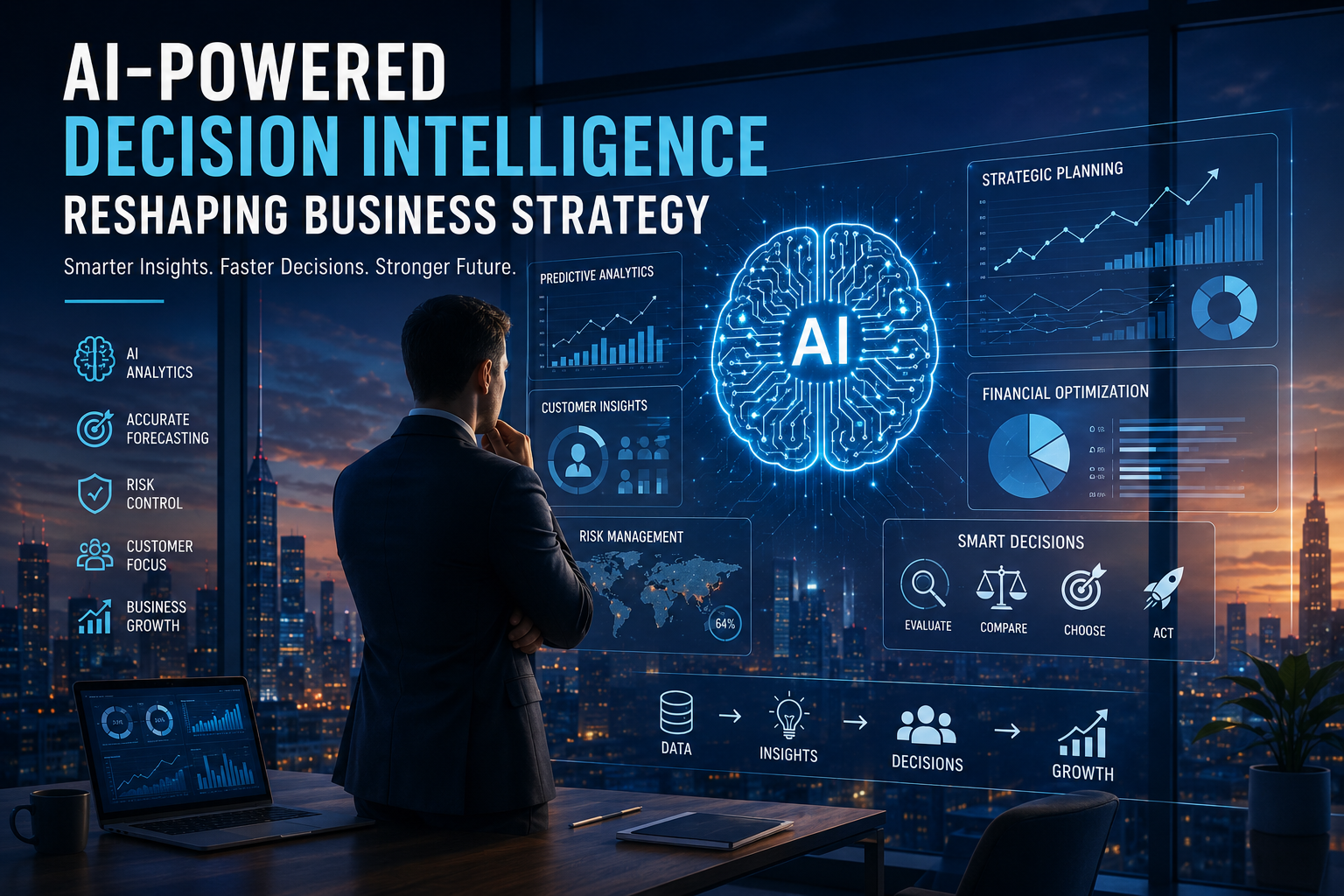
Artificial intelligence is moving beyond automation and becoming a central part of how businesses make decisions. In 2026, companies are increasingly using AI to analyze market conditions, understand customers, identify risks, forecast demand, and determine where resources should be invested. The result is a new approach to business strategy built around faster, more data-driven decision-making.
For years, executives relied on reports, spreadsheets, surveys, and historical performance data to guide major decisions. These tools remain valuable, but modern businesses operate in an environment where markets can change within hours. Customer expectations evolve quickly, competitors launch new products faster, and economic conditions can shift unexpectedly.
AI-powered decision intelligence is emerging as a solution to this challenge. By combining artificial intelligence, machine learning, data analytics, and real-time information, businesses can turn large amounts of complex data into actionable insights.
What Is AI-Powered Decision Intelligence?
AI-powered decision intelligence refers to the use of artificial intelligence and advanced analytics to support or improve business decisions. Instead of simply collecting information, these systems analyze patterns, identify relationships, forecast potential outcomes, and help decision-makers understand their available options.
Traditional business intelligence often answers questions such as what happened and why it happened. AI-powered decision intelligence goes further by helping businesses determine what could happen next and what actions may produce better results.
For example, an e-commerce company can use AI to analyze customer behavior, inventory levels, seasonal trends, advertising performance, and purchasing patterns. The system could then forecast which products are likely to experience increased demand and help the company adjust inventory before shortages occur.
This ability to move from historical analysis toward predictive and prescriptive decision-making is becoming increasingly important.
Why Businesses Need Faster Decisions
The speed of modern markets has changed the value of information. Having accurate information is important, but receiving that information too late can make it much less useful.
A marketing team may discover that a campaign is underperforming after several weeks of analysis. An AI-powered system, however, can monitor campaign performance continuously and identify unusual changes almost immediately.
The same principle applies to supply chains, customer service, financial planning, cybersecurity, and product development.
Businesses that can recognize changes early have more time to respond. This creates a competitive advantage because strategic decisions no longer have to depend entirely on lengthy reporting cycles.
AI does not eliminate the need for human leadership. Instead, it can give executives better information at the moment when decisions need to be made.
AI Is Transforming Strategic Planning
Strategic planning has traditionally involved annual forecasts and long-term assumptions. While long-term planning remains essential, businesses are increasingly supplementing it with dynamic forecasting.
AI systems can process multiple variables simultaneously. Economic indicators, customer activity, competitor movements, internal sales data, operational costs, and other signals can be analyzed together.
This allows companies to create different scenarios.
What happens if demand increases by 20%?
What if operating costs rise?
What if a competitor enters the market?
What if customers shift toward a different product category?
Instead of preparing a single forecast, leadership teams can use AI to examine several possible futures and develop strategies for each scenario.
This makes strategic planning more flexible and resilient.
Improving Customer Understanding
Customers generate enormous amounts of information through purchases, searches, website interactions, social media activity, support conversations, and other digital behaviors.
AI can analyze these signals to identify patterns that may be difficult for humans to detect manually.
Businesses can use these insights to understand customer preferences, identify emerging needs, personalize recommendations, and improve customer experiences.
For example, an online retailer might discover that customers who purchase a particular product frequently show interest in another product several days later. Instead of waiting for a traditional marketing analysis, an AI system can identify the relationship and help the company create targeted recommendations.
Personalization can also extend beyond product recommendations. AI can help businesses determine which communication channels, messages, offers, and customer service approaches are most effective for different audiences.
Smarter Financial Decisions
Financial decision-making is another area where AI can create significant advantages.
Businesses constantly need to decide where money should be allocated. Marketing budgets, hiring plans, technology investments, inventory purchases, and expansion strategies all compete for limited resources.
AI can evaluate historical financial information alongside current operational data to identify patterns and potential risks.
For example, predictive systems can help companies forecast cash-flow requirements, identify unusual expenses, estimate demand, and evaluate different investment scenarios.
However, AI-generated financial recommendations should not automatically be treated as guarantees. Business leaders still need to consider economic conditions, regulations, market uncertainty, and other factors that may not be fully represented in the available data.
The strongest approach combines AI-generated insights with experienced human judgment.
AI and Risk Management
Risk management is becoming increasingly important as businesses become more digitally connected.
Cybersecurity threats, supply-chain disruptions, changing regulations, financial volatility, and reputational risks can all affect organizations.
AI can continuously monitor large datasets and detect unusual patterns that may indicate emerging problems.
A cybersecurity system, for example, can identify abnormal login behavior or unusual network activity. A supply-chain system can monitor delivery patterns and highlight potential disruptions.
The objective is not necessarily to predict every problem perfectly. Instead, AI can help businesses identify warning signals earlier and prioritize areas that require human attention.
The Human Role Remains Critical
The rise of AI-powered decision-making does not mean that executives or employees will become irrelevant.
In fact, human judgment becomes even more important when AI systems are responsible for analyzing increasingly complex information.
AI can identify patterns, generate forecasts, and compare scenarios, but leaders must determine whether those recommendations align with the company's values, objectives, customers, and long-term strategy.
Human creativity is also essential.
A machine may identify that a particular market is growing, but a leadership team must decide how the company should enter that market. AI can provide evidence, while people provide vision, context, ethics, and accountability.
The future is therefore more likely to involve collaboration between humans and intelligent systems rather than complete replacement of human decision-makers.
Challenges Businesses Must Address
Despite its potential, AI-powered decision intelligence comes with challenges.
Data quality is one of the biggest concerns. If an AI system receives incomplete, outdated, or inaccurate information, its recommendations may also be unreliable.
Businesses must also consider privacy and security. Customer and employee data should be handled responsibly, particularly when AI systems process sensitive information.
Another challenge is algorithmic bias. AI systems can reproduce biases present in the data used to train or operate them. Companies need appropriate testing, monitoring, and governance processes to reduce these risks.
Finally, employees need training. Introducing AI without preparing people to understand and use its recommendations can limit the value of the technology.
Building an AI-Ready Business
Companies do not necessarily need to transform their entire operations at once.
A practical approach is to identify decisions that are repetitive, data-intensive, and measurable. These may include demand forecasting, customer segmentation, inventory planning, marketing optimization, or operational reporting.
Businesses can begin with one area, measure the results, and gradually expand AI capabilities.
Leadership should also establish clear rules around data quality, human oversight, privacy, security, and accountability.
The goal should not be to use AI simply because it is available. Instead, organizations should identify where intelligent technology can create measurable business value.
The Future of Business Decision-Making
AI-powered decision intelligence is likely to become an increasingly important component of modern business strategy.
As AI systems become better at processing real-time information, businesses will have greater opportunities to move from reactive decision-making toward proactive strategies.
The competitive advantage will not necessarily belong to companies with the largest AI budgets. It may belong to organizations that can integrate AI effectively into everyday decision-making while maintaining strong human leadership.
Companies that combine reliable data, intelligent technology, experienced employees, and clear strategic objectives can build more responsive organizations.
In 2026 and beyond, business success will increasingly depend on the ability to understand change before it becomes obvious, evaluate opportunities quickly, and act with confidence. AI can provide the intelligence required to support that process, but people will remain responsible for turning intelligence into meaningful strategy.
The next generation of successful businesses will therefore not simply be AI-powered. They will be AI-informed, human-led, and strategically adaptable.