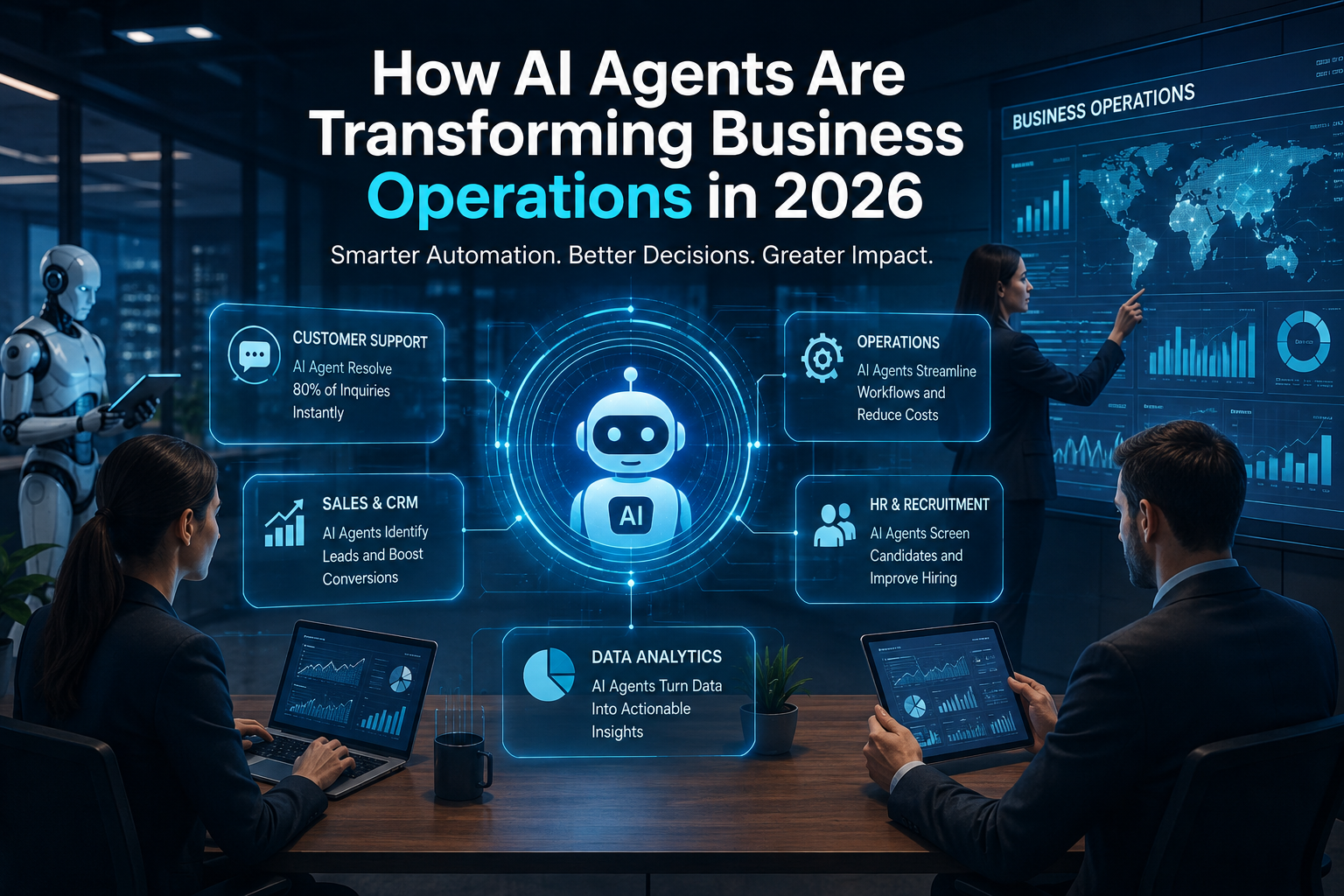
Artificial intelligence has moved far beyond simple chatbots and automation tools. In 2026, one of the most important developments in enterprise technology is the rapid emergence of AI agents—intelligent software systems capable of understanding goals, making decisions, completing tasks, and coordinating multiple steps with limited human intervention.
Businesses have spent years automating repetitive processes. Traditional automation, however, generally follows predefined rules. AI agents represent a significant change because they can interpret information, adapt to changing situations, interact with different systems, and determine how to complete a task.
From customer service and marketing to finance, operations, sales, and human resources, agent-based AI could become an increasingly important part of the modern digital workforce.
What Are AI Agents?
AI agents are software systems designed to perform tasks on behalf of users or organizations.
Unlike conventional software that requires users to manually perform every action, an AI agent can receive an objective and determine the steps required to accomplish it.
For example, instead of asking an employee to collect sales data, analyze performance, prepare a report, and send recommendations to management, an AI agent could potentially coordinate several of these activities automatically.
An agent might retrieve information from approved business systems, analyze the data, identify unusual patterns, create a summary, and recommend possible actions.
The difference is important. Traditional software primarily provides tools for humans to use. Agentic AI increasingly allows software to participate directly in workflows.
From Automation to Intelligent Action
Business automation is not new. Companies have used software for decades to automate payroll, inventory management, accounting, customer communications, and other repetitive processes.
However, traditional automation usually depends on clearly defined conditions.
For example, a system might automatically send an invoice when an order is completed. The workflow works because developers have already determined exactly what should happen.
AI agents can potentially handle more complicated situations.
They may analyze context, compare different sources of information, select tools, and modify their actions according to the situation.
This creates opportunities to automate workflows that previously required continuous human involvement.
AI Agents in Customer Service
Customer service is one of the most obvious areas where AI agents can create value.
Traditional chatbots often rely on scripted responses and predefined questions. More advanced AI agents can potentially understand customer requests, retrieve account information, search knowledge bases, recommend solutions, and complete approved actions.
Imagine a customer contacting an online retailer because an order has not arrived.
Instead of simply providing tracking information, an AI agent could potentially check the delivery status, identify a shipping problem, determine available replacement options, and prepare an appropriate resolution.
Human representatives could then concentrate on unusual, sensitive, or high-value situations requiring judgment and empathy.
This combination of AI efficiency and human oversight may become a common customer-service model.
Transforming Sales Operations
Sales teams spend considerable time on administrative work.
Representatives may need to research prospects, update customer relationship management systems, prepare follow-up messages, schedule meetings, and analyze previous interactions.
AI agents can help automate parts of this process.
An intelligent sales agent could analyze potential leads, prioritize opportunities based on predefined criteria, prepare account summaries, suggest follow-up actions, and ensure CRM information remains updated.
Salespeople would still remain responsible for relationships, negotiations, and strategic conversations.
However, reducing administrative workload could allow them to spend more time communicating directly with customers.
Smarter Marketing Workflows
Marketing departments are another area where agentic AI may have a significant impact.
Modern digital marketing involves numerous connected activities, including keyword research, content planning, advertising, social media, email marketing, analytics, and conversion optimization.
AI agents could help coordinate these processes.
For example, an agent could monitor campaign performance and identify advertisements with declining engagement. It could then analyze audience behavior and recommend changes to targeting, messaging, or budget allocation.
Other agents could analyze search trends, organize content calendars, identify gaps in existing content, and summarize campaign performance.
Rather than replacing marketing strategy, these systems can provide marketers with faster access to information and recommendations.
AI Agents in Finance
Finance departments frequently manage highly structured but time-consuming processes.
AI agents may assist with invoice processing, expense classification, financial reporting, reconciliation, forecasting, and anomaly detection.
For example, an agent could continuously analyze transactions and identify unusual spending patterns requiring review.
It could also compare actual expenses with budgets and alert managers when specific departments are approaching predetermined limits.
Financial decisions involving significant risk should still receive appropriate human oversight. However, AI can reduce the amount of manual work required to identify issues and prepare financial information.
Improving Supply Chain Operations
Global supply chains generate enormous amounts of information.
Businesses must monitor suppliers, inventory, transportation, demand, production schedules, costs, and potential disruptions.
AI agents can help connect these different sources of information.
An intelligent system could continuously monitor inventory levels and compare them with expected demand. If it identifies a potential shortage, it could alert supply-chain managers and recommend possible responses.
More advanced systems could evaluate alternative suppliers or distribution strategies within rules established by the organization.
This ability to detect and respond to operational changes could make supply chains more resilient.
Multi-Agent Systems Could Become More Common
One of the most interesting developments is the emergence of multi-agent systems.
Instead of relying on one AI system to perform every task, organizations may deploy specialized agents that work together.
A marketing agent might analyze customer demand while a sales agent evaluates leads and a finance agent estimates revenue implications.
These systems could exchange relevant information and coordinate activities within established permissions.
This approach resembles human organizations, where different departments have specialized responsibilities but collaborate toward shared objectives.
Multi-agent systems could eventually become an important architecture for enterprise automation.
The Human Role Is Changing
The growth of AI agents does not mean businesses can simply remove humans from every process.
Instead, human roles may increasingly move toward supervision, judgment, strategy, relationship management, and exception handling.
Employees may spend less time manually transferring information between systems and more time reviewing AI recommendations or addressing complex situations.
This creates a new workplace skill: AI orchestration.
Employees will need to understand how to assign tasks to AI systems, evaluate their output, identify mistakes, and determine when human intervention is necessary.
Businesses that train employees to work effectively with AI may gain more value than organizations that view automation only as a method of reducing headcount.
Security and Governance Become Essential
Giving AI systems greater autonomy also introduces new risks.
An agent capable of accessing business applications could potentially interact with confidential customer records, financial information, internal documents, or operational systems.
Organizations therefore need strict permission structures.
An AI agent should have access only to the information and tools required for its assigned responsibilities.
Businesses may also need detailed activity logs showing what an agent accessed, what decisions it made, and what actions it performed.
Human approval should remain mandatory for sensitive activities such as major financial transactions, legal commitments, employee decisions, or significant changes to critical infrastructure.
Governance will become increasingly important as agentic AI becomes more capable.
Measuring the Business Value of AI Agents
Companies should avoid implementing AI agents simply because the technology is popular.
Successful adoption requires clear business objectives.
Organizations should identify workflows where AI can produce measurable improvements, such as reducing processing time, improving customer response speed, lowering operational costs, or increasing employee productivity.
Starting with controlled use cases can help businesses evaluate performance and identify risks before expanding AI agents across the organization.
Companies should also establish metrics to determine whether the technology actually produces better outcomes.
The Rise of the AI-Augmented Enterprise
The long-term impact of AI agents may extend beyond individual tasks.
Businesses could eventually operate with interconnected networks of intelligent systems supporting employees across departments.
A manager beginning the workday might receive an automatically prepared briefing containing important customer developments, operational problems, financial changes, and recommended priorities.
Instead of manually searching multiple dashboards, the manager could interact with an AI system that has already gathered relevant information.
This could create what might be described as the AI-augmented enterprise—an organization where employees and intelligent systems continuously collaborate.
Challenges Businesses Must Address
Despite their potential, AI agents are not perfect.
They can misunderstand instructions, make incorrect assumptions, or generate inaccurate information. Integrating them with older enterprise software can also be technically difficult.
Organizations therefore need strong testing procedures and clear boundaries.
Data quality is another major challenge. An intelligent agent working with incomplete or inaccurate business information may produce poor recommendations regardless of how advanced its underlying AI technology is.
Successful agentic AI adoption therefore depends on technology, data quality, cybersecurity, governance, employee training, and organizational strategy.
The Future of Agentic Business
The development of AI agents represents a broader transformation in the relationship between humans and software.
For decades, employees have learned how to operate software applications. The emerging model reverses part of that relationship: increasingly, employees can describe objectives while intelligent software determines how to perform parts of the work.
The transition will not happen overnight.
Different industries will adopt agentic AI at different speeds depending on regulation, risk, infrastructure, and business requirements.
However, organizations that begin experimenting responsibly today can develop valuable experience before AI agents become more deeply integrated into enterprise operations.
Conclusion
AI agents are transforming business automation from simple rule-based processes into increasingly intelligent and adaptive workflows.
Their potential applications span customer service, sales, marketing, finance, supply chains, analytics, and many other business functions.
The greatest opportunity is not simply automating more tasks. It is creating organizations where people can focus on strategic and creative responsibilities while intelligent systems handle larger portions of repetitive operational work.
At the same time, businesses must balance autonomy with accountability. Security, human oversight, data quality, and responsible AI governance will remain critical.
In 2026 and beyond, the companies that gain the greatest advantage from AI agents may not be those that automate everything. They may be the organizations that learn how to combine human judgment with intelligent automation most effectively.