
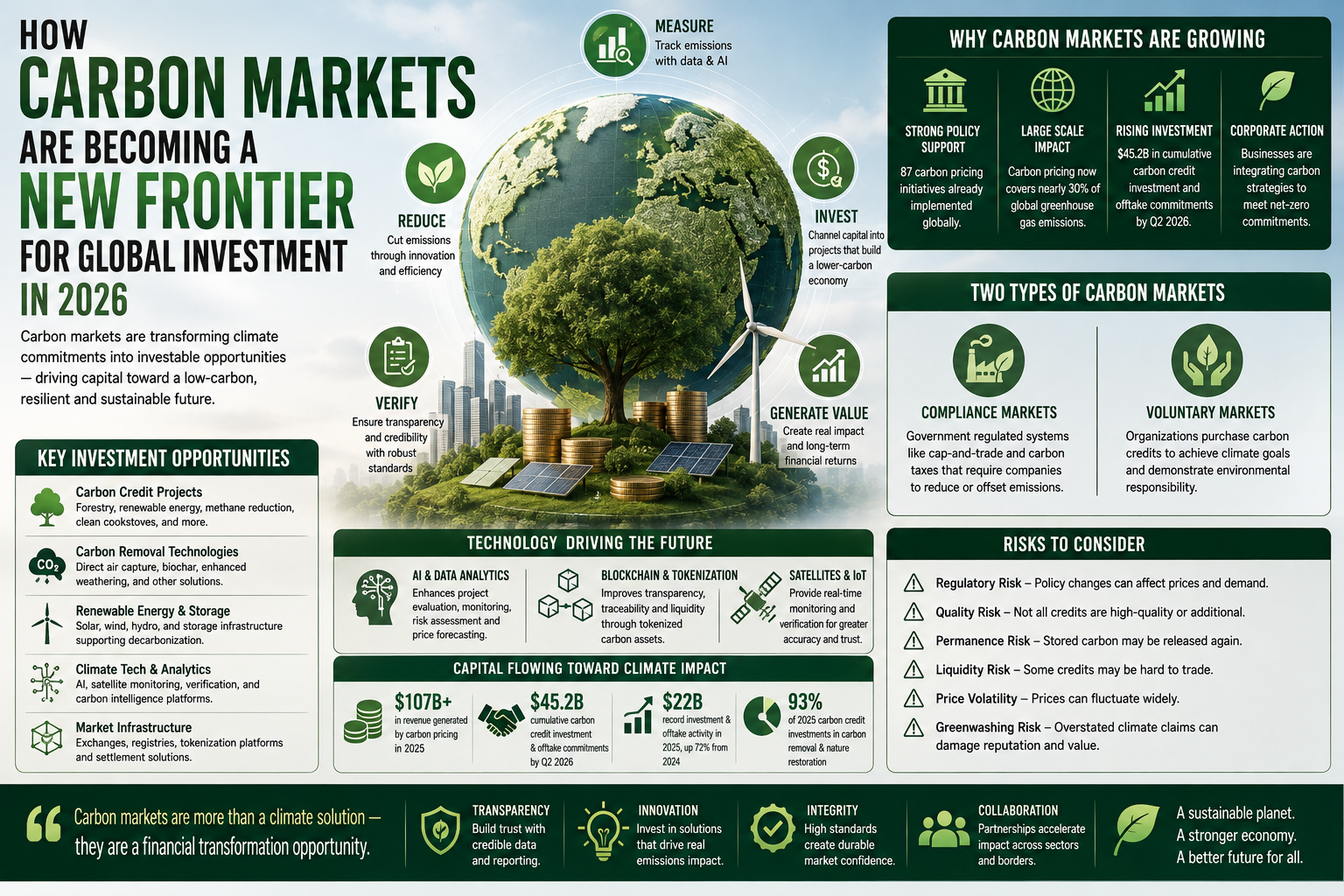
Carbon markets are moving from a relatively specialized environmental policy tool toward a broader financial ecosystem attracting corporations, project developers, investors, banks, and institutional capital.
The basic idea is straightforward: put a financial value on greenhouse-gas emissions and create mechanisms through which emissions can be reduced, avoided, or compensated. But the market has become increasingly sophisticated, with emissions-trading systems, carbon taxes, carbon-crediting mechanisms, project finance, long-term offtake agreements, and emerging digital infrastructure all playing a role.
In 2026, the opportunity is becoming particularly significant for investors. The World Bank reports that direct carbon pricing now covers nearly 30% of global greenhouse-gas emissions across 87 implemented policies, while carbon pricing generated more than $107 billion in public revenue during 2025.
At the same time, private capital is flowing into projects intended to generate future carbon credits. MSCI reports that cumulative investment and offtake commitments reached $45.2 billion by Q2 2026, with investment accounting for $38.1 billion and offtake agreements exceeding $7 billion.
These developments suggest that carbon markets are becoming an increasingly important intersection between climate policy, technology, commodities, and finance.
What Are Carbon Markets?
Carbon markets are systems that assign economic value to greenhouse-gas emissions.
There are two major categories.
Compliance Markets
Compliance markets operate under government or regulatory frameworks.
Companies may be required to obtain emissions allowances or comply with defined carbon-pricing mechanisms.
Examples include emissions-trading systems and carbon taxes.
Voluntary Carbon Markets
Voluntary markets allow companies and other organizations to purchase carbon credits to support climate-related objectives.
A carbon credit generally represents a quantified reduction, removal, or avoidance of greenhouse-gas emissions, subject to the methodology and standard governing the project.
The two markets have different rules and purposes, but both are becoming increasingly important to global climate finance.
Why Carbon Markets Are Growing
Governments are introducing or expanding carbon-pricing systems as part of broader climate policies.
The World Bank's 2026 carbon-pricing report says that all large middle-income economies now have either implemented or are planning direct carbon-pricing instruments.
This creates a growing economic incentive for companies to reduce emissions.
As carbon becomes more financially significant, businesses increasingly need to consider carbon costs when making decisions about:
Energy
Manufacturing
Transportation
Supply chains
Infrastructure
Technology
Capital investment
Carbon markets therefore have implications far beyond environmental departments.
Carbon Markets as an Investment Opportunity
Investors are increasingly looking beyond traditional stocks and bonds for exposure to emerging markets connected to the energy transition.
Carbon markets can provide opportunities across several areas:
Carbon-credit projects
Carbon-removal technologies
Renewable-energy projects
Forest conservation
Methane reduction
Biochar
Direct-air capture
Carbon-capture infrastructure
Market infrastructure and analytics
MSCI reported that global carbon-credit investment and offtake activity reached a record $22 billion in 2025, up 72% from 2024.
This does not mean carbon credits are automatically attractive investments. Project quality, regulatory developments, verification, delivery, and market demand remain critical.
The Rise of Carbon Removal
One of the most interesting developments is the growing investment in carbon-removal projects.
Traditional carbon projects have often focused on reducing or avoiding emissions.
Carbon removal takes a different approach by removing carbon dioxide from the atmosphere and storing it.
Technologies and approaches include:
Direct-air capture
Biochar
Reforestation
Afforestation
Enhanced weathering
Other engineered or nature-based removals
MSCI's analysis shows that carbon engineering and nature restoration together represented 93% of tracked 2025 carbon-credit deal activity, with $10.3 billion in carbon engineering and $10.1 billion in nature restoration.
This demonstrates how capital is increasingly moving toward projects that could generate future carbon-removal supply.
Corporate Offtake Agreements
A major development is the rise of long-term carbon-credit offtake agreements.
Instead of waiting for credits to become available on the spot market, companies can agree to purchase future credits from specific projects.
This provides developers with greater certainty about future demand and can help finance projects before they are fully operational.
MSCI reports that cumulative announced offtake agreements had reached more than $7 billion by Q2 2026, approximately 15 times the level recorded in 2022.
For investors, this creates another way of participating in carbon markets through project financing and forward contracts.
Carbon Pricing and Corporate Strategy
Carbon markets can influence corporate investment decisions.
A company evaluating a new manufacturing facility, energy source, or supply chain may increasingly need to consider future carbon costs.
If carbon prices rise, high-emission operations can become more expensive.
This can improve the economic case for:
Renewable energy
Energy efficiency
Electrification
Low-carbon manufacturing
Carbon capture
Cleaner transportation
Carbon pricing can therefore influence capital allocation throughout the economy.
AI Is Entering Carbon Markets
Artificial intelligence can make carbon markets more data-driven.
Carbon projects require significant amounts of information.
AI can potentially analyze:
Satellite imagery
Environmental measurements
Project documentation
Emissions data
Land-use changes
Weather information
Historical project performance
For investors, these tools could improve due diligence.
For project developers, AI could help monitor projects and identify changes that require investigation.
However, AI-generated analysis cannot replace independent verification where regulatory or market standards require it.
Blockchain and Tokenized Carbon Credits
Blockchain technology is another emerging component of carbon markets.
A carbon credit can potentially be represented digitally on a blockchain, creating a transparent record of issuance, transfer, and retirement.
Tokenization could potentially improve:
Transaction tracking
Market accessibility
Settlement
Transparency
Digital ownership records
But blockchain does not automatically guarantee that a carbon credit is legitimate.
The underlying project still needs credible measurement, reporting, verification, and governance.
A fraudulent or low-quality credit does not become high-quality simply because it is represented by a blockchain token.
The Importance of Carbon-Credit Quality
Quality is becoming one of the most important issues in the market.
Investors and corporate buyers want confidence that a credit represents a genuine climate benefit.
Important considerations include:
Additionality
Permanence
Measurement
Verification
Leakage
Project governance
Double counting
Delivery risk
The Columbia Center on Global Energy Policy noted in 2026 that concerns about carbon-credit credibility have slowed market growth and that stronger safeguards could help create more liquid and scalable markets.
This means the future market may increasingly reward high-integrity credits rather than simply large quantities of inexpensive credits.
Managing Permanence Risk
Nature-based carbon projects face a specific challenge: stored carbon can potentially be released again.
A forest can burn.
A project can experience environmental damage.
Land-use conditions can change.
This creates permanence risk.
Recent developments in carbon-market governance are exploring stronger mechanisms including insurance, permanence trusts, conservation easements, and longer monitoring obligations.
Investors therefore need to consider not just whether a project generates credits but how long the claimed climate benefit is expected to remain valid.
Carbon Markets and Institutional Investors
Institutional investors can participate in the carbon ecosystem through several channels.
They may invest in:
Carbon-credit developers
Carbon-removal companies
Climate infrastructure
Carbon-market platforms
Energy-transition projects
Specialized investment funds
The investment case can be different from traditional commodity investing.
Carbon markets are heavily influenced by regulation and climate policy.
This means investors need expertise in both financial markets and environmental policy.
The Role of Regulation
Regulation will remain one of the biggest forces shaping carbon markets.
Governments determine how compliance markets operate, while international frameworks influence cross-border carbon-credit activity.
The Paris Agreement's Article 6 mechanisms are particularly important for international carbon-market cooperation.
In April 2026, UNIDO and the Paris Agreement Article 6 Implementation Partnership announced cooperation aimed at strengthening high-integrity carbon markets and expanding climate finance for industrial decarbonization.
Greater regulatory clarity could increase confidence among institutional investors.
Carbon Markets and Emerging Economies
Developing economies could play a major role in the next phase of carbon markets.
Many carbon-reduction and removal opportunities are located in emerging markets because of their forests, agricultural systems, renewable-energy potential, and industrial-development needs.
Carbon finance can potentially provide additional capital for these projects.
However, investors need to evaluate political risk, regulatory stability, land rights, project governance, and verification quality.
The objective should be to create markets that provide genuine climate benefits while supporting sustainable economic development.
The Risks Investors Need to Understand
Carbon markets can provide opportunities, but they also involve significant risks.
Regulatory Risk
Policy changes can affect demand and prices.
Quality Risk
Low-quality credits may lose market value.
Permanence Risk
Some projects can experience reversals.
Liquidity Risk
Certain carbon credits may be difficult to sell.
Price Risk
Carbon-credit prices can vary substantially by project type and market.
Greenwashing Risk
Companies can face reputational damage if climate claims are not credible.
Technology Risk
New carbon-removal technologies may not perform as expected.
Investors need detailed due diligence rather than relying solely on headline market growth.
The Future of Carbon Finance
Carbon markets are gradually becoming more sophisticated.
The future could involve an ecosystem combining:
Carbon pricing + project finance + AI monitoring + blockchain infrastructure + institutional capital + climate policy
Technology could make markets more transparent.
Better verification could improve trust.
Long-term offtake agreements could provide project developers with financing.
Institutional investors could provide capital for projects that require significant upfront investment.
At the same time, regulators will need to maintain strong standards.
Conclusion
Carbon markets are emerging as an increasingly important part of the global financial system.
Direct carbon pricing now covers nearly 30% of global emissions, while billions of dollars are being committed to carbon-credit projects and future offtake agreements.
The investment opportunity extends beyond buying carbon credits.
It includes carbon-removal technologies, climate infrastructure, project development, data platforms, verification systems, and financial services supporting the market.
Artificial intelligence and blockchain could further transform how carbon projects are monitored, verified, traded, and financed.
But market growth will ultimately depend on trust.
Investors and corporate buyers need confidence that credits represent genuine climate benefits, that projects can deliver what they promise, and that regulatory frameworks provide consistent standards.
The carbon market of the future is therefore unlikely to be simply a marketplace for environmental credits.
It could become a sophisticated financial ecosystem connecting climate policy, technology, commodities, infrastructure, and institutional capital.
In 2026, that transformation is already underway.
For investors willing to understand both the financial and environmental dimensions, carbon markets could become one of the most important new frontiers in the global transition toward a lower-carbon economy.
, voluntary carbon market, compliance carbon market, AI carbon markets, blockchain carbon credits, tokenized carbon credits, ESG investing, climate investment, carbon trading, sustainability finance, energy transition.