
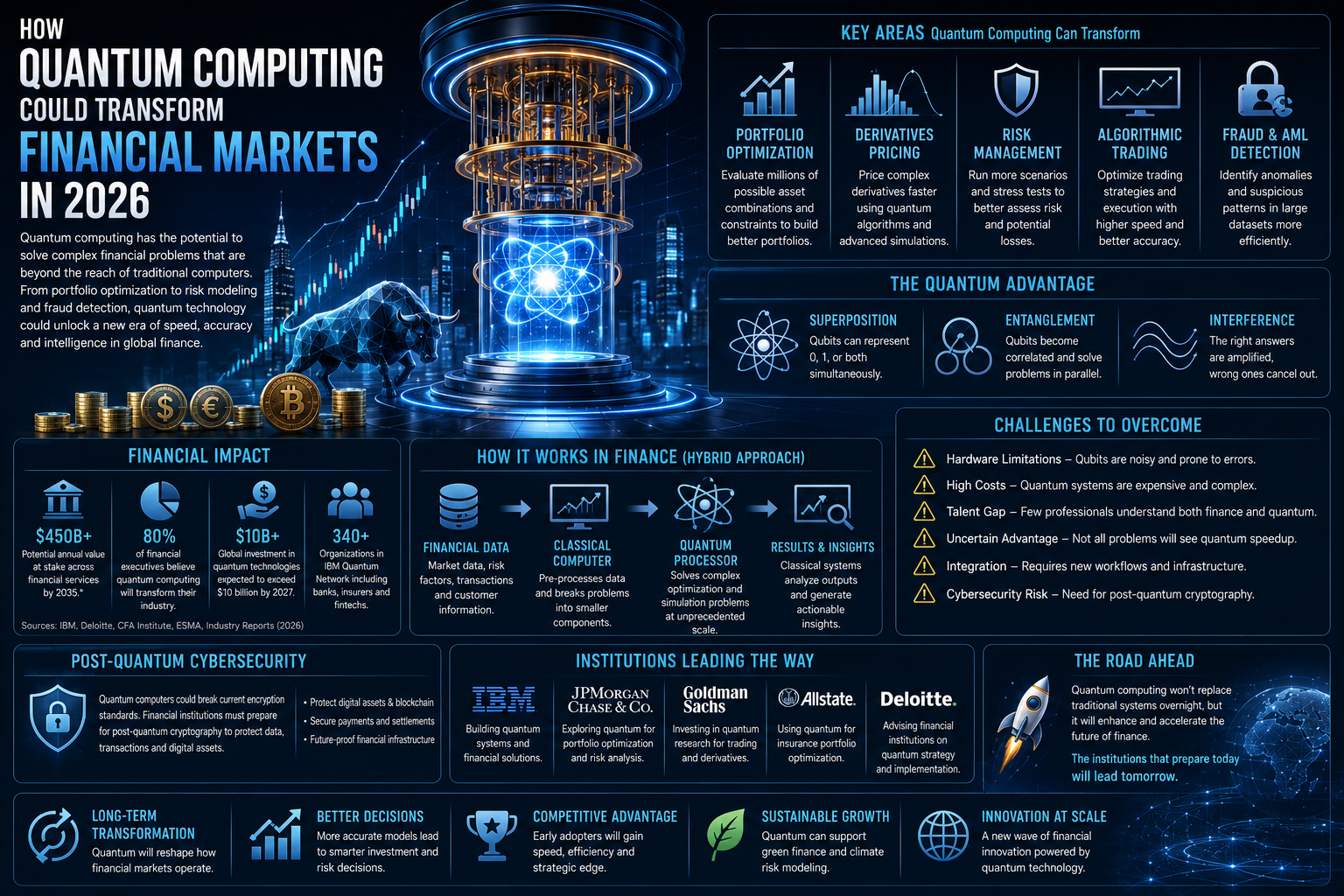
Financial markets are built on complex calculations. Portfolio managers need to evaluate thousands of possible asset combinations, banks calculate the prices and risks of derivatives, insurers model potential losses, and financial institutions run increasingly sophisticated fraud and risk systems.
Traditional computers are powerful enough to handle many of these tasks, but some financial problems become extremely difficult as the number of variables and possible outcomes increases.
This is where quantum computing is attracting growing attention.
Quantum computers use quantum-mechanical principles to process certain types of problems differently from conventional computers. In finance, researchers and financial institutions are investigating whether this approach could improve optimization, simulation, pricing, risk analysis, and other computationally intensive workflows.
The opportunity is significant, but it is important to distinguish between potential quantum advantage and commercially proven advantage. A 2026 European Securities and Markets Authority analysis notes that many proposed financial applications remain experimental and that practical speedups over classical methods are still an open question in several areas.
What Is Quantum Computing?
Traditional computers process information using bits represented as 0 or 1.
Quantum computers use qubits, which can exploit quantum properties such as superposition and entanglement.
This does not mean quantum computers are simply faster versions of conventional computers.
Their potential advantage comes from using specialized algorithms for particular classes of problems.
For financial institutions, the most interesting opportunities involve problems where the number of possible combinations or scenarios becomes extremely large.
These include portfolio optimization, derivatives pricing, risk simulations, and certain machine-learning applications.
Why Finance Is Interested in Quantum Technology
Financial institutions constantly solve optimization and simulation problems.
A portfolio manager might need to choose hundreds of securities while considering:
Expected returns
Volatility
Correlations
Liquidity
Transaction costs
Regulatory constraints
Position limits
Investor objectives
As constraints increase, the number of possible portfolio configurations can become enormous.
Quantum algorithms may eventually help explore some of these complex search spaces more efficiently.
IBM identifies targeting and prediction, trading optimization, and risk profiling among the major financial-services areas being explored for quantum computing.
Quantum Portfolio Optimization
Portfolio optimization is one of the most frequently discussed applications.
Traditional optimization techniques can already solve many portfolio problems effectively.
However, more complicated portfolios can include numerous constraints.
For example, an institutional investor may want to maximize expected return while limiting:
Sector concentration
Turnover
Transaction costs
Risk exposure
Minimum and maximum holdings
Quantum optimization algorithms can potentially help search through these combinations.
Recent research published in npj Unconventional Computing has examined quantum stochastic approaches to portfolio optimization, while also highlighting limitations of traditional mean-variance methods in certain practical settings.
The realistic near-term model is likely to be hybrid: quantum systems handle specific optimization components while classical computers perform other calculations.
Derivatives Pricing
Derivatives are another area where quantum computing could have substantial long-term potential.
Options and other derivatives often require complex mathematical models.
Pricing can involve simulating many possible future market conditions.
Banks may need to calculate:
Option prices
Credit valuation adjustments
Market risk
Hedging requirements
Expected exposures
Quantum algorithms involving amplitude estimation and quantum Monte Carlo methods are being studied for these problems.
A 2026 study examining multi-option portfolio pricing and credit valuation adjustments explored quantum algorithms designed to improve statistical estimation for complex derivatives calculations.
This is one area where researchers see a particularly interesting potential advantage.
Risk Management
Financial institutions constantly ask:
What happens if markets move dramatically?
Risk teams run thousands or millions of scenarios involving interest rates, currencies, equities, commodities, credit spreads, and other variables.
The objective is to estimate potential losses and determine how much capital should be held against different risks.
Quantum computing could eventually accelerate certain types of probability and scenario calculations.
IBM identifies risk profiling as one of the major areas where financial institutions are investigating quantum technology.
This could become especially valuable for banks and insurers that need to perform large-scale stress tests.
Fraud Detection and Anomaly Detection
Quantum computing is also being explored for machine-learning applications.
Financial institutions process enormous quantities of transactions.
Systems must identify suspicious patterns while minimizing false positives.
Potential quantum applications include:
Fraud detection
Anomaly detection
Customer segmentation
Risk classification
Pattern recognition
However, quantum machine learning remains less mature than some optimization and simulation applications.
Financial institutions are therefore likely to experiment with hybrid AI and quantum workflows rather than immediately replacing conventional machine-learning systems.
Quantum Computing and Algorithmic Trading
Trading systems depend on speed, optimization, and data analysis.
Quantum computing could potentially help optimize trading decisions under complex constraints.
Research and industry experiments are already examining quantum-enabled trading optimization.
IBM's financial-services research identifies asset-trading optimization as one of the areas being tested experimentally.
However, quantum computing is unlikely to simply replace high-frequency trading infrastructure.
Classical computing remains extremely efficient for many trading tasks.
The more realistic opportunity may be using quantum systems for specific optimization problems that are difficult to solve efficiently through conventional methods.
Hybrid Quantum-Classical Finance
The most realistic path toward quantum finance is not a complete replacement of classical computers.
Instead, financial institutions can combine both technologies.
A future workflow might look like:
Classical computer → prepares financial data → quantum processor → solves specialized optimization → classical system → analyzes results
This approach allows institutions to use quantum processors only where they provide potential value.
The CFA Institute highlighted hybrid quantum-classical methods as an important near-term approach for optimization, scenario generation, and other financial applications.
Quantum Computing and AI
AI and quantum computing could eventually complement one another.
AI is particularly effective at pattern recognition, prediction, language processing, and data analysis.
Quantum computing may be useful for certain optimization and simulation problems.
A financial institution could therefore combine:
AI + classical computing + quantum optimization
For example, an AI model could identify investment opportunities while a quantum optimization system evaluates how to allocate capital under complex constraints.
This is still an emerging concept, but it illustrates how financial computing could become increasingly heterogeneous.
Insurance Could Benefit
Insurance companies face some of the most complex risk calculations in finance.
They need to model correlated risks involving:
Natural disasters
Healthcare
Property
Interest rates
Longevity
Catastrophic events
IBM and Allstate published research in 2026 exploring how quantum computing could help construct better insurance portfolios using optimization techniques.
Insurance could therefore become an important early testing ground for quantum finance.
Post-Quantum Cybersecurity
Quantum computing presents another financial challenge.
The same technology that could eventually improve financial calculations could threaten some existing cryptographic systems.
Banks, exchanges, custodians, payment networks, and blockchain systems rely heavily on cryptography to protect information and authorize transactions.
If sufficiently powerful quantum computers become available, some current cryptographic methods could become vulnerable.
This creates the need for post-quantum cryptography.
Financial institutions cannot necessarily wait until powerful quantum computers arrive.
Migrating large infrastructure to new cryptographic standards can take years.
Blockchain and Digital Assets
Quantum computing is particularly relevant to digital assets because blockchain networks rely heavily on cryptographic algorithms.
If quantum-capable attackers eventually become powerful enough to break certain cryptographic assumptions, some digital-asset systems could face security challenges.
This means the development of quantum-resistant blockchain infrastructure could become increasingly important.
For BullNext's audience, this creates an interesting connection between two major technology trends:
Blockchain innovation today and quantum security tomorrow.
Commercial Investment Is Increasing
Financial institutions are not waiting for quantum technology to become completely mature before experimenting with it.
IBM's 2026 quantum roadmap targets early examples of quantum advantage through integration with high-performance computing.
IBM also announced in June 2026 that its quantum ecosystem had grown to more than 340 Quantum Network members, including organizations from financial services and other industries.
Meanwhile, recent reporting indicates that companies are increasing commercial investment in quantum computing as they prepare for potential future applications.
This suggests that financial institutions increasingly view quantum computing as a strategic technology rather than purely an academic experiment.
The Current Limitations
Despite the excitement, quantum finance has substantial limitations.
Hardware
Current quantum computers remain constrained by noise, error rates, and scalability.
Cost
Quantum hardware and specialized expertise can be expensive.
Talent
Financial institutions need professionals who understand both finance and quantum computing.
Uncertain Advantage
Classical algorithms continue to improve rapidly.
Integration
Quantum systems must integrate with existing financial infrastructure.
Regulation
Financial institutions will need to validate and govern quantum-generated outputs.
These challenges mean adoption will likely be gradual.
Where Quantum Finance Could Have the Biggest Impact
The strongest opportunities may emerge in areas where computational complexity is genuinely limiting existing systems.
Potential high-value applications include:
Portfolio optimization
Derivatives pricing
Liquidity optimization
Risk analysis
Fraud and anomaly detection
Insurance portfolio optimization
Scenario generation
Post-quantum cybersecurity
Deloitte's analysis of more than 50 financial-services use cases identifies derivative pricing, liquidity optimization, portfolio optimization, risk analysis, supervised anomaly detection, and unsupervised anomaly detection among the highest-priority areas based on business impact and technical feasibility.
What Financial Institutions Should Do Now
Financial institutions do not necessarily need to purchase quantum computers today.
Instead, they can begin preparing by identifying problems where quantum computing could eventually create value.
Organizations can:
Build internal quantum expertise
Test small proof-of-concepts
Work with quantum technology providers
Identify optimization bottlenecks
Develop hybrid computing workflows
Evaluate post-quantum security requirements
Train investment and risk teams
Early preparation can help institutions understand where the technology is genuinely useful.
The Future of Quantum Finance
The future is unlikely to be a world where every financial calculation runs on a quantum computer.
Instead, financial institutions may operate heterogeneous computing environments.
Classical CPUs and GPUs will handle conventional workloads.
AI accelerators will process machine-learning applications.
Quantum processors will tackle selected problems where their algorithms offer an advantage.
Cloud platforms could allow financial institutions to access quantum resources without owning the underlying hardware.
This model could gradually integrate quantum computing into existing financial infrastructure.
Conclusion
Quantum computing could become one of the most significant long-term technologies for financial markets.
Its potential applications span portfolio optimization, derivatives pricing, risk management, fraud detection, trading optimization, insurance modeling, and cybersecurity.
But the industry should remain realistic.
Quantum computers have not yet replaced classical financial systems, and practical quantum advantage remains uncertain for many applications. Current research increasingly points toward hybrid quantum-classical workflows rather than wholesale replacement of conventional computing.
The opportunity is nevertheless substantial.
Financial institutions that begin experimenting today can build the skills, infrastructure, and governance required to take advantage of future developments.
At the same time, they need to prepare for the security implications of quantum computing.
The most important question for financial institutions is therefore not simply “When will quantum computers become powerful?”
It is:
“Which financial problems should we be preparing to solve with quantum technology?”
In 2026, that question is moving from academic research into corporate strategy.
As quantum hardware improves and hybrid systems become more practical, the technology could reshape some of the most computationally demanding parts of finance—creating new possibilities for investment optimization, risk management, pricing, and financial security.