
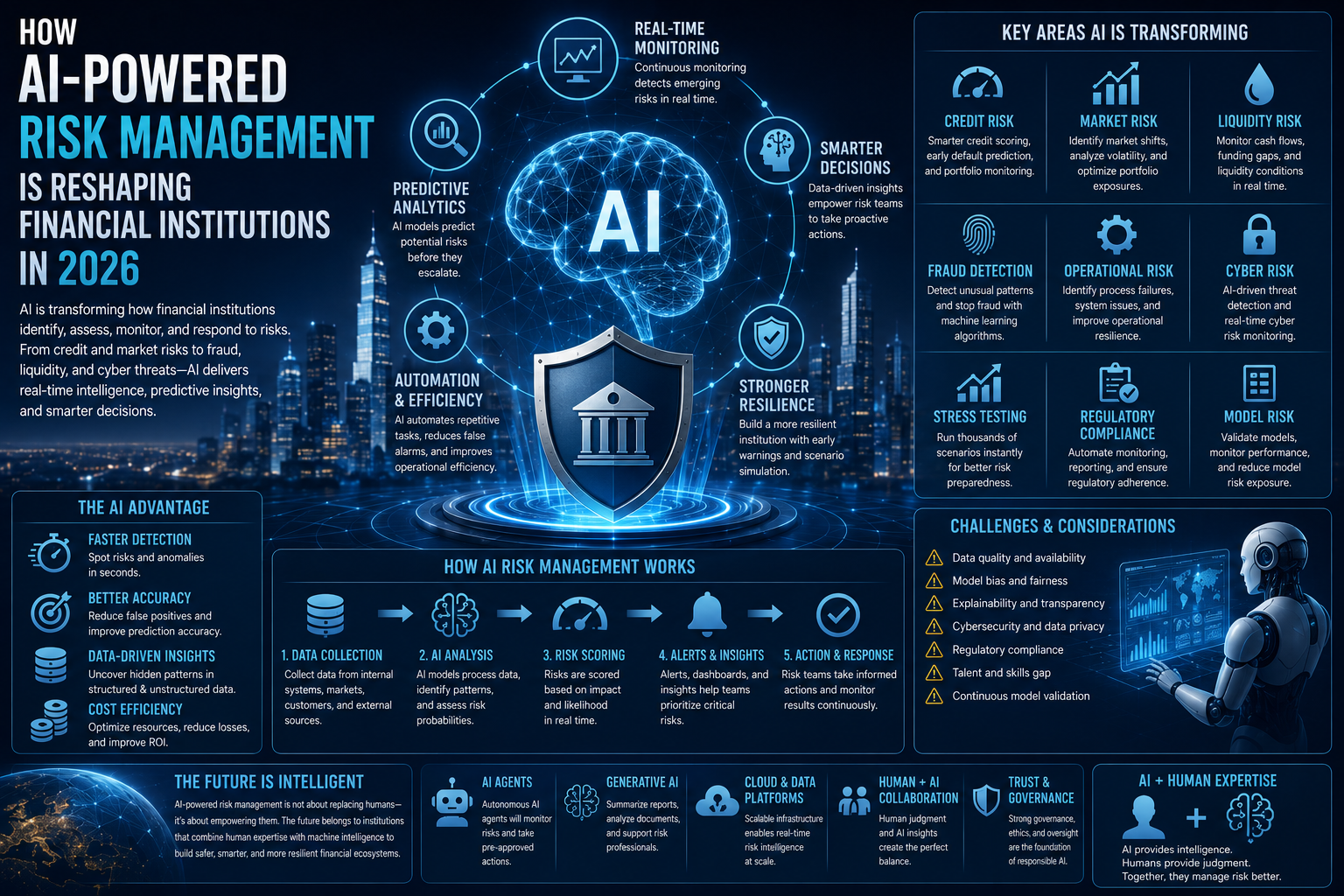
Financial institutions operate in an environment where risks can change within minutes. Interest rates, currencies, market prices, credit conditions, cyber threats, liquidity, and customer behavior can all shift rapidly.
Traditional risk-management systems remain essential, but they often depend on historical data, predefined rules, and periodic analysis. Artificial intelligence is changing that model by allowing banks, insurers, asset managers, payment companies, and other financial institutions to analyze larger datasets and identify emerging risks faster.
In 2026, AI-powered risk management is moving toward continuous monitoring, predictive analytics, automated alerts, and intelligent decision support.
The objective is not to eliminate human risk professionals. Instead, AI can help them identify important signals earlier and focus their attention on the risks that matter most.
What Is AI-Powered Risk Management?
AI-powered risk management uses artificial intelligence and machine learning to identify, analyze, monitor, and predict financial and operational risks.
Applications include:
Credit-risk assessment
Market-risk monitoring
Liquidity management
Fraud detection
Cybersecurity
Stress testing
Operational-risk analysis
Regulatory compliance
Portfolio monitoring
Traditional systems often ask:
“What happened?”
AI-powered systems can also ask:
“What is changing?”
and potentially:
“What could happen next?”
That predictive capability is one of the most important reasons financial institutions are investing in AI.
Why Traditional Risk Systems Are Changing
Financial institutions generate enormous quantities of information.
A bank can process millions of transactions.
An asset manager may monitor thousands of securities.
An insurer may analyze claims, policies, weather patterns, and demographic information.
A payment company can process transactions across multiple countries and currencies.
Conventional systems can struggle when data becomes increasingly complex and unstructured.
AI can help combine different information sources and identify relationships that may be difficult to detect manually.
Real-Time Risk Monitoring
One of AI's biggest advantages is continuous monitoring.
Traditional risk reports may be produced daily, weekly, or monthly.
AI systems can analyze relevant data continuously.
For example, a financial institution could monitor:
Market prices
Credit spreads
Transaction activity
Liquidity
Customer behavior
Cybersecurity signals
Economic indicators
If conditions change significantly, the system can generate an alert.
This allows risk teams to investigate emerging issues before they become larger problems.
AI and Credit Risk
Credit risk remains one of the most important risks for banks and lenders.
Institutions need to estimate whether borrowers will repay their obligations.
Traditional credit models often rely on financial history and predefined variables.
AI can analyze a wider range of information.
Potential inputs include:
Income
Debt
Payment history
Cash flow
Transaction behavior
Industry conditions
Macroeconomic trends
This can potentially improve risk segmentation.
However, financial institutions must ensure that AI models do not introduce inappropriate bias or rely on unreliable information.
Predictive Credit Risk
The next stage goes beyond assessing a borrower's current condition.
AI can attempt to identify signs that financial health may deteriorate.
For example, a company could show:
Declining cash flow
Increasing debt
Slower customer payments
Falling sales
Rising costs
Individually, each signal might appear manageable.
AI can combine them and identify a potentially significant change in credit risk.
This can give lenders more time to respond.
AI and Market Risk
Market risk comes from changes in financial-market conditions.
Examples include movements in:
Interest rates
Equities
Bonds
Currencies
Commodities
Digital assets
AI can monitor relationships between these variables.
It can also identify unusual correlations or volatility changes.
For portfolio managers, this can help reveal exposures that may not be obvious during normal market conditions.
AI-Powered Stress Testing
Financial institutions regularly perform stress tests.
They ask questions such as:
What happens if interest rates rise sharply?
What if equity markets fall significantly?
What if credit defaults increase?
What if liquidity disappears from an important market?
AI can help institutions generate and analyze large numbers of scenarios.
Instead of relying only on a limited number of predefined scenarios, financial institutions can potentially explore a broader range of conditions.
The technology does not predict exactly what will happen.
Instead, it helps institutions understand how vulnerable their portfolios and operations could be.
Liquidity Risk
Liquidity can disappear quickly during periods of financial stress.
A company may own valuable assets but still face problems if those assets cannot be converted into cash quickly enough.
AI can monitor:
Cash balances
Withdrawals
Funding requirements
Market liquidity
Customer behavior
Asset concentration
An AI system could detect unusual withdrawal patterns or changes in funding conditions.
This provides risk teams with earlier warning signals.
Fraud Detection
AI has become increasingly important in fraud prevention.
Traditional fraud systems often use rules.
For example:
Transaction above a certain amount → investigate.
AI can analyze behavior more dynamically.
It can identify unusual combinations of:
Transaction size
Location
Device
Account behavior
Timing
Counterparty
Historical activity
This can help distinguish legitimate unusual transactions from potentially fraudulent behavior.
Generative AI for Risk Teams
Generative AI is changing how risk professionals interact with information.
Instead of manually reviewing thousands of documents, analysts can use AI to summarize:
Regulatory updates
Risk reports
Corporate filings
Credit documents
Internal policies
Market developments
A risk analyst could ask:
“Which major risks changed across our portfolio this week?”
The AI system could organize relevant information and highlight areas requiring attention.
Human analysts can then verify the findings.
AI Agents in Financial Risk
AI agents could take automation further.
An AI risk agent could continuously monitor approved data sources, identify anomalies, prepare reports, and escalate important events.
For example:
Market data → AI agent detects unusual volatility → analyzes portfolio exposure → prepares risk summary → alerts risk manager.
The human professional remains responsible for the final decision.
This creates a model of automated monitoring with human governance.
Operational Risk
Not every financial risk comes from markets.
Operational failures can be equally damaging.
Examples include:
Technology outages
Processing errors
Employee mistakes
Vendor failures
Cyberattacks
Data-quality problems
AI can analyze operational data and identify recurring patterns.
If a particular process repeatedly produces errors, an AI system can potentially detect the pattern and recommend investigation.
Cybersecurity and Financial Risk
Cybersecurity is increasingly part of financial risk management.
Banks and financial institutions are attractive targets because they control valuable financial information and payment infrastructure.
AI can monitor network activity and identify suspicious behavior.
Potential applications include:
Threat detection
Account takeover prevention
Malware detection
Anomaly monitoring
Identity verification
Transaction security
However, AI also introduces new cybersecurity risks.
Attackers can use AI to create more sophisticated attacks.
Financial institutions therefore need security systems capable of defending against increasingly automated threats.
AI and Regulatory Compliance
Financial institutions operate under extensive regulatory requirements.
Compliance teams need to monitor transactions, customers, products, and operational processes.
AI can help automate parts of this work.
Applications include:
AML monitoring
Sanctions screening
Regulatory reporting
Document analysis
Customer-risk classification
Transaction monitoring
The technology can reduce manual workloads.
But regulatory responsibility remains with the institution.
AI-generated decisions must therefore be explainable, auditable, and appropriately governed.
The Model-Risk Challenge
AI models themselves can create risk.
A model may produce incorrect predictions.
It may perform well under normal conditions but fail during unusual events.
It may also contain hidden biases or depend on poor-quality data.
This creates the concept of model risk.
Financial institutions therefore need processes to:
Validate models
Monitor performance
Test unusual scenarios
Document assumptions
Detect model drift
Maintain human oversight
The more important the decision, the stronger these controls need to be.
Explainability Matters
A traditional financial rule may be easy to explain.
An AI model can be much more complicated.
If a system rejects a loan or identifies a transaction as high-risk, financial institutions may need to understand why.
Explainable AI can help risk teams understand which factors influenced an output.
This is important not only for regulators but also for internal governance.
Data Quality Is Critical
AI cannot compensate for fundamentally unreliable data.
Financial institutions need high-quality information from:
Internal systems
Market-data providers
Customer records
Transaction databases
Regulatory sources
External datasets
Errors in the underlying data can produce incorrect risk assessments.
Data governance is therefore becoming an essential part of AI risk management.
AI and Systemic Risk
As more financial institutions adopt similar AI models, another issue can emerge.
If many institutions respond to the same signals in the same way, their actions could become correlated.
For example, multiple AI systems might identify the same market risk and recommend similar portfolio adjustments.
If institutions act simultaneously, market movements could become amplified.
This is one reason AI adoption needs to be considered not only at the individual institution level but also at the broader financial-system level.
AI in Insurance
Insurance is another area where AI-powered risk management can have major applications.
Insurers can use AI to analyze:
Claims
Weather data
Property information
Customer behavior
Medical information
Catastrophe models
This can help improve underwriting and claims management.
AI can also support early identification of unusual claims patterns that may indicate fraud.
AI and Wealth Management
Asset managers and wealth platforms can use AI to monitor portfolio risk.
An AI system can evaluate:
Asset allocation
Concentration
Volatility
Correlations
Liquidity
Sector exposure
It can then notify advisors or portfolio managers when a portfolio moves significantly away from its intended risk profile.
This can make risk management more continuous.
AI and Digital Assets
Digital-asset markets create additional risk-management challenges.
Cryptocurrency markets operate continuously and can experience significant volatility.
AI can monitor:
Wallet activity
Exchange flows
Market volatility
Liquidity
Transaction patterns
Counterparty exposure
This can help institutions manage digital-asset portfolios alongside traditional investments.
Building a Human-AI Risk Model
The strongest approach is unlikely to be fully automated risk management.
Instead, institutions can divide responsibilities.
AI handles:
Data processing
Pattern detection
Continuous monitoring
Risk scoring
Alert generation
Scenario analysis
Humans handle:
Strategic judgment
Escalation
Policy decisions
Regulatory interpretation
Model governance
Final high-impact decisions
This combination provides automation without removing accountability.
What Financial Institutions Should Do
Organizations beginning their AI risk journey should start with clearly defined problems.
They can:
Identify repetitive risk processes.
Improve data quality.
Test AI on limited workflows.
Establish model-governance policies.
Keep humans involved in high-impact decisions.
Continuously monitor model performance.
Create strong cybersecurity controls.
Document AI-generated decisions.
This creates a safer path toward broader adoption.
The Future of Intelligent Risk Management
Financial institutions are moving toward risk systems that operate continuously rather than periodically.
The future could look like:
Real-time data → AI analysis → predictive risk assessment → automated alert → human decision → continuous monitoring
This model can help institutions respond faster to changing conditions.
It can also make risk management more proactive.
Instead of waiting for a loss to appear in a monthly report, institutions can attempt to identify the conditions that may lead to that loss.
Conclusion
AI-powered risk management is becoming a major component of modern financial infrastructure.
Banks, insurers, asset managers, payment companies, and fintech platforms can use AI to monitor risks, analyze complex datasets, detect fraud, forecast credit problems, run scenarios, and improve regulatory workflows.
The technology's biggest value may be its ability to turn risk management from a periodic reporting process into a continuous intelligence system.
But AI does not remove financial risk.
It creates new responsibilities around data quality, model validation, cybersecurity, explainability, governance, and systemic behavior.
The institutions that gain the greatest advantage will therefore not necessarily be those that automate the most.
They will be those that combine high-quality data, advanced AI, experienced risk professionals, strong governance, and disciplined decision-making.
In 2026, the future of financial risk management is becoming increasingly intelligent—but the most effective systems will remain human-governed.