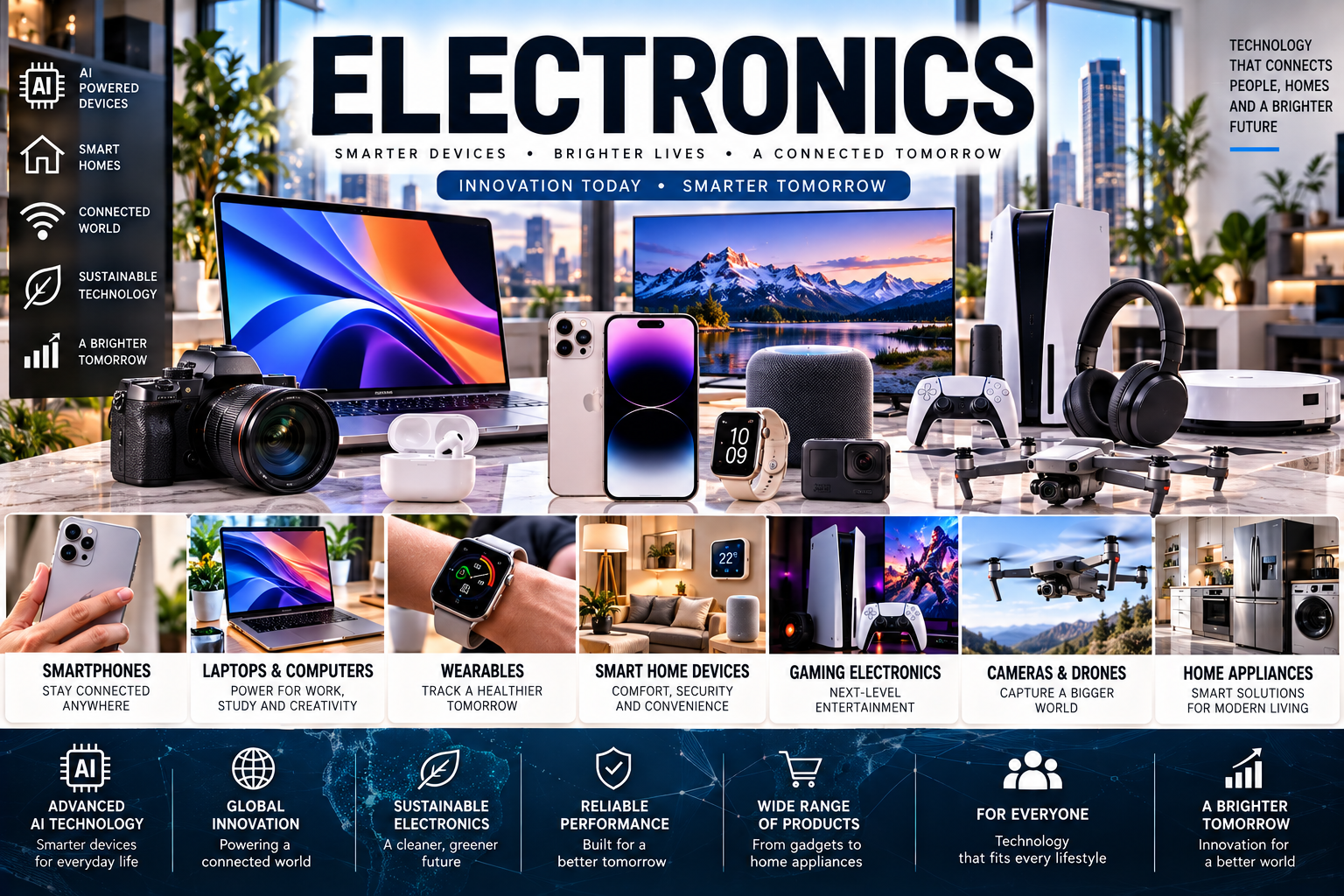
Electronics have become an essential part of modern life, connecting people, businesses, homes, vehicles, healthcare systems, entertainment platforms, and industrial operations. From smartphones and laptops to smart appliances, wearable devices, gaming systems, connected vehicles, and artificial intelligence hardware, electronics continue to transform how people work and live.
The electronics industry is also undergoing a major shift in 2026. Artificial intelligence is increasing demand for advanced processors, memory, networking equipment, data-center infrastructure, and edge-computing devices. At the consumer level, smartphones, PCs, wearables, smart-home products, audio devices, and connected technologies continue to evolve. Deloitte describes AI as a major force reshaping hardware and consumer technology in 2026.
What Are Electronics?
Electronics refers to devices and systems that use electrical circuits, semiconductors, sensors, processors, batteries, displays, communications components, and other technologies to perform specific functions.
Electronics can range from very small components to complex systems.
Major categories include:
Smartphones
Computers
Tablets
Televisions
Audio equipment
Wearables
Smart-home devices
Gaming hardware
Cameras
Appliances
Automotive electronics
Medical electronics
Industrial electronics
Semiconductor components
Networking equipment
AI hardware
The industry combines hardware, software, connectivity, data, and increasingly artificial intelligence.
The Global Electronics Industry
The electronics industry is one of the world's largest technology ecosystems.
It includes companies involved in:
Semiconductor design
Chip manufacturing
Component production
Device assembly
Software integration
Hardware distribution
Retail
Cloud infrastructure
Telecommunications
Consumer technology
Industrial technology
The semiconductor sector is particularly important because processors and memory chips are fundamental components of modern electronic products.
Gartner's September 2026 forecast projects worldwide semiconductor revenue of about $1.68 trillion for 2026, with memory remaining a major driver and GPUs and dedicated AI accelerators continuing to benefit from AI infrastructure investment.
Consumer Electronics
Consumer electronics are products designed primarily for individuals and households.
Major categories include:
Smartphones
Smartphones combine computing, cameras, communications, entertainment, payments, navigation, and AI features in a portable device.
Laptops and PCs
Computers remain central to education, business, gaming, content creation, engineering, and professional work.
Tablets
Tablets occupy a space between smartphones and traditional computers and are widely used for entertainment, education, productivity, and creative work.
Televisions
Modern televisions increasingly combine large displays with streaming platforms, gaming capabilities, internet connectivity, and smart-home integration.
Audio Devices
The audio category includes:
Wireless earbuds
Headphones
Speakers
Soundbars
Home audio systems
Gaming Electronics
Gaming hardware includes:
Consoles
Gaming PCs
Handheld devices
Controllers
VR headsets
Gaming monitors
Accessories
Electronics and Artificial Intelligence
Artificial intelligence is becoming one of the most important forces shaping the electronics industry.
AI requires substantial computing power, which increases demand for specialized processors, memory, networking equipment, cooling systems, and data-center infrastructure.
Deloitte reports that AI infrastructure demand is driving growth in enterprise hardware, while data centers are increasingly being designed around higher power requirements, liquid cooling, and faster optical networking.
AI is also moving into consumer electronics.
Examples include:
AI smartphones
AI PCs
AI-enabled cameras
Smart glasses
AI earbuds
Smart home assistants
AI-powered televisions
Intelligent appliances
On-device AI
AI-Native Consumer Devices
The electronics industry is experimenting with devices designed around AI rather than simply adding AI as an extra feature.
Deloitte highlights emerging AI-native devices such as smart glasses with translation capabilities, voice-enabled devices, and other new wearable formats. At the same time, adoption remains uncertain as consumers evaluate whether they need separate AI devices or prefer AI functionality integrated into smartphones and earbuds.
This creates an important design question for electronics manufacturers:
Should AI be a feature inside existing devices, or should AI create entirely new device categories?
The answer may shape the next generation of consumer electronics.
Smartphones and Mobile Electronics
Smartphones remain one of the most important electronics categories globally.
Modern smartphones increasingly combine:
Advanced processors
AI capabilities
High-resolution cameras
OLED displays
5G connectivity
Satellite connectivity
Biometric security
Mobile payments
Advanced battery systems
However, the smartphone market also faces component-cost pressures.
Deloitte's 2026 hardware outlook notes that memory shortages and higher memory costs could weigh on smartphone production and contribute to higher average selling prices.
Computers and AI PCs
Personal computers are also changing as manufacturers integrate AI-focused processors and features.
AI PCs can provide capabilities such as:
On-device AI processing
Image generation
Productivity assistants
Voice processing
Translation
Security functions
Local data analysis
This shift is creating a new category of computing in which some AI workloads can run directly on the device rather than depending entirely on cloud servers.
Wearable Electronics
Wearables are expanding beyond traditional fitness trackers and smartwatches.
The category includes:
Smartwatches
Fitness trackers
Smart rings
Smart glasses
Wireless earbuds
Health-monitoring devices
Connected clothing
Emerging AI wearables
Deloitte reports that 136.5 million wearable units were shipped in the second quarter of 2025, up 9.6% year over year, and expects the category to evolve toward more AI-enhanced and health-focused products.
Smart Home Electronics
Smart-home technology connects household devices through wireless networks and software.
Examples include:
Smart lighting
Security cameras
Smart thermostats
Robot vacuums
Smart speakers
Connected appliances
Video doorbells
Smart locks
Home energy systems
The long-term opportunity is to create an ecosystem where devices communicate with one another.
However, adoption can depend heavily on price, convenience, reliability, privacy, and whether consumers perceive enough practical value from connected products.
Electronics and the Internet of Things
The Internet of Things, or IoT, connects physical devices to networks and software.
IoT electronics are used in:
Homes
Factories
Hospitals
Offices
Vehicles
Agriculture
Logistics
Retail
Sensors can collect information about temperature, movement, location, energy use, equipment performance, and other conditions.
When combined with AI, these systems can potentially analyze information in real time and automate decisions.
Semiconductor Technology
Semiconductors are the foundation of modern electronics.
They power:
CPUs
GPUs
AI accelerators
Memory
Smartphones
PCs
Vehicles
Data centers
Networking systems
Industrial equipment
AI is significantly changing semiconductor demand.
Gartner's August 2026 forecast estimated worldwide semiconductor revenue at approximately $1.56 trillion for 2026, while its later September forecast raised the estimate to approximately $1.68 trillion. The changing forecasts demonstrate how rapidly AI-related semiconductor demand and memory-market conditions are evolving.
Memory Chips
Memory is particularly important for electronics.
Major memory technologies include:
DRAM
NAND flash
High-bandwidth memory
Storage technologies
AI systems require large quantities of memory, particularly for high-performance computing and data-center workloads.
Gartner's August 2026 forecast projected memory revenue of approximately $837 billion for the year and identified memory as the largest contributor to semiconductor revenue growth.
Electronics Manufacturing
Electronics manufacturing involves a complex international supply chain.
A typical product may involve:
Chip Design → Semiconductor Manufacturing → Components → Assembly → Testing → Logistics → Retail → Consumer
Important manufacturing regions include Asia, North America, and Europe, with different regions specializing in semiconductor production, components, assembly, design, and advanced manufacturing.
The complexity of these supply chains makes electronics companies sensitive to:
Semiconductor shortages
Shipping disruptions
Energy costs
Raw-material prices
Trade policies
Geopolitical developments
Manufacturing capacity
Electronics and Sustainability
Environmental concerns are becoming increasingly important for the electronics industry.
Major sustainability issues include:
Electronic waste
Battery recycling
Energy consumption
Device longevity
Packaging
Rare minerals
Manufacturing emissions
Product repairability
Manufacturers are exploring recycled materials, energy-efficient components, longer product lifecycles, and improved recycling programs.
Consumers are also paying greater attention to whether devices are durable and repairable.
Electronic Waste
Electronic waste, often called e-waste, includes discarded:
Smartphones
Computers
TVs
Appliances
Batteries
Accessories
Circuit boards
Rapid product cycles can increase electronic waste.
Improving recycling infrastructure and designing products for longer use can help reduce the environmental impact of the electronics industry.
Electronics and Energy Efficiency
Energy efficiency is becoming increasingly important at both the consumer and infrastructure levels.
For consumer devices, better efficiency can extend battery life.
For data centers and AI infrastructure, energy efficiency can reduce operating costs and help manage increasing electricity requirements.
Deloitte notes that AI-driven data-center growth is increasing demand for power, cooling, and advanced networking infrastructure.
Automotive Electronics
Cars are becoming increasingly electronic.
Modern vehicles can contain systems for:
Infotainment
Navigation
Driver assistance
Cameras
Radar
Sensors
Battery management
Connectivity
Digital dashboards
Electric powertrains
Electric vehicles are particularly dependent on advanced electronics and software.
As vehicles become more connected and automated, automotive electronics are becoming an increasingly important part of the broader electronics ecosystem.
Medical Electronics
Electronics also play a critical role in healthcare.
Medical electronics include:
Patient monitors
Imaging systems
Wearable health devices
Diagnostic equipment
Hospital communication systems
Surgical technology
Remote monitoring devices
Wearable technology can also provide consumers with information about activity, sleep, and other health-related measurements, although medical interpretation should remain under appropriate professional guidance.
Gaming Electronics
Gaming continues to drive innovation in consumer electronics.
Modern gaming ecosystems include:
High-performance GPUs
Gaming PCs
Consoles
Handheld gaming systems
High-refresh-rate displays
Virtual reality
Cloud gaming
Gaming accessories
The demand for high-performance graphics and processing also connects gaming technology with the broader semiconductor industry.
Electronics Retail and E-Commerce
The way consumers buy electronics has changed significantly.
Online shopping allows customers to compare:
Prices
Specifications
Reviews
Features
Availability
Warranty options
Retailers increasingly combine physical stores with e-commerce, allowing customers to research products online and purchase through stores, websites, or mobile apps.
Electronics and Consumer Trust
Trust is becoming increasingly important as electronic devices collect and process more personal information.
Privacy and security concerns affect products such as:
Smartphones
Smart speakers
Security cameras
Smart TVs
Wearables
Smart-home devices
Deloitte identifies data responsibility and consumer trust as important factors shaping technology purchasing decisions in 2026.
Companies therefore need to consider cybersecurity, privacy, software updates, transparent data practices, and responsible AI development.
Major Electronics Trends for 2026
1. AI-Powered Devices
Artificial intelligence is moving from software applications into physical consumer products.
2. AI Data-Center Hardware
Demand for GPUs, AI accelerators, memory, networking, cooling, and power systems is reshaping the hardware industry.
3. AI PCs
Computers are increasingly being designed to process AI workloads locally.
4. Smart Wearables
Smartwatches, rings, glasses, earbuds, and other wearable devices are becoming more intelligent.
5. Edge Computing
More processing is moving closer to where data is generated, reducing latency and potentially improving privacy.
6. Connected Homes
Smart appliances and home-security products continue to develop toward more integrated ecosystems.
7. Advanced Semiconductors
The demand for specialized chips continues to increase as AI, vehicles, robotics, and cloud infrastructure become more computationally intensive.
8. Energy Efficiency
Manufacturers are focusing more heavily on power consumption and efficient electronics.
9. Sustainable Electronics
Recycling, repairability, durable products, and responsible materials are receiving greater attention.
10. New Device Form Factors
Smart glasses, AI wearables, foldable devices, and other emerging formats are expanding the definition of consumer electronics.
Challenges Facing the Electronics Industry
The electronics industry has significant growth opportunities but also faces substantial challenges.
These include:
Semiconductor shortages
Memory-price volatility
Supply-chain disruptions
Geopolitical uncertainty
Rising manufacturing costs
Cybersecurity threats
Privacy concerns
Electronic waste
Short product lifecycles
Consumer affordability
Rapid technological change
Gartner's 2026 research highlights how AI demand is reshaping semiconductor supply chains, including memory, advanced packaging, power, cooling, and critical materials.
The Future of Electronics
The future of electronics is likely to be defined by the convergence of hardware, software, AI, connectivity, and automation.
Devices are becoming more intelligent while computing is becoming more distributed.
A future electronics ecosystem may include:
AI Smartphones + AI PCs + Smart Glasses + Wearables + Smart Homes + Connected Vehicles + Edge Computing + Cloud AI
These technologies will increasingly communicate with one another.
At the same time, manufacturers will need to address energy consumption, privacy, cybersecurity, sustainability, affordability, and supply-chain resilience.
Frequently Asked Questions
What are electronics?
Electronics are devices and systems that use electrical circuits, semiconductors, processors, sensors, batteries, displays, and other components to perform specific functions.
What are the main types of electronics?
Major categories include smartphones, computers, televisions, audio equipment, wearables, smart-home devices, gaming hardware, automotive electronics, medical electronics, and industrial systems.
How is AI changing electronics?
AI is increasing demand for specialized processors, memory, networking equipment, data centers, and AI-enabled consumer devices.
What is the role of semiconductors in electronics?
Semiconductors provide the processing, memory, communication, and control capabilities required by modern electronic devices.
Are wearables part of the electronics industry?
Yes. Smartwatches, fitness trackers, smart rings, smart glasses, wireless earbuds, and other connected devices are major wearable-electronics categories.
What are the biggest electronics trends in 2026?
Major trends include AI-powered devices, AI infrastructure, advanced semiconductors, smart wearables, AI PCs, connected homes, edge computing, sustainable electronics, and new device form factors.
Conclusion
Electronics are at the center of the modern technology economy.
From smartphones and computers to semiconductors, smart homes, wearables, vehicles, healthcare systems, and AI infrastructure, electronic technologies are becoming increasingly connected and intelligent.
The 2026 industry is particularly shaped by artificial intelligence. AI is driving demand for advanced chips and data-center hardware while also introducing new possibilities for consumer devices. Deloitte describes AI as a major force reshaping both enterprise hardware and consumer technology, while Gartner's latest semiconductor forecasts show the scale of the investment flowing into the underlying chip ecosystem.
Looking ahead, the electronics industry will likely continue evolving toward smarter, more connected, more efficient, and increasingly AI-enabled products. The companies that successfully balance innovation with affordability, security, sustainability, and consumer trust will play an important role in shaping the next generation of technology.