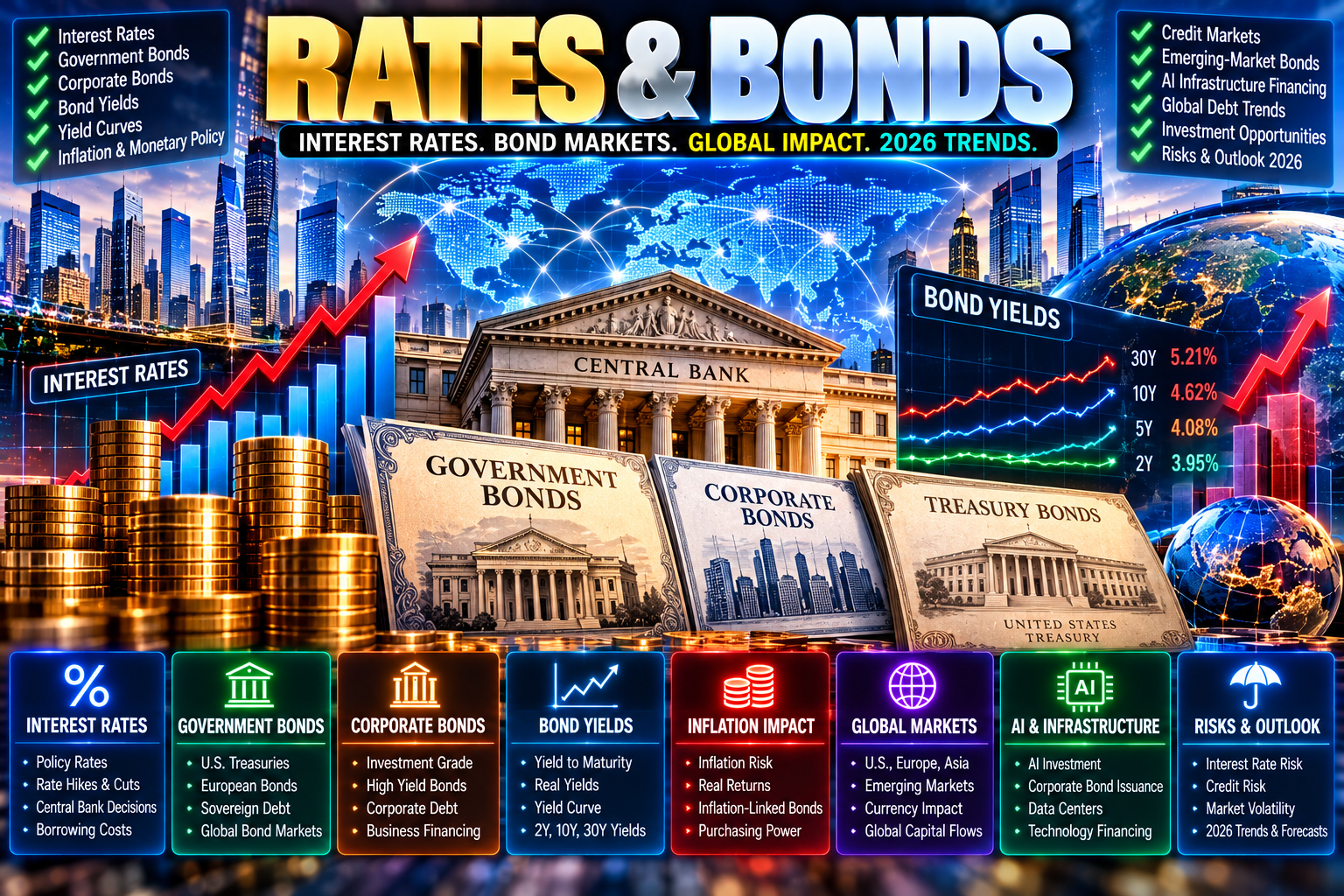
Rates and bonds are two of the most important components of the global financial system. Interest rates influence the cost of borrowing, while bonds provide governments, companies, and other organizations with a major source of financing. Together, they affect mortgages, corporate loans, currencies, stock valuations, investment portfolios, government budgets, and economic growth.
In 2026, rates and bonds have become particularly important as investors navigate inflation, energy prices, government debt, monetary policy, geopolitical uncertainty, and large-scale investment in artificial intelligence infrastructure.
Bond markets have experienced significant volatility during September 2026. Recent market reporting indicates that U.S. and European sovereign yields have moved sharply higher, while investors increasingly consider the possibility that interest rates could remain elevated for longer than previously expected.
Understanding how rates and bonds interact can therefore provide valuable insight into the broader financial markets.
What Are Interest Rates?
An interest rate is the cost of borrowing money or the return earned for lending money.
Interest rates can apply to:
Mortgages
Personal loans
Business loans
Credit cards
Government debt
Corporate bonds
Savings accounts
Money-market instruments
Central banks influence short-term interest rates through monetary policy.
When inflation is elevated, central banks may maintain or increase policy rates to reduce demand and bring inflation under control. When inflation falls and economic activity weakens, central banks may have more room to lower rates.
However, market interest rates do not always move exactly with central-bank rates.
Long-term borrowing costs also depend on inflation expectations, economic growth, government borrowing, investor demand, fiscal policy, and the compensation investors require for holding longer-duration debt.
What Are Bonds?
A bond is a debt security.
When an investor buys a bond, the investor is effectively lending money to the bond issuer. In return, the issuer normally promises to make interest payments and repay the principal at maturity.
Major bond issuers include:
Governments
Corporations
Municipal authorities
Financial institutions
International organizations
Common types include government bonds, corporate bonds, municipal bonds, investment-grade bonds, high-yield bonds, inflation-linked bonds, and emerging-market bonds.
How Bond Prices and Yields Work
One of the most important concepts in fixed-income investing is the inverse relationship between bond prices and yields.
When the price of an existing bond falls, its yield generally rises. When its price rises, its yield generally falls.
For example, imagine an existing bond pays a fixed annual coupon of $50 on a $1,000 face value. If investors later demand higher returns because market interest rates have increased, that existing bond may need to trade below $1,000 so its effective yield becomes competitive with newly issued bonds.
This relationship means that rising interest rates can create losses for investors holding existing fixed-rate bonds, particularly longer-duration bonds.
Why Interest Rates Matter to Bonds
Interest rates and bonds are closely connected.
When market interest rates rise:
Bond prices generally fall → Bond yields rise
When market interest rates decline:
Bond prices generally rise → Bond yields fall
The impact is not identical for every bond.
Short-term bonds generally have lower interest-rate sensitivity than long-term bonds. Bonds with longer maturities and higher duration can experience larger price changes when yields move.
This is why duration is an important concept in bond investing.
What Is Bond Yield?
Bond yield represents the return investors receive from holding a bond.
There are several different yield measures.
Coupon Rate
The coupon rate is the stated interest payment relative to a bond's face value.
Current Yield
Current yield compares annual coupon payments with the bond's current market price.
Yield to Maturity
Yield to maturity estimates the annualized return an investor would receive if the bond were held until maturity, assuming payments are made as expected and the bond is not sold earlier.
Real Yield
Real yield adjusts nominal yields for inflation expectations.
Real yields are closely watched because they help investors assess the inflation-adjusted return available from bonds.
Government Bonds
Government bonds are among the most closely monitored instruments in global financial markets.
Major government bond markets include:
U.S. Treasuries
German Bunds
UK Gilts
Japanese Government Bonds
French government bonds
Italian government bonds
Australian government bonds
Canadian government bonds
Emerging-market sovereign bonds
U.S. Treasury securities are particularly important because Treasury yields influence global borrowing costs and serve as benchmarks for many other financial assets.
The U.S. Treasury Market
The U.S. Treasury market is one of the world's largest and most important government bond markets.
Key maturities include:
1-month Treasury bills
3-month Treasury bills
6-month Treasury bills
1-year Treasury bills
2-year Treasury notes
5-year Treasury notes
10-year Treasury notes
30-year Treasury bonds
The 10-year Treasury yield is especially important because it is widely used as a benchmark for mortgages, corporate borrowing, valuation models, and global financial markets.
As of September 29, 2026, Reuters reported the U.S. 10-year Treasury yield around 5.21%, close to a multi-year high. The 2-year yield had also risen sharply during September.
Why Bond Yields Are Rising in 2026
Several factors are influencing bond yields in 2026.
Inflation
Persistent inflation can reduce the purchasing power of future bond payments. Investors may therefore demand higher yields to compensate for inflation risk.
Energy Prices
Higher energy prices can increase inflation expectations.
The IMF has identified higher energy prices as an important factor behind renewed inflation pressures and higher bond yields during 2026.
Government Borrowing
Large fiscal deficits require governments to issue more debt.
Higher debt issuance can increase the supply of bonds that markets need to absorb. If investor demand does not increase proportionally, yields can rise.
Economic Growth
Stronger economic growth can increase expectations for higher interest rates and reduce demand for traditional safe-haven bonds.
Central-Bank Policy
Expectations about future monetary policy are among the most important drivers of short-term bond yields.
Term Premium
Investors may demand additional compensation for holding longer-term bonds because of uncertainty around inflation, government debt, interest rates, and future economic conditions.
The Bond Market in September 2026
September 2026 has been an unusually challenging month for global sovereign bonds.
Reuters reported on September 29 that two-year U.S. Treasury yields had risen by nearly 60 basis points during the month, putting them on track for their largest monthly increase since early 2023. Ten-year U.S. Treasury yields had moved above 5%, while yields in several European markets also climbed significantly.
The report linked the bond-market pressure to higher energy prices, persistent inflation concerns, increased government borrowing, and stronger economic expectations connected to the AI investment cycle.
The IMF's 2026 Global Financial Stability Report had also warned that elevated government debt and increased refinancing requirements could make sovereign bond markets more sensitive to yield increases.
What Is the Yield Curve?
The yield curve shows interest rates across different bond maturities.
A normal yield curve generally slopes upward:
Short-term yields < Long-term yields
This means investors require higher yields for committing money over longer periods.
An inverted yield curve occurs when short-term yields are higher than long-term yields.
A flat yield curve occurs when yields across maturities are relatively similar.
Investors watch yield curves because they contain information about expectations for inflation, economic growth, monetary policy, and future interest rates.
Why the 2-Year and 10-Year Yields Matter
The 2-year Treasury yield is highly sensitive to expectations for central-bank policy.
The 10-year Treasury yield reflects a broader combination of:
Expected economic growth
Inflation expectations
Future interest rates
Government borrowing
Term premium
Investor demand
The difference between the 10-year and 2-year yields is commonly called the 2s10s spread.
Financial analysts monitor this spread to understand changes in the shape of the yield curve.
Corporate Bonds
Governments are not the only major bond issuers.
Companies issue corporate bonds to finance:
Expansion
Acquisitions
Capital expenditure
Refinancing
Working capital
Technology investment
Infrastructure
Corporate bonds generally offer higher yields than government bonds because investors take on additional credit risk.
Corporate bonds are often divided into two broad categories:
Investment Grade
Investment-grade bonds are issued by companies considered to have relatively stronger credit profiles.
High Yield
High-yield bonds offer higher interest rates because they carry greater credit risk.
When financial conditions tighten, corporate borrowing costs can rise significantly.
AI and the Bond Market
Artificial intelligence has become an increasingly important factor in the bond market.
Large technology companies and AI infrastructure providers require enormous amounts of capital for:
Data centers
Semiconductor infrastructure
Cloud computing
Power generation
Networking
Computing equipment
This investment can be financed through cash flow, equity, bank financing, or corporate bonds.
Reuters reported in September 2026 that bond issuance by major AI infrastructure companies and hyperscalers had exceeded $200 billion during the year, more than doubling from the previous year.
This creates an interesting interaction between AI investment and interest rates.
Higher AI investment can support economic growth and corporate activity, but increased corporate bond issuance also adds to the overall supply of debt that investors must absorb.
Interest Rates and Stock Markets
Rates and bonds also influence stock markets.
When interest rates rise, investors may reassess the value of future corporate earnings.
Growth companies can be particularly sensitive because a larger portion of their expected value may come from earnings projected further into the future.
Higher bond yields can also make fixed-income investments more attractive relative to equities.
This does not mean stocks always fall when rates rise. Corporate earnings, economic growth, productivity, valuations, and investor sentiment also matter.
Rates and Mortgages
Mortgage rates are closely connected to broader interest-rate conditions.
In many markets, long-term mortgage rates are influenced by government bond yields and expectations for future monetary policy.
When bond yields rise, mortgage borrowing costs can also increase.
This can affect:
Housing affordability
Home purchases
Refinancing
Construction
Real-estate investment
Consumer spending
Therefore, bond markets can influence the real economy through the housing market.
Inflation-Linked Bonds
Inflation-linked bonds are designed to provide protection against changes in consumer prices.
Examples include inflation-protected government securities.
Their principal or interest payments can be adjusted according to inflation measures.
These instruments can become particularly relevant when investors are concerned that inflation could remain elevated for longer than expected.
Emerging-Market Bonds
Emerging-market bonds offer investors exposure to developing economies.
They can be issued in:
Local currencies
U.S. dollars
Euros
Other major currencies
Emerging-market bonds can offer higher yields than bonds from advanced economies, but they also carry additional risks.
These include:
Currency volatility
Political risk
Inflation
External financing requirements
Capital outflows
Higher refinancing costs
The IMF has highlighted that emerging-market assets can be particularly sensitive to changes in global risk sentiment and cross-border portfolio flows.
Bond Market Volatility
Bond markets can experience significant volatility when expectations change quickly.
Important drivers include:
Inflation reports
Employment data
Central-bank meetings
Government budgets
Debt auctions
Energy prices
Geopolitical events
Economic forecasts
The MOVE Index is one commonly followed measure of U.S. Treasury-market volatility.
Higher bond volatility can affect broader financial markets because government bonds serve as benchmarks for many other assets.
Rates and Bonds: Key Indicators to Watch
Investors following rates and bonds often monitor several indicators simultaneously.
Indicator | What It Shows |
|---|---|
Policy rate | Central-bank monetary stance |
2-year yield | Short-term rate expectations |
10-year yield | Long-term borrowing conditions |
30-year yield | Long-duration financing costs |
Yield curve | Relationship between maturities |
Real yield | Inflation-adjusted return |
Credit spread | Corporate credit risk |
MOVE Index | Bond-market volatility |
CPI | Consumer inflation |
PPI | Producer-price pressures |
Employment data | Labor-market conditions |
GDP | Economic growth |
PMI | Business activity |
Treasury auctions | Government-debt demand |
Looking at these indicators together can provide a more complete picture than following a single interest rate.
Major Rates and Bond Trends for 2026
Several themes are shaping the rates and bonds landscape.
Higher-for-Longer Rates
Investors are reassessing how quickly interest rates can decline when inflation remains sensitive to energy prices.
Elevated Government Debt
High debt levels are increasing attention on fiscal sustainability and government borrowing costs.
Higher Bond Issuance
Governments and major corporations are issuing large amounts of debt, increasing the importance of investor demand.
AI Infrastructure Financing
AI investment is creating additional financing requirements for technology and infrastructure companies.
Persistent Inflation Risk
Energy-price shocks remain a major source of inflation uncertainty.
Increased Bond Volatility
Rapid changes in inflation and monetary-policy expectations can create larger moves in yields.
Risks in the Bond Market
Bonds are often considered lower-risk than equities, but they are not risk-free.
Important bond-market risks include:
Interest-Rate Risk
Bond prices can decline when yields rise.
Credit Risk
A bond issuer may experience financial difficulties or default.
Inflation Risk
Inflation can reduce the real purchasing power of fixed payments.
Liquidity Risk
Some bonds may be difficult to sell quickly without accepting a lower price.
Currency Risk
Foreign-currency bonds can lose value for investors when exchange rates move unfavorably.
Reinvestment Risk
When interest rates decline, investors may have difficulty reinvesting coupons or maturing bonds at comparable yields.
Sovereign Risk
Government bonds can also face fiscal and political risks, particularly in highly indebted economies.
The Future of Rates and Bonds
The future direction of rates and bonds will depend on the interaction between inflation, economic growth, monetary policy, fiscal policy, energy prices, and financial-market conditions.
The IMF has warned that high public debt and refinancing needs can amplify the impact of rising yields. It also noted that higher bond yields can spill into credit markets and create additional pressure on leveraged investors and financial institutions.
At the same time, higher yields can make government bonds more attractive to investors seeking income.
This creates a complex environment in which the same increase in yields can create both opportunities and risks.
Conclusion
Rates and bonds are fundamental to the global financial system.
Interest rates influence borrowing costs, while bonds provide financing for governments and companies and serve as important investment instruments. Bond yields also influence stock valuations, mortgages, currencies, corporate financing, and international capital flows.
In 2026, the rates and bonds market is being shaped by inflation, energy prices, government borrowing, monetary policy, AI investment, geopolitical uncertainty, and changing expectations about economic growth.
The sharp rise in sovereign yields during September highlights why investors and businesses are paying close attention to bond-market data.
Understanding policy rates, bond prices, yields, duration, yield curves, credit spreads, and inflation expectations provides a foundation for understanding how modern financial markets work.
Frequently Asked Questions
What are rates and bonds?
Rates refer to interest rates charged on borrowing or earned on lending, while bonds are debt securities issued by governments, companies, and other organizations.
Why do bond prices fall when interest rates rise?
Existing bonds with fixed coupons become less attractive when newly issued bonds offer higher yields. Their market prices therefore generally decline until their effective yields become competitive.
What is bond yield?
Bond yield represents the return an investor receives from a bond based on its price, coupon payments, maturity, and other factors.
What is the most important government bond yield?
The U.S. 10-year Treasury yield is one of the most closely watched government bond yields because it influences global borrowing costs and financial valuations.
What causes interest rates to rise?
Interest rates can rise because of inflation, stronger economic growth, central-bank policy, increased government borrowing, higher risk premiums, or changing market expectations.
Are bonds safer than stocks?
Bonds can have lower volatility than many stocks, but they still carry interest-rate, credit, inflation, liquidity, and currency risks.
What is the yield curve?
The yield curve shows the relationship between interest rates and bond maturities, such as 2-year, 10-year, and 30-year government bonds.
Why are bond yields important for the economy?
Bond yields influence government financing costs, corporate borrowing, mortgages, investment decisions, and financial-market valuations.
How does inflation affect bonds?
Higher inflation can reduce the real value of future fixed payments and may lead investors to demand higher yields.
What are the major bond trends in 2026?
Key themes include elevated sovereign yields, persistent inflation uncertainty, high government debt, increased bond issuance, AI-related corporate financing, and greater bond-market volatility.