Exchange-traded funds, commonly known as ETFs, have become one of the most important investment vehicles in modern financial markets. They combine characteristics of mutual funds and individual securities, allowing investors to gain exposure to baskets of stocks, bonds, commodities, currencies, or other assets while trading ETF shares on a stock exchange.
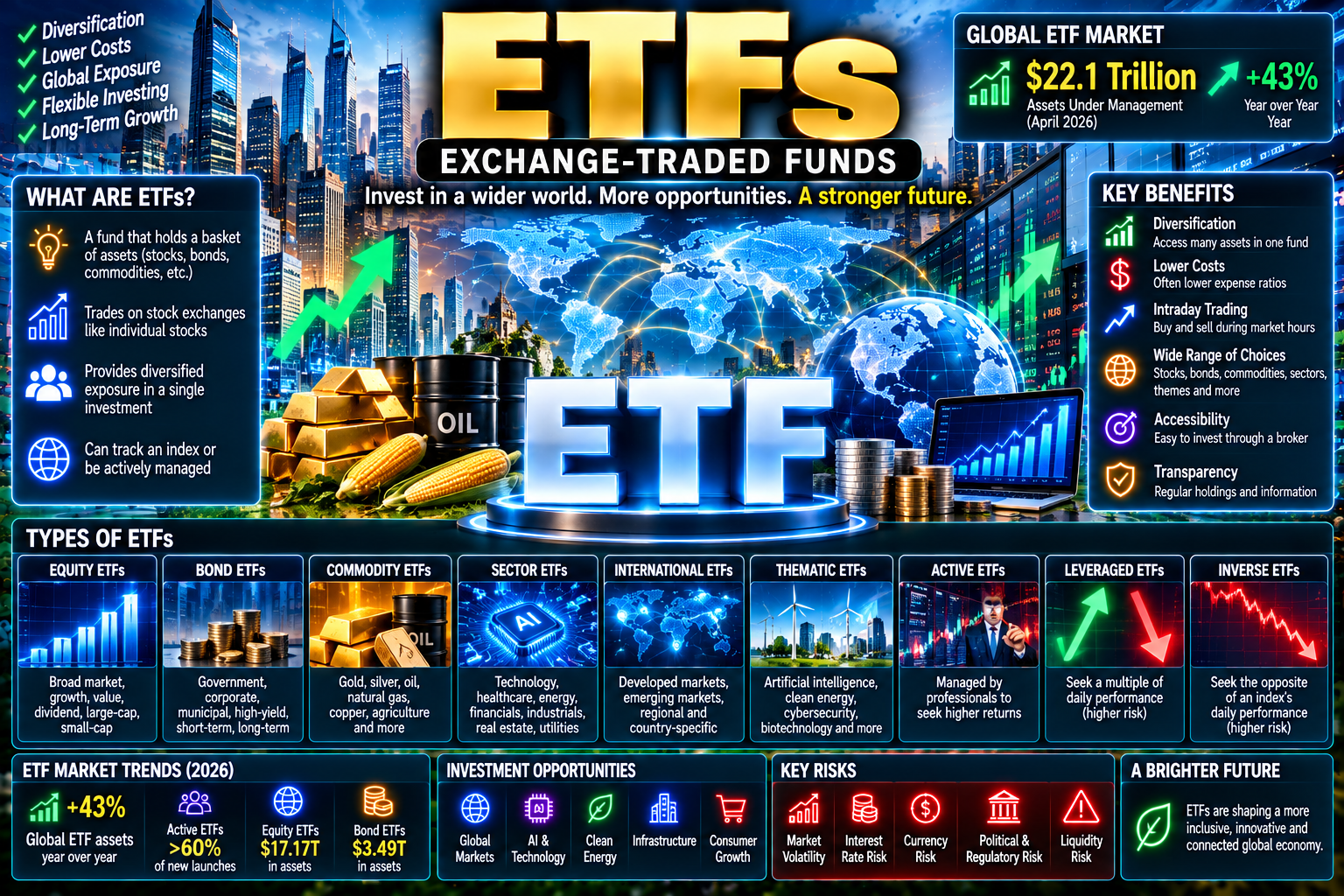
The global ETF industry has expanded dramatically. JPMorgan reported that global ETF assets under management reached approximately $22.1 trillion at the end of April 2026, up 43% year over year. Active ETFs have also expanded rapidly, accounting for more than 60% of new ETF launches in each of the previous six years.
ETFs are no longer limited to broad stock-market indexes. Today's ETF market includes equity funds, bond funds, commodity ETFs, sector funds, thematic ETFs, international funds, actively managed ETFs, leveraged and inverse products, and many specialized strategies.
What Is an ETF?
An exchange-traded fund is an investment fund whose shares trade on a stock exchange throughout the trading day.
Like a mutual fund, an ETF pools money from investors and uses that money to purchase a portfolio of securities or other assets. Each ETF share represents a proportional interest in that portfolio.
Unlike a traditional mutual fund, however, ETF shares are bought and sold by investors on an exchange at market prices.
An ETF can hold:
Stocks
Government bonds
Corporate bonds
Commodities
Currencies
Real estate securities
International securities
Short-term instruments
A combination of assets
Some ETFs are designed to track indexes, while others are actively managed.
How Do ETFs Work?
The basic ETF structure can be understood through four components:
1. The Fund
An asset manager creates and operates the ETF. The fund holds a portfolio based on its stated investment strategy.
2. The Portfolio
The ETF may hold hundreds or thousands of securities, depending on its strategy.
For example, a broad-market ETF might own shares in hundreds of companies.
3. The Exchange
ETF shares trade on a stock exchange during normal market hours, similar to individual stocks.
4. The Investor
Investors purchase ETF shares through a brokerage account. The market price changes throughout the trading session according to supply and demand.
The ETF's market price can sometimes trade slightly above or below the underlying portfolio's net asset value, known as NAV.
ETF Net Asset Value
Net asset value, or NAV, represents the value of the assets held by a fund after liabilities are deducted, divided by the number of outstanding shares.
ETF market prices and NAV are generally closely connected, but they do not have to be identical at every moment.
An ETF can trade:
At a premium to NAV
At a discount to NAV
Close to NAV
Market makers and the ETF creation-and-redemption mechanism generally help keep ETF prices aligned with the underlying portfolio.
What Is the Creation and Redemption Process?
One of the key differences between ETFs and ordinary stocks is the creation-and-redemption mechanism.
Large financial institutions known as authorized participants can generally exchange baskets of securities with an ETF provider for ETF shares, or exchange ETF shares for underlying securities.
This process helps maintain the relationship between:
ETF market price ↔ ETF NAV ↔ underlying assets
It is an important structural feature of the ETF ecosystem.
Main Types of ETFs
The ETF market has become extremely diverse.
1. Equity ETFs
Equity ETFs invest primarily in stocks.
They can track:
Broad stock indexes
Large-cap companies
Small-cap companies
Growth stocks
Value stocks
Dividend-paying stocks
Specific industries
Individual countries
Global markets
Equity ETFs are among the most widely used ETF products.
2. Bond ETFs
Bond ETFs provide exposure to fixed-income securities.
They may invest in:
Government bonds
Corporate bonds
Municipal bonds
Treasury securities
Investment-grade bonds
High-yield bonds
International bonds
Short-term bonds
Long-term bonds
Bond ETFs can allow investors to obtain diversified fixed-income exposure through a single traded security.
3. Commodity ETFs
Commodity ETFs provide exposure to commodities or commodity-related assets.
Examples include exposure to:
Gold
Silver
Oil
Natural gas
Copper
Agriculture
Broad commodity indexes
However, investors should examine how a particular commodity ETF obtains exposure. Some products hold physical commodities while others use futures, swaps, or securities related to commodity-producing companies.
4. Sector ETFs
Sector ETFs focus on particular industries.
Examples include:
Technology
Healthcare
Financial services
Energy
Industrials
Consumer goods
Real estate
Utilities
Communication services
Sector ETFs allow investors to target specific areas of the economy without purchasing every individual company.
5. International ETFs
International ETFs invest outside an investor's domestic market.
They can provide exposure to:
Emerging markets
Developed markets
Europe
Asia
Latin America
Individual countries
Global equities
International ETFs can provide geographic diversification but introduce additional currency, political, regulatory, and market risks.
6. Thematic ETFs
Thematic ETFs focus on long-term economic or technological themes.
Examples include:
Artificial intelligence
Robotics
Cybersecurity
Clean energy
Electric vehicles
Semiconductors
Biotechnology
Cloud computing
Digital infrastructure
Thematic funds can be more concentrated than broad-market ETFs, so investors should examine their underlying holdings carefully.
7. Dividend ETFs
Dividend ETFs focus on companies that pay dividends.
These funds are often designed around characteristics such as:
Dividend yield
Dividend growth
Dividend consistency
Financial quality
Dividend payments are not guaranteed and can change when companies alter their distributions.
8. Actively Managed ETFs
Not all ETFs simply track indexes.
In an actively managed ETF, a portfolio manager makes investment decisions rather than mechanically following a predetermined index.
Active ETFs have grown rapidly. JPMorgan reported that active products represented more than 60% of new ETF launches in each of the six years preceding 2026.
9. Leveraged ETFs
Leveraged ETFs attempt to produce a multiple of the daily performance of an underlying index or asset.
For example, a product might seek approximately twice the daily movement of an index.
These products are significantly more complex than traditional ETFs.
10. Inverse ETFs
Inverse ETFs are designed to seek the opposite of an underlying benchmark's daily performance.
They may be used for short-term hedging or tactical strategies.
The SEC warns that leveraged and inverse ETFs generally target daily performance, and their performance over periods longer than one day can differ substantially from the expected multiple or inverse result because of daily compounding.
ETF Index Funds vs. Active ETFs
One of the biggest distinctions in the ETF market is between passive and active strategies.
Passive ETFs
A passive ETF generally attempts to track an index.
The objective is not necessarily to outperform the benchmark but to closely replicate its performance after expenses and other costs.
Active ETFs
An active ETF uses a portfolio manager or investment team to select securities according to a strategy.
The manager may attempt to:
Identify undervalued companies
Respond to market conditions
Adjust sector exposure
Manage risk
Seek higher returns
Use fundamental research
Each approach has different costs, risks, and objectives.
Benefits of ETFs
ETFs have several characteristics that have contributed to their growth.
Diversification
A single ETF can provide exposure to many securities.
This can reduce the impact that poor performance from one company has on the entire portfolio, although diversification does not eliminate investment risk.
Intraday Trading
ETF shares trade throughout the day.
Investors can generally buy or sell them during exchange trading hours at market prices.
Accessibility
Many ETFs can be purchased through standard brokerage accounts, often without requiring investors to purchase an entire portfolio of individual securities.
Transparency
Many ETFs regularly disclose their holdings and provide information about their investment objectives, costs, and risks.
Potentially Lower Costs
Many index ETFs have relatively low expense ratios compared with actively managed funds.
However, investors should consider total costs rather than focusing only on the headline expense ratio.
Portfolio Flexibility
ETFs can be used for different objectives, including:
Long-term investing
Diversification
Income generation
Geographic exposure
Sector allocation
Bond exposure
Commodity exposure
Tactical strategies
ETF Costs
ETF investing is not free.
Important costs include:
Expense Ratio
The expense ratio represents the annual operating expenses charged by the fund relative to its assets.
Even a small difference in annual expenses can become significant over a long investment period.
Bid-Ask Spread
The bid is the price at which buyers are willing to purchase ETF shares, while the ask is the price at which sellers are willing to sell.
The difference is the bid-ask spread.
The SEC notes that more liquid ETFs generally have smaller spreads, while wider spreads can create an additional trading cost.
Brokerage Costs
Depending on the brokerage platform and market, investors may face commissions or other transaction costs.
Tracking Difference
An index ETF may not perfectly match the performance of its underlying index.
Expenses, trading costs, portfolio sampling, taxes, and other factors can contribute to differences.
The SEC notes that index funds can underperform their benchmarks because of fees, trading costs, and tracking error.
ETF Risks
ETFs are not risk-free investments.
Market Risk
If the securities held by an ETF decline, the ETF's value can decline.
Liquidity Risk
Some ETFs trade much less frequently than major funds.
Lower trading activity can result in wider bid-ask spreads.
Tracking Risk
An ETF may fail to perfectly replicate its benchmark.
Currency Risk
International ETFs can be affected by foreign-exchange movements.
Interest-Rate Risk
Bond ETFs can decline in value when interest rates rise, depending on the characteristics of their holdings.
Concentration Risk
A specialized ETF may hold a relatively small number of companies or be heavily concentrated in one sector.
Commodity Risk
Commodity-linked ETFs can be affected by commodity prices, futures-market conditions, rolling costs, and other factors.
Leverage Risk
Leveraged and inverse ETFs can produce substantial losses over short periods and may behave very differently from investors' expectations when held longer than their stated daily objective.
ETFs vs. Mutual Funds
ETFs and mutual funds share many characteristics, but their structures differ.
Feature | ETFs | Mutual Funds |
|---|---|---|
Trading | Throughout trading day | Generally priced once daily |
Market price | Changes during the day | Based on NAV |
Diversification | Often available | Often available |
Active management | Available | Available |
Index strategies | Available | Available |
Brokerage account | Commonly used | May use broker or fund provider |
Bid-ask spread | Yes | Generally no exchange spread |
Expense ratio | Varies | Varies |
Premium/discount to NAV | Possible | Generally not an intraday feature |
Tax efficiency | Often potentially higher in taxable accounts | Varies |
The SEC notes that ETFs may have tax advantages compared with similar mutual funds because many ETFs use in-kind transactions that can reduce capital-gains distributions. However, tax treatment depends on the investor's circumstances and jurisdiction.
ETFs vs. Individual Stocks
An individual stock represents ownership in one company.
An ETF may represent ownership in a portfolio containing many companies or other assets.
For example:
Individual stock → one company
Broad equity ETF → many companies
This means ETFs can make diversification easier, while individual stocks provide more concentrated exposure.
Neither structure eliminates market risk.
Global ETF Market in 2026
The ETF industry has reached enormous scale.
JPMorgan reported approximately $22.1 trillion in global ETF assets under management at the end of April 2026, representing 43% year-over-year growth.
LSEG Lipper data showed that equity ETFs represented the largest asset category globally in July 2026, with approximately $17.17 trillion in assets, followed by bond ETFs at approximately $3.49 trillion. Alternative ETFs represented about $717.6 billion, while commodity ETFs held approximately $431.8 billion.
The data demonstrates that ETFs now span almost every major asset class.
ETF Flows in 2026
ETF flows are closely watched because they show where investors are allocating capital.
LSEG reported that July 2026 global ETF inflows were led by equity ETFs with approximately $197.7 billion, followed by bond ETFs with approximately $64.7 billion.
International and emerging-market exposure has also attracted attention. BlackRock's iShares reported that emerging-market ETFs gathered more than $35 billion during the first quarter of 2026, although flows weakened as geopolitical tensions increased.
These flows illustrate how ETFs are increasingly being used to allocate capital across countries, regions, sectors, and asset classes.
ETFs and Artificial Intelligence
Artificial intelligence is influencing the ETF industry in two ways.
First, AI is becoming an investment theme itself.
This has contributed to the creation and expansion of ETFs focused on:
AI companies
Semiconductors
Robotics
Data centers
Cloud computing
Digital infrastructure
Technology companies
Second, AI is changing how investment managers research markets.
Potential applications include:
Portfolio analysis
Data processing
Risk monitoring
Research automation
Market surveillance
Thematic classification
Portfolio construction
However, investors should distinguish between an ETF that broadly invests in technology and one that is narrowly concentrated in a particular AI theme.
Emerging-Market ETFs
Emerging-market ETFs allow investors to gain diversified exposure to developing economies through a single fund.
Potential exposure can include countries such as:
China
India
Brazil
Taiwan
South Korea
Mexico
Indonesia
South Africa
Emerging-market ETFs can provide exposure to faster-growing economies, but they may also carry higher currency, political, regulatory, and market risks.
The 2026 increase in international ETF flows has included strong interest in emerging-market exposures, according to iShares' Q1 market review.
How to Evaluate an ETF
Before investing in an ETF, investors can examine several important factors.
1. Investment Objective
Understand exactly what the ETF is designed to accomplish.
2. Holdings
Look at the securities and assets inside the fund.
3. Expense Ratio
Compare ongoing fund expenses with comparable products.
4. Liquidity
Check average trading volume and bid-ask spreads.
5. Tracking Difference
For index ETFs, compare historical fund performance with the underlying benchmark.
6. Fund Size
Larger funds may have greater liquidity and established trading ecosystems, although size alone does not determine quality or suitability.
7. Concentration
Examine whether a small number of holdings account for a large portion of the portfolio.
8. Strategy
Determine whether the ETF is:
Passive
Active
Leveraged
Inverse
Thematic
Sector-focused
Broad-market
9. Tax Treatment
Tax rules differ by country and investor circumstances, so investors should understand the applicable rules before investing.
10. Risk
Review the fund prospectus and shareholder information rather than assuming that all ETFs carry similar risks.
ETF Investing Strategies
ETFs can be incorporated into different investment strategies.
Long-Term Diversification
An investor may use broad-market ETFs as a core component of a diversified portfolio.
Asset Allocation
ETFs can provide exposure to multiple asset classes, including stocks and bonds.
Geographic Diversification
International ETFs can help investors obtain exposure outside their domestic market.
Sector Allocation
Investors can use sector ETFs to increase or decrease exposure to particular industries.
Income Strategies
Bond and dividend-oriented ETFs can be used by investors seeking portfolio income, although distributions can fluctuate.
Tactical Investing
More experienced investors may use specialized ETFs to express short-term views, but tactical strategies generally carry greater complexity and risk.
The Future of ETFs
The ETF industry is continuing to evolve.
Several trends are likely to remain important.
Active ETFs
The rapid growth of active ETFs suggests that the distinction between traditional active funds and exchange-traded products is becoming less pronounced.
More Specialized Products
ETF providers continue to develop funds focused on specific themes, industries, countries, investment factors, and strategies.
Digital Investment Platforms
Online brokerage platforms are making ETFs increasingly accessible to retail investors.
AI-Powered Investing
Artificial intelligence could influence ETF research, portfolio management, product design, and risk analysis.
International Expansion
ETF markets are developing across North America, Europe, Asia, and other regions, expanding access to global investments.
Fixed-Income Growth
Bond ETFs have become a major component of the global ETF ecosystem, providing investors with exchange-traded access to a wide range of fixed-income markets.
Conclusion
ETFs have transformed the way investors access financial markets. By combining portfolio diversification with exchange-based trading, they offer a flexible structure for accessing stocks, bonds, commodities, international markets, sectors, themes, and other assets.
The global ETF industry has grown into a multi-trillion-dollar market. In 2026, global ETF assets reached approximately $22.1 trillion, while equity and bond ETFs accounted for the vast majority of industry assets.
However, ETFs are not automatically low-risk investments. Investors need to understand the underlying assets, fees, liquidity, tracking differences, concentration, currency exposure, and strategy-specific risks.
Traditional broad-market ETFs can be very different from leveraged, inverse, commodity, or highly concentrated thematic ETFs.
As financial markets become increasingly digital and global, ETFs are likely to remain an important part of modern investing. The continued growth of active ETFs, international funds, bond products, AI-focused strategies, and specialized investment vehicles suggests that the ETF industry will continue expanding in both scale and complexity.
Frequently Asked Questions About ETFs
What does ETF stand for?
ETF stands for Exchange-Traded Fund.
What is an ETF?
An ETF is an investment fund whose shares trade on a stock exchange. It can hold stocks, bonds, commodities, or other assets.
Are ETFs stocks?
ETFs trade like stocks on exchanges, but an ETF generally represents an interest in a portfolio of investments rather than ownership of a single company.
Are ETFs risky?
Yes. ETFs carry investment risk, and their risk depends on the assets and strategy inside the fund. Investors can lose some or all of their investment.
Can ETFs pay dividends?
Yes. ETFs holding dividend-paying stocks or income-producing securities can distribute income to shareholders.
What is an ETF expense ratio?
The expense ratio represents the annual operating expenses charged by an ETF relative to its assets.
What is ETF tracking error?
Tracking error is the difference between an index fund's performance and the performance of the index it is designed to track.
Are ETFs better than mutual funds?
ETFs and mutual funds have different structures and characteristics. The appropriate choice depends on an investor's objectives, costs, tax circumstances, trading needs, and preferred investment strategy.
What are leveraged ETFs?
Leveraged ETFs seek a multiple of an underlying benchmark's daily performance. They are complex products and can produce significant losses, particularly when held for longer periods than their daily objective.
What are emerging-market ETFs?
Emerging-market ETFs invest in securities from developing economies and can provide diversified exposure to countries and companies across regions such as Asia, Latin America, Africa, and other emerging markets.
How big is the global ETF market?
JPMorgan reported global ETF assets of approximately $22.1 trillion at the end of April 2026, demonstrating the scale of the modern ETF industry.