Innovation is one of the most important forces shaping modern business, technology, science, and society. From artificial intelligence and robotics to biotechnology, clean energy, digital platforms, and advanced materials, innovation is changing how organizations create products, solve problems, compete, and deliver value.
But innovation is not simply about having new ideas. Successful innovation requires a structured approach to identifying opportunities, testing assumptions, managing risk, understanding customers, using technology effectively, and scaling solutions.
In 2026, innovation is also becoming increasingly connected to technology convergence. The World Economic Forum highlights how AI, robotics, advanced materials, engineering biology, quantum technologies, next-generation energy, spatial intelligence, and computing can combine to create capabilities that would be difficult to achieve through a single technology alone.
This makes understanding the rules of innovation increasingly important for companies, entrepreneurs, researchers, and policymakers.
What Are Innovation Rules?
Innovation rules are the principles and practices that guide how organizations discover, develop, test, implement, and scale new ideas.
They can apply to:
Business innovation
Product development
Technology innovation
Scientific research
Startup development
Digital transformation
Process improvement
Social innovation
Government innovation
Sustainable innovation
Artificial intelligence
Healthcare and biotechnology
Financial technology
There is no single universal rulebook for innovation. However, successful innovation generally depends on combining creativity with experimentation, evidence, customer understanding, responsible risk management, and the ability to execute.
Why Innovation Matters
Innovation can improve productivity, create new markets, solve complex problems, and generate new economic opportunities.
The OECD has described innovation as an important contributor to productivity, economic growth, and the ability to address societal challenges.
Innovation also allows organizations to respond to changing customer expectations and technological developments.
For example, companies may innovate by:
Creating a new product
Improving an existing service
Automating a repetitive process
Using AI to analyze information
Developing a new business model
Reducing production costs
Improving customer experience
Developing sustainable materials
Entering a new market
Combining existing technologies in a new way
Innovation does not always mean inventing something completely new. Sometimes the most valuable innovation comes from combining existing technologies or processes in a different way.
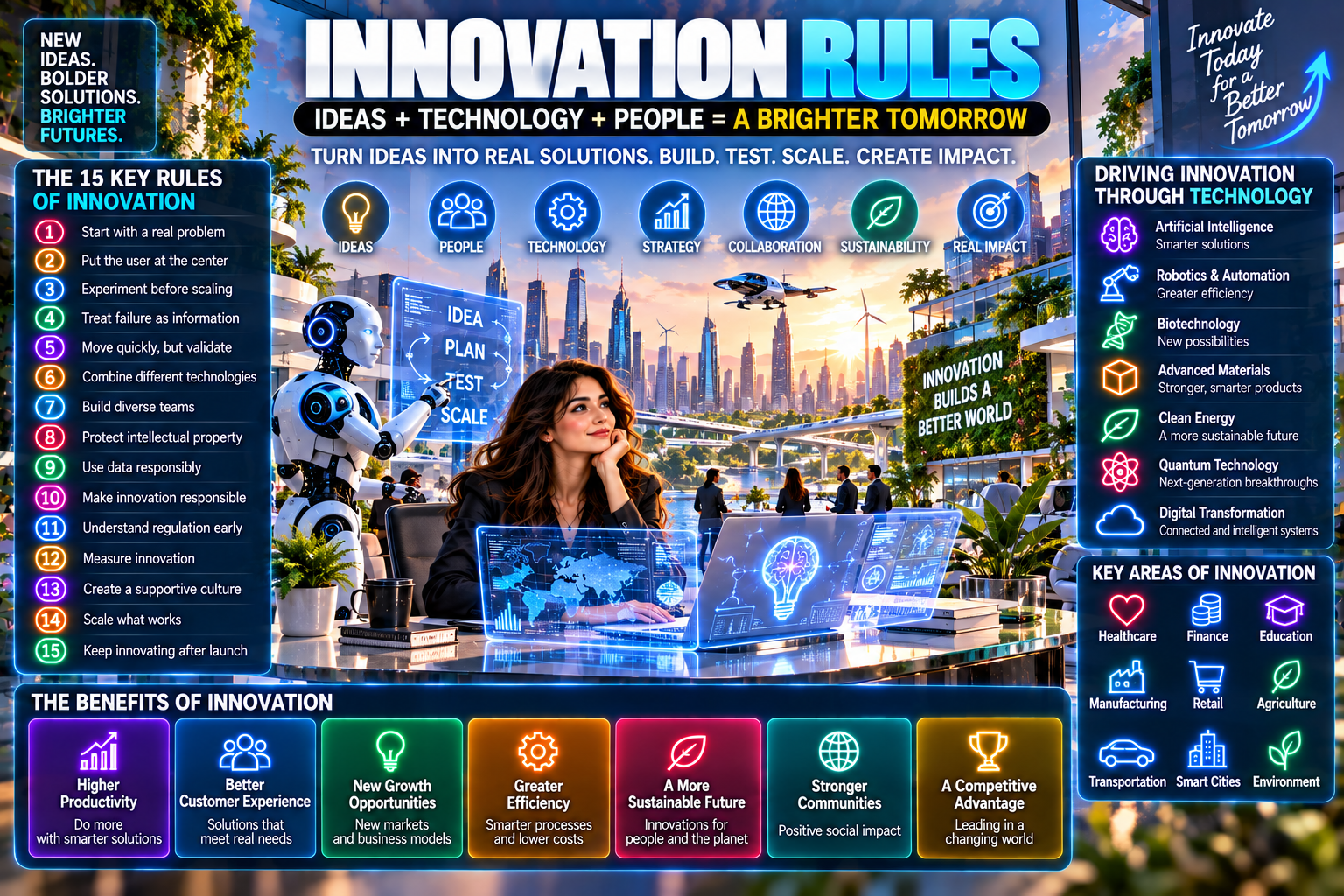
The 15 Essential Rules of Innovation
1. Start With a Real Problem
One of the most important innovation rules is to begin with a genuine problem rather than technology for its own sake.
A new technology may appear exciting, but innovation becomes more valuable when it addresses a meaningful need.
Before developing an idea, organizations should ask:
What problem are we solving?
Who experiences the problem?
How serious is it?
How is the problem currently solved?
What makes the existing solution inadequate?
Would people or organizations actually use a better solution?
This approach helps prevent organizations from investing heavily in products that have little practical demand.
2. Put the User at the Center
Innovation should ultimately create value for someone.
Customers, employees, patients, businesses, communities, or other users can provide valuable information about what actually needs improvement.
Organizations can use:
Customer interviews
Surveys
Product testing
Usage data
Feedback forms
Focus groups
Market research
Prototype testing
Customer feedback should not necessarily determine every decision, but it can reveal problems that internal teams may overlook.
User-centered innovation is particularly important when developing healthcare, financial, educational, and consumer technologies where trust and usability can significantly affect adoption.
3. Experiment Before Scaling
Innovation involves uncertainty. Instead of immediately investing large amounts of money and resources, organizations can test ideas on a smaller scale.
A common innovation cycle is:
Idea → Prototype → Test → Learn → Improve → Scale
Early experiments can reveal whether an idea works technically and whether users actually value it.
The World Economic Forum's 2026 emerging-technology research also highlights a broader shift toward digital modelling and simulation, which can help shorten the distance between scientific discovery and real-world deployment.
Small experiments can therefore reduce the cost of failure and increase the amount organizations learn before making major investments.
4. Treat Failure as Information
Not every experiment will succeed.
An unsuccessful prototype can still provide useful information about:
Customer preferences
Technical limitations
Production costs
Market demand
Security problems
Operational requirements
Business-model assumptions
The important distinction is between productive failure and unmanaged failure.
Productive failure happens when organizations design experiments that limit downside while producing useful information.
The objective is not to fail unnecessarily. The objective is to learn quickly enough that unsuccessful ideas do not consume excessive resources.
5. Move Quickly, but Do Not Skip Validation
Speed can be important in competitive markets, particularly when technology changes rapidly.
However, moving quickly does not mean launching products without testing.
Organizations should distinguish between:
Speed of learning and speed of deployment.
The first should often be high.
The second should depend on risk.
A low-risk software feature might be tested quickly. A medical device, financial system, autonomous technology, or safety-critical product may require much more extensive validation.
Good innovation therefore combines agility with appropriate safeguards.
6. Combine Different Technologies
Modern innovation increasingly comes from combining technologies rather than developing them in isolation.
The World Economic Forum's 2026 Technology Convergence report describes how combinations involving AI, robotics, engineering biology, advanced materials, quantum technologies, spatial intelligence, computing, and next-generation energy can create new capabilities.
For example:
AI + robotics can create more autonomous machines.
AI + healthcare data can support new approaches to diagnosis and research.
IoT + cloud computing + analytics can create connected industrial systems.
Biology + engineering + AI can accelerate certain areas of biotechnology.
This means innovation teams increasingly need knowledge that crosses traditional industry boundaries.
7. Build Diverse Teams
Innovation benefits from different perspectives.
A team containing only people with identical backgrounds and expertise may overlook important questions.
Innovation teams can include:
Engineers
Designers
Scientists
Business specialists
Marketing professionals
Data analysts
Security experts
Legal professionals
Operations teams
Customer representatives
Cross-functional collaboration can help organizations identify technical, commercial, operational, ethical, and customer-related issues earlier.
8. Protect Intellectual Property
Innovation can create valuable intellectual property.
Depending on the situation, organizations may need to consider:
Patents
Copyright
Trademarks
Trade secrets
Proprietary data
Software rights
Licensing agreements
Research agreements
Intellectual-property strategy should be considered before publicly revealing potentially valuable inventions.
However, intellectual property should not become an excuse for avoiding collaboration. Organizations can use licensing, partnerships, research agreements, and other structures to collaborate while protecting important assets.
9. Use Data Responsibly
Data is a major component of modern innovation.
Organizations use data to:
Understand customers
Train AI systems
Predict demand
Improve operations
Detect fraud
Optimize supply chains
Develop products
Measure performance
But innovation involving data can also create privacy, security, discrimination, and governance risks.
Responsible innovation therefore requires organizations to understand what data they collect, why they collect it, how it is used, who can access it, and how it is protected.
The OECD emphasizes that technology governance should incorporate shared values, human rights, stakeholder participation, and technology assessment.
10. Make Innovation Responsible
Innovation can create significant benefits, but new technologies can also introduce new risks.
Artificial intelligence, biotechnology, quantum technologies, autonomous systems, and connected infrastructure can have complex social and economic consequences.
Responsible innovation asks questions such as:
Is the technology safe?
Is it secure?
Could it create unfair outcomes?
Could it be misused?
Does it protect privacy?
Is it accessible?
Are users properly informed?
What happens if the system fails?
Who is accountable?
The OECD's framework for emerging technologies recommends embedding values throughout the innovation process, strengthening foresight and technology assessment, engaging stakeholders, developing agile regulation, and supporting international cooperation.
11. Understand Regulation Early
Regulation can influence whether and how an innovation reaches the market.
This is particularly important for:
Healthcare
Finance
Artificial intelligence
Biotechnology
Energy
Transportation
Telecommunications
Consumer data
Cybersecurity
The OECD's 2025 Regulatory Policy Outlook notes that experimentation, regulatory sandboxes, flexible approaches, and ongoing policy review can help governments respond to rapidly changing technologies.
The World Economic Forum has similarly argued in its 2026 work on regulatory innovation that regulation increasingly functions as infrastructure for technological innovation, affecting trust, inclusion, and competitiveness.
For businesses, this means regulatory analysis should happen early rather than after a product has already been built.
12. Measure Innovation
Innovation should be measured using meaningful indicators.
Possible metrics include:
Number of experiments
Time from idea to prototype
Prototype success rate
Customer adoption
Revenue from new products
Cost savings
Customer satisfaction
Product engagement
Patent activity
Research output
Time to market
Return on innovation investment
However, organizations should avoid measuring innovation solely by the number of ideas generated.
A company can have thousands of ideas and still produce little meaningful innovation.
The more useful question is:
How much measurable value is created from innovation activity?
13. Create a Culture That Supports Innovation
Innovation cannot depend entirely on a single department.
Organizations need an environment where employees can identify problems, propose improvements, test ideas, and collaborate.
A supportive innovation culture can include:
Open communication
Leadership support
Research budgets
Experimentation programs
Cross-functional teams
Training
Internal innovation challenges
Recognition for useful ideas
Access to technology
Safe channels for reporting problems
Employees who understand that thoughtful experimentation is valued may be more willing to contribute ideas.
14. Scale What Works
A successful prototype is not automatically a successful business.
Scaling introduces new challenges involving:
Manufacturing
Infrastructure
Hiring
Customer support
Cybersecurity
Compliance
Distribution
Supply chains
Financing
Data
Reliability
Before scaling, organizations should ask:
Can we deliver this solution consistently, securely, affordably, and at the required volume?
Innovation becomes commercially meaningful when organizations can move from experimentation to repeatable delivery.
15. Keep Innovating After Launch
Innovation does not end when a product reaches the market.
Customer expectations change. Competitors introduce alternatives. Technologies improve. Regulations evolve.
Therefore, organizations should continuously monitor:
Customer feedback
Product performance
Market changes
Emerging technologies
Competitor activity
Security risks
Regulatory developments
New business opportunities
Continuous improvement can help products remain relevant after their initial launch.
Innovation and Artificial Intelligence
Artificial intelligence is changing how innovation itself happens.
AI can support:
Research
Product design
Data analysis
Software development
Market research
Simulation
Forecasting
Content creation
Customer support
Scientific discovery
The World Economic Forum reported in 2026 that AI is helping researchers model and evaluate scientific possibilities before some physical experiments are conducted, potentially changing the economics and speed of discovery.
AI can therefore become both a product of innovation and a tool for innovation.
Organizations still need human judgment, domain expertise, validation, and governance when applying AI to important decisions.
Innovation and Sustainability
Sustainability is increasingly connected to innovation.
Innovators are developing technologies that aim to:
Reduce energy consumption
Lower emissions
Improve resource efficiency
Reduce waste
Improve recycling
Develop alternative materials
Improve energy storage
Support renewable energy
Increase agricultural efficiency
The World Economic Forum's 2026 emerging-technology research identifies a recurring trend toward technologies that can become more personal, decentralized, and resource-efficient.
Sustainable innovation can therefore combine economic value with environmental objectives.
Innovation in Different Industries
Healthcare
Innovation is transforming diagnostics, medical research, telemedicine, medical devices, digital health, and personalized care.
Finance
Fintech innovation includes digital payments, AI-assisted services, fraud detection, blockchain applications, and automated financial processes.
Manufacturing
Smart factories combine robotics, sensors, AI, automation, and data analytics to improve production.
Retail
Retail innovation includes e-commerce, personalized recommendations, automated logistics, digital payments, and connected customer experiences.
Energy
Innovation is supporting batteries, renewable energy, smart grids, energy storage, and alternative energy technologies.
Transportation
Electric vehicles, autonomous systems, connected infrastructure, and advanced logistics are changing transportation.
Agriculture
Precision agriculture uses sensors, satellite data, automation, robotics, and analytics to improve farming decisions.
Education
Digital platforms, AI tutoring systems, immersive learning, and personalized education tools are changing how people learn.
A Practical Innovation Framework
Businesses can organize their innovation process into seven stages:
1. Discover
Identify important problems and opportunities.
2. Define
Clearly describe the problem, customer, market, and desired outcome.
3. Explore
Generate multiple potential solutions.
4. Experiment
Build prototypes and test assumptions.
5. Validate
Use evidence to determine whether the solution creates meaningful value.
6. Scale
Develop the infrastructure, business model, team, and processes required for expansion.
7. Improve
Continue learning from users, data, technology, and market conditions.
This creates a repeatable innovation cycle rather than treating innovation as a one-time event.
Common Innovation Mistakes
Organizations can undermine innovation by:
Chasing technology without a real problem
Ignoring customers
Spending too much before testing
Avoiding experimentation
Refusing to learn from failure
Building overly complex products
Ignoring cybersecurity
Underestimating regulation
Failing to protect intellectual property
Scaling too early
Measuring ideas instead of outcomes
Ignoring employee feedback
Treating innovation as a separate department
Failing to update successful products
Avoiding these mistakes can make innovation more disciplined and sustainable.
The Future of Innovation
The future of innovation is likely to be increasingly interconnected.
AI, robotics, biotechnology, advanced materials, quantum computing, spatial technologies, energy systems, and digital infrastructure are increasingly interacting with one another.
The World Economic Forum's 2026 emerging-technologies report identifies technologies approaching the point of real-world deployment and emphasizes the importance of the decisions, investments, and conditions required to scale them responsibly.
This suggests that future innovation will not simply be about creating individual technologies. It will increasingly involve connecting technologies, organizations, data, people, infrastructure, and regulatory systems.
The organizations that can experiment effectively, learn quickly, manage risk, collaborate across disciplines, and scale responsibly will be better positioned to participate in this changing environment.
Final Thoughts
Innovation is more than creativity. It is a process of turning ideas into useful outcomes.
The most important innovation rules include starting with real problems, understanding users, experimenting before scaling, learning from failure, combining technologies, building diverse teams, protecting intellectual property, using data responsibly, considering regulation, measuring outcomes, and continuously improving.
Modern innovation is also becoming more interconnected. AI, robotics, biotechnology, computing, advanced materials, energy, and other technologies can combine to create entirely new possibilities.
Ultimately, innovation succeeds when ideas, technology, people, evidence, and execution come together to create meaningful value.
Frequently Asked Questions
What are innovation rules?
Innovation rules are practical principles that help organizations identify opportunities, develop ideas, test solutions, manage risks, and scale successful innovations.
Why are innovation rules important?
They provide structure for managing uncertainty and help organizations avoid wasting resources on ideas that have not been properly tested or validated.
What is the first rule of innovation?
A strong starting point is to identify a real and meaningful problem before deciding which technology or solution to build.
Does innovation always require new technology?
No. Innovation can involve a new product, process, service, business model, customer experience, or combination of existing technologies.
Is failure part of innovation?
Unsuccessful experiments can provide valuable information. The goal is to design experiments so that failure produces useful learning without creating unnecessary costs or risks.
How is AI changing innovation?
AI can accelerate research, analysis, design, software development, simulation, forecasting, and other parts of the innovation process. It can also become the technology underlying entirely new products and services.
Why is regulation important for innovation?
Regulation can influence safety, privacy, competition, market access, and public trust. Considering regulatory requirements early can help organizations develop solutions that can be deployed responsibly.
What is responsible innovation?
Responsible innovation considers the potential benefits and risks of a technology while incorporating factors such as safety, privacy, security, fairness, accessibility, accountability, and social impact.
How can businesses measure innovation?
Businesses can measure innovation through metrics such as customer adoption, revenue from new products, cost savings, time to market, customer satisfaction, successful experiments, and measurable operational improvements.
What is the future of innovation?
Innovation is increasingly moving toward technology convergence, where AI, robotics, biotechnology, advanced materials, computing, energy, and other fields interact to create new capabilities and applications.