The creator economy has transformed the way people produce content, build personal brands, connect with audiences, and generate income online.
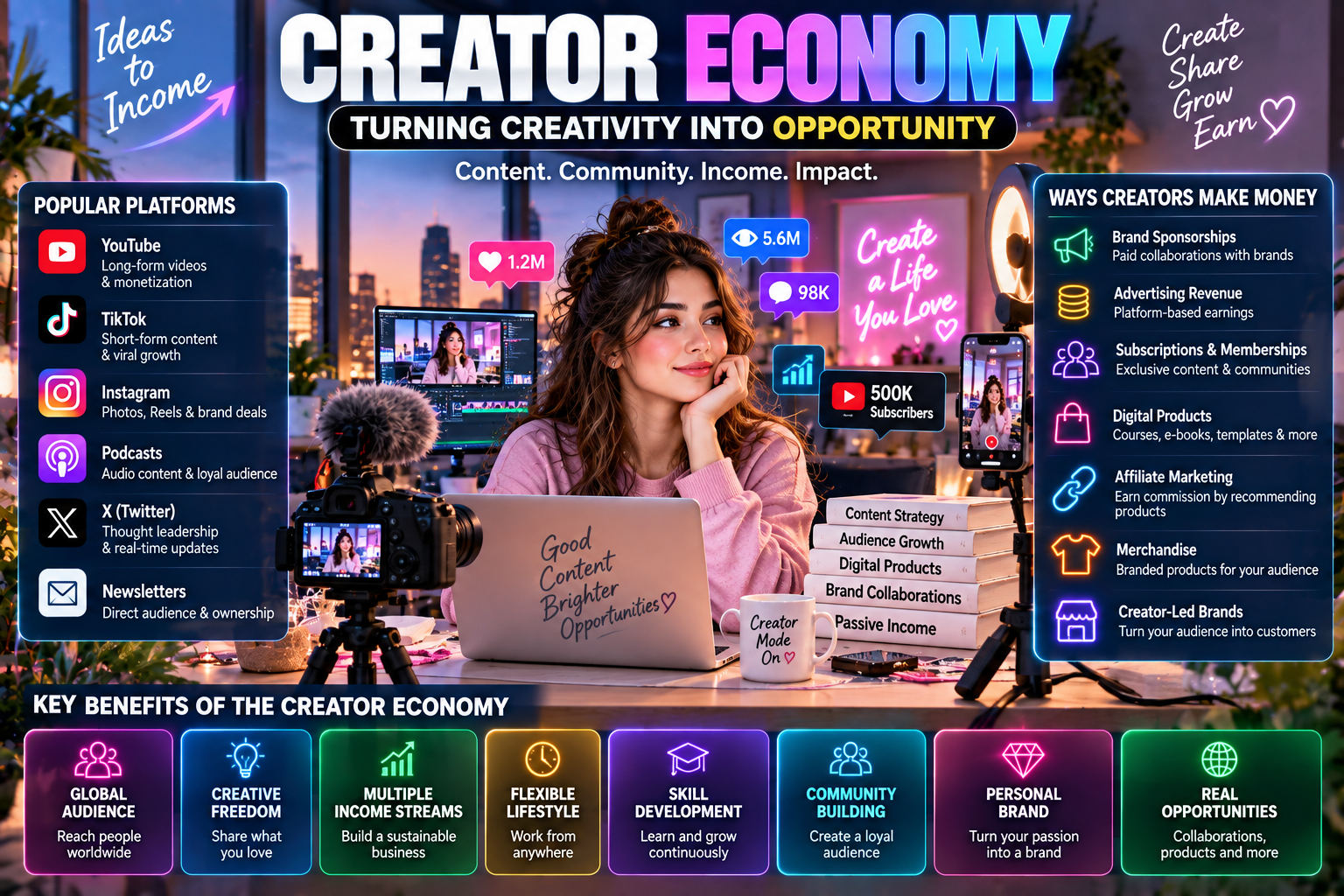
What once looked like a hobby—making videos, writing posts, taking photographs, streaming games, or sharing tutorials—has developed into a growing business ecosystem. Today, creators can earn through advertising, sponsorships, subscriptions, digital products, affiliate marketing, memberships, merchandise, consulting, courses, and creator-led brands.
Visa's 2025 Creator Report estimated approximately 207 million creators worldwide and found that 68% of surveyed creators considered themselves small-business owners.
The creator economy is also being reshaped by artificial intelligence. Adobe's 2026 Creators' Toolkit Report found that 87% of creators using creative AI said it had accelerated their business or audience growth, while 75% described creative AI as integrated or essential to their workflow.
What Is the Creator Economy?
The creator economy is the ecosystem in which individuals create and monetize digital content, audiences, communities, products, or services.
Creators can include:
YouTubers
TikTok creators
Instagram creators
Bloggers
Podcasters
Streamers
Photographers
Designers
Writers
Educators
Influencers
Musicians
Online coaches
Digital entrepreneurs
The creator economy combines content, technology, audiences, advertising, commerce, and entrepreneurship.
Unlike traditional media, creators can often build direct relationships with their audiences without owning a television network, newspaper, publishing company, or production studio.
Why the Creator Economy Is Growing
Several factors have contributed to the growth of the creator economy.
Lower Barriers to Entry
A smartphone, internet connection, and free or inexpensive editing tools can be enough to begin creating content.
Creators no longer necessarily need professional studios, expensive cameras, or large teams to reach audiences.
Global Audiences
Digital platforms allow creators to reach viewers across countries and languages.
A creator based in one country can potentially build an audience in dozens of markets.
Short-Form Video
Short-form video has become an important format for discovery and audience growth.
Platforms such as TikTok, Instagram, and YouTube provide creators with tools for producing and distributing short videos.
Improved Monetization
Creators now have more ways to generate revenue than simply relying on advertising.
These include subscriptions, memberships, sponsorships, affiliate marketing, digital products, and direct commerce.
How Creators Make Money
Creator income can come from multiple sources.
Advertising Revenue
Platforms can share advertising revenue with eligible creators.
YouTube, for example, has developed advertising and membership-based monetization systems for creators.
Advertising can be useful, but relying on one platform's payout system can expose creators to changes in algorithms, policies, or advertising demand.
Brand Sponsorships
Brands can pay creators to promote products or services.
Creator marketing can provide companies with access to specific communities and audiences.
Goldman Sachs has identified brand deals, platform advertising revenue, subscriptions, donations, and direct payments as major creator-economy revenue sources.
Affiliate Marketing
Creators can earn commissions by recommending products through affiliate links.
This model is particularly common among:
Technology reviewers
Beauty creators
Fashion creators
Travel creators
Lifestyle influencers
Product reviewers
Subscriptions and Memberships
Creators can offer exclusive content or community access through paid memberships.
This can provide recurring revenue rather than relying entirely on one-time purchases or advertising.
Digital Products
Creators can develop and sell:
Online courses
E-books
Templates
Presets
Design assets
Guides
Software
Educational materials
Digital products can be attractive because they can often be sold repeatedly without manufacturing physical inventory.
Merchandise
Creators with strong communities can develop branded products such as clothing, accessories, books, or collectibles.
Creator-Led Brands
The creator economy is increasingly moving beyond content.
Some creators are becoming entrepreneurs by launching their own businesses and consumer brands.
These can include:
Beauty products
Fashion brands
Food and beverages
Fitness products
Software
Education businesses
Digital services
Adobe reported in 2025 that 56% of surveyed U.S. consumers had purchased from creator-led brands, with younger consumers reporting particularly strong engagement.
This shows how audiences can potentially become customers when creators successfully connect their personal brands with products.
Social Media Platforms and Creators
Social platforms are central to the creator economy.
Different platforms provide different opportunities.
YouTube
YouTube supports long-form videos, Shorts, livestreaming, advertising, memberships, and other creator monetization features.
TikTok
TikTok focuses heavily on short-form video and algorithmic content discovery.
Instagram combines short videos, photos, Stories, messaging, shopping, and creator partnerships.
Podcasts
Podcasting allows creators to develop longer-form relationships with audiences through audio.
Newsletters
Email newsletters can provide creators with direct communication channels that are less dependent on social-media algorithms.
The Importance of Personal Branding
A strong personal brand can help creators differentiate themselves in a crowded digital environment.
Personal branding can involve:
A recognizable visual style
A consistent topic
A distinctive voice
Expertise
Storytelling
Community interaction
Consistent publishing
The objective is not simply to gain followers.
A sustainable creator business often depends on building trust, recognition, engagement, and a clearly defined audience.
Creator Economy and Artificial Intelligence
Artificial intelligence is changing almost every stage of content creation.
Creators can use AI for:
Brainstorming
Research
Writing
Image generation
Video editing
Audio production
Translation
Captions
Content repurposing
Thumbnail creation
Audience analysis
Adobe's 2026 global creator research found that creative AI is becoming deeply integrated into creator workflows.
AI as a Creative Assistant
AI does not necessarily have to replace the creator.
Instead, it can act as a productivity tool.
For example, a creator could use AI to generate ten content ideas, select one, create an outline, produce a first draft, edit a video, generate captions, and prepare multiple social-media versions.
The creator can then provide the final judgment, personality, experience, and creative direction.
Adobe's 2026 research found that creators continue to place importance on human creative control even while adopting AI tools.
AI and Creator Productivity
One of the biggest advantages of AI is the ability to reduce repetitive work.
A creator running a small business may need to handle:
Content planning
Editing
Emails
Social media
Customer service
Analytics
Invoicing
Sponsorship proposals
AI tools can potentially automate or accelerate parts of these processes.
This can allow creators to spend more time on creative work and audience relationships.
Mobile Technology and the Creator Economy
The smartphone has effectively become a portable production studio.
Creators can now:
Record video
Edit footage
Add captions
Create thumbnails
Publish content
Analyze performance
Communicate with audiences
all from a mobile device.
Adobe's 2026 survey found that mobile creation is becoming increasingly important, with creators using mobile devices throughout the content workflow.
The Role of Communities
A large audience is not always the same as a strong business.
Creators can build communities around shared interests such as:
Gaming
Beauty
Technology
Fitness
Travel
Education
Finance
Food
Fashion
Entrepreneurship
Communities can provide feedback, engagement, product ideas, and recurring customers.
Micro-Creators
The creator economy is not limited to people with millions of followers.
Micro-creators with smaller but highly engaged audiences can be valuable to brands because their communities may be more specialized.
For example, a creator with 20,000 followers focused entirely on professional photography may be highly relevant to a camera company.
Audience relevance and engagement can therefore matter alongside follower count.
Creator Economy and Small Business
Creators increasingly operate like small businesses.
They may need to manage:
Revenue
Expenses
Taxes
Contracts
Invoices
Payments
Marketing
Customer relationships
Intellectual property
Business planning
Visa's research found that many creators view themselves as entrepreneurs and want financial tools designed around the way creator businesses operate.
Financial Challenges for Creators
Creator income can be unpredictable.
Revenue may depend on:
Advertising rates
Sponsorships
Platform algorithms
Audience size
Seasonal demand
Product sales
Platform policies
A creator who earns heavily from one platform can also face significant risk if that platform changes its monetization rules.
Diversifying revenue can help reduce dependence on a single source.
Creator Economy and E-Commerce
E-commerce is becoming increasingly connected to content creation.
A creator can introduce a product through a video, demonstrate it, answer questions, and direct viewers to a purchase page.
This creates a simplified path:
Content → Audience → Trust → Product Discovery → Purchase
Social commerce and creator-led brands can therefore bring content and shopping closer together.
Challenges Facing the Creator Economy
Despite its opportunities, the creator economy has significant challenges.
Platform Dependence
Creators often depend on platforms they do not control.
Changes to algorithms, monetization policies, or account rules can affect reach and revenue.
Competition
Millions of people are producing content, making differentiation increasingly difficult.
Burnout
Maintaining a consistent publishing schedule can create pressure.
Creators may feel they need to remain constantly visible online.
Income Instability
Creator income can fluctuate substantially from month to month.
Copyright
Creators must understand copyright rules when using music, images, video clips, and other materials.
Privacy
Creators who share personal information can face increased privacy and security risks.
AI and Authenticity
The rapid growth of AI-generated content creates questions about originality, disclosure, ownership, and audience trust.
Adobe's 2025 research found that 69% of surveyed creators were concerned about their content being used to train AI without permission.
The Importance of Authenticity
As AI-generated content becomes easier to produce, human personality may become even more important.
Audiences may increasingly value:
Personal experience
Original opinions
Expertise
Storytelling
Personality
Transparency
Adobe's 2026 research similarly emphasizes that as AI becomes more common, a creator's individual voice, taste, and judgment can become more important differentiators.
Creator Economy and Intellectual Property
Creators own valuable intellectual property.
This can include:
Brand names
Logos
Videos
Photos
Music
Written content
Courses
Designs
Characters
Digital products
Protecting this intellectual property can become increasingly important as a creator business grows.
How to Build a Creator Business
A creator starting a business can follow a simple framework.
Step 1: Choose a Niche
Focus on a topic where you can consistently provide useful, entertaining, or interesting content.
Step 2: Understand the Audience
Identify what your target audience wants to learn, watch, buy, or discuss.
Step 3: Choose Platforms
Select platforms that match your content format and audience.
Step 4: Publish Consistently
Develop a realistic publishing schedule.
Step 5: Build an Owned Audience
Email lists, websites, communities, and customer databases can reduce dependence on social platforms.
Step 6: Diversify Revenue
Consider multiple income streams rather than depending entirely on advertising or sponsorships.
Step 7: Measure Performance
Track metrics such as:
Views
Engagement
Watch time
Click-through rates
Conversion rates
Audience retention
Revenue
Step 8: Develop Products
As the audience grows, creators can consider courses, merchandise, services, subscriptions, or other products.
The Future of the Creator Economy
The creator economy is likely to become increasingly connected with AI, e-commerce, digital payments, automation, and personalized content.
AI agents could eventually assist creators with repetitive business activities such as scheduling, research, analytics, customer communication, and content organization.
Adobe's 2025 creator research found strong interest in AI agents that could learn a creator's style, while its 2026 research continued to show substantial creator adoption of creative AI.
Another important trend is the movement from creator to entrepreneur.
Creators may increasingly build companies around their audiences rather than simply producing sponsored content.
Creator Economy: From Followers to Businesses
The creator economy is evolving through several stages:
Audience → Community → Brand → Products → Business
A creator may begin by publishing free content, develop an audience, build trust, launch a product, and eventually establish a larger company.
This model gives individual creators opportunities that were historically available mainly to large media organizations and established brands.
Final Thoughts
The creator economy has changed the relationship between content, audiences, and business.
Creators can now reach global audiences, build communities, collaborate with brands, sell products, develop services, and create independent businesses using relatively accessible digital tools.
Artificial intelligence is accelerating this transformation by helping creators research, produce, edit, distribute, and analyze content. At the same time, human creativity, authenticity, judgment, and audience trust remain important differentiators.
The future creator economy will likely be more than an industry built around social media influencers. It is becoming a broader digital-business ecosystem where individual creativity can become a brand, a community, and potentially a scalable business.
FAQs About the Creator Economy
What is the creator economy?
The creator economy is the ecosystem in which individuals create and monetize digital content, audiences, communities, products, and services.
How do creators make money?
Creators can earn through advertising, sponsorships, subscriptions, memberships, affiliate marketing, digital products, merchandise, courses, consulting, and creator-led brands.
Is the creator economy growing?
Yes. Visa estimates approximately 207 million creators worldwide and projects a creator-industry valuation of $500 billion by 2027 based on its cited industry research.
How is AI changing the creator economy?
AI can help creators with ideation, writing, image and video production, editing, translation, analytics, and repetitive business tasks.
Do creators need millions of followers?
No. Smaller creators can build specialized communities and monetize through niche audiences, sponsorships, products, services, and memberships.
What are the biggest challenges for creators?
Major challenges include platform dependence, competition, income instability, burnout, copyright, privacy, and maintaining audience trust.
What is a creator-led brand?
A creator-led brand is a business or product brand developed, founded, or strongly promoted by a creator or online personality.
What is the future of the creator economy?
The creator economy is likely to become increasingly connected with AI, e-commerce, digital payments, automation, creator-led products, subscriptions, and independent online businesses.