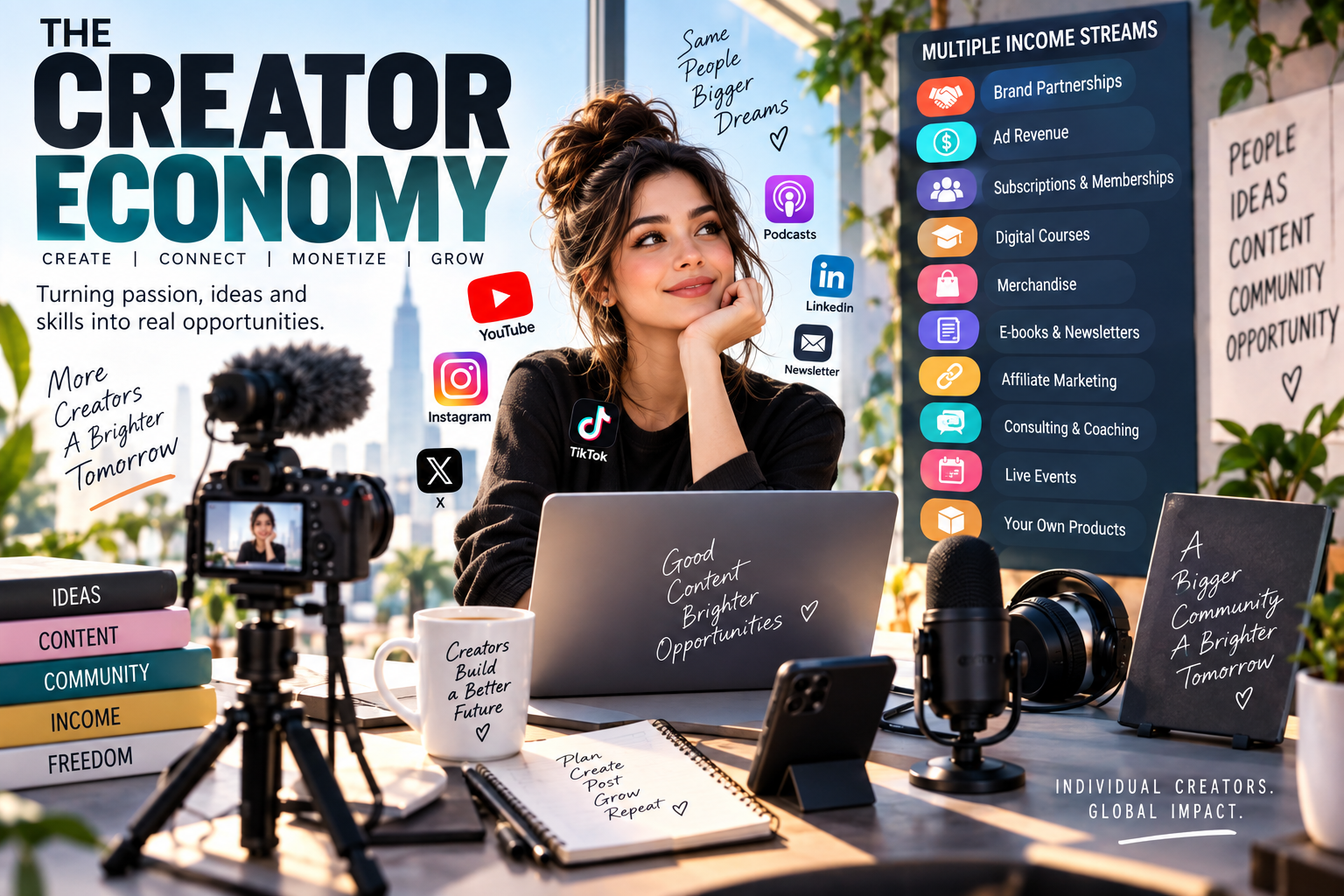
The creator economy has evolved from a niche internet trend into a powerful global business ecosystem. Millions of creators now earn income by producing content, building communities, launching products, and partnering with brands across platforms such as YouTube, Instagram, TikTok, podcasts, newsletters, and independent websites.
What once started as people sharing videos, photos, and ideas online has developed into a sophisticated economy where personal brands can become full-scale businesses.
What Is the Creator Economy?
The creator economy refers to the ecosystem of independent individuals who earn money from their content, skills, knowledge, or online communities. Creators can include video producers, influencers, writers, podcasters, artists, educators, musicians, gamers, and entrepreneurs.
Unlike traditional media businesses, creators can communicate directly with audiences without requiring a television network, publishing company, or large production team. Digital platforms have dramatically reduced the cost of reaching millions of potential customers.
Multiple Ways to Make Money
Advertising remains an important source of creator income, but successful creators increasingly diversify their businesses.
Common revenue streams include:
Brand sponsorships and partnerships
Advertising and platform monetization
Paid memberships and subscriptions
Digital courses and educational products
E-books and newsletters
Merchandise and physical products
Affiliate marketing
Consulting and coaching
Live events and experiences
Direct sales through personal websites
This diversification is important because creators are increasingly treating their online presence as a business rather than simply a social-media account.
Social Media Is the Distribution Engine
Platforms have become powerful distribution channels for creators. Short-form video can help a new creator reach a large audience, while long-form content, newsletters, podcasts, and communities can turn that attention into deeper relationships.
The creator's audience is often the most valuable asset. A loyal community can generate recurring revenue and provide creators with opportunities to launch new products or services.
However, creators also face a major challenge: dependence on platforms. Changes to algorithms, monetization policies, advertising rates, or account rules can significantly affect income.
The Rise of the One-Person Business
Technology has made it possible for an individual creator to operate many functions that once required an entire company.
A creator can now use artificial intelligence, editing software, payment platforms, online stores, analytics tools, and automation to handle content production, marketing, customer service, and sales.
This has created a new type of entrepreneur: the creator-operator.
These individuals combine creativity with business skills, building companies around their expertise and personal brands.
Artificial Intelligence Is Changing the Creator Economy
AI is becoming another major force in the creator economy. Creators can use AI tools to generate ideas, research topics, edit videos, create graphics, translate content, analyze audiences, and automate repetitive tasks.
The technology can lower production costs and allow individuals to produce more content with smaller teams.
At the same time, AI creates new challenges. The increasing volume of automatically generated content could make it harder for audiences to identify original and trustworthy creators. As a result, authenticity, expertise, and strong communities may become even more valuable.
The Business Opportunity
The creator economy is also attracting investors and traditional companies. Brands increasingly recognize that creators can provide something traditional advertising often struggles to deliver: direct relationships with highly engaged audiences.
For businesses, working with creators can provide targeted access to specific communities. For creators, brand partnerships can provide capital to expand their operations and develop new products.
The relationship is becoming increasingly sophisticated, with creators moving from simple sponsored posts toward long-term partnerships, product collaborations, and even ownership stakes in businesses.
Challenges Facing Creators
Despite the opportunities, becoming a successful creator is not easy. Competition is intense, audience attention is limited, and income can be unpredictable.
Creators must also deal with platform dependency, changing algorithms, burnout, copyright issues, brand safety concerns, and the pressure to constantly produce new content.
Building an audience is only the first step. Sustainable creators increasingly focus on converting attention into businesses they control, such as email lists, websites, memberships, products, and communities.
The Future of the Creator Economy
The next phase of the creator economy is likely to be less about simply becoming an influencer and more about building independent businesses.
Creators will increasingly combine content, technology, community, commerce, and intellectual property. Some will remain individual entrepreneurs, while others will build teams and companies around their personal brands.
The most successful creators may ultimately look less like social-media personalities and more like modern media companies—starting with one person, one idea, and an audience.
Conclusion
The creator economy has changed the traditional relationship between audiences, media, and businesses. Individuals no longer need access to traditional institutions to build an audience or launch a global business.
As technology continues to lower the barriers to content creation and entrepreneurship, the creator economy is likely to remain an important part of the digital economy.
The biggest opportunity may not simply be creating content. It may be turning attention into ownership, community into business, and creativity into lasting economic value.