Exchange-traded funds, commonly known as ETFs, have transformed the way people invest. They provide investors with a simple way to gain exposure to stocks, bonds, commodities, currencies, sectors and entire markets through a single investment product.
Instead of purchasing dozens or hundreds of individual securities, an investor can buy shares of an ETF that holds a collection of assets. ETFs combine some of the characteristics of mutual funds with the flexibility of stocks because they can generally be bought and sold throughout the trading day on an exchange.
The popularity of ETFs has grown because of their diversification, flexibility, transparency and relatively straightforward structure. They are used by individual investors, financial advisers, institutions and professional portfolio managers.
However, ETFs are not automatically low-risk investments. Different ETFs can have very different objectives, strategies and levels of volatility. Understanding how they work is essential before investing.
What Is an ETF?
An exchange-traded fund is an investment fund that holds a portfolio of assets and has shares that trade on a stock exchange.
An ETF can track an index such as a broad stock-market index, but ETFs can also focus on specific industries, countries, commodities, bonds or investment strategies.
For example, one ETF might provide exposure to a broad group of large companies, while another might focus specifically on technology stocks.
The key idea is diversification.
Instead of buying one company's stock, an investor can purchase an ETF containing shares of many companies.
This can reduce the impact that the performance of one individual company has on the overall investment.
How Do ETFs Work?
ETFs pool investors' money and use it to purchase assets according to the fund's investment strategy.
If an ETF is designed to track a particular stock index, the fund manager will generally hold securities that correspond closely to that index.
The ETF then issues shares that investors can buy and sell on an exchange.
The market price of an ETF can move throughout the trading day based on supply and demand.
The value of the underlying assets is known as the net asset value, or NAV.
Although an ETF's market price can temporarily trade above or below its NAV, the creation and redemption process used by authorized participants generally helps keep the market price close to the value of the underlying portfolio.
ETFs vs. Mutual Funds
ETFs and mutual funds have several similarities. Both can provide diversified exposure to a portfolio of securities and can be professionally managed.
However, their trading structures are different.
Mutual funds are generally bought or sold at a price calculated at the end of the trading day.
ETFs, on the other hand, trade on exchanges throughout the day, meaning investors can generally buy and sell them during market hours.
This flexibility is one of the reasons ETFs have become popular among investors.
ETFs can also offer relatively low operating costs, although fees vary significantly from one fund to another.
Types of ETFs
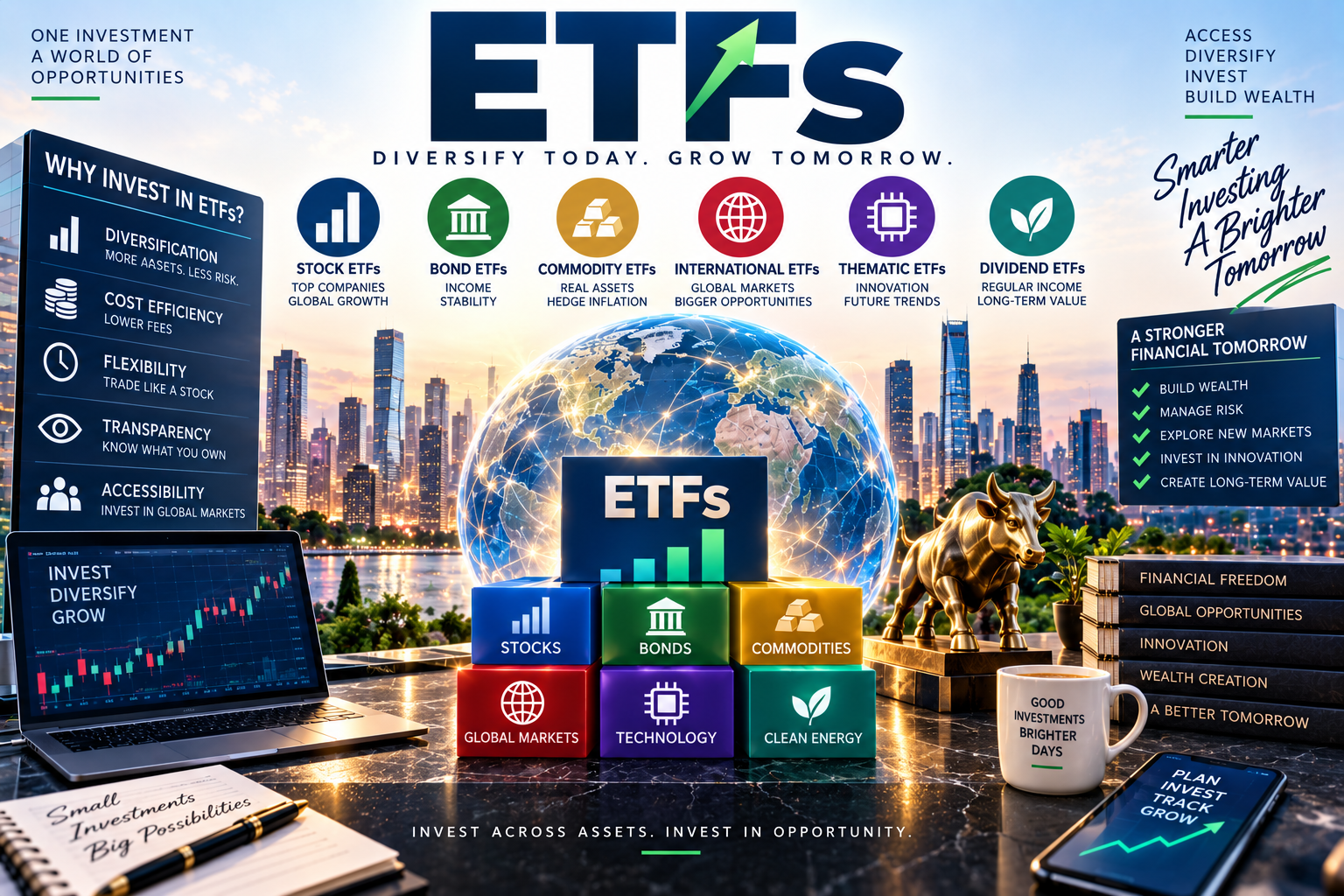
There are many different types of ETFs.
Broad Market ETFs
Broad-market ETFs invest across a large number of companies and are designed to provide exposure to an entire market or major market segment.
They can be useful for investors seeking diversified exposure rather than trying to select individual stocks.
Sector ETFs
Sector ETFs focus on specific industries.
Examples include:
Technology
Healthcare
Financial services
Energy
Consumer goods
Real estate
Utilities
Sector ETFs allow investors to target particular areas of the economy.
Bond ETFs
Bond ETFs invest in fixed-income securities.
They can focus on government bonds, corporate bonds, municipal bonds or international debt.
Bond ETFs are often used to generate income and diversify portfolios, although they remain sensitive to interest-rate and credit conditions.
Commodity ETFs
Commodity ETFs provide exposure to commodities such as gold, silver, oil or agricultural products.
Some funds hold physical commodities, while others gain exposure through futures contracts or related securities.
Commodity ETFs can provide diversification but may experience significant volatility.
International ETFs
International ETFs allow investors to gain exposure to companies outside their home country.
They can focus on individual countries, regions or broad groups of international markets.
These funds introduce additional considerations such as currency movements, political risk and differences in regulations.
Dividend ETFs
Dividend-focused ETFs invest in companies that pay dividends.
They are often attractive to investors seeking income alongside potential capital appreciation.
However, dividend payments are not guaranteed, and high dividend yields do not necessarily indicate a better investment.
Thematic ETFs
Thematic ETFs focus on long-term trends or specific investment themes.
Examples can include:
Artificial intelligence
Clean energy
Cybersecurity
Electric vehicles
Biotechnology
Robotics
Cloud computing
Thematic ETFs can provide exposure to emerging industries but may be more concentrated and volatile than broad-market funds.
Passive vs. Active ETFs
ETFs can be either passive or actively managed.
Passive ETFs
Passive ETFs generally seek to track an index rather than outperform it.
Because they follow predefined investment rules, passive funds can often operate with relatively low management costs.
Active ETFs
Active ETFs use portfolio managers to select investments with the goal of outperforming a benchmark or achieving another specific objective.
Active management can provide greater flexibility but may involve higher costs and more complex strategies.
Benefits of ETFs
ETFs offer several potential advantages.
Diversification
One of the biggest benefits is diversification.
A single ETF may hold dozens, hundreds or even thousands of securities.
This means an investor does not have to rely entirely on the performance of one company.
Flexibility
Because ETFs trade on exchanges, investors can generally buy and sell them during market hours.
This provides more trading flexibility than traditional mutual funds.
Accessibility
ETFs allow investors to gain exposure to markets that might otherwise be difficult to access directly.
An investor can potentially obtain exposure to international stocks, government bonds, commodities or specific industries through one fund.
Transparency
Many ETFs disclose their holdings regularly, allowing investors to understand what they own.
Cost Efficiency
Some ETFs have relatively low expense ratios because of their passive structure.
However, investors should consider all costs, including trading commissions where applicable, bid-ask spreads and fund expenses.
ETF Costs
Understanding costs is important when selecting an ETF.
Expense Ratio
The expense ratio represents the annual operating expenses charged by the fund, expressed as a percentage of assets.
A lower expense ratio can be beneficial, especially for long-term investors, because fees reduce investment returns over time.
Bid-Ask Spread
The bid price is the price at which buyers are willing to purchase ETF shares, while the ask price is the price at which sellers are willing to sell.
The difference between them is the bid-ask spread.
Highly liquid ETFs often have narrower spreads, while less liquid funds can have wider spreads.
Trading Costs
Depending on the brokerage platform, investors may also face trading-related costs.
Even when commissions are zero, investors should consider spreads and other expenses.
ETFs and Diversification
Diversification is one of the central principles of portfolio construction.
Imagine an investor buys shares in only one company. If that company experiences serious financial problems, the investor could suffer a large loss.
An ETF containing hundreds of companies spreads exposure across many businesses.
However, diversification does not eliminate risk.
A broad stock-market ETF can still fall significantly during a major market downturn.
Similarly, a sector ETF can be heavily affected by problems within one industry.
The type of ETF therefore matters just as much as the fact that it is an ETF.
ETFs and Long-Term Investing
ETFs are frequently used as long-term investment tools.
A diversified ETF can allow investors to participate in the growth of financial markets without selecting individual securities.
Some investors use ETFs as the foundation of a long-term portfolio and combine them with other investments according to their financial goals and risk tolerance.
Long-term investors often focus on diversification, costs, asset allocation and consistency rather than trying to predict short-term market movements.
ETFs and Dollar-Cost Averaging
ETFs can also be used with a strategy known as dollar-cost averaging.
Under this approach, an investor invests a fixed amount at regular intervals regardless of whether markets are rising or falling.
For example, an investor might invest a fixed amount every month into a diversified ETF.
When prices are lower, the same amount buys more shares. When prices are higher, it buys fewer shares.
Dollar-cost averaging does not guarantee profits or protect against losses, but it can help investors maintain a disciplined investment approach.
ETF Risks
Despite their advantages, ETFs involve investment risks.
Market Risk
If the underlying market falls, the ETF can also lose value.
Concentration Risk
Some ETFs focus heavily on a single sector, industry or country.
Liquidity Risk
Certain ETFs may have low trading volumes, which can result in wider spreads.
Currency Risk
International ETFs may be affected by exchange-rate movements.
Interest-Rate Risk
Bond ETFs can lose value when interest rates rise, depending on their duration and holdings.
Tracking Risk
An ETF may not perfectly match the performance of its underlying index because of fees, transaction costs and other factors.
Commodity Risk
Commodity ETFs can be highly volatile and may have additional complexities when they use futures contracts.
Leveraged and Inverse ETFs
Some ETFs use financial strategies designed to provide leveraged or inverse exposure to an index.
A leveraged ETF may attempt to produce a multiple of the daily performance of an underlying index.
An inverse ETF seeks to move in the opposite direction of its benchmark.
These products are generally designed for specific investment or trading objectives and can behave very differently from traditional long-term ETFs.
Because their performance can compound differently over multiple days, investors need to understand their structure carefully before using them.
ETFs and Technology
Technology has played an important role in the growth of ETFs.
Online brokerage platforms have made ETFs easier for individual investors to access.
Digital investment tools also allow investors to compare funds, examine holdings, review historical performance and construct diversified portfolios.
Technology has also contributed to the development of more specialized ETFs focused on areas such as artificial intelligence, cybersecurity, automation and other emerging themes.
ETFs and Artificial Intelligence
Artificial intelligence is becoming an increasingly important investment theme.
Several ETFs now focus on companies involved in AI infrastructure, semiconductor manufacturing, cloud computing, robotics and software.
Investors interested in AI can therefore gain diversified exposure to a group of companies rather than trying to identify a single winner.
However, thematic ETFs can be concentrated and may trade at valuations that already reflect high expectations for future growth.
Investors should therefore examine the underlying holdings rather than investing based solely on the theme.
ETFs and Global Markets
ETFs have also made international investing more accessible.
An investor can use ETFs to gain exposure to markets across Asia, Europe, Latin America, emerging economies or developed markets.
This can help investors diversify geographically.
However, international investing introduces additional risks, including currency fluctuations, political developments, economic differences and regulatory changes.
Emerging-market ETFs can offer exposure to economies with strong long-term growth potential, but they may also experience greater volatility than developed-market funds.
How to Choose an ETF
Investors should evaluate several factors before selecting an ETF.
Investment Objective
Understand exactly what the ETF is designed to track or achieve.
Holdings
Review the companies, bonds, commodities or other assets inside the fund.
Expense Ratio
Compare the fund's annual operating expenses with similar ETFs.
Liquidity
Look at trading volume and bid-ask spreads.
Performance
Historical performance can provide useful information, although it does not guarantee future returns.
Risk
Consider whether the fund's volatility and concentration match your investment objectives.
Fund Size
Larger funds can sometimes offer greater liquidity and established trading markets, although fund size alone should not determine an investment decision.
The Future of ETFs
The ETF industry is likely to continue evolving as investors seek lower costs, greater diversification and access to new investment themes.
Artificial intelligence, clean energy, cybersecurity, digital infrastructure, healthcare innovation and emerging markets could continue influencing new ETF products.
At the same time, investors may increasingly demand products that combine traditional diversification with specific environmental, social, technological or economic themes.
Competition among ETF providers could also encourage innovation and put pressure on fees.
However, greater choice creates another challenge: investors must distinguish between useful investment products and highly specialized funds that may carry risks they do not fully understand.
ETFs and Portfolio Construction
ETFs can serve different roles within an investment portfolio.
A broad-market ETF may provide the core of a portfolio.
Bond ETFs can provide exposure to fixed-income markets.
International ETFs can provide geographic diversification.
Sector or thematic ETFs can be used to express a specific investment view.
The appropriate combination depends on an investor's objectives, time horizon and tolerance for risk.
There is no single ETF portfolio that is appropriate for everyone.
Conclusion
ETFs have become one of the most important investment vehicles in modern financial markets.
They offer investors access to diversified portfolios, sectors, bonds, commodities, international markets and investment themes through products that can generally be traded throughout the day.
Their flexibility and accessibility make them useful for both new and experienced investors.
However, an ETF is not automatically safe simply because it contains multiple investments. The underlying assets, investment strategy, fees, liquidity and market conditions all matter.
Broad-market ETFs can provide diversification, while sector, commodity, international and thematic ETFs can provide more targeted exposure. Leveraged and inverse ETFs require additional care because their structures can produce results that differ significantly from traditional buy-and-hold investments.
For investors considering ETFs, the most important step is understanding what the fund actually owns and how it is designed to perform.
As financial markets continue to evolve, ETFs are likely to remain an important bridge between investors and global opportunities. Whether the goal is long-term diversification, income, international exposure or access to emerging investment themes, ETFs provide a flexible way to participate in financial markets.
Frequently Asked Questions
What does ETF stand for?
ETF stands for exchange-traded fund. It is an investment fund whose shares trade on a stock exchange.
Are ETFs better than individual stocks?
ETFs can provide greater diversification than investing in a single stock, but whether they are better depends on an investor's objectives, risk tolerance and strategy.
Are ETFs risky?
ETFs can carry market, sector, currency, interest-rate, liquidity and other risks. The level of risk depends on the assets and strategy of the individual ETF.
What is a broad-market ETF?
A broad-market ETF invests across a large group of companies or securities to provide diversified exposure to a market or major market segment.
Do ETFs pay dividends?
Some ETFs distribute dividends or other income generated by their underlying holdings. The amount and frequency depend on the fund.
What is an expense ratio?
An expense ratio is the annual operating cost of an ETF, expressed as a percentage of the fund's assets.
Can ETFs be used for long-term investing?
Yes. Many investors use diversified ETFs as long-term investment vehicles, although the suitability of any ETF depends on its underlying assets and the investor's goals.
What is the difference between an ETF and a mutual fund?
Both can provide diversified investment exposure, but ETFs generally trade throughout the day on exchanges, while traditional mutual funds are generally priced and transacted at the end of the trading day.
What are thematic ETFs?
Thematic ETFs focus on specific investment themes such as artificial intelligence, clean energy, cybersecurity, robotics or biotechnology.
Can ETFs lose money?
Yes. ETF prices can decline when the underlying investments lose value. Diversification can reduce concentration risk but cannot eliminate investment losses.