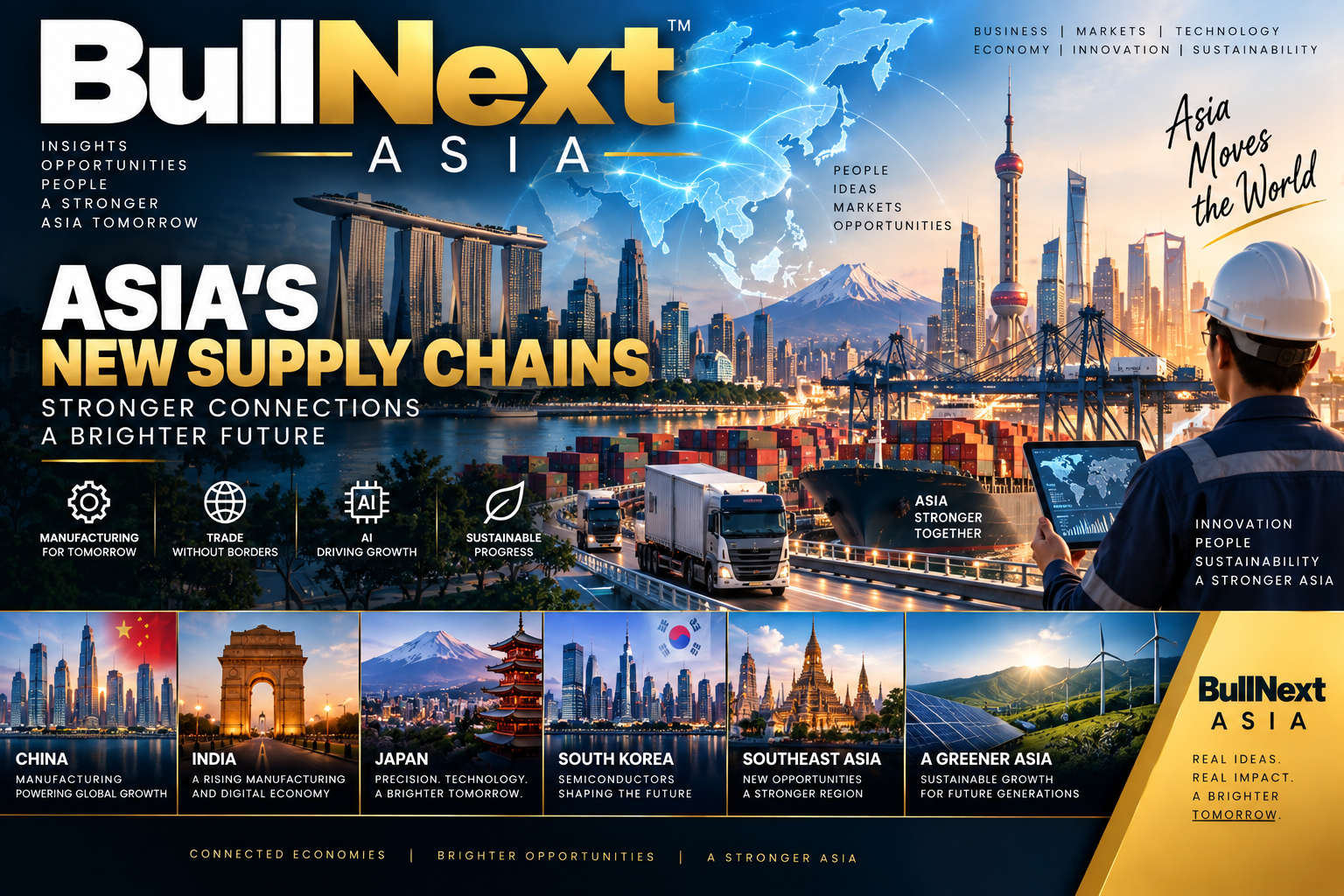
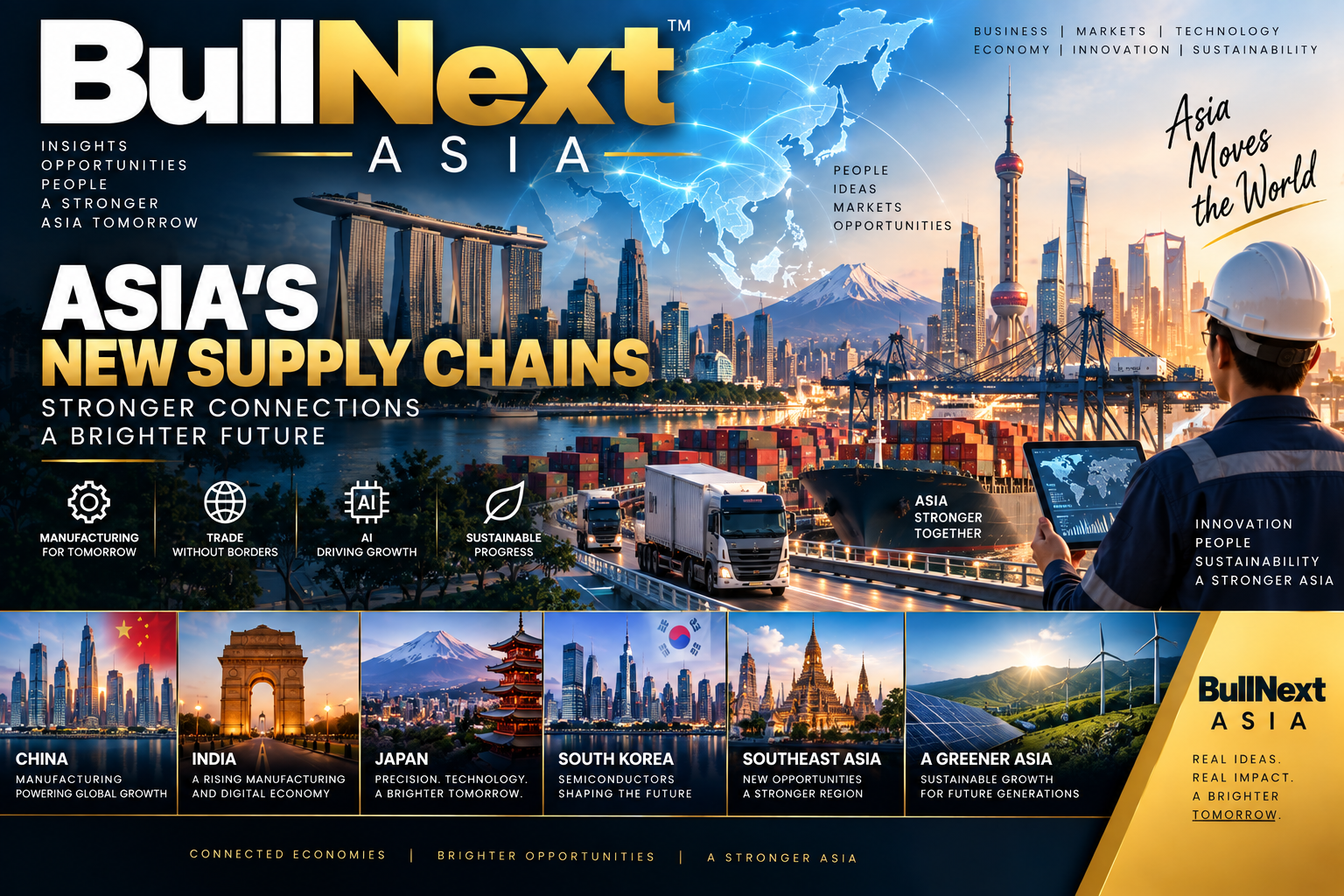
Asia has long been at the center of global manufacturing and international trade. From electronics and automobiles to semiconductors, consumer products, machinery, and digital technology, companies around the world depend on Asian production networks.
But the structure of these supply chains is changing.
Businesses are increasingly looking for greater resilience, multiple manufacturing locations, reliable infrastructure, skilled workers, and access to growing consumer markets. This is creating new opportunities across Asia while also changing the relationships between established economic powers and emerging markets.
For BullNext Asia, the transformation of regional supply chains is one of the most important stories to watch because it connects manufacturing, technology, infrastructure, investment, employment, and global trade.
Why Asia Remains Central to Global Supply Chains
Asia contains some of the world's most important manufacturing economies.
China remains a major global production center, while Japan and South Korea have significant strengths in advanced manufacturing, electronics, automobiles, machinery, and technology.
At the same time, countries across Southeast Asia are attracting investment in manufacturing, logistics, digital services, and industrial development.
India is also becoming increasingly important as companies expand manufacturing capacity and look for opportunities in one of the world's largest consumer markets.
This creates a highly connected regional ecosystem.
A product may be designed in one country, use components manufactured in several others, be assembled somewhere else, and eventually be sold to customers around the world.
The Shift Toward Supply-Chain Resilience
For decades, businesses often prioritized efficiency and cost.
Today, resilience has become increasingly important.
Companies have learned that concentrating production or sourcing in a single location can create significant risks when unexpected events disrupt transportation, trade, energy supplies, or production.
As a result, businesses are increasingly considering strategies that spread production and sourcing across multiple locations.
This does not necessarily mean abandoning established manufacturing centers.
Instead, companies may add new facilities, suppliers, or logistics routes in other Asian markets.
The result could be a more diversified regional manufacturing network.
Southeast Asia's Growing Role
Southeast Asia is particularly important to this transformation.
Countries such as Vietnam, Indonesia, Malaysia, Thailand, Singapore, and the Philippines offer different combinations of manufacturing capabilities, consumer markets, infrastructure, labor, natural resources, and geographic advantages.
Vietnam, for example, has become an important manufacturing location for electronics and consumer products.
Malaysia has strengths in semiconductors and is also attracting major investment in data centers.
Indonesia offers a large domestic consumer market and important natural resources.
Singapore plays a major role as a financial, logistics, and regional business hub.
Each country therefore contributes differently to the broader Asian economic network.
India and the Manufacturing Opportunity
India's growing role in manufacturing is another important development.
The country's large domestic market provides an advantage for companies that want to combine production with access to consumers.
India also has a large technology and services workforce, expanding digital infrastructure, and increasing investment in manufacturing and physical infrastructure.
As global companies diversify production, India has the potential to become an increasingly important part of international supply chains.
However, continued growth will depend on infrastructure, logistics, workforce development, policy implementation, and the ability of businesses to operate efficiently at scale.
China's Role Is Changing, Not Disappearing
The diversification of supply chains does not mean China's importance is disappearing.
China continues to have enormous manufacturing capacity, extensive supplier networks, advanced infrastructure, engineering expertise, and access to a large domestic market.
These advantages are difficult to replicate quickly.
At the same time, China's industrial base is becoming increasingly sophisticated.
The country is moving beyond traditional manufacturing into areas such as electric vehicles, batteries, renewable energy equipment, robotics, advanced electronics, and other technology-intensive industries.
This means China may remain a critical part of global supply chains even as some production becomes more geographically diversified.
Japan and South Korea: Moving Up the Value Chain
Japan and South Korea occupy a different position within Asia's manufacturing ecosystem.
Both economies have strong capabilities in advanced technology and high-value industrial production.
Japan is particularly important in robotics, machinery, automobiles, precision manufacturing, and advanced materials.
South Korea has major strengths in semiconductors, electronics, batteries, automobiles, and advanced manufacturing.
These industries are becoming increasingly important as artificial intelligence and electrification create demand for advanced components and infrastructure.
Semiconductors Become Strategic
Few industries demonstrate Asia's importance better than semiconductors.
Modern economies depend on chips for smartphones, computers, automobiles, industrial equipment, telecommunications, data centers, and artificial intelligence.
Taiwan and South Korea are particularly important within the semiconductor ecosystem, while Japan also has significant strengths in semiconductor materials and manufacturing equipment.
The rapid growth of AI has increased attention on semiconductor supply chains because advanced computing requires enormous quantities of specialized chips and supporting infrastructure.
BullNext's recent Asian-market coverage highlights the continuing importance of AI and semiconductor demand to regional markets.
AI Is Creating a New Industrial Economy
Artificial intelligence is not only a software story.
It is creating demand for physical infrastructure.
AI requires:
Advanced semiconductors
Data centers
Electricity
Cooling systems
Networking equipment
Cloud infrastructure
Specialized computing systems
This means countries with strong energy infrastructure, technology capabilities, construction industries, and telecommunications networks can benefit from the expansion of AI.
The result is a connection between the digital economy and traditional industries.
AI growth can increase demand for factories, power systems, industrial equipment, real estate, and logistics.
Data Centers and Asia's Infrastructure
Data centers are becoming an increasingly important part of Asia's technology infrastructure.
As cloud computing and AI expand, businesses require facilities capable of processing and storing enormous quantities of data.
This creates opportunities for countries that can provide reliable electricity, telecommunications connectivity, suitable land, and a supportive business environment.
Malaysia and Singapore are among the Asian markets receiving attention for data-center development.
However, the rapid expansion of data centers also creates challenges around electricity consumption, water usage, land availability, and environmental sustainability.
Logistics Is Becoming More Important
Manufacturing cannot function without logistics.
Factories need raw materials.
Warehouses need transportation.
Retailers need distribution networks.
Consumers expect increasingly fast delivery.
As Asian supply chains become more diversified, logistics infrastructure becomes even more important.
Ports, airports, railways, highways, warehouses, and distribution centers can determine how efficiently goods move between manufacturers and customers.
This creates opportunities for businesses involved in logistics, industrial real estate, transportation, and infrastructure development.
The Rise of Industrial Real Estate
Supply-chain transformation is also influencing property markets.
Manufacturers and logistics companies require warehouses, factories, distribution centers, and specialized facilities.
As businesses establish new operations, demand for industrial real estate can increase in strategically located areas.
Properties near ports, highways, airports, rail networks, and major consumer markets can become particularly important.
This creates a connection between Asian manufacturing trends and the real estate sector.
Energy Will Be a Major Factor
One of the biggest challenges facing Asia's future industrial growth is energy.
Factories need reliable electricity.
Data centers require enormous amounts of power.
Electric vehicles increase demand for charging infrastructure.
Urbanization increases residential and commercial energy consumption.
Countries therefore need to expand energy capacity while managing costs and environmental concerns.
Renewable energy, natural gas, nuclear power, energy storage, and modern electricity grids could all play roles in meeting Asia's future requirements.
Digital Trade Is Connecting Businesses
Physical supply chains are increasingly supported by digital systems.
Businesses can use cloud platforms to coordinate suppliers, track shipments, monitor inventory, analyze demand, and manage international operations.
Artificial intelligence can potentially improve forecasting and identify inefficiencies.
Digital payments can simplify transactions.
Real-time tracking can provide greater visibility across transportation networks.
This creates a more connected supply chain in which physical goods and digital information move together.
The New Asian Consumer
Supply-chain development is not only about exports.
Asia is also home to enormous consumer markets.
Rising incomes, urbanization, smartphone adoption, and digital payments are changing consumer behavior across many countries.
Consumers increasingly purchase electronics, automobiles, financial services, travel, healthcare, entertainment, food, and online services.
This means companies may increasingly build operations in Asia not only to manufacture products but also to sell them directly to regional consumers.
What Businesses Should Consider
Companies evaluating Asian markets should look beyond labor costs.
Important considerations include:
Infrastructure
Can products move efficiently through roads, ports, airports, and railways?
Workforce
Are skilled workers available for manufacturing, technology, engineering, and management?
Energy
Can businesses access reliable and competitively priced electricity?
Regulations
How predictable are local regulations and investment policies?
Consumer Demand
Is the domestic market large enough to support long-term growth?
Supplier Networks
Are local suppliers and supporting industries available?
Technology
Can businesses access the digital infrastructure needed for modern operations?
These factors can determine whether a market becomes a successful long-term investment destination.
Risks Behind the Opportunity
Asia's supply-chain transformation also carries risks.
Geopolitical tensions can disrupt trade.
Currency movements can affect investment returns.
Changes in tariffs can influence manufacturing costs.
Energy shortages can affect production.
Extreme weather can disrupt transportation and infrastructure.
Regulatory changes can alter investment conditions.
Businesses therefore need to balance efficiency with resilience.
What the Future Could Look Like
The future Asian supply chain may be more diversified, automated, digital, and interconnected.
A company may manufacture components in several countries, use AI to forecast demand, operate automated warehouses, track shipments in real time, and sell directly to consumers through digital platforms.
Factories may increasingly use robotics and intelligent systems.
Warehouses may become more automated.
Ports may use digital logistics systems.
Data centers may become as strategically important as traditional industrial infrastructure.
This transformation could create opportunities across technology, manufacturing, logistics, energy, real estate, and financial services.
BullNext Asia's Perspective
BullNext's Asian coverage looks beyond daily market movements to the larger forces shaping the region, including technology, manufacturing, AI, foreign investment, consumer growth, commodities, and economic development.
Supply-chain transformation connects many of these themes.
A new factory can create demand for industrial property.
Industrial growth can increase energy consumption.
Energy investment can create infrastructure opportunities.
Technology investment can increase semiconductor demand.
Consumer growth can strengthen ecommerce and logistics.
These developments are connected, and understanding those connections can provide a clearer picture of Asia's economic future.
Frequently Asked Questions
Why are Asian supply chains changing?
Businesses are increasingly focused on resilience, diversification, infrastructure, geopolitical risk, and access to growing consumer markets.
Is China losing its importance in manufacturing?
China remains a major global manufacturing center. However, some companies are diversifying production by adding operations in other Asian countries.
Why is India becoming important for manufacturing?
India combines a large domestic market, expanding infrastructure, a growing technology sector, and a large workforce, making it an increasingly important manufacturing and investment market.
Which Southeast Asian countries are attracting investment?
Vietnam, Indonesia, Malaysia, Singapore, Thailand, and the Philippines are among the countries receiving attention for manufacturing, technology, logistics, and digital-economy opportunities.
Why are semiconductors important to Asia?
Semiconductors are essential for electronics, automobiles, AI systems, telecommunications, and industrial technology. Several Asian economies are major participants in the global semiconductor supply chain.
How is AI affecting Asian economies?
AI is increasing demand for semiconductors, data centers, electricity, cloud infrastructure, networking equipment, and advanced manufacturing.
Why is logistics important?
Efficient logistics allow raw materials, components, and finished products to move between suppliers, factories, warehouses, retailers, and consumers.
Will Asia remain important to global trade?
Asia is likely to remain a major center for manufacturing, technology, consumer markets, and international trade, although the structure of regional supply chains will continue to evolve.
Conclusion
Asia's economic future is being shaped by more than stock markets and short-term economic data.
Behind the headlines is a much larger transformation involving factories, ports, warehouses, data centers, semiconductor plants, energy systems, digital platforms, and millions of consumers.
China continues to provide enormous manufacturing depth.
India is expanding its industrial and digital capabilities.
Japan and South Korea remain leaders in advanced technology.
Southeast Asia is attracting new manufacturing and technology investment.
Together, these developments are creating a more diversified and interconnected Asian economy.
For businesses and investors, the opportunity is not simply to identify the next low-cost manufacturing location.
It is to understand how technology, infrastructure, people, capital, trade, and consumers are coming together to reshape the region.
That is the story BullNext Asia will continue to follow as Asia enters its next chapter.