
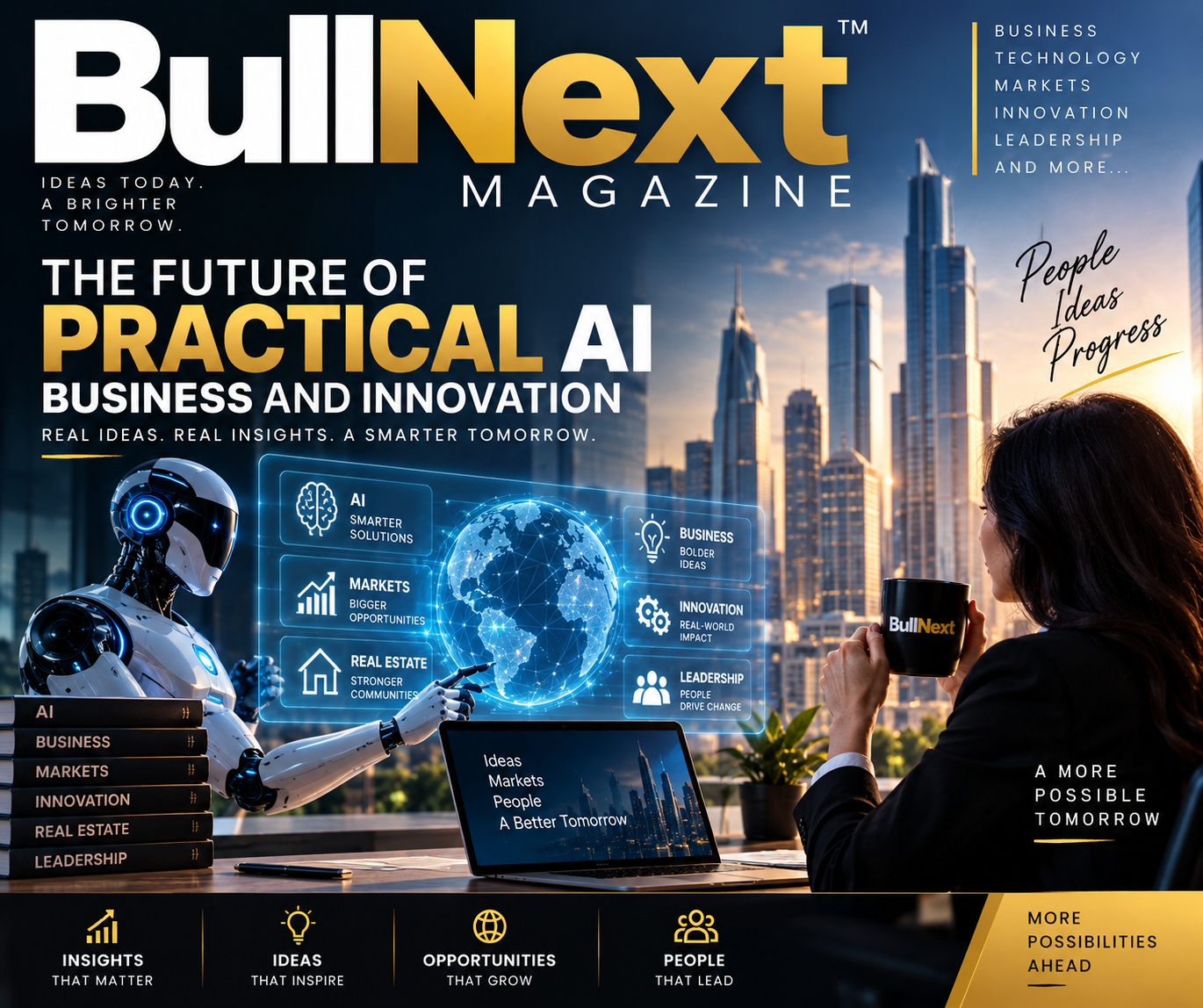
The business world is entering a new phase of technological transformation. Artificial intelligence is moving beyond simple experiments and becoming part of the systems companies use to operate, communicate, analyze information, serve customers, and make decisions.
At the same time, financial markets are responding to changing economic conditions, new technologies are creating entirely new business models, and leaders are being challenged to adapt faster than ever.
This is the environment explored through BullNext Magazine — a broader look at the ideas, technologies, markets, and innovations shaping the future of business.
A New Era of Business
For many years, digital transformation meant moving traditional processes onto computers and cloud platforms.
Today, the transformation is going further.
Artificial intelligence can analyze information, generate content, automate workflows, recognize patterns, assist customers, and increasingly perform multi-step tasks.
This creates an important shift for businesses.
The question is no longer simply whether a company should use technology. The more important question is where technology can create meaningful value.
A business might use AI to process thousands of customer requests, identify unusual transactions, analyze sales data, classify products, prepare documents, or support employees with real-time information.
The most valuable applications may therefore be the ones that quietly improve everyday operations.
From AI Hype to Practical AI
Artificial intelligence has attracted enormous attention, but businesses are increasingly looking beyond demonstrations.
A powerful AI model can generate impressive results in a test environment. However, a real business needs technology that can work reliably with existing systems, processes, employees, customers, and regulations.
This is where practical AI becomes important.
Instead of asking, “What can AI do?” businesses can begin with a different question:
“What problem are we trying to solve?”
That approach can lead to more focused implementations.
For example, an ecommerce company may discover that employees spend hours every day processing repetitive orders. Rather than introducing AI simply because it is popular, the company can identify that workflow as an opportunity for automation.
The result could be a system that receives an order, analyzes the information, performs routine checks, generates the required documentation, and alerts an employee only when something unusual occurs.
The technology becomes useful because it is connected to a real business problem.
The Rise of AI Agents
One of the most important developments in business technology is the emergence of AI agents.
Traditional software generally performs specific functions when a user gives it instructions.
AI agents can potentially operate across multiple steps of a workflow.
A simplified process could look like:
Receive information → Analyze → Decide → Take action → Report
For businesses, this could have significant implications.
An AI agent could potentially assist with customer service, sales operations, document processing, research, compliance, logistics, finance, or internal administration.
This does not mean that every business process should become fully automated.
Human oversight remains important, particularly when decisions involve financial consequences, sensitive information, legal requirements, or complex judgment.
The opportunity lies in creating a partnership between people and intelligent systems.
Automation and the Modern Workplace
Automation has always played a role in business.
Factories automated manufacturing processes. Computers automated calculations and record keeping. The internet automated communication and information sharing.
AI introduces another layer.
Instead of automating only clearly defined mechanical tasks, intelligent systems can potentially work with information, language, patterns, and decisions.
This could change the nature of many jobs.
Employees may spend less time copying information between systems, preparing repetitive documents, searching for basic information, or responding to routine requests.
Instead, they may spend more time on strategy, relationships, creativity, negotiation, problem-solving, and decisions that require human experience.
The future workplace may therefore not be about humans versus AI.
It may be about humans working with AI.
Data Is Becoming a Strategic Asset
AI is only as useful as the information surrounding it.
Businesses already generate enormous amounts of data through websites, applications, sales systems, customer interactions, financial platforms, supply chains, and internal operations.
The challenge is turning this information into useful insight.
AI-powered analytics can help businesses identify patterns and relationships that might otherwise be difficult to see.
For example, a company could analyze customer behavior to identify purchasing trends, evaluate which products are performing best, or detect changes in demand.
Financial teams could use data to monitor performance and identify unusual activity.
Operations teams could analyze workflows to discover bottlenecks.
The value of data therefore extends beyond storage.
The real advantage comes from turning information into better decisions.
AI-Powered Decision Making
Business intelligence has traditionally focused on understanding what happened.
AI-powered decision systems can potentially go further by helping businesses explore what could happen next.
A company could use historical information, current market conditions, customer behavior, and other variables to evaluate possible scenarios.
For example:
What happens if demand increases?
What happens if costs rise?
Which products could generate stronger margins?
Which customers may require additional support?
Which operational processes are creating unnecessary costs?
AI cannot eliminate uncertainty, but it can help decision-makers process large amounts of information more efficiently.
Human judgment remains essential, but technology can make that judgment better informed.
Innovation Beyond Technology
Innovation is not limited to artificial intelligence.
Businesses can innovate through products, services, processes, marketing, customer experiences, and business models.
Sometimes the most important innovation is not a completely new invention.
It may be a better way of doing something that already exists.
A company might redesign its customer onboarding process, introduce a subscription model, simplify payments, automate internal approvals, or create a more efficient supply chain.
These changes can have significant effects even when customers never see the technology behind them.
This is why innovation should be viewed as a business discipline rather than simply a technology trend.
Global Markets and Business Strategy
Technology does not operate in isolation from the economy.
Businesses and investors also need to understand interest rates, inflation, currencies, energy prices, consumer demand, corporate earnings, and geopolitical developments.
A change in interest rates can affect borrowing costs.
Energy prices can influence manufacturing and transportation expenses.
Currency movements can affect international businesses.
Economic growth can influence consumer spending.
These factors can determine whether companies expand, reduce investment, hire employees, or enter new markets.
For this reason, understanding technology and understanding markets are increasingly connected.
The Growing Importance of Asia
Asia remains an important part of the global economic story.
The region includes some of the world's largest manufacturing centers, technology markets, consumer populations, financial systems, and emerging economies.
Countries across Asia are playing different roles in technology, manufacturing, trade, energy, finance, and digital services.
India continues to attract attention because of its large economy, technology sector, expanding digital infrastructure, and growing consumer market.
China remains an important global manufacturing and technology center.
Japan and South Korea continue to play major roles in advanced technology, electronics, automotive industries, and innovation.
Southeast Asia is also developing rapidly as businesses expand manufacturing, digital services, ecommerce, and regional supply chains.
For global businesses and investors, understanding these markets can provide a broader perspective on where future growth may emerge.
Leadership in the Age of AI
Technology can change quickly.
Leadership must keep up.
Modern business leaders increasingly need to understand not only financial performance but also technology, data, AI, cybersecurity, employee development, and changing customer expectations.
However, leadership remains fundamentally human.
Good leadership requires communication, accountability, judgment, empathy, and the ability to make decisions under uncertainty.
AI can provide information.
It cannot replace responsibility.
The most effective leaders may therefore be those who understand how to combine technological capabilities with human judgment.
The Changing Customer Experience
Customer expectations are evolving alongside technology.
People increasingly expect businesses to respond quickly and provide convenient digital experiences.
AI can support this shift by helping businesses personalize communication, answer routine questions, analyze customer behavior, and provide employees with useful information.
But automation should not make customer experiences feel less human.
A customer may appreciate an instant automated answer for a simple question.
For a complicated problem, however, they may want to speak to a real person.
The strongest customer experience may therefore combine automation with human support.
Real Estate in a Digital Economy
Real estate is another area being influenced by technology and changing economic conditions.
Property markets are increasingly connected to infrastructure, demographics, employment, financing, technology, and sustainability.
Smart buildings can use connected systems to improve energy efficiency and management.
Digital platforms can make it easier for buyers and investors to research properties.
Data analytics can help businesses understand market conditions and demand.
At the same time, traditional fundamentals remain important.
Location, accessibility, property quality, infrastructure, affordability, and demand continue to influence real estate decisions.
Technology changes the way property is evaluated, but it does not eliminate the importance of the underlying asset.
The Importance of Adaptability
One theme connects AI, markets, business, innovation, and leadership:
Adaptability.
Businesses cannot assume that today's successful strategy will remain successful forever.
Technology changes.
Customers change.
Markets change.
Competitors change.
Regulations change.
Organizations that can recognize these changes and respond effectively may have an advantage.
This does not mean constantly chasing every new trend.
Instead, businesses need to distinguish between meaningful change and temporary hype.
Building Businesses Around Real Problems
The next generation of successful technology companies may focus less on creating technology for its own sake and more on solving specific problems.
A company that reduces customs complexity for ecommerce businesses may create more value than a company simply advertising itself as an “AI company.”
A system that saves employees hours of repetitive work every week can be more valuable than an impressive demonstration that nobody uses.
This is the foundation of practical innovation.
Problem first. Technology second. Results always.
What the Future Could Look Like
The coming years may bring increasingly connected business systems.
AI agents could communicate with software platforms.
Businesses could automate larger portions of their operations.
Decision systems could analyze market conditions in real time.
Digital twins could help companies simulate physical environments.
Smart buildings could optimize their own energy consumption.
Customers could receive more personalized services.
Financial markets could continue responding to the enormous investment being made in AI infrastructure.
At the same time, new challenges will emerge.
Companies will need to address cybersecurity, privacy, AI reliability, regulation, workforce transformation, and the responsible use of automated decision-making.
The future will therefore not simply be about adopting more technology.
It will be about adopting the right technology in the right way.
BullNext's Role
BullNext brings these different subjects together through coverage of business, technology, AI, innovation, markets, leadership, real estate, and other areas shaping modern life.
This broader perspective matters because today's biggest developments rarely exist in isolation.
AI affects business.
Business affects markets.
Markets influence investment.
Innovation changes customer behavior.
Leadership determines how organizations respond.
Global economic conditions influence all of them.
Understanding those connections can help readers see beyond individual headlines and recognize the larger trends shaping the future.
Conclusion
The next era of business will be defined by rapid technological development, changing markets, new forms of innovation, and evolving expectations from customers and employees.
Artificial intelligence is becoming more practical.
AI agents are moving toward real-world workflows.
Businesses are searching for measurable value from automation.
Markets are responding to technological investment.
Innovation is becoming increasingly important across industries.
And leadership is evolving to meet a more complex environment.
The organizations that succeed may not necessarily be those that adopt every new technology.
They may be the ones that understand their problems, recognize meaningful opportunities, invest intelligently, and continuously adapt.
That is the larger story behind the themes explored through BullNext Magazine.
The future of business is not simply about technology.
It is about people, ideas, markets, innovation, and the ability to turn change into opportunity.