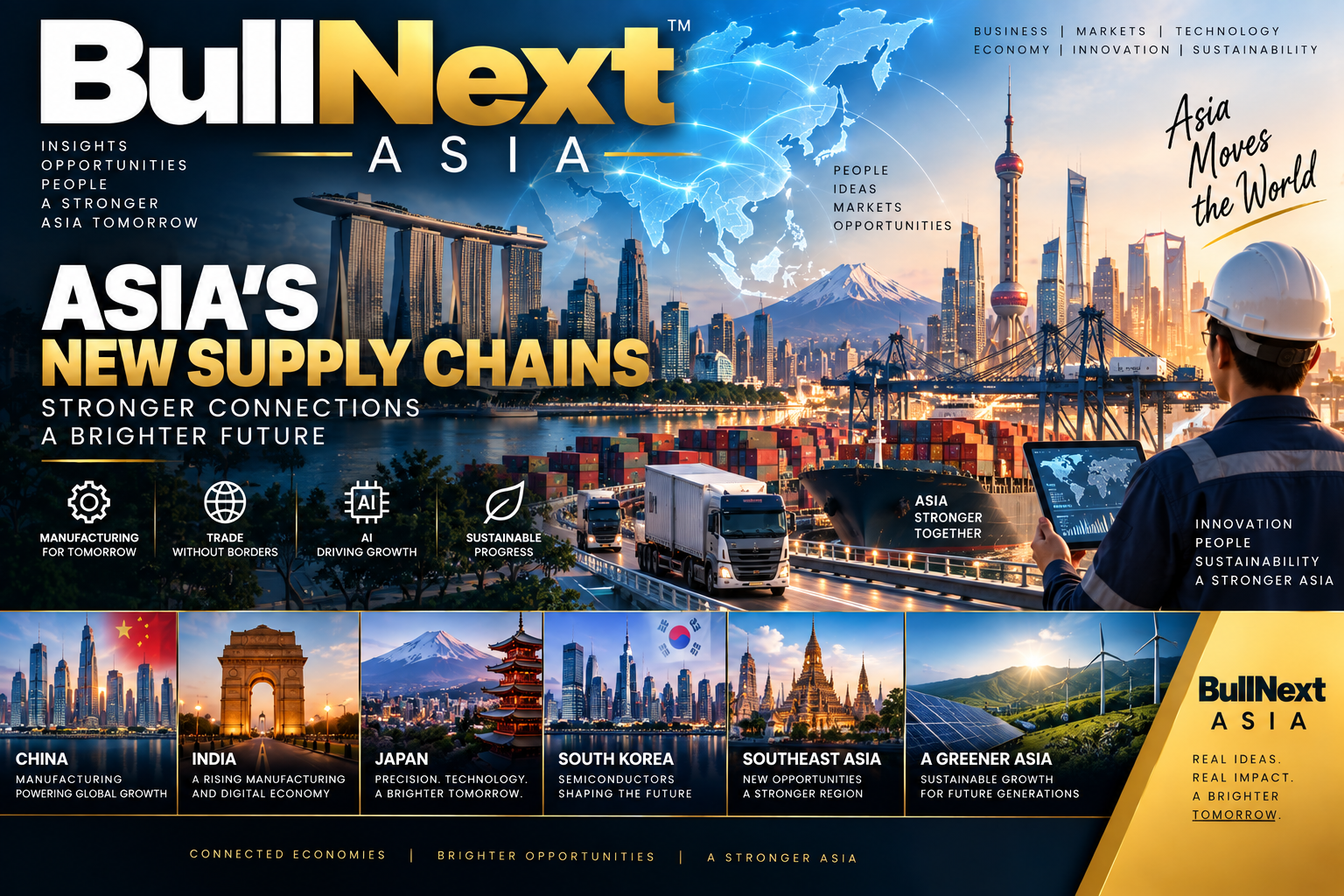
bullnext Asia is entering a new phase of economic transformation.
For decades, the region has been known as the world's manufacturing center. Today, that role is expanding. Asia is becoming a major hub for artificial intelligence, semiconductors, digital finance, renewable energy, advanced manufacturing, ecommerce, logistics, and technology-driven services.
From China's industrial strength and Japan's advanced technology to India's expanding digital economy and Southeast Asia's growing manufacturing base, the region is developing multiple engines of growth.
For businesses and investors, the important question is no longer simply whether Asia will grow. The bigger question is which industries and countries will shape Asia's next economic chapter.
Asia's Economic Transformation
Asia's growth story is becoming more diversified.
Traditional manufacturing remains important, but new industries are increasingly contributing to economic activity. Technology companies, semiconductor manufacturers, fintech platforms, logistics businesses, data centers, renewable-energy companies, and digital-service providers are becoming increasingly important.
This transformation is also changing how businesses operate.
A product may be designed in Japan, use components manufactured in South Korea or Taiwan, be assembled in Southeast Asia, supported by software developed in India, and eventually sold to consumers around the world.
This interconnected system gives Asia an important position in global trade.
Artificial Intelligence Is Changing Asian Industries
Artificial intelligence is becoming one of the region's most important technological opportunities.
Asian businesses are using AI for manufacturing, financial services, customer support, logistics, healthcare, retail, cybersecurity, software development, and marketing.
AI is particularly important because Asia already has many of the industries required to build and deploy AI systems.
The region has major semiconductor manufacturers, electronics companies, engineering talent, data centers, telecommunications networks, and large technology markets.
As AI adoption expands, demand for computing power, chips, electricity, networking equipment, and digital infrastructure is likely to remain an important economic theme.
The Semiconductor Race
Semiconductors have become a strategic industry for Asia.
Modern economies depend on chips for smartphones, automobiles, computers, industrial equipment, cloud computing, artificial intelligence, and increasingly connected devices.
South Korea and Taiwan remain particularly important parts of the semiconductor ecosystem, while China, Japan, Singapore, Malaysia, and other Asian economies are strengthening different parts of the technology supply chain.
The growth of AI is adding another layer of demand.
AI data centers require advanced processors, memory, networking equipment, cooling systems, and enormous amounts of electricity.
This means semiconductor investment can have effects far beyond the technology sector.
India's Digital Economy
India is developing a different but equally important growth model.
Its large domestic market, expanding technology sector, digital payments ecosystem, services industry, manufacturing ambitions, and growing middle class are creating opportunities across multiple sectors.
Digital technology is particularly important.
Consumers can increasingly access banking, payments, shopping, education, entertainment, and other services through smartphones and online platforms.
This creates opportunities for technology companies while also allowing traditional businesses to reach customers more efficiently.
India's growing role in manufacturing and global supply chains could further strengthen its position in the Asian economy.
China's Next Economic Chapter
China remains one of Asia's most important economic powers.
Its manufacturing capabilities, domestic consumer market, technology companies, infrastructure, and international trade relationships continue to influence global markets.
However, China's economic story is changing.
Advanced manufacturing, electric vehicles, robotics, artificial intelligence, renewable energy, semiconductors, and high-tech products are becoming increasingly important.
This transition could move China's economy further toward higher-value industries while maintaining its position as a major manufacturing power.
Japan's Technology Advantage
Japan continues to offer a different type of opportunity.
The country has decades of expertise in robotics, automobiles, machinery, electronics, advanced materials, and industrial technology.
As manufacturers around the world invest in automation, Japanese technology companies could benefit from increasing demand for sophisticated machinery and robotics.
Japan also remains an important financial market within Asia.
Its economy and markets are influenced by currency movements, interest rates, corporate earnings, exports, and global demand.
Southeast Asia Becomes More Important
Southeast Asia is becoming one of the most interesting parts of Asia's economic transformation.
Countries such as Vietnam, Indonesia, Malaysia, Thailand, Singapore, and the Philippines offer different combinations of manufacturing capacity, natural resources, technology, infrastructure, consumer demand, and strategic location.
Companies are increasingly looking at Southeast Asia as they diversify international supply chains.
Manufacturing, electronics, semiconductors, logistics, data centers, tourism, digital services, and renewable energy are all creating opportunities across the region.
This does not mean every Southeast Asian economy will develop at the same pace. Infrastructure, regulations, workforce skills, currencies, and government policies vary significantly between countries.
But collectively, the region is becoming harder for global businesses to ignore.
The Rise of Digital Consumers
Asia's consumer economy is also changing rapidly.
Millions of consumers are becoming more connected through smartphones and digital platforms.
Online shopping, mobile payments, food delivery, streaming, digital banking, travel platforms, and social commerce are becoming part of everyday life across many Asian markets.
This creates opportunities for companies that understand local consumers.
The next generation of Asian consumers is likely to demand faster services, personalized experiences, convenient digital payments, and products designed around mobile technology.
Infrastructure Will Define the Next Decade
Economic growth requires infrastructure.
Asia's future will depend not only on technology companies but also on roads, ports, airports, railways, power networks, telecommunications systems, logistics centers, and data centers.
Digital infrastructure is becoming particularly important.
AI applications and cloud computing require enormous amounts of computing capacity. Data centers require reliable electricity, cooling, connectivity, and suitable locations.
This creates opportunities across construction, real estate, energy, telecommunications, and technology.
Energy Becomes a Strategic Advantage
Energy could become one of the biggest factors determining Asia's future competitiveness.
Technology-intensive industries require large amounts of electricity.
Semiconductor factories, manufacturing facilities, electric vehicles, and AI data centers all depend on reliable energy supplies.
At the same time, Asian economies are investing in solar power, wind energy, batteries, nuclear energy, electric vehicles, and other technologies.
Countries capable of providing reliable and increasingly sustainable energy could gain an advantage in attracting industrial investment.
Supply Chains Are Becoming More Flexible
Global businesses are also changing the way they think about supply chains.
Instead of depending entirely on one manufacturing location, companies are increasingly considering multiple production and sourcing locations.
This trend is creating opportunities for emerging Asian manufacturing centers.
Vietnam, Malaysia, India, Indonesia, and other economies can potentially benefit when companies seek additional production capacity or alternative suppliers.
The result could be a more interconnected but also more diversified Asian supply chain.
Real Estate and the Asian Growth Story
Economic transformation also creates demand for real estate.
Manufacturing investment requires industrial facilities.
Ecommerce requires warehouses and logistics centers.
Technology companies require offices and data centers.
Growing populations require residential communities.
As Asian economies expand, commercial and industrial real estate could become increasingly connected to broader economic trends.
For investors, understanding where businesses are building factories, warehouses, technology facilities, and infrastructure can provide insight into emerging economic hubs.
What Businesses Should Watch
Companies looking toward Asia should pay attention to several major trends.
AI and automation: Technology adoption could reshape productivity across industries.
Semiconductors: Chip manufacturing and related supply chains will remain strategically important.
Consumer growth: Rising incomes and digital adoption could create new markets.
Infrastructure: Roads, ports, energy systems, telecommunications, and data centers will support future growth.
Supply-chain diversification: Companies may continue expanding production across multiple Asian countries.
Energy: Reliable and affordable electricity will become increasingly important for industrial and technology investment.
Risks Behind Asia's Growth
Asia's opportunities also come with significant risks.
Geopolitical tensions, trade restrictions, currency movements, inflation, changing interest rates, regulatory differences, energy prices, and supply-chain disruptions can all affect businesses and investors.
Technology markets can also experience periods of rapid growth followed by sharp corrections.
This means Asia should not be viewed as a single investment opportunity.
Each country has its own economic conditions, policies, industries, strengths, and challenges.
The Future of BullNext Asia
The Asian economy is becoming increasingly complex.
The region is no longer defined only by low-cost manufacturing. It is developing into a combination of advanced technology, manufacturing, financial services, digital commerce, infrastructure, energy, innovation, and consumer markets.
China remains a major industrial and technological power.
India is expanding its digital and manufacturing capabilities.
Japan continues to provide advanced industrial expertise.
South Korea remains critical to the semiconductor and technology ecosystem.
Southeast Asia is gaining importance in manufacturing, logistics, digital services, and consumer markets.
Together, these developments are creating a more diversified Asian economy.
Final Thoughts
Asia's next economic chapter could be defined by technology, connectivity, and diversification.
AI may transform industries. Semiconductors will remain strategically important. Digital consumers will create new markets. Supply-chain diversification could strengthen emerging manufacturing hubs. Renewable energy and infrastructure investment could support the next generation of economic growth.
For businesses and investors, understanding these underlying trends may be more valuable than simply following daily market movements.
BullNext Asia provides a lens for understanding these changes — from markets and technology to business, investment, innovation, and the forces shaping the region's future.
As Asia continues to evolve, its influence on the global economy is likely to become even stronger.
Frequently Asked Questions
What is BullNext Asia?
BullNext Asia focuses on economic, business, technology, investment, and market developments across Asia.
Why is Asia important to the global economy?
Asia is a major center for manufacturing, technology, trade, semiconductors, finance, digital commerce, and consumer markets.
Which Asian countries are attracting business attention?
China, India, Japan, South Korea, Singapore, Malaysia, Vietnam, Indonesia, Thailand, and the Philippines are among the markets attracting attention for different reasons.
How is AI affecting Asia?
AI is influencing manufacturing, semiconductors, financial services, logistics, healthcare, retail, software, and data-center infrastructure.
Why are semiconductor industries important?
Semiconductors power many modern technologies, including smartphones, vehicles, computers, industrial equipment, and AI systems.
Is Southeast Asia becoming more important?
Yes. Its manufacturing capabilities, growing consumer markets, strategic location, digital economies, and expanding infrastructure are increasing its importance in global business.
What are the biggest risks in Asian markets?
Major risks include geopolitical tensions, trade restrictions, inflation, currency volatility, regulatory changes, energy costs, supply-chain disruptions, and economic slowdowns.