Healthcare is one of the most important sectors in modern society. It includes the prevention, diagnosis, treatment, management, and rehabilitation of illness, as well as services designed to support health and well-being throughout life.
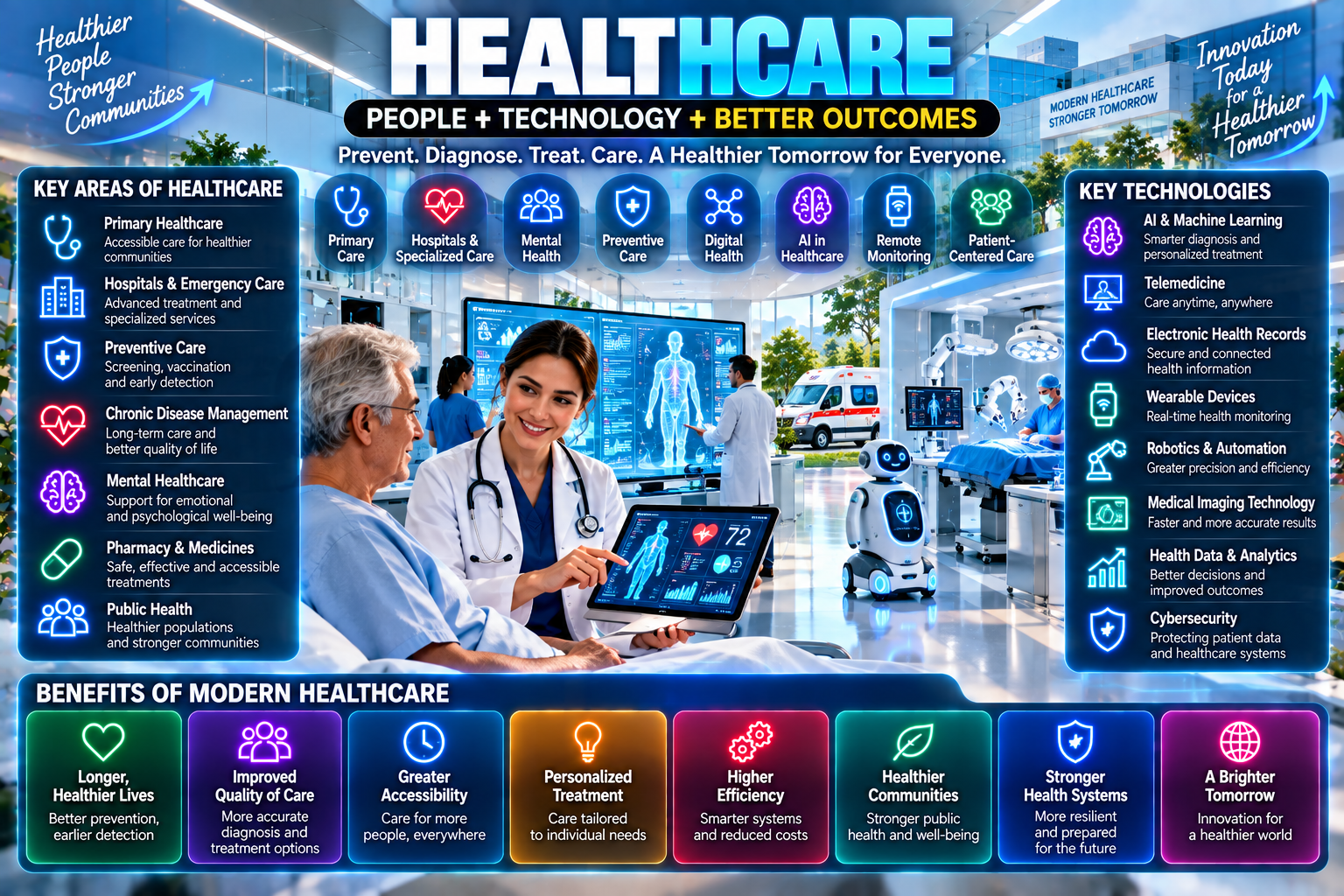
The healthcare industry is also undergoing significant technological change. Artificial intelligence, digital health platforms, electronic health records, telemedicine, wearable devices, data analytics, robotics, and connected medical technologies are changing how healthcare professionals deliver services and how patients interact with health systems.
At the same time, technology is only one part of healthcare. Strong health systems also depend on trained health professionals, accessible primary care, reliable medicines and medical products, public-health programs, financing, infrastructure, and patient trust.
The World Health Organization describes universal health coverage as ensuring that people can access the quality health services they need without financial hardship. WHO also identifies primary health care as a foundation for achieving this goal.
What Is Healthcare?
Healthcare refers to services and systems designed to protect, maintain, improve, and restore people's health.
Healthcare can include:
Disease prevention
Health promotion
Primary care
Emergency care
Hospital treatment
Surgery
Diagnostic services
Mental health services
Rehabilitation
Maternal and child health
Pharmacy services
Palliative care
Public health
Telemedicine
Digital health
Long-term disease management
Healthcare involves many different professionals, including doctors, nurses, pharmacists, therapists, technicians, researchers, public-health specialists, administrators, and other healthcare workers.
Why Is Healthcare Important?
Healthcare affects individual well-being as well as communities and economies.
Effective healthcare systems can help:
Prevent disease
Detect illness earlier
Treat acute conditions
Manage chronic diseases
Reduce avoidable complications
Support maternal and child health
Improve quality of life
Respond to health emergencies
Support healthy ageing
Protect communities from infectious diseases
Healthcare also has an economic dimension.
People who are healthy are generally better able to participate in education, employment, family life, and community activities.
Health systems themselves are major employers and require substantial investment in facilities, medicines, technology, research, and workforce development.
Primary Healthcare
Primary healthcare is often the first point of contact between people and the health system.
It can include:
General medical consultations
Preventive services
Vaccination
Screening
Health education
Maternal care
Child health
Management of chronic conditions
Mental health support
Referral to specialists
WHO describes primary health care as a whole-of-society approach that combines integrated health services, action on broader determinants of health, and empowerment of individuals and communities.
Strong primary care can help people receive appropriate services closer to their communities while reducing unnecessary pressure on more specialized facilities.
Hospitals and Specialized Care
Hospitals provide more advanced services that may not be available in primary-care settings.
Hospital services can include:
Emergency medicine
Surgery
Intensive care
Maternity services
Diagnostic imaging
Laboratory services
Oncology
Cardiology
Neurology
Orthopedics
Specialized pediatric care
Modern hospitals increasingly depend on digital systems to coordinate patients, medical records, laboratory results, imaging, medication information, staffing, and administrative operations.
Preventive Healthcare
Preventive healthcare focuses on reducing health risks before serious illness develops.
Examples include:
Vaccination
Health screening
Regular checkups
Healthy nutrition
Physical activity
Tobacco prevention
Infection prevention
Oral health
Mental health support
Workplace health programs
Prevention can also involve public-health policies addressing environmental, social, and economic factors that influence health.
This is one reason healthcare increasingly extends beyond hospitals and clinics.
Chronic Disease Management
Chronic diseases can require long-term monitoring and treatment.
Examples include:
Diabetes
Cardiovascular disease
Asthma
Chronic respiratory diseases
Kidney disease
Arthritis
Some neurological conditions
Certain cancers
Healthcare systems increasingly use digital tools to support long-term disease management.
These can include:
Remote monitoring
Digital health applications
Electronic records
Medication reminders
Virtual consultations
Wearable devices
Patient portals
The objective is to help patients and healthcare professionals monitor conditions over time rather than relying exclusively on occasional appointments.
Digital Healthcare
Digital health refers to the use of digital technologies to support health and healthcare.
It can include:
Electronic health records
Telemedicine
Mobile health applications
Remote patient monitoring
Digital therapeutics
Health information systems
Wearable devices
Artificial intelligence
Health analytics
Digital diagnostics
The OECD reports that digital technologies such as telemedicine, electronic health records, digital therapeutics, and AI are increasingly being used in healthcare. It also emphasizes the importance of interoperability, data quality, privacy, equity, and implementation.
Electronic Health Records
Electronic health records, or EHRs, allow health information to be stored and accessed digitally.
Depending on the healthcare system, records may contain:
Medical history
Diagnoses
Medications
Laboratory results
Imaging reports
Allergies
Vaccination records
Treatment information
Clinical notes
Digital records can improve information availability and continuity of care when systems are properly designed and integrated.
However, healthcare organizations must protect sensitive health information through appropriate cybersecurity, privacy controls, access management, and governance.
Telemedicine
Telemedicine allows healthcare services to be delivered remotely using communication technologies.
It can involve:
Video consultations
Telephone consultations
Remote monitoring
Digital prescriptions
Online follow-up appointments
Specialist consultations
Telemedicine can be especially useful when patients face geographic, mobility, or access barriers.
However, not every medical situation can be handled remotely. Some conditions require physical examination, laboratory testing, imaging, procedures, or emergency treatment.
Artificial Intelligence in Healthcare
Artificial intelligence is becoming an increasingly important healthcare technology.
AI can potentially support:
Medical image analysis
Clinical decision support
Drug discovery
Health research
Disease surveillance
Administrative automation
Patient communication
Documentation
Risk prediction
Health-system management
WHO states that AI is already being used in areas including diagnosis and clinical care, drug development, disease surveillance, outbreak response, and health-system management.
AI should generally support healthcare professionals rather than being treated as an automatic replacement for clinical judgment.
The appropriate level of human oversight depends on the application, risk, evidence, and regulatory environment.
AI in Medical Research
AI can help researchers process large quantities of information.
Potential applications include:
Drug discovery
Molecular analysis
Clinical research
Literature analysis
Disease modeling
Medical imaging research
Public-health analysis
AI can potentially accelerate some research workflows, but results still need scientific validation.
In September 2026, WHO published a report calling for stronger ethics oversight of AI-related health research, emphasizing risks involving human rights, equity, scientific integrity, and public trust.
This illustrates why technological progress in healthcare must be accompanied by appropriate ethical and scientific safeguards.
Healthcare Data and Analytics
Healthcare generates large quantities of information.
Data can come from:
EHRs
Hospitals
Laboratories
Medical imaging
Wearable devices
Public-health systems
Insurance systems
Clinical research
Patient applications
Healthcare analytics can help organizations understand:
Patient demand
Hospital capacity
Treatment patterns
Disease trends
Resource utilization
Operational performance
High-quality data is particularly important for AI.
Poor-quality or incomplete data can reduce the reliability of analytical systems and potentially contribute to inequitable outcomes.
Wearable Health Technology
Wearable devices can collect information such as:
Heart rate
Physical activity
Sleep patterns
Exercise data
Movement
Some physiological measurements
Depending on the device and intended use, this information can support personal wellness, monitoring, or research.
However, consumer wellness data should not automatically be treated as equivalent to clinical measurements.
Healthcare professionals may need additional information and validated clinical tests to make medical decisions.
Remote Patient Monitoring
Remote patient monitoring uses connected technologies to collect patient information outside traditional healthcare facilities.
It can be useful for selected patients with ongoing conditions or specific monitoring needs.
Potential benefits include:
Earlier identification of changes
Fewer unnecessary visits
Greater convenience
Continuous or frequent monitoring
Better communication between patients and healthcare teams
Successful implementation requires reliable devices, connectivity, clinical workflows, trained staff, and appropriate data-management systems.
Healthcare Cybersecurity
Healthcare organizations hold highly sensitive information and operate critical systems.
Cybersecurity risks can affect:
Patient records
Medical devices
Hospital networks
Laboratory systems
Pharmacy systems
Billing platforms
Communication systems
Important cybersecurity measures include:
Strong authentication
Access controls
Encryption
Network security
Endpoint protection
Security monitoring
Regular updates
Data backups
Incident response
Employee training
Healthcare cybersecurity is particularly important because disruption can affect not only information systems but also clinical operations.
Healthcare Workforce
Healthcare depends heavily on skilled professionals.
The workforce includes:
Physicians
Nurses
Pharmacists
Dentists
Physiotherapists
Psychologists
Laboratory professionals
Radiology professionals
Community health workers
Healthcare administrators
Researchers
Technology can assist these professionals, but healthcare remains highly dependent on human expertise and patient interaction.
WHO notes that health systems cannot function without health workers and emphasizes their availability, accessibility, quality, and protection.
Patient-Centered Healthcare
Modern healthcare increasingly emphasizes patient-centered care.
This means considering:
Patient needs
Preferences
Values
Communication
Accessibility
Safety
Continuity
Shared decision-making
Technology can support patient-centered care through:
Patient portals
Digital appointments
Online records
Remote consultations
Personalized communication
Digital reminders
However, technology should not make healthcare less personal.
A successful digital healthcare system should use technology to strengthen communication and access rather than create unnecessary barriers.
Healthcare Accessibility
Access to healthcare can be affected by:
Geography
Income
Transportation
Infrastructure
Workforce availability
Disability
Language
Digital access
Health literacy
Digital healthcare can reduce some barriers, but it can also create new ones when people lack reliable internet access, suitable devices, digital skills, or accessible services.
This is why digital health should be designed around inclusion.
The OECD highlights equity as a central consideration in digital-health transformation, while WHO continues to emphasize equitable access to health services through universal health coverage.
Universal Health Coverage
Universal health coverage means that people can access the health services they need without experiencing financial hardship.
It covers services across the health continuum, including:
Health promotion
Prevention
Treatment
Rehabilitation
Palliative care
WHO reported in its December 2025 UHC fact sheet that the world was not on track to achieve universal health coverage at the current pace. It estimated that about 4.6 billion people were not fully covered by essential health services in 2023, while 2.1 billion people experienced financial hardship from health spending in 2022.
These figures demonstrate that healthcare innovation must be considered alongside affordability and access.
Healthcare Innovation
Innovation is occurring across many areas.
Examples include:
AI-assisted diagnostics
Digital therapeutics
Robotic surgery
Wearable sensors
Telemedicine
Precision medicine
Genomic technologies
Smart hospitals
Remote monitoring
Advanced medical imaging
Digital health platforms
Innovation can improve healthcare when it is supported by evidence, appropriate regulation, clinical expertise, and sustainable implementation.
Robotics in Healthcare
Robotics is being used in several healthcare environments.
Applications can include:
Surgical assistance
Rehabilitation
Laboratory automation
Hospital logistics
Pharmacy automation
Patient support
Disinfection
Robotics can help healthcare organizations perform certain tasks with precision or consistency.
However, the role of robotics varies considerably by application, and clinical use requires appropriate testing, safety controls, training, and regulatory oversight.
Personalized Healthcare
Personalized healthcare seeks to tailor prevention or treatment based on characteristics of individual patients.
Information may include:
Medical history
Genetics
Biomarkers
Lifestyle
Treatment response
Clinical data
Advances in data science and biomedical research can support more individualized approaches.
However, personalized healthcare requires careful attention to privacy, evidence quality, affordability, and equitable access.
Mental Healthcare
Mental health is an important part of overall healthcare.
Services can include:
Counseling
Psychotherapy
Psychiatric care
Community support
Crisis services
Rehabilitation
Preventive interventions
Digital technologies can provide additional ways to access information and certain forms of support.
However, digital mental-health tools should be evaluated carefully, particularly when they involve AI, sensitive personal information, or clinical decision-making.
WHO's current AI-for-health work emphasizes ethical governance and safety across health applications, including mental health.
Healthcare and Public Health
Healthcare systems operate alongside public-health programs.
Public health focuses on the health of populations and communities.
It can include:
Vaccination
Disease surveillance
Health education
Outbreak response
Environmental health
Nutrition
Injury prevention
Screening
Community health programs
Digital systems can help public-health organizations analyze information and respond to emerging threats.
AI can also support disease surveillance and outbreak-response activities, although public-health applications require strong governance and evidence.
Healthcare and Healthy Ageing
Population ageing is increasing demand for healthcare and long-term care in many countries.
Healthcare systems may need to support:
Chronic disease management
Rehabilitation
Mobility
Medication management
Home-based care
Long-term care
Mental well-being
Social support
Technology can assist through remote monitoring, telemedicine, digital records, assistive technologies, and connected devices.
But ageing populations also increase the need for human caregivers and healthcare professionals.
The Future of Healthcare
Healthcare is likely to become increasingly connected, preventive, data-driven, and personalized.
AI-Assisted Care
AI will continue to support selected clinical, administrative, and research tasks.
Digital Health
Telemedicine, digital records, remote monitoring, and health applications will continue developing.
Smart Hospitals
Hospitals may increasingly connect medical devices, information systems, logistics, and analytics platforms.
Preventive Care
Healthcare may place greater emphasis on detecting and managing risks before severe disease develops.
Home-Based Healthcare
Some services may increasingly move from hospitals toward homes and community settings where clinically appropriate.
Healthcare Data Interoperability
Better data exchange can support continuity of care when privacy and security requirements are properly addressed.
Personalized Medicine
Advances in biomedical science and data analysis may enable increasingly individualized prevention and treatment.
Responsible AI
Healthcare organizations will need strong frameworks for evaluating AI safety, evidence, privacy, bias, accountability, and human oversight.
WHO's current AI-for-health strategy emphasizes governance, safety, equity, and evidence-based adoption.
Challenges Facing Modern Healthcare
Despite technological progress, healthcare faces significant challenges.
Healthcare Costs
Medical services, medicines, infrastructure, technology, and workforce costs can create financial pressures.
Workforce Shortages
Many health systems need sufficient numbers of trained professionals.
Health Inequality
Access and outcomes can differ significantly between communities.
Cybersecurity
Digital healthcare creates important information-security risks.
Data Privacy
Health information is highly sensitive and requires strong protections.
Technology Costs
Advanced technologies can be expensive to implement and maintain.
Interoperability
Different healthcare systems may struggle to exchange information effectively.
AI Governance
AI requires appropriate oversight, validation, transparency, and accountability.
Digital Divide
Not every patient has equal access to devices, connectivity, or digital skills.
How Healthcare Can Become More Resilient
Healthcare systems can strengthen resilience by focusing on several areas:
Invest in primary healthcare.
Strengthen the healthcare workforce.
Improve health-data infrastructure.
Protect medical information and systems.
Expand appropriate digital-health services.
Improve supply-chain resilience.
Support preventive healthcare.
Develop emergency preparedness.
Evaluate AI and digital technologies carefully.
Prioritize accessibility and equity.
WHO emphasizes that primary health care is central to resilient, people-centered health systems and universal health coverage.
Final Thoughts
Healthcare is evolving from a system focused primarily on treating illness toward a broader ecosystem involving prevention, primary care, digital technology, data, personalized services, community health, and continuous patient support.
Artificial intelligence, telemedicine, electronic health records, wearable devices, robotics, analytics, and connected medical technologies are creating new opportunities.
However, healthcare technology cannot replace the foundations of a strong health system.
People still need accessible primary care, skilled health professionals, reliable medicines, safe facilities, affordable services, trustworthy information, and effective public-health programs.
The future of healthcare will therefore depend on combining technology with human expertise, evidence, safety, privacy, accessibility, and patient-centered care.
Digital innovation can help healthcare systems become more responsive and connected, but its benefits will depend on how responsibly and equitably those technologies are implemented.
Frequently Asked Questions
What is healthcare?
Healthcare includes services and systems that promote health, prevent disease, diagnose and treat illness, support rehabilitation, and provide ongoing care.
What is primary healthcare?
Primary healthcare is a people-centered approach that brings integrated health services closer to communities and includes prevention, treatment, rehabilitation, palliative care, and health promotion.
How is AI changing healthcare?
AI can support medical imaging, clinical decision support, drug development, disease surveillance, research, administrative tasks, and health-system management.
What is digital healthcare?
Digital healthcare uses technologies such as electronic health records, telemedicine, mobile health applications, remote monitoring, digital therapeutics, analytics, and AI to support healthcare delivery.
What is telemedicine?
Telemedicine is the delivery of selected healthcare services remotely through technologies such as video, telephone, and digital communication platforms.
Why is healthcare cybersecurity important?
Healthcare systems contain sensitive patient information and support critical clinical operations, making cybersecurity important for protecting privacy, availability, and safety.
What is universal health coverage?
Universal health coverage means people can access the quality health services they need without experiencing financial hardship.
What is the future of healthcare?
Future healthcare is likely to involve greater use of AI, digital health, remote monitoring, personalized medicine, data analytics, robotics, preventive care, and connected health systems.
Can technology replace healthcare professionals?
Technology can automate or assist selected tasks, but healthcare continues to depend on human clinical expertise, judgment, communication, empathy, and decision-making.
Why is primary care important?
Primary care provides accessible first-contact services and helps coordinate prevention, diagnosis, treatment, and long-term health management. WHO identifies primary health care as a foundation for universal health coverage.