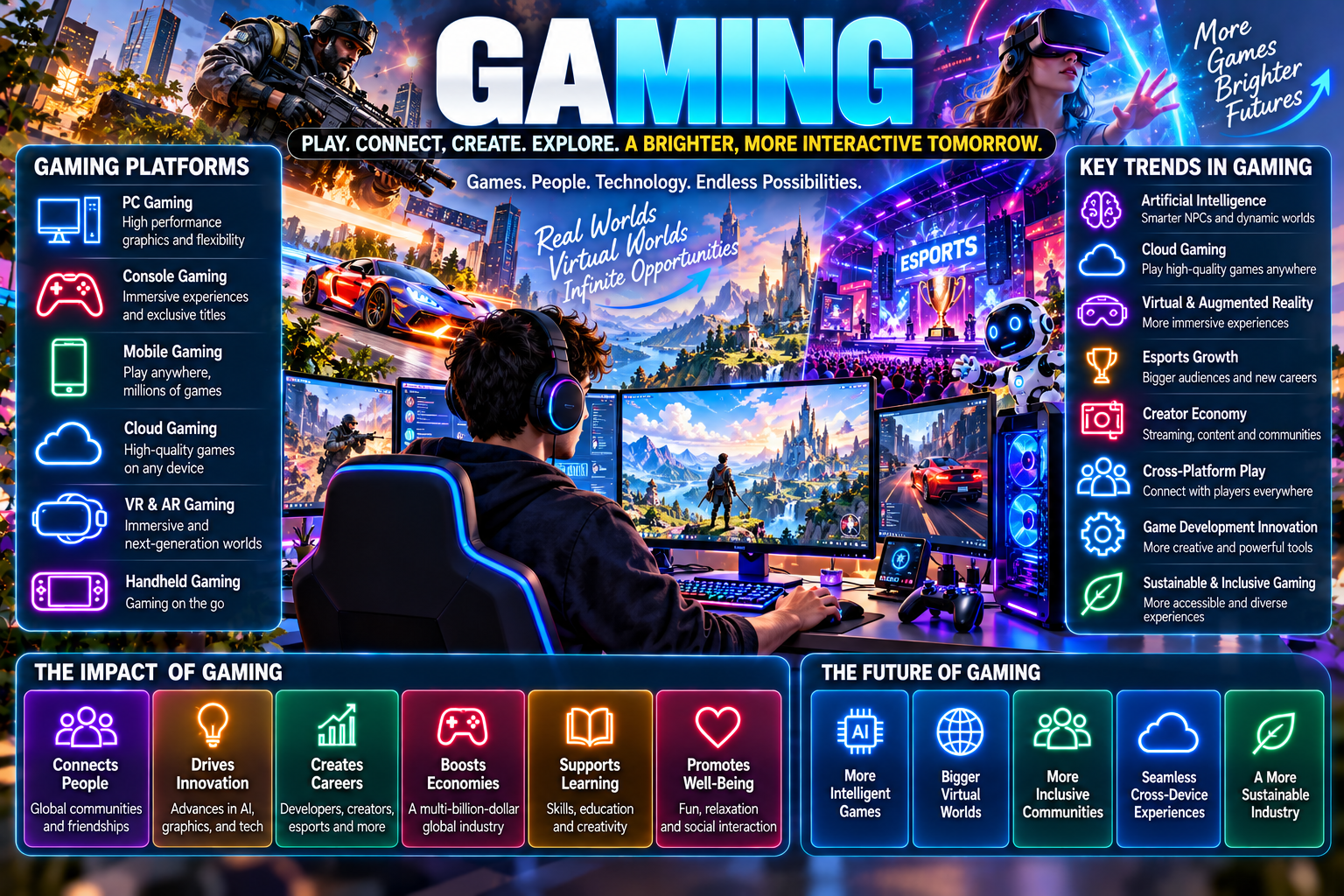
Gaming has evolved from a niche form of entertainment into one of the world's largest digital industries. Video games now combine entertainment, technology, storytelling, social interaction, online communities, esports, digital commerce, artificial intelligence, cloud computing, and content creation.
Players can access games through smartphones, PCs, consoles, handheld devices, browsers, and cloud platforms. Meanwhile, developers are using increasingly sophisticated game engines, artificial intelligence, real-time graphics, online infrastructure, and analytics to create interactive experiences for global audiences.
The scale of the industry continues to grow. Newzoo forecasts that the global games market will generate $213.9 billion in revenue in 2026, up 6.1% year over year, with approximately 3.7 billion players worldwide. Mobile is forecast to remain the largest platform at $121.1 billion, followed by console at $46.9 billion and PC at $45.9 billion.
Gaming is therefore not simply about playing video games. It is a major technology ecosystem influencing entertainment, software development, hardware, advertising, digital payments, social platforms, and emerging technologies.
What Is Gaming?
Gaming generally refers to playing interactive digital games for entertainment, competition, social interaction, education, or other purposes.
Video games can be played on:
Smartphones
Tablets
PCs
Gaming consoles
Handheld gaming devices
Smart TVs
Web browsers
Cloud platforms
Virtual reality headsets
Gaming experiences range from single-player adventures to massive online worlds involving millions of players.
Modern games can include:
Story-driven campaigns
Multiplayer competitions
Open-world exploration
Sports simulations
Strategy games
Role-playing games
Racing
Shooters
Puzzle games
Simulation
Survival games
Social experiences
The Global Gaming Industry
The gaming industry includes much more than game developers.
Its ecosystem includes:
Game publishers
Developers
Hardware manufacturers
Game engines
Digital storefronts
Cloud platforms
Esports organizations
Streaming platforms
Content creators
Advertising companies
Payment providers
Gaming accessories
Online communities
Investors
The global games market reached $201.6 billion in 2025, according to Newzoo's updated full-year analysis. Mobile generated $113.3 billion, PC generated $43.6 billion, and console generated $44.7 billion.
Newzoo's 2026 forecast indicates continued growth, although different platforms are following different paths. Mobile remains the largest market, while PC and console are increasingly influenced by premium game releases, subscriptions, pricing, and established franchises.
Mobile Gaming
Mobile gaming is the largest segment of the global gaming market.
Smartphones have made gaming accessible to billions of people without requiring dedicated gaming hardware.
Mobile games can include:
Casual games
Puzzle games
Strategy games
Role-playing games
Sports games
Multiplayer games
Battle royale games
Simulation games
Social experiences
Mobile gaming also supports different monetization models.
These include:
Free-to-play
In-app purchases
Advertising
Subscriptions
Premium downloads
Battle passes
Digital items
Newzoo forecasts mobile gaming revenue at $121.1 billion in 2026, representing 6.8% year-over-year growth. The company notes that mobile downloads are declining while spending continues to grow, meaning monetization depth is becoming increasingly important.
PC Gaming
PC gaming remains an important part of the industry because computers provide flexibility, performance, customization, and access to a large ecosystem of digital games.
PC gaming can include:
AAA games
Independent games
Strategy games
Competitive esports
Simulation
MMORPGs
Multiplayer shooters
Early-access games
User-generated content
PC players can also customize hardware, graphics settings, peripherals, and software.
Newzoo forecasts PC gaming revenue at $45.9 billion in 2026, up 5.3% year over year.
The PC market also supports a large ecosystem of digital storefronts, game modifications, community-created content, streaming, and esports.
Console Gaming
Console gaming remains one of the industry's major platforms.
Major console ecosystems include platforms from:
Sony
Microsoft
Nintendo
Consoles provide standardized hardware and software environments that allow developers to optimize games for a specific platform.
Console gaming includes:
Physical games
Digital downloads
Online multiplayer
Game subscriptions
Downloadable content
Digital purchases
Accessories
Streaming services
Newzoo forecasts console gaming revenue at $46.9 billion in 2026, up 5.1% year over year. Multi-game subscriptions, pricing, new hardware, and major releases are among the factors influencing the segment.
Cloud Gaming
Cloud gaming allows games to be processed on remote servers and streamed to players over the internet.
Instead of requiring a powerful local device to render the entire game, cloud infrastructure performs much of the processing.
Potential benefits include:
Reduced hardware requirements
Instant access
Cross-device gaming
Easier game distribution
Flexible access to large game libraries
However, cloud gaming depends heavily on:
Internet speed
Latency
Server availability
Data-center infrastructure
Subscription economics
Regional network quality
Cloud gaming is therefore closely connected to developments in cloud computing, broadband, 5G, edge computing, and data centers.
AI and Gaming
Artificial intelligence is becoming increasingly important throughout the gaming ecosystem.
AI can be used in:
Non-player characters
Enemy behavior
Game testing
Procedural content
Animation
Dialogue
Player personalization
Fraud detection
Moderation
Customer support
Game development
Traditional game AI often uses predefined rules and algorithms.
Newer generative AI systems can potentially assist with creating:
Dialogue
Concept ideas
Art references
Code
Audio
Game assets
Testing scenarios
AI could therefore influence both how games are developed and how players experience them.
However, AI-generated content also raises questions involving intellectual property, quality control, originality, privacy, and the role of human creators.
AI-Powered Non-Player Characters
Non-player characters, commonly called NPCs, have traditionally followed scripted behavior.
AI could make NPC interactions more dynamic.
Future NPCs may potentially:
Understand natural language
Remember previous interactions
React to player behavior
Adapt their personalities
Generate conversations
Change strategies
Participate in dynamic narratives
This could make game worlds feel more responsive.
However, developers must balance AI-generated behavior with gameplay design, performance, safety, consistency, and narrative control.
Gaming and Virtual Reality
Virtual reality provides immersive gaming experiences by placing players inside digitally generated environments.
VR can support:
Adventure games
Simulation
Fitness
Education
Social experiences
Horror
Training
Multiplayer environments
Related technologies include:
VR headsets
Motion controllers
Spatial audio
Hand tracking
Eye tracking
Mixed reality
As hardware and software improve, immersive gaming could become increasingly connected with social platforms and digital environments.
Augmented and Mixed Reality
Unlike traditional VR, augmented reality overlays digital information or objects onto the physical environment.
Mixed reality combines physical and digital elements in more interactive ways.
Gaming applications could include:
Location-based games
Interactive environments
Educational experiences
Multiplayer augmented games
Digital collectibles
Spatial gaming
Advances in cameras, sensors, processors, displays, and AI can contribute to the development of these experiences.
Esports
Esports refers to organized competitive video gaming.
Professional esports can involve:
Teams
Individual players
Coaches
Analysts
Tournament organizers
Sponsors
Streaming platforms
Publishers
Popular competitive genres include:
Multiplayer online battle arenas
First-person shooters
Fighting games
Sports games
Strategy games
Battle royale games
Esports has created new professional roles beyond players, including commentators, content creators, coaches, event organizers, analysts, and production teams.
Gaming Content Creators and Streaming
Gaming and online content creation have become closely connected.
Players can broadcast their gameplay through streaming platforms or create:
Reviews
Tutorials
Gameplay videos
Walkthroughs
News
Comedy content
Challenges
Esports analysis
Live streams
Successful gaming creators can generate revenue through:
Advertising
Sponsorships
Memberships
Subscriptions
Donations
Affiliate marketing
Merchandise
Brand partnerships
This has created a broader gaming creator economy.
Game Development
Creating a modern video game can involve large teams with specialized skills.
Development teams may include:
Game designers
Programmers
Artists
Animators
Writers
Audio designers
Producers
Quality-assurance testers
Technical artists
User-interface designers
Community managers
Game development typically involves several stages.
Concept
The team develops the basic idea, genre, audience, mechanics, and vision.
Pre-Production
Design documents, prototypes, technical requirements, art direction, and production plans are developed.
Production
Developers build the game world, mechanics, characters, systems, levels, audio, and user interface.
Testing
The game is tested for:
Bugs
Performance
Balance
Usability
Compatibility
Security
Launch
The game is released through physical or digital distribution channels.
Post-Launch
Many modern games continue to receive:
Updates
New content
Events
Patches
Expansions
Seasonal features
Newzoo's research indicates that sustained engagement and post-launch support were important drivers of game performance in 2025, highlighting the importance of maintaining player communities after release.
Game Engines
Game engines provide tools that developers can use to build games.
They can provide:
Graphics rendering
Physics
Audio
Animation
Networking
Lighting
Asset management
Scripting
Development tools
Popular game-development ecosystems include engines such as Unreal Engine and Unity.
Game engines have also expanded beyond gaming into:
Film
Architecture
Automotive design
Simulation
Education
Virtual production
This illustrates how gaming technology can influence other industries.
Gaming Monetization Models
Gaming businesses use multiple revenue models.
Premium Games
Players purchase a game upfront.
Free-to-Play
The game can be downloaded without an initial purchase while generating revenue through other mechanisms.
In-App Purchases
Players can purchase digital items, upgrades, or other content.
Subscriptions
Players pay recurring fees for access to games or services.
Battle Passes
Players purchase access to seasonal progression and rewards.
Advertising
Free games can generate revenue by displaying advertisements.
Downloadable Content
Developers can sell additional content after the initial release.
Different platforms use different combinations of these models.
Newzoo's 2026 analysis notes that PC, console, and mobile have different revenue dynamics, with mobile increasingly relying on deeper monetization while premium spending remains important across PC and console.
Free-to-Play Gaming
Free-to-play models have significantly changed the industry.
Players can access a game without purchasing it upfront.
Revenue may come from:
Cosmetic items
Battle passes
Character customization
Virtual currencies
Expansions
Advertising
The advantage for developers is a potentially larger initial audience.
The challenge is maintaining a healthy balance between monetization and player experience.
Live-Service Games
Live-service games are designed to operate over extended periods rather than ending after a single release.
They can receive:
New seasons
Events
Characters
Maps
Items
Challenges
Balance updates
Story content
Live-service models can create long-term communities.
However, competition for player attention is intense.
Newzoo's 2026 research highlights the importance of sustained engagement and the increasing concentration of player attention around established ecosystems.
Gaming Communities
Modern games can function as social platforms.
Players may:
Chat
Form teams
Join communities
Share content
Compete
Stream gameplay
Create modifications
Participate in events
Community management has therefore become an important part of game development.
Developers need to address:
Toxic behavior
Harassment
Cheating
Spam
Fraud
Account security
Age-appropriate experiences
Gaming and Social Interaction
Online multiplayer games allow people to interact across geographic boundaries.
Gaming can provide spaces for:
Friendship
Competition
Teamwork
Communication
Community participation
Platforms such as Roblox demonstrate how gaming can evolve toward broader user-generated and social ecosystems. Newzoo reported that Roblox's revenue rose 36% in 2025, while playtime increased 69%, illustrating the scale of some gaming platforms as interactive social ecosystems.
Gaming Hardware
The gaming hardware ecosystem includes:
PCs
Consoles
Handheld devices
Graphics cards
Processors
Monitors
Gaming keyboards
Gaming mice
Controllers
Headsets
VR equipment
Hardware performance influences graphics quality, frame rates, resolution, loading times, and game complexity.
However, rising hardware costs can influence how quickly players upgrade.
Newzoo's 2026 analysis notes that memory and component costs are becoming a shared challenge across gaming platforms, partly because AI infrastructure is competing for some of the same semiconductor resources.
Gaming and Cybersecurity
As games become connected services, cybersecurity becomes increasingly important.
Gaming accounts can contain:
Personal information
Payment information
Digital purchases
Virtual items
Social connections
Common risks include:
Account theft
Phishing
Malware
Cheating software
Fraud
Credential attacks
Fake giveaways
Social engineering
Players should use:
Strong passwords
Multi-factor authentication
Official stores
Secure payment methods
Updated software
Developers and publishers also need strong security systems to protect user accounts and digital infrastructure.
Gaming and Accessibility
Accessibility can make games available to more players.
Features can include:
Adjustable subtitles
Colorblind modes
Remappable controls
Difficulty settings
Audio descriptions
Text-to-speech
Speech-to-text
Controller customization
Visual indicators
Adjustable interface sizes
Accessible design can improve gaming experiences for people with different physical, visual, auditory, or cognitive needs.
Gaming and Education
Games can also be used for education and training.
Educational gaming can support:
Problem-solving
Strategy
Collaboration
Historical learning
Language learning
STEM education
Simulations
Game-based learning can make complex concepts more interactive.
Simulation games can also provide safe environments for practicing skills before applying them in real-world settings.
Gaming and the Global Economy
Gaming has become an important part of the digital economy.
Its ecosystem creates activity across:
Software
Hardware
Advertising
Digital payments
Cloud infrastructure
Data centers
Media
Entertainment
Tourism
Events
Content creation
The market is also geographically diverse.
Newzoo forecasts Asia-Pacific to account for 47% of global games revenue in 2026, with North America at 27% and Europe at 18%. The Middle East and Africa are forecast to be among the faster-growing regions by player numbers and revenue growth.
Gaming in Emerging Markets
Gaming growth is increasingly connected to expanding internet access, smartphones, affordable devices, digital payments, and younger populations.
Emerging markets can add large numbers of players even when average spending per player differs from established markets.
Newzoo expects player growth to become increasingly concentrated in emerging regions through the end of the decade, while the largest markets continue to account for a substantial share of consumer spending.
This creates opportunities for developers that can adapt games to local:
Languages
Payment systems
Hardware conditions
Cultural preferences
Internet infrastructure
Pricing levels
The Future of Gaming
Gaming is likely to become increasingly connected with artificial intelligence, cloud computing, immersive technologies, and digital communities.
AI-Generated Game Content
AI could assist developers in creating:
Characters
Dialogue
Environments
Textures
Audio
Animations
Testing scenarios
Human designers will still need to guide creative direction and quality.
Smarter NPCs
AI could create characters capable of more natural interactions and adaptive behavior.
Cloud-Based Gaming
Faster networks and improved cloud infrastructure could make high-quality gaming available across more devices.
Cross-Platform Gaming
Players increasingly expect games to connect different devices and ecosystems.
More Social Games
Gaming may continue moving toward persistent social environments where entertainment, communication, creation, and community overlap.
Greater Personalization
AI and analytics could help games adapt content, difficulty, recommendations, and experiences to individual players.
More User-Generated Content
Players may increasingly become creators themselves by building maps, characters, experiences, and virtual worlds.
Challenges Facing the Gaming Industry
The gaming industry also faces significant challenges.
Development Costs
Large games can require substantial investments in technology, talent, marketing, and infrastructure.
Competition for Attention
Players have more entertainment options than ever.
Discoverability
Thousands of games compete for visibility across digital storefronts.
Monetization Pressure
Developers must balance revenue generation with player satisfaction.
Cybersecurity
Online games require protection against account theft, fraud, cheating, and attacks.
Content Moderation
Large online communities require systems for dealing with abuse and harmful behavior.
Hardware Costs
Increasing component costs can affect both developers and consumers.
AI and Intellectual Property
AI-generated assets create questions involving ownership, licensing, originality, and the use of training data.
How Gaming Companies Can Stay Competitive
Gaming companies can focus on several areas.
Create Strong Player Experiences
Gameplay, storytelling, performance, and accessibility remain fundamental.
Understand Players
Analytics can help developers understand:
Engagement
Retention
Spending
Player preferences
Game difficulty
Community behavior
Build Communities
Strong communities can extend the life of a game.
Invest in Technology
AI, cloud infrastructure, analytics, and modern game engines can improve development and player experiences.
Support Games After Launch
Regular updates and meaningful content can help maintain player interest.
Protect Players
Security and privacy should be part of the product experience.
Final Thoughts
Gaming has become a global technology and entertainment ecosystem connecting software, hardware, storytelling, social interaction, cloud computing, artificial intelligence, digital commerce, esports, and content creation.
The industry's scale continues to expand. Newzoo forecasts $213.9 billion in global games revenue and 3.7 billion players in 2026, while different platforms continue to follow distinct growth and monetization paths.
Mobile remains the largest platform, PC continues to support premium and competitive gaming, and consoles remain important for major releases and subscription ecosystems.
At the same time, AI is opening new possibilities for game development, NPC behavior, personalization, testing, and content creation.
The future of gaming will likely be increasingly interactive, social, intelligent, connected, and accessible.
Rather than being limited to traditional video games, gaming technology is becoming part of a broader digital ecosystem where entertainment, communication, creativity, technology, and online communities increasingly overlap.
Frequently Asked Questions
What is gaming?
Gaming is the activity of playing interactive digital games for entertainment, competition, social interaction, education, or other purposes.
How big is the gaming industry?
Newzoo forecasts the global games market to generate approximately $213.9 billion in 2026, with about 3.7 billion players worldwide.
Which gaming platform is the largest?
Mobile is currently the largest gaming platform by revenue and player reach. Newzoo forecasts mobile gaming revenue of $121.1 billion in 2026.
What is cloud gaming?
Cloud gaming allows games to be processed on remote servers and streamed to players over an internet connection.
How is AI changing gaming?
AI can support game development, NPC behavior, testing, personalization, customer service, content creation, and player analytics.
What is esports?
Esports is organized competitive video gaming involving players, teams, tournaments, broadcasts, and professional ecosystems.
What is a live-service game?
A live-service game is designed to receive ongoing updates, events, new content, and other post-launch support over an extended period.
How do free-to-play games make money?
Free-to-play games can generate revenue through in-app purchases, cosmetic items, battle passes, advertising, subscriptions, and other digital products.
Is gaming becoming more social?
Yes. Multiplayer games, user-generated platforms, streaming, communities, voice communication, and virtual environments increasingly combine gaming with social interaction.
What is the future of gaming?
Future gaming is likely to involve greater use of AI, cloud computing, immersive technologies, cross-platform experiences, user-generated content, personalized gameplay, and increasingly social digital environments.