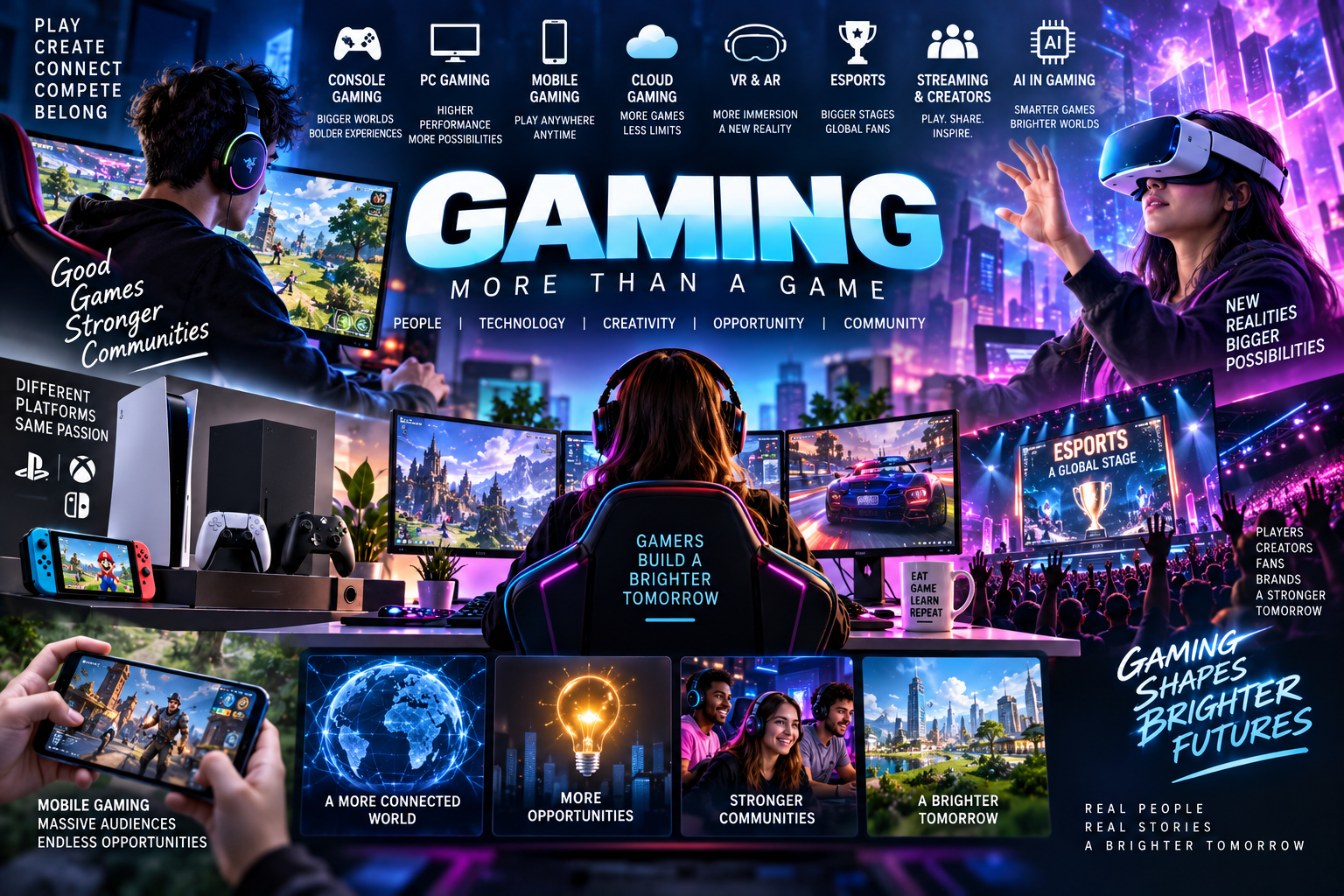
Gaming has evolved from a niche form of entertainment into one of the world's most influential digital industries. What was once associated primarily with home consoles and arcade machines has become a vast ecosystem spanning smartphones, personal computers, consoles, cloud platforms, esports, streaming, virtual worlds, and interactive experiences.
Today, gaming connects hundreds of millions of people through digital communities. It influences entertainment, technology, advertising, hardware, software development, and even social interaction. Game developers are creating increasingly sophisticated virtual environments, while players are spending more time participating in digital communities rather than simply consuming traditional media.
The gaming industry is also becoming an important business and technology market. Revenue can come from game sales, subscriptions, downloadable content, advertising, in-game purchases, licensing, merchandise, esports, and other digital services.
As technology continues to advance, gaming is likely to become even more immersive, connected, and interactive.
The Evolution of Gaming
The history of gaming has been defined by rapid technological progress.
Early video games were relatively simple, with limited graphics and basic controls. Over time, improvements in computing power allowed developers to create more detailed environments, complex gameplay mechanics, realistic sound, and sophisticated storytelling.
The arrival of home consoles brought gaming into millions of households. Personal computers then expanded the market further, particularly for strategy games, role-playing games, simulations, and online multiplayer experiences.
The introduction of smartphones created another major transformation. Mobile gaming made interactive entertainment accessible to people who might never have owned a traditional gaming console or computer.
Gaming has therefore evolved from a dedicated entertainment activity into an everyday digital experience.
Mobile Gaming
Mobile gaming is one of the most accessible segments of the industry.
Smartphones and tablets provide users with gaming devices that they already carry every day. Players can enjoy short sessions while traveling, waiting, or relaxing at home.
Mobile games also introduced business models that differ from traditional premium game sales. Many titles are free to download and generate revenue through advertising, optional purchases, subscriptions, or virtual items.
The mobile market has also expanded the global gaming audience by reducing the cost and technical requirements associated with gaming.
For developers, mobile platforms provide access to enormous audiences, although competition is intense and discovering new games can be difficult.
Console and PC Gaming
Console and PC gaming remain important parts of the industry.
Modern consoles provide powerful hardware capable of delivering detailed graphics, advanced physics, immersive audio, and large-scale virtual worlds.
PC gaming offers a different type of flexibility. Players can choose hardware configurations, customize systems, access extensive game libraries, and participate in communities built around modifications, competitive gaming, and specialized genres.
Both platforms continue to evolve as developers explore new approaches to graphics, artificial intelligence, online multiplayer, and interactive storytelling.
Online Multiplayer and Digital Communities
Gaming has increasingly become a social activity.
Online multiplayer allows players to communicate and compete with people from different countries. Voice chat, messaging, social features, and shared virtual spaces can turn games into communities.
For many players, the social experience can be just as important as the gameplay itself.
Large online games can develop their own cultures, economies, events, and communities. Developers increasingly treat these games as long-term platforms rather than products that are simply purchased and completed.
This shift has changed how games are developed and supported.
The Rise of Live-Service Games
Traditional games were often released as complete products. Modern live-service games can operate differently.
Developers may continuously introduce new maps, characters, events, challenges, cosmetics, storylines, and gameplay features.
This model allows games to remain active for years and creates recurring engagement.
For businesses, live-service models can generate recurring revenue through subscriptions, in-game purchases, seasonal content, and other services.
However, maintaining a live game requires continuous investment. Players also expect regular updates, reliable servers, effective customer support, and meaningful new content.
Esports and Competitive Gaming
Competitive gaming has developed into a major entertainment category.
Esports tournaments bring professional players and teams together to compete in organized competitions. Popular games can attract large online audiences, sponsorships, advertising, media partnerships, and event revenue.
Professional gaming has created new career opportunities beyond players themselves. Coaches, analysts, commentators, event organizers, broadcasters, content creators, and team managers are all part of the ecosystem.
Esports also demonstrates how gaming can move beyond individual entertainment and become a spectator experience.
Gaming and Streaming
Streaming has changed how people discover and experience games.
Platforms such as YouTube and Twitch allow creators to broadcast gameplay, reviews, tutorials, competitions, and entertainment to large audiences.
Gaming creators can build communities around their personalities and expertise. Revenue can come from advertising, memberships, sponsorships, subscriptions, donations, affiliate marketing, and partnerships.
This has created an important connection between gaming and the broader creator economy.
A successful creator can sometimes become an independent media business, while game publishers can benefit from creators who introduce new audiences to their products.
Artificial Intelligence in Gaming
Artificial intelligence is increasingly influencing game development.
Developers can use AI to assist with animation, testing, content creation, dialogue, game balancing, and other production processes.
AI can also contribute to gameplay. Intelligent non-player characters can potentially respond more dynamically to player actions, creating more unpredictable and personalized experiences.
Generative AI may eventually allow developers to create increasingly dynamic environments, characters, and narratives.
However, the use of AI also raises questions about intellectual property, creative ownership, employment, data, and the role of human artists and developers.
The industry will need to balance technological efficiency with creativity and responsible development.
Virtual Reality and Immersive Gaming
Virtual reality has introduced another dimension to gaming.
Instead of viewing a game through a traditional screen, players can enter an interactive three-dimensional environment using specialized headsets and controllers.
VR can create highly immersive experiences in gaming, education, training, simulation, and other fields.
Augmented reality offers a different approach by combining digital elements with the physical world.
Although immersive technologies still face challenges involving hardware costs, comfort, accessibility, and widespread adoption, they continue to represent an important area of innovation.
Cloud Gaming
Cloud gaming aims to reduce the need for powerful local hardware.
Instead of running a game entirely on a console or computer, processing can take place on remote servers and the resulting video can be streamed to the player.
This could allow users to access sophisticated games on a wider range of devices.
Cloud gaming also introduces challenges. A reliable, fast internet connection is important because delays between player actions and system responses can affect the experience.
As internet infrastructure improves, cloud gaming could become increasingly important to the industry's long-term development.
Gaming as a Business
The gaming industry has developed a wide variety of business models.
Traditional premium games are still sold as individual products, while free-to-play titles can generate revenue through optional purchases and advertising.
Subscriptions allow players to access collections of games for recurring fees.
Publishers can also generate revenue through downloadable expansions, digital items, licensing, merchandise, and partnerships.
The diversity of business models has made gaming attractive to technology companies, entertainment businesses, investors, and advertisers.
However, successful monetization requires maintaining player trust. Businesses that prioritize aggressive monetization at the expense of gameplay or transparency can damage their relationships with audiences.
The Economics of Game Development
Creating modern games can require significant investment.
Large productions may involve programmers, designers, artists, writers, animators, sound engineers, producers, testers, marketers, and other specialists.
Development can take years and involve substantial financial risk.
At the same time, digital distribution has created opportunities for independent developers.
Small studios can use widely available development tools and online platforms to create and distribute games without requiring the infrastructure traditionally associated with major publishers.
Independent games have become an important source of innovation, often experimenting with unusual gameplay mechanics, artistic styles, and storytelling.
Gaming Hardware and Technology
Gaming has also driven innovation in hardware.
Graphics processors, high-refresh-rate displays, specialized controllers, gaming laptops, consoles, storage technologies, networking equipment, and immersive devices have all benefited from demand created by gamers.
The gaming market can therefore influence broader technology development.
Advances in graphics processing, for example, can benefit applications beyond gaming, including artificial intelligence, scientific computing, simulation, and professional visualization.
Gaming and Social Connection
Gaming can create communities that cross geographic and cultural boundaries.
Players can form friendships, join teams, communicate through online communities, and participate in shared experiences regardless of where they live.
For some players, online gaming provides an important form of social interaction.
However, digital communities also require responsible management. Harassment, cheating, scams, toxic behavior, and inappropriate content can damage the player experience.
Game companies increasingly need systems for moderation, reporting, account security, and community management.
Gaming and Education
Gaming technology is also finding applications beyond entertainment.
Educational games can make learning more interactive. Simulations can help students and professionals practice skills in controlled environments.
Game-based learning can be useful because it provides immediate feedback and encourages users to experiment and solve problems.
Businesses and institutions can also use simulations for training in areas where real-world practice may be expensive or risky.
As interactive technologies improve, the boundary between gaming and education may become increasingly flexible.
Challenges Facing the Gaming Industry
Despite its growth, gaming faces several challenges.
One concern is the increasing complexity and cost of developing major games. Large budgets can make projects financially risky.
Another issue is player privacy and data protection. Online games can collect significant amounts of information about users, making responsible data management important.
Gaming companies must also address cybersecurity threats, cheating, account theft, harassment, and fraud.
There are also ongoing discussions about screen time, in-game spending, age-appropriate content, and healthy gaming habits.
The industry's long-term success will depend partly on its ability to address these concerns while continuing to innovate.
The Future of Gaming
The future of gaming will likely be defined by greater connectivity, intelligence, personalization, and immersion.
Artificial intelligence may create more responsive characters and dynamic game worlds. Cloud technology could make advanced games accessible across more devices. Virtual and augmented reality may provide new ways to interact with digital environments.
Social features will likely remain important as games increasingly function as communities rather than isolated experiences.
The distinction between gaming, entertainment, social media, and digital commerce may also become less clear.
Games could increasingly become platforms where people not only play but also communicate, create content, attend events, purchase digital products, and build communities.
Conclusion
Gaming has transformed from a specialized form of entertainment into a major digital industry connecting technology, creativity, business, and culture.
Mobile devices have expanded accessibility, online multiplayer has created global communities, esports has turned gaming into spectator entertainment, and streaming has connected games with the creator economy.
Meanwhile, AI, cloud computing, virtual reality, and increasingly powerful hardware are opening new possibilities for developers and players.
The industry's future will depend not only on technological innovation but also on how companies respond to issues involving privacy, security, responsible monetization, accessibility, and digital well-being.
Ultimately, gaming is becoming more than a way to play. It is becoming a digital ecosystem where people create, compete, communicate, entertain, and experience new forms of interactive technology.
Frequently Asked Questions About Gaming
1. What is the gaming industry?
The gaming industry is the global business ecosystem surrounding video games, including development, publishing, hardware, digital distribution, esports, streaming, advertising, subscriptions, and in-game purchases.
2. Why is gaming important?
Gaming is important because it has become a major form of entertainment and a significant technology industry. It also drives innovation in graphics, computing, artificial intelligence, networking, and interactive experiences.
3. What are the main types of gaming?
Major categories include mobile gaming, PC gaming, console gaming, cloud gaming, virtual reality gaming, augmented reality gaming, and competitive esports.
4. What is mobile gaming?
Mobile gaming refers to playing games on smartphones and tablets. It is one of the most accessible forms of gaming because users can play without owning dedicated gaming hardware.
5. What is esports?
Esports is organized competitive gaming in which professional or amateur players and teams compete in tournaments and leagues, often in front of large online or physical audiences.
6. How does the gaming industry make money?
Gaming companies generate revenue through game sales, subscriptions, advertising, downloadable content, in-game purchases, licensing, merchandise, esports, and other digital services.
7. How is AI changing gaming?
AI can assist developers with testing, content creation, animation, dialogue, game balancing, and other production tasks. It can also create more responsive characters and dynamic gameplay experiences.
8. What is cloud gaming?
Cloud gaming allows games to be processed on remote servers and streamed to a player's device. This can reduce the need for powerful local gaming hardware.
9. What is the future of gaming?
The future of gaming is likely to involve more AI, cloud technology, immersive experiences, connected communities, personalized gameplay, and cross-platform entertainment.
10. Can gaming be used for education?
Yes. Games and simulations can support education and professional training by providing interactive environments, immediate feedback, and opportunities to practice skills.
11. What challenges does gaming face?
Major challenges include cybersecurity, privacy, cheating, harassment, excessive spending, development costs, content moderation, and maintaining healthy digital habits.
12. Is gaming becoming part of the creator economy?
Yes. Streamers, video creators, reviewers, esports personalities, and gaming influencers can build audiences and generate income through advertising, sponsorships, memberships, subscriptions, and partnerships.
13. Will gaming replace traditional entertainment?
Gaming is unlikely to completely replace traditional entertainment, but it is increasingly competing with television, film, music, and social media for people's attention while also creating new forms of interactive entertainment.