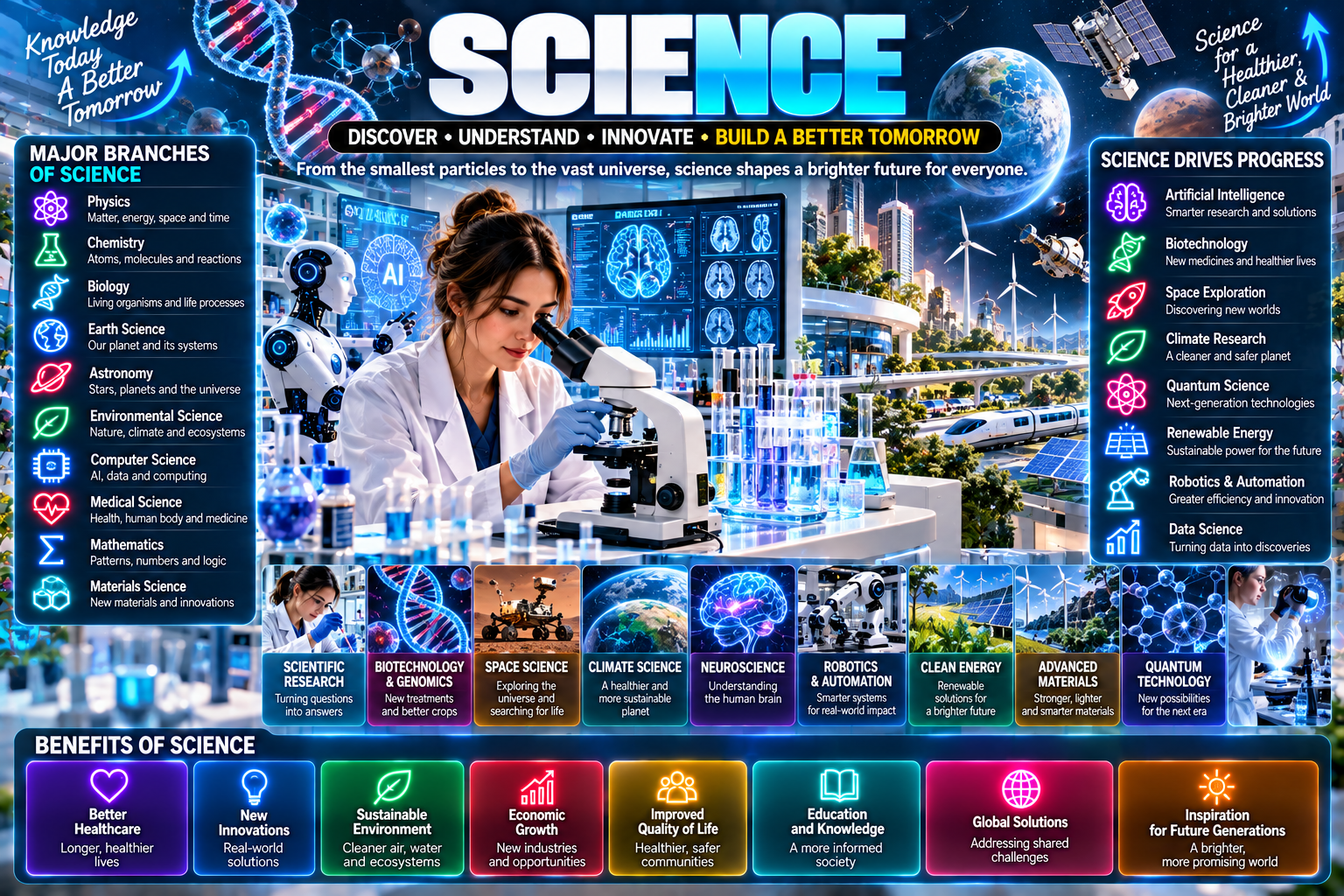
Science is one of humanity's most powerful tools for understanding the natural world. From studying microscopic cells and particles to exploring distant galaxies, science helps people explain how the universe works, develop new technologies, improve health, understand Earth's climate, and solve complex problems.
Modern science is no longer limited to traditional laboratories. Researchers now use artificial intelligence, advanced computing, robotics, satellites, genomics, biotechnology, sensors, and massive datasets to investigate questions that were previously difficult or impossible to answer.
In 2026, scientific research is increasingly connected with technology and innovation. The U.S. National Science Foundation's State of U.S. Science and Engineering 2026 highlights major developments across research and development, STEM education, scientific publications, technology transfer, invention, innovation, and the science and engineering workforce.
What Is Science?
Science is a systematic way of studying the natural world through observation, measurement, experimentation, analysis, and evidence.
Scientists develop questions, create hypotheses, collect data, test explanations, and communicate results so that other researchers can evaluate and build upon the findings.
Science is not simply a collection of facts. It is an ongoing process of discovering, testing, correcting, and expanding knowledge.
A simplified scientific process can be represented as:
Question → Hypothesis → Experiment → Data → Analysis → Conclusion → Further Research
Scientific knowledge can change when stronger evidence becomes available. This ability to test and revise explanations is one of the foundations of scientific progress.
Why Is Science Important?
Science affects almost every part of modern life.
It contributes to:
Medicine
Agriculture
Energy
Transportation
Communications
Computing
Manufacturing
Environmental protection
Space exploration
Food production
Materials development
Public health
Climate research
Artificial intelligence
Biotechnology
Scientific research can also provide the foundation for new products, industries, and technologies.
The NSF's 2026 indicators describe science, technology, and innovation activities as expanding knowledge and potentially translating discoveries into products, licensed technologies, companies, economic activity, and productivity.
Major Branches of Science
Science covers a vast range of disciplines.
1. Physics
Physics studies matter, energy, motion, forces, space, time, and the fundamental laws governing the universe.
Major areas include:
Quantum physics
Particle physics
Astrophysics
Nuclear physics
Condensed matter physics
Thermodynamics
Optics
Relativity
Physics has contributed to technologies ranging from semiconductors and medical imaging to satellites and advanced computing.
2. Chemistry
Chemistry studies matter and the interactions between atoms and molecules.
Chemists investigate:
Chemical reactions
Materials
Pharmaceuticals
Energy storage
Catalysts
Polymers
Nanomaterials
Molecular structures
Chemistry is closely connected to medicine, manufacturing, agriculture, environmental science, and materials engineering.
3. Biology
Biology studies living organisms and the processes that allow life to exist.
Major areas include:
Genetics
Microbiology
Molecular biology
Ecology
Evolution
Neuroscience
Zoology
Botany
Cell biology
Immunology
Modern biology increasingly overlaps with computer science, engineering, chemistry, and data science.
4. Earth Science
Earth science examines our planet and its interconnected systems.
It includes:
Geology
Meteorology
Oceanography
Hydrology
Atmospheric science
Geophysics
Climate science
NASA's Earth System Science Research Program uses satellite, airborne, ground-based, and modeling approaches to improve understanding of Earth's interconnected systems.
5. Astronomy and Space Science
Astronomy studies objects and phenomena beyond Earth.
Scientists investigate:
Stars
Planets
Galaxies
Black holes
Neutron stars
Exoplanets
Dark matter
Cosmic radiation
The early universe
Space science also includes planetary science and the study of whether life could exist elsewhere.
NASA describes its scientific mission as seeking to understand the universe, search for life elsewhere, and improve understanding of life on Earth and in space.
6. Environmental Science
Environmental science examines relationships between humans, ecosystems, and the physical environment.
It can involve:
Climate change
Biodiversity
Pollution
Water resources
Soil health
Ecosystems
Conservation
Renewable energy
Environmental chemistry
Environmental research can help governments, businesses, and communities understand risks and design strategies for protecting natural resources.
7. Computer Science
Computer science studies computation, algorithms, software, information systems, and computational processes.
Modern areas include:
Artificial intelligence
Machine learning
Robotics
Cybersecurity
Computer vision
Natural language processing
Quantum computing
Distributed systems
Data science
Computer science has become deeply integrated with scientific research itself.
Science and Artificial Intelligence
Artificial intelligence is increasingly becoming a tool for scientific research.
AI can help researchers:
Analyze large datasets
Identify patterns
Generate predictions
Model complex systems
Search scientific literature
Design experiments
Analyze images
Discover potential molecules
Assist scientific simulations
This does not mean AI replaces scientific reasoning. Researchers still need to validate results, understand uncertainty, identify errors, and determine whether conclusions are supported by evidence.
WHO reports that AI is already reshaping health research by changing how health data are analyzed and how technologies are developed and evaluated.
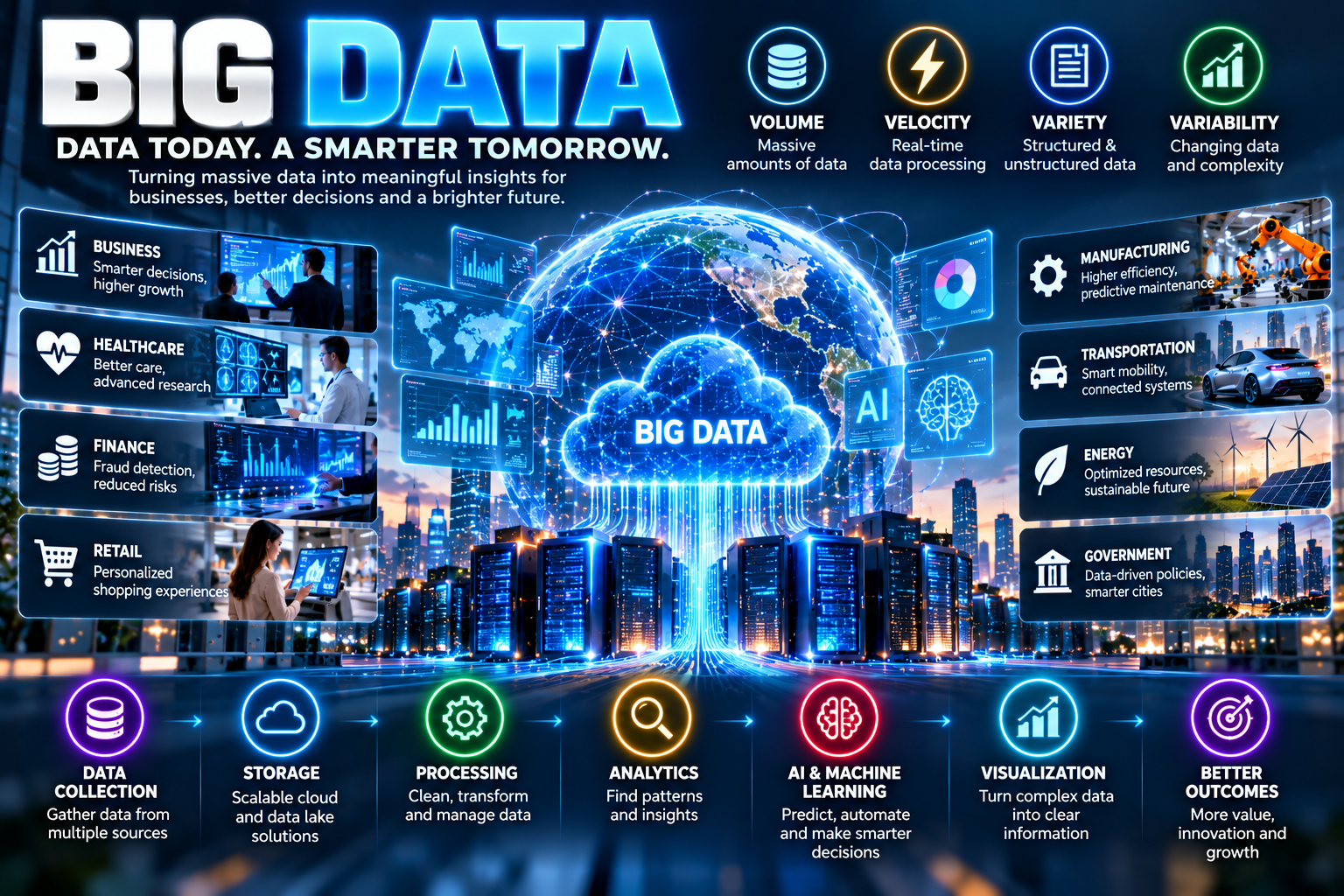
Big Data and Science
Modern scientific research can generate enormous quantities of data.
Examples include:
Telescope observations
Satellite imagery
DNA sequencing
Climate measurements
Particle physics experiments
Medical records
Ocean sensors
Genomic databases
Researchers need advanced systems to store, process, visualize, and analyze this information.
Big Data has therefore become an important part of modern science.
Scientific Research
Scientific research generally falls into several broad categories.
Basic Research
Basic research seeks to understand fundamental principles without necessarily targeting an immediate commercial application.
Examples include research into:
Fundamental particles
Cellular processes
Mathematical structures
Cosmic phenomena
Applied Research
Applied research focuses on solving specific practical problems.
Examples include:
Developing a new medical treatment
Improving batteries
Creating drought-resistant crops
Developing cleaner industrial processes
Experimental Development
Experimental development uses existing scientific knowledge to create or improve products, processes, or systems.
The NSF's 2026 data classify U.S. R&D into basic research, applied research, and experimental development; experimental development represented about 67% of U.S. R&D performance in 2024.
The Scientific Method
The scientific method provides a structured approach to investigating questions.
Step 1: Observation
Scientists observe something interesting or identify a problem.
Step 2: Question
They formulate a question that can be investigated.
Step 3: Hypothesis
A testable explanation is proposed.
Step 4: Experiment
Researchers design experiments or collect appropriate observations.
Step 5: Data Collection
Measurements and observations are recorded.
Step 6: Analysis
Scientists analyze the data using appropriate methods.
Step 7: Conclusion
The evidence is evaluated against the original hypothesis.
Step 8: Repetition and Review
Other researchers may repeat the work or examine the results through peer review.
This process helps distinguish evidence-based conclusions from unsupported claims.
Peer Review and Scientific Communication
Scientific knowledge depends heavily on communication.
Researchers publish findings through:
Scientific journals
Conferences
Research databases
Books
Reports
Open datasets
Peer review allows researchers with relevant expertise to evaluate scientific work before or after publication, depending on the publishing model.
Scientific communication also allows researchers to reproduce experiments, compare results, identify errors, and build upon previous discoveries.
Science and Healthcare
Science is central to modern healthcare.
Research supports:
Vaccines
Medicines
Medical imaging
Diagnostics
Surgery
Genetics
Disease surveillance
Medical devices
Public health programs
WHO describes research as essential for addressing health challenges and supporting surveillance, diagnostics, vaccines, and medicines.
Scientific research can also help identify emerging health threats and improve preparedness.
Genomics and Biotechnology
Advances in biology and biotechnology are creating new opportunities in healthcare, agriculture, environmental science, and manufacturing.
Genomics allows researchers to study genetic information at increasingly detailed levels.
Biotechnology can be applied to:
Drug development
Gene-based research
Agricultural improvement
Industrial biotechnology
Synthetic biology
Diagnostics
Biomaterials
However, these technologies also raise questions involving ethics, safety, privacy, regulation, and equitable access.
Science and Climate Change
Climate science combines information from atmospheric science, oceanography, geology, ecology, physics, and other disciplines.
Researchers study:
Temperature changes
Atmospheric composition
Ocean conditions
Ice systems
Weather patterns
Ecosystem responses
Carbon cycles
Satellites and other Earth-observation technologies provide important measurements for studying planetary systems.
NASA's Earth science program combines observations and modeling to improve understanding of Earth's interconnected processes and support societal outcomes.
Science and Space Exploration
Space exploration creates opportunities for scientific discovery beyond Earth.
Researchers study:
Planetary atmospheres
Lunar geology
Mars
Asteroids
Exoplanets
Solar activity
The origins of galaxies
The evolution of the universe
Space missions also generate technologies and scientific data that can be useful for researchers on Earth.
Quantum Science
Quantum science investigates physical phenomena at extremely small scales.
Quantum research contributes to areas such as:
Quantum computing
Quantum communications
Quantum sensing
Fundamental physics
Advanced materials
Quantum technologies remain an active research area, with potential applications in computing, sensing, communications, and scientific measurement.
Materials Science
Materials science explores how materials are structured, how they behave, and how they can be engineered for specific applications.
Researchers work with:
Metals
Ceramics
Polymers
Semiconductors
Nanomaterials
Composites
Biomaterials
New materials can influence industries such as electronics, transportation, construction, energy, medicine, and aerospace.
Science and Energy
Scientific research plays a major role in developing energy technologies.
Research areas include:
Solar energy
Wind energy
Batteries
Hydrogen
Nuclear energy
Energy storage
Smart grids
Advanced materials
Energy efficiency
The challenge is not simply producing energy but developing systems that are reliable, affordable, efficient, and environmentally sustainable.
Science and Agriculture
Agricultural science helps improve food production and resource efficiency.
Researchers investigate:
Crop genetics
Soil science
Plant diseases
Precision agriculture
Irrigation
Agricultural robotics
Food science
Pest management
Climate-resilient crops
Sensors, satellite imagery, AI, and biotechnology are increasingly connected with traditional agricultural research.
Science and Innovation
Science and innovation are closely connected but are not identical.
Science primarily seeks to understand how the world works.
Innovation focuses on creating or improving products, services, processes, and systems.
Scientific discovery can create the foundation for innovation.
For example:
Scientific discovery → Engineering → Prototype → Product → Real-world application
Not every scientific discovery immediately becomes a commercial technology, and many innovations also come from combining existing scientific knowledge in new ways.
The Global Scientific Research System
Science is increasingly international.
Researchers collaborate through:
Universities
Government laboratories
Private companies
International organizations
Research institutes
Scientific societies
The NSF's 2026 science and engineering indicators show that global science involves interconnected research, workforce, R&D, innovation, technology transfer, and high-technology industries.
International collaboration can allow researchers to combine expertise, data, equipment, and funding.
Science Education and STEM
Science education helps develop the next generation of researchers, engineers, healthcare professionals, and technology specialists.
STEM generally refers to:
Science
Technology
Engineering
Mathematics
The NSF's 2026 indicators include STEM education, the STEM workforce, research and development, invention, innovation, and high-technology industries as major components of the science and engineering ecosystem.
Science education is therefore not only about preparing scientists. It also supports broader technological and economic capabilities.
The Role of Scientific Institutions
Universities, research institutes, governments, companies, and nonprofit organizations all contribute to scientific research.
Different organizations may focus on:
Basic research
Applied research
Commercial development
Public health
National laboratories
Environmental monitoring
Space exploration
Industrial research
Modern scientific progress often occurs when these groups collaborate.
Ethics in Modern Science
Scientific progress must be accompanied by responsible research practices.
Important considerations include:
Human safety
Animal welfare
Privacy
Data protection
Research integrity
Informed consent
Environmental impact
Responsible AI
Equitable access
Dual-use risks
WHO's 2026 guidance on AI-related health research emphasizes the need for stronger ethics review and oversight because AI can create new risks involving human rights, fairness, equity, and public trust.
Ethics is therefore not separate from science. It is part of responsible scientific practice.
Challenges Facing Modern Science
Science faces several major challenges.
Funding
Scientific research can require significant long-term investment.
Complexity
Modern research questions increasingly cross traditional disciplinary boundaries.
Data
Researchers must manage enormous quantities of information while maintaining data quality.
Reproducibility
Scientific findings need appropriate validation and replication.
Public Trust
Scientific institutions need to communicate evidence and uncertainty clearly.
Misinformation
False or misleading scientific claims can spread rapidly through digital platforms.
Research Ethics
New technologies can create ethical questions that existing systems were not designed to address.
Access
Scientific knowledge, research infrastructure, and advanced technologies are not distributed equally around the world.
The Future of Science
The future of science is likely to become increasingly interdisciplinary and technology-driven.
Important areas include:
AI-Assisted Discovery
AI may increasingly help scientists analyze evidence, identify patterns, generate hypotheses, and explore complex datasets.
Autonomous Laboratories
Robotics and AI could automate portions of laboratory experimentation.
Digital Twins and Simulation
Computer models can help researchers study complex systems before conducting some physical experiments.
Advanced Genomics
Genomics may continue expanding our understanding of disease, biology, and biological variation.
Quantum Technologies
Quantum computing and sensing may open new scientific and technological possibilities.
Space Science
New missions and increasingly powerful instruments will continue expanding knowledge about planets, stars, galaxies, and the universe.
Climate Science
Advanced Earth-observation systems and models will continue improving understanding of planetary systems.
Interdisciplinary Research
Future discoveries may increasingly emerge at the intersection of fields rather than inside a single discipline.
Science in 2026
Scientific research in 2026 is characterized by growing connections between research, technology, data, and innovation.
The NSF reports that U.S. science and engineering activity has increasingly concentrated around information technologies and critical and emerging technologies, while business has become the dominant performer and funder of U.S. R&D.
At the same time, organizations such as WHO are emphasizing forward-looking research, emerging technologies, scientific foresight, and responsible innovation in health.
This reflects a broader transformation in science: researchers are not only studying individual phenomena but increasingly building interconnected systems involving data, computation, engineering, biology, and advanced technology.
Why Scientific Literacy Matters
Scientific literacy helps people evaluate information and make informed decisions.
A scientifically literate person does not need to be an expert in every scientific discipline. Instead, they should understand basic concepts such as:
Evidence
Uncertainty
Correlation
Causation
Probability
Experimental design
Peer review
Scientific consensus
Data quality
These skills are increasingly important in a world where scientific information is widely available online.
Final Thoughts
Science is a continuous process of discovering, testing, questioning, and improving our understanding of the world.
Its influence extends from the smallest particles and biological molecules to entire ecosystems, planets, and galaxies. Modern science increasingly combines traditional research methods with AI, advanced computing, robotics, genomics, satellites, large datasets, and sophisticated modeling.
The future of science will likely depend not only on individual discoveries but also on collaboration between disciplines, institutions, countries, industries, and communities.
As scientific capabilities become more powerful, responsible research, ethical oversight, transparent communication, and public trust will become increasingly important.
Science ultimately provides one of humanity's most important mechanisms for turning questions into evidence, evidence into knowledge, and knowledge into new possibilities.
Frequently Asked Questions
What is science?
Science is a systematic approach to understanding the natural world through observation, measurement, experimentation, evidence, and analysis.
What are the major branches of science?
Major branches include physics, chemistry, biology, Earth science, astronomy, environmental science, and computer science, along with many specialized disciplines.
Why is science important?
Science helps explain natural phenomena, improve healthcare, develop technologies, understand Earth, explore space, solve practical problems, and expand human knowledge.
What is the scientific method?
The scientific method generally involves asking a question, developing a hypothesis, conducting research or experiments, collecting data, analyzing evidence, and evaluating conclusions.
What is basic research?
Basic research seeks to expand fundamental knowledge and understand how natural or theoretical systems work without necessarily targeting an immediate practical application.
What is applied science?
Applied science uses scientific knowledge to address specific practical problems or develop useful applications.
How is AI changing science?
AI can help researchers analyze large datasets, identify patterns, model complex systems, search information, design experiments, and support scientific discovery.
What is interdisciplinary science?
Interdisciplinary science combines knowledge and methods from multiple fields to investigate problems that cannot be adequately addressed by one discipline alone.
What role does science play in technology?
Scientific discoveries often provide the knowledge that engineers and innovators use to develop new technologies, although technology can also advance through engineering and experimentation.
What is the future of science?
The future is likely to involve greater use of AI, automation, advanced computing, genomics, quantum technologies, space research, Earth observation, robotics, and interdisciplinary collaboration.