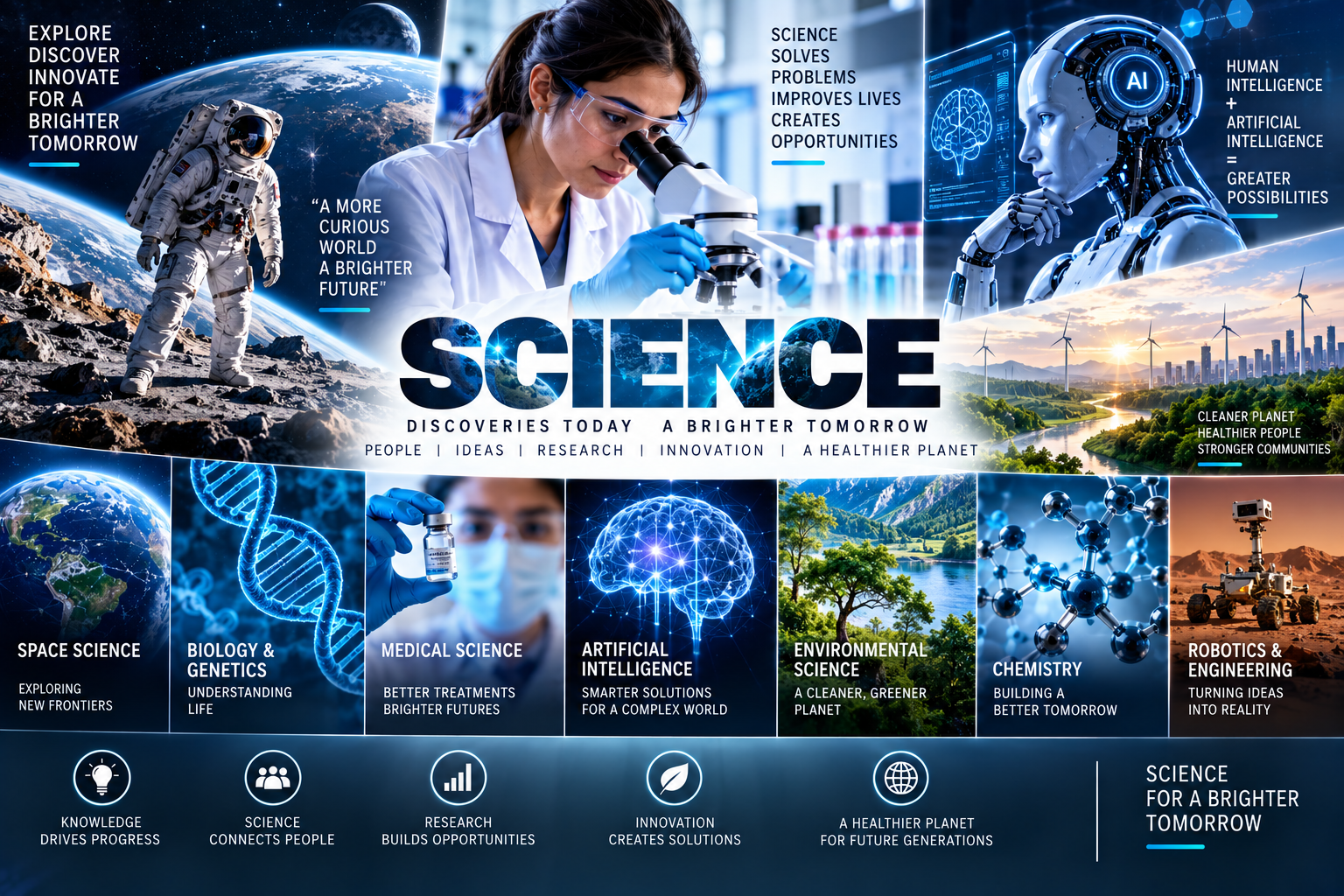
Science is one of the most powerful forces shaping modern civilization. It helps humanity understand the natural world, develop new technologies, improve healthcare, explore space, protect the environment, and address some of the most complex challenges facing society.
From the study of microscopic cells to the exploration of distant galaxies, science covers an enormous range of knowledge. Physics, chemistry, biology, astronomy, earth science, environmental science, neuroscience, and many other disciplines contribute to our understanding of how the world works.
Scientific progress rarely happens overnight. It is built through observation, experimentation, evidence, collaboration, and continuous questioning. Researchers develop hypotheses, test ideas, analyze results, and refine their understanding when new evidence becomes available.
Today, science is entering a particularly exciting period. Artificial intelligence, advanced computing, biotechnology, robotics, space technology, and powerful scientific instruments are accelerating research and opening opportunities that were previously difficult to imagine.
What Is Science?
Science is a systematic approach to understanding the natural world through observation, evidence, experimentation, analysis, and reasoning.
Scientists investigate questions about matter, energy, living organisms, the Earth, the atmosphere, the universe, and countless other subjects.
One of the defining characteristics of science is that scientific ideas can be tested. Evidence can support a hypothesis, challenge it, or lead researchers to develop a better explanation.
Science is therefore not simply a collection of facts. It is an ongoing process of discovery and improvement.
The Major Fields of Science
Science includes many interconnected disciplines.
Physics
Physics studies matter, energy, forces, motion, space, and time. It provides the foundation for many technologies, from electronics and telecommunications to energy systems and advanced computing.
Chemistry
Chemistry examines substances, their properties, structures, and interactions. Chemical research contributes to pharmaceuticals, materials, agriculture, energy, manufacturing, and environmental technologies.
Biology
Biology focuses on living organisms. Researchers study cells, genetics, evolution, ecosystems, microorganisms, animals, and human biology.
Astronomy
Astronomy investigates stars, planets, galaxies, black holes, and the wider universe. Modern telescopes and space missions continue to expand our understanding of cosmic history and the origins of planetary systems.
Earth and Environmental Science
Earth sciences examine the planet's atmosphere, oceans, geology, climate, and ecosystems. This knowledge is increasingly important as societies address environmental challenges and seek more sustainable ways to use natural resources.
Science and Technology
Science and technology are closely connected but are not identical.
Science seeks to understand how the world works, while technology applies knowledge to create tools, systems, and solutions.
Scientific discoveries can lead to technological breakthroughs, while new technologies can provide scientists with better ways to conduct research.
For example, advanced computing allows researchers to simulate complex systems, while sophisticated microscopes allow scientists to observe structures that were once invisible.
This relationship creates a cycle in which scientific knowledge enables technological development and technology accelerates scientific discovery.
Artificial Intelligence in Science
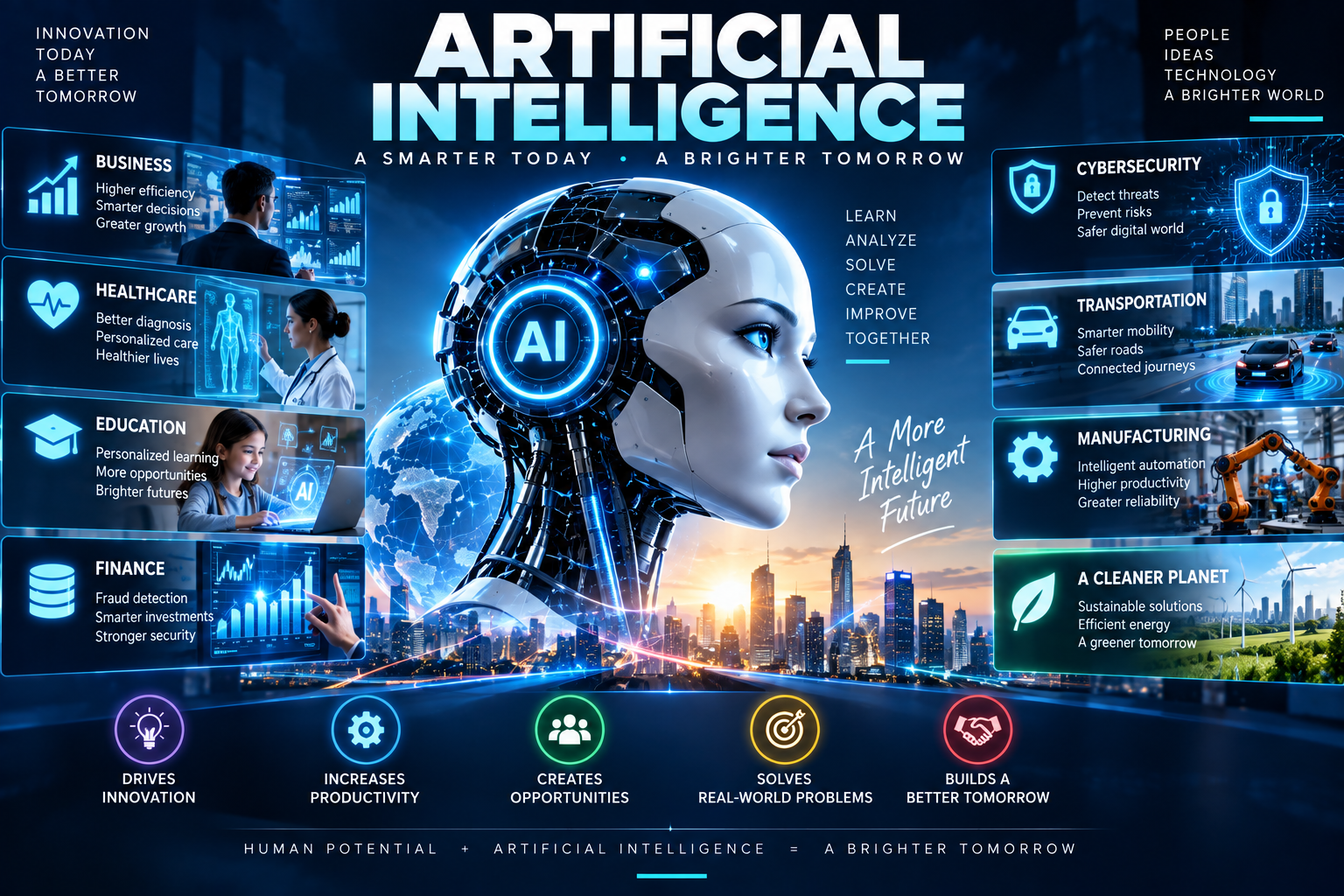
Artificial intelligence is becoming an increasingly important research tool.
Scientists can use AI to analyze enormous datasets, identify patterns, simulate systems, process images, and assist with research workflows.
In fields such as biology and astronomy, researchers may have to analyze massive amounts of information. AI can help identify potentially important signals that would be difficult to detect manually.
Machine learning can also support drug discovery, materials research, climate modeling, and scientific forecasting.
However, AI does not eliminate the need for scientific expertise. Researchers still need to determine whether results are reliable, understand limitations, design appropriate experiments, and interpret findings within their scientific context.
The Importance of Scientific Research
Scientific research provides the foundation for many advances in society.
Research can be basic or applied.
Basic research seeks to expand knowledge without necessarily targeting an immediate commercial application. Applied research focuses more directly on solving specific problems.
Both are important.
A discovery that initially appears theoretical can eventually lead to technologies with enormous practical value.
This makes long-term investment in scientific research important for universities, governments, businesses, and research institutions.
Science and Healthcare
Science has transformed healthcare.
Advances in biology, chemistry, genetics, medical imaging, immunology, and other fields have contributed to improved methods of prevention, diagnosis, and treatment.
Modern medicine depends heavily on scientific research.
Researchers continue to investigate diseases, develop new therapies, study genetics, and explore how the human body responds to different treatments.
Biotechnology is also creating new possibilities in areas such as gene-based research, cell therapies, diagnostics, and pharmaceutical development.
The connection between scientific research and healthcare demonstrates how knowledge generated in laboratories can eventually influence millions of lives.
Genetics and Biotechnology
Genetics has become one of the most rapidly advancing areas of modern science.
Researchers can study DNA to understand biological characteristics, inherited conditions, and relationships between genes and disease.
Advances in biotechnology have also made it possible to manipulate biological systems for research and medical purposes.
Gene-editing technologies have created opportunities to investigate diseases and explore potential treatments.
However, biotechnology raises important ethical questions. Scientific capabilities need to be accompanied by responsible governance, appropriate safety standards, and careful consideration of potential consequences.
Science and Space Exploration
Space science continues to expand the boundaries of human knowledge.
Scientists study planets, moons, asteroids, stars, galaxies, and the origins of the universe using telescopes, satellites, probes, and other instruments.
Space missions can also contribute to our understanding of Earth's environment.
The search for life beyond Earth remains one of the most fascinating questions in science. Researchers investigate whether conditions capable of supporting life may exist elsewhere in the solar system or beyond.
Space exploration also drives technological innovation in communications, robotics, materials, computing, and engineering.
Climate and Environmental Science
Environmental science has become increasingly important as societies deal with climate change, pollution, biodiversity loss, water management, and resource challenges.
Scientists collect information from satellites, sensors, weather stations, oceans, ice, forests, and other environments to understand changes occurring across the planet.
Climate models can help researchers explore possible future scenarios.
Scientific evidence can inform decisions about energy, infrastructure, agriculture, conservation, transportation, and environmental policy.
The complexity of environmental systems makes collaboration across disciplines especially important.
Scientific Instruments and Discovery
Scientific progress often depends on the tools available to researchers.
Microscopes allow scientists to study structures at extremely small scales. Telescopes allow observations of distant objects in space. Particle accelerators help researchers investigate fundamental components of matter.
Satellites can monitor the Earth's atmosphere and oceans.
Advances in sensors, imaging, computing, and laboratory equipment continuously expand what scientists can observe and measure.
In many cases, new discoveries become possible because researchers develop better instruments.
The Role of Data
Modern science is increasingly data-intensive.
Researchers can collect enormous quantities of information through experiments, sensors, satellites, genomic sequencing, simulations, and observational systems.
Data science and high-performance computing help scientists process this information.
Reliable data management is essential because scientific conclusions depend on the quality of evidence.
Researchers need methods for validating information, documenting experiments, reproducing results, and communicating findings clearly.
The combination of scientific expertise and advanced data analysis is likely to become even more important in the coming years.
Scientific Collaboration
Modern scientific problems are often too complex for one researcher or institution to solve alone.
Large research projects may involve scientists from multiple countries and disciplines.
International collaboration allows researchers to share expertise, equipment, data, and resources.
Examples include large astronomy projects, particle physics experiments, climate research programs, medical research networks, and global biodiversity studies.
Collaboration can accelerate discovery while also creating opportunities for researchers with different perspectives to challenge assumptions and develop new approaches.
Science Education
Science education is essential for building future generations of researchers, engineers, healthcare professionals, entrepreneurs, and informed citizens.
Effective science education goes beyond memorizing facts.
Students benefit from learning how to ask questions, evaluate evidence, conduct experiments, interpret data, and understand uncertainty.
Scientific literacy is also important outside professional research. People regularly encounter claims about health, technology, climate, food, medicine, and other scientific topics.
Understanding how evidence works can help individuals make better-informed decisions.
Science and Business
Scientific research also plays an important role in the economy.
Businesses invest in research and development to create new products, improve manufacturing processes, develop medicines, discover materials, and gain competitive advantages.
Industries such as pharmaceuticals, biotechnology, energy, electronics, agriculture, aerospace, and advanced manufacturing depend heavily on scientific research.
Universities and research institutions can also work with businesses to commercialize discoveries.
This relationship between science and business can accelerate the movement of ideas from laboratories into real-world applications.
Science and Energy
Energy research is another major area of scientific innovation.
Scientists and engineers are exploring ways to improve renewable energy, energy storage, nuclear technologies, grid systems, and energy efficiency.
Solar and wind power have become increasingly important components of energy systems, while battery research is supporting electric vehicles and energy storage.
Future energy technologies could play an important role in reducing emissions while meeting growing global energy demand.
Scientific research is essential because energy systems involve complex interactions between physics, chemistry, engineering, economics, and environmental science.
Challenges Facing Science
Science faces challenges as well as opportunities.
Research can be expensive and time-consuming. Some experiments require specialized equipment and large teams.
Researchers also face challenges involving data quality, reproducibility, funding, communication, and public trust.
Another challenge is the spread of misinformation.
Scientific findings can be misunderstood or presented without appropriate context, particularly when complex research is reduced to simple headlines.
Clear communication is therefore an important part of modern science.
Researchers and institutions need to explain evidence, uncertainty, limitations, and the difference between established findings and early-stage research.
Ethics and Responsible Science
Scientific progress creates responsibilities.
Research involving humans, animals, genetic technologies, artificial intelligence, and other sensitive areas requires careful ethical consideration.
Scientists and institutions need to consider potential risks as well as potential benefits.
Responsible science involves transparency, appropriate oversight, ethical review, data protection, safety procedures, and honest communication of results.
Public trust depends partly on confidence that scientific research is conducted responsibly.
The Future of Science
The future of science will likely be defined by increasing collaboration between humans and advanced technologies.
Artificial intelligence may accelerate research and help scientists analyze increasingly complex datasets.
Quantum computing could eventually contribute to certain scientific simulations and computational problems.
Biotechnology may create new opportunities in medicine and agriculture.
Space science could provide new insights into planetary systems and the origins of the universe.
At the same time, environmental science will remain critical as humanity seeks to manage resources and respond to global environmental challenges.
The boundaries between scientific disciplines may also become less distinct. Biology, computing, chemistry, physics, engineering, and data science are increasingly interacting to solve complex problems.
Science and the Future of Humanity
Science does more than explain the world. It expands the range of possibilities available to humanity.
Every major scientific discovery can change how people understand themselves and their surroundings.
The scientific process encourages curiosity, skepticism, evidence-based reasoning, and a willingness to revise conclusions when new information becomes available.
These principles are particularly valuable in a rapidly changing world.
As societies face challenges involving health, climate, energy, technology, food, resources, and space, scientific knowledge will remain essential to informed decision-making.
Conclusion
Science is a continuous journey of discovery.
From understanding the smallest components of matter to exploring distant galaxies, scientific research expands human knowledge and creates the foundation for technological and economic progress.
Artificial intelligence, biotechnology, advanced computing, space exploration, environmental research, and data science are opening new frontiers while creating important ethical and social questions.
The future of science will depend on investment, collaboration, education, responsible innovation, and public trust.
Ultimately, science is not simply about finding answers. It is about asking better questions, testing ideas with evidence, learning from what we discover, and using knowledge responsibly to build a better future.
Frequently Asked Questions About Science
1. What is science?
Science is a systematic process of studying the natural world through observation, experimentation, evidence, analysis, and reasoning.
2. Why is science important?
Science helps humanity understand nature, improve healthcare, develop technology, address environmental challenges, explore space, and make evidence-based decisions.
3. What are the main fields of science?
Major fields include physics, chemistry, biology, astronomy, earth science, environmental science, neuroscience, and many specialized disciplines.
4. How does science contribute to technology?
Scientific discoveries provide knowledge that can be applied to develop new technologies, while advanced technologies also give scientists better tools for research and discovery.
5. How is AI used in science?
AI can help researchers analyze large datasets, identify patterns, process images, simulate systems, support drug discovery, and accelerate certain research activities.
6. What is biotechnology?
Biotechnology uses biological systems, organisms, or biological processes to develop products and technologies, with applications in healthcare, agriculture, research, and other fields.
7. Why is space science important?
Space science helps researchers understand the universe, planets, stars, galaxies, and the origins of cosmic systems while also supporting technological development.
8. How does science help fight climate change?
Climate and environmental science provide evidence about Earth's systems, climate patterns, emissions, ecosystems, and potential solutions, helping inform environmental decisions and technologies.
9. Why is scientific research important?
Scientific research expands knowledge and can lead to advances in medicine, technology, energy, agriculture, manufacturing, and other areas.
10. What role does data play in science?
Data provides evidence that researchers use to test hypotheses, identify patterns, evaluate theories, and develop scientific conclusions.
11. Why is scientific collaboration important?
Many modern scientific problems are highly complex. Collaboration allows researchers from different disciplines and countries to share knowledge, equipment, data, and expertise.
12. What are the challenges facing modern science?
Challenges include research costs, funding, data quality, reproducibility, misinformation, ethical questions, public trust, and the complexity of increasingly advanced technologies.
13. What is the future of science?
The future will likely involve greater use of AI, advanced computing, biotechnology, robotics, space technologies, data science, and interdisciplinary research to address increasingly complex scientific questions.