
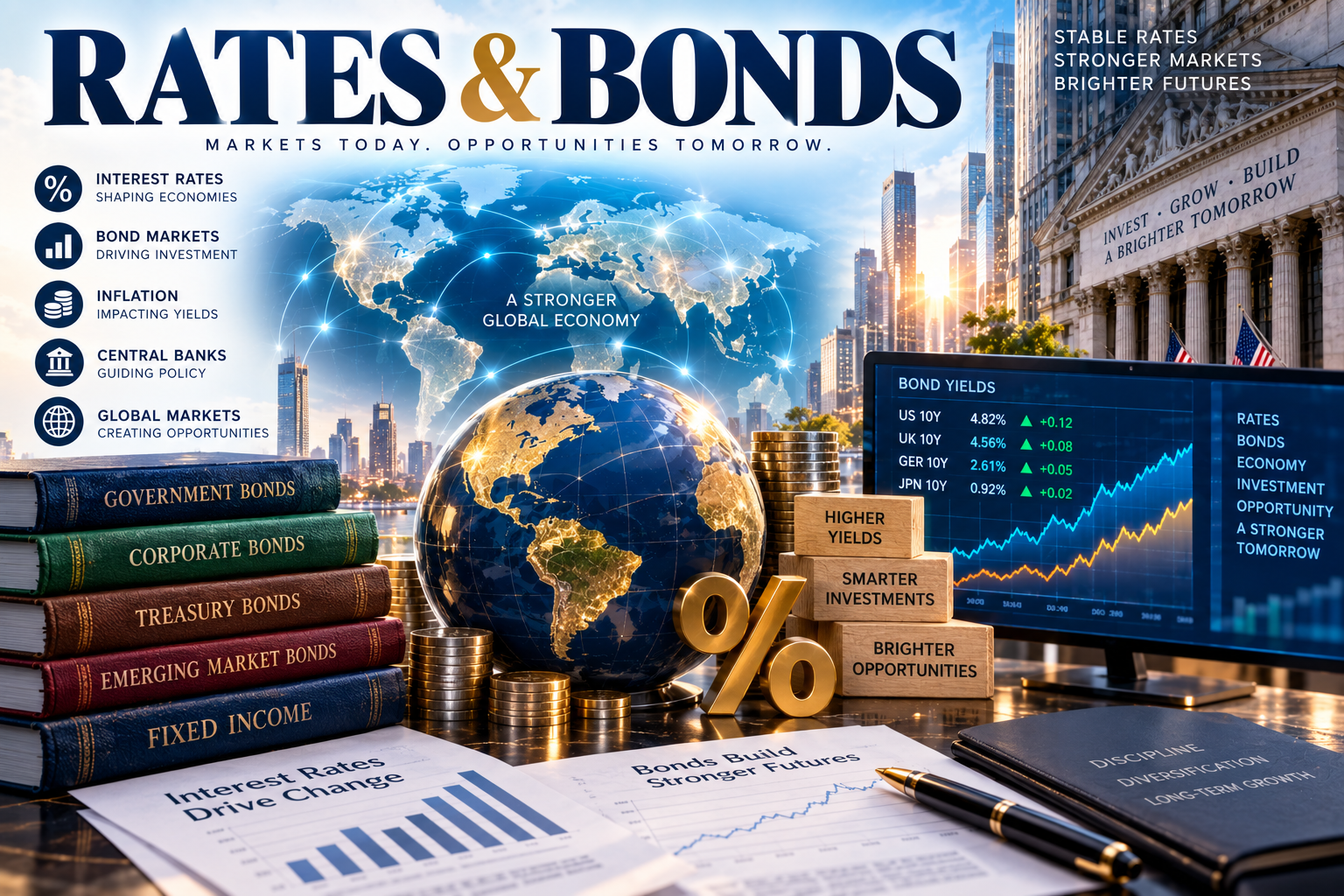
Rates and bonds are at the center of global financial markets. Interest rates influence borrowing costs, savings, mortgages, corporate investment, currencies, government finances, and stock valuations, while bonds provide governments and companies with a major source of financing.
In 2026, rates and bond markets are facing an unusually complicated environment. Inflation remains a concern in several major economies, energy prices have risen sharply amid geopolitical tensions, government debt is high, and central banks are reassessing their policy paths. At the same time, economic growth and investment in areas such as artificial intelligence are supporting demand.
The International Monetary Fund projects global growth of 3.0% in 2026 and 3.4% in 2027, but warns that inflation uncertainty and financial-market repricing remain important risks. The IMF also reports that longer-term yields are elevated globally.
What Are Rates & Bonds?
“Rates” generally refers to interest rates across financial markets, particularly central-bank policy rates, government bond yields, lending rates, and other borrowing costs.
“Bonds” are debt securities issued by governments, corporations, municipalities, and other borrowers. When investors purchase a bond, they are effectively lending money to the issuer in exchange for interest payments and repayment of the principal according to the bond's terms.
The relationship between rates and bonds is extremely important.
When interest rates rise, newly issued bonds generally offer higher yields. Existing bonds with lower coupon payments can become less attractive, causing their market prices to fall.
When interest rates decline, existing bonds with higher coupons can become more valuable, potentially pushing their market prices higher.
This inverse relationship is one of the most important concepts in fixed-income investing.
How Interest Rates Affect the Economy
Interest rates influence almost every part of the economy.
When central banks increase policy rates, borrowing becomes more expensive. Businesses may delay investment, consumers may reduce borrowing, and housing activity can weaken.
When rates decline, financing becomes cheaper. Businesses may invest more, consumers may borrow more, and economic activity can receive a boost.
Interest rates also influence savings. Higher rates can make deposits and short-term fixed-income investments more attractive, while lower rates can encourage investors to seek returns in stocks and other assets.
Because of these effects, central banks carefully consider inflation, employment, economic growth, financial stability, and other factors when setting monetary policy.
Central Banks and Rates in 2026
Major central banks remain among the most important drivers of global bond markets.
The U.S. Federal Reserve, European Central Bank, Bank of England, and Bank of Japan are all being closely monitored by investors.
In September 2026, expectations are particularly fluid. In the United States, markets are debating whether the Federal Reserve will raise rates at its September meeting as inflation remains above target and energy prices have increased. Recent comments from Fed Governor Christopher Waller have also highlighted the possibility of keeping rates unchanged if inflation continues to cool.
In Europe, the ECB is widely expected to raise its policy rate by 25 basis points in September because of renewed inflation pressure, particularly from energy costs. A Reuters poll found most economists expected this to be the final increase of the current tightening cycle, although the outlook remains dependent on inflation and geopolitical developments.
The Bank of Japan is another important factor. Rising Japanese rates can influence the yen and global capital flows because Japanese investors are major participants in international bond markets.
Government Bonds
Government bonds are among the most important assets in global financial markets.
Major government bond markets include:
U.S. Treasury securities
German Bunds
UK Gilts
Japanese Government Bonds
French government bonds
Italian government bonds
Emerging-market sovereign debt
Government bonds are often used as benchmarks for pricing other financial assets.
For example, the U.S. 10-year Treasury yield influences mortgage rates, corporate borrowing costs, equity valuations, and international capital flows.
However, government bonds are not completely risk-free from an investment perspective. Their prices can fall when yields rise, and investors can face inflation, duration, currency, and credit risks depending on the security.
U.S. Treasury Market
The U.S. Treasury market is the world's most important government bond market.
Treasury securities are closely followed by investors because they influence global borrowing costs and are widely used as benchmarks.
In September 2026, U.S. Treasury yields have been elevated. Reuters reported that 10-year Treasury yields were approaching 5%, reflecting inflation concerns, large government borrowing needs, and strong nominal economic growth.
Higher Treasury yields can create both opportunities and challenges.
For investors, higher yields can make government bonds more attractive as sources of income. However, rising yields reduce the market value of bonds that were issued earlier at lower rates.
European Bond Markets
European bond markets are also responding to changing inflation and monetary-policy expectations.
German Bunds are particularly important because they serve as a benchmark for euro-area borrowing costs.
In September 2026, German 10-year yields have risen as investors anticipate additional ECB tightening and assess the effect of higher energy prices.
Other European government bond markets can move differently depending on fiscal conditions, economic growth, inflation, and perceived credit risk.
Countries with higher debt burdens may face larger increases in borrowing costs when investors demand additional compensation for risk.
UK Gilts and Rising Borrowing Costs
The UK bond market has faced particularly strong pressure.
On September 8, 2026, the United Kingdom sold 30-year government bonds at a record yield of 5.8168%, the highest level recorded since the UK Debt Management Office began operations in 1998.
Higher long-term yields increase the government's financing costs and can also influence mortgages, corporate borrowing, and investment decisions.
The UK example demonstrates how bond markets can reflect concerns about inflation, public finances, interest rates, and long-term economic conditions.
Corporate Bonds
Governments are not the only issuers of bonds.
Companies issue corporate bonds to raise money for expansion, acquisitions, refinancing, capital expenditure, and other purposes.
Corporate bonds typically offer higher yields than government securities because investors face greater credit risk.
Corporate bonds are generally divided into two broad categories:
Investment-Grade Bonds
Investment-grade bonds are issued by companies with relatively strong credit profiles.
They generally offer lower yields than riskier corporate debt but may provide greater stability.
High-Yield Bonds
High-yield bonds are issued by companies with lower credit ratings.
They offer higher potential income to compensate investors for greater default and market risk.
Economic slowdowns can increase pressure on highly leveraged companies, making credit analysis especially important.
Bond Yields and Prices
One of the most important relationships in bond investing is the connection between prices and yields.
When bond prices rise, yields generally fall.
When bond prices fall, yields generally rise.
Consider a simple example. Suppose an investor owns an existing bond paying a fixed coupon of 4%. If newly issued bonds begin offering 5%, the older 4% bond becomes less attractive. Its market price may therefore decline until its yield becomes competitive with newer securities.
This relationship means investors can potentially earn income from bonds while also experiencing capital gains or losses depending on market prices.
Bond Duration
Duration measures how sensitive a bond's price is to changes in interest rates.
Long-duration bonds generally experience larger price movements when rates change.
Short-duration bonds tend to be less sensitive.
For example, an investor who expects interest rates to rise may prefer shorter-duration bonds because they generally have less exposure to price declines caused by rising yields.
An investor expecting rates to fall may consider longer-duration bonds because they can potentially benefit more from declining yields.
Duration is therefore a critical concept for managing fixed-income portfolios.
Inflation and Bonds
Inflation can have a significant impact on bond investors.
Traditional bonds generally make fixed payments. If inflation rises significantly, those payments lose purchasing power.
This is why investors closely monitor inflation when evaluating bond yields.
When markets expect higher inflation, investors may demand higher yields to compensate for the expected loss of purchasing power.
Inflation-linked bonds provide an alternative. These securities are designed so that their principal or interest payments are adjusted according to an inflation measure.
The Impact of Energy Prices
Energy prices have become particularly important for rates and bonds in 2026.
Brent crude recently moved toward $100 per barrel amid escalating Middle East tensions. Higher oil prices can increase inflation expectations and make central banks more cautious about lowering rates.
This creates a difficult environment for bond markets.
If higher energy prices push inflation higher, central banks may maintain restrictive monetary policy for longer. That can keep bond yields elevated.
At the same time, persistently high energy costs can weaken economic growth, creating a complicated balance between inflation and recession risks.
Government Debt and Bond Markets
Government debt is another major factor influencing bond yields.
Governments issue bonds to finance budget deficits, infrastructure projects, public services, and other spending.
When borrowing requirements increase, markets may demand higher yields to absorb additional debt issuance.
The IMF has warned that rising debt and higher bond yields could increase debt-service costs worldwide. It has also noted that rising yields in advanced economies could create difficulties for emerging and developing economies by increasing their borrowing costs.
This makes fiscal sustainability increasingly important for investors.
Emerging-Market Bonds
Emerging-market bonds can provide higher yields than many developed-market securities, but they generally carry additional risks.
These include:
Currency volatility
Political risk
Inflation
Higher refinancing costs
Credit risk
Capital outflows
Commodity-price exposure
The IMF reports that investor appetite for hard-currency emerging-market debt has remained relatively strong, although policy-rate expectations vary considerably across emerging economies depending on their energy exposure.
Emerging-market bonds can therefore offer attractive income opportunities but require careful assessment of economic and political conditions.
Bonds and Portfolio Diversification
Bonds can play several roles in an investment portfolio.
They can provide income, diversify equity exposure, and potentially offer greater stability than stocks during certain market conditions.
However, bonds do not always rise when stocks fall.
Inflation shocks, rising interest rates, credit stress, and liquidity problems can cause both stocks and bonds to decline simultaneously.
This is why investors should consider the specific type of bonds they own, including maturity, credit quality, duration, currency, and issuer.
Bond Funds and ETFs
Investors do not necessarily need to purchase individual bonds.
Bond mutual funds and exchange-traded funds provide diversified exposure to fixed-income markets.
A bond ETF might focus on:
U.S. Treasuries
Corporate bonds
High-yield debt
Municipal bonds
Emerging-market debt
Short-term bonds
Long-term bonds
Inflation-protected securities
Bond funds can simplify diversification, but investors should remember that fund prices can fluctuate and that bond funds generally do not have a fixed maturity date like individual bonds.
Key Risks in Rates & Bonds
Interest-Rate Risk
Bond prices can fall when interest rates rise.
Inflation Risk
Inflation can reduce the purchasing power of fixed interest payments.
Credit Risk
Corporate and emerging-market issuers may experience financial difficulties or default.
Liquidity Risk
Some bonds may be difficult to sell quickly without accepting a lower price.
Currency Risk
Foreign bonds can produce losses when exchange rates move against the investor.
Reinvestment Risk
When bonds mature or pay coupons, investors may have to reinvest at lower rates if market interest rates have declined.
What Investors Should Watch in 2026
Several indicators will be particularly important for rates and bonds during the remainder of 2026.
Inflation: Consumer and producer price data will influence central-bank decisions.
Energy prices: Oil and gas prices could determine whether inflation pressures intensify.
Central-bank policy: Fed, ECB, and BOJ decisions can move global bond markets.
Government debt: Rising issuance can put upward pressure on long-term yields.
Economic growth: A slowdown could eventually support lower interest rates, while stronger growth could keep yields elevated.
Employment: Labor-market strength influences inflation and central-bank policy.
Bond auctions: Demand at government debt auctions provides useful information about investor appetite.
Credit spreads: Widening spreads can signal rising concerns about corporate and financial risks.
The Outlook for Rates & Bonds
The 2026 outlook for rates and bonds remains highly dependent on inflation and economic developments.
If inflation continues to decline, central banks may eventually gain more flexibility to reduce interest rates. Such an environment could support bond prices, particularly for longer-duration securities.
However, persistent energy inflation, geopolitical tensions, large fiscal deficits, and strong economic activity could keep rates higher for longer.
The IMF has already identified higher global long-term yields and inflation uncertainty as important financial risks.
The result is likely to be a bond market where opportunities remain available, but investors need to pay close attention to duration, credit quality, inflation, and monetary policy.
Conclusion
Rates and bonds are fundamental components of the global financial system. Interest rates determine the cost of money, while bonds provide governments and businesses with access to financing and investors with potential income and diversification.
In 2026, bond markets are navigating high government debt, elevated long-term yields, geopolitical uncertainty, energy-price pressures, inflation concerns, and changing central-bank expectations.
For investors, understanding the relationship between bond prices and yields is essential. It is equally important to consider duration, credit quality, inflation, currency exposure, and liquidity before making fixed-income decisions.
As global markets continue to evolve, rates and bonds will remain among the most important indicators of economic conditions and financial-market sentiment.
FAQs About Rates & Bonds
What are rates in financial markets?
Rates generally refer to interest rates, including central-bank policy rates, government bond yields, lending rates, and other borrowing costs.
What is a bond?
A bond is a debt investment in which an investor lends money to a government, company, or other issuer in exchange for interest payments and repayment of principal under specified terms.
Why do bond prices fall when interest rates rise?
Existing bonds with lower fixed coupons become less attractive when newly issued bonds offer higher yields. Their market prices generally fall to compensate for the difference.
Are bonds a safe investment?
Some high-quality government bonds can be relatively lower-risk than many other investments, but bonds still carry interest-rate, inflation, liquidity, currency, and credit risks.
What is bond duration?
Duration measures a bond's sensitivity to changes in interest rates. Longer-duration bonds generally experience larger price movements when rates change.
How does inflation affect bonds?
Higher inflation reduces the purchasing power of fixed bond payments and can lead investors to demand higher yields.
Why are Treasury yields important?
U.S. Treasury yields are major global benchmarks that influence borrowing costs, stock valuations, mortgages, currencies, and other bond markets.
Are bond ETFs different from individual bonds?
Yes. Individual bonds have specific maturity dates, while bond ETFs hold portfolios of securities and trade throughout the day. Bond ETF prices can fluctuate with market conditions.
What should investors watch in the bond market?
Investors should monitor inflation, central-bank policy, government debt, economic growth, employment, energy prices, bond yields, credit spreads, and government bond auctions.