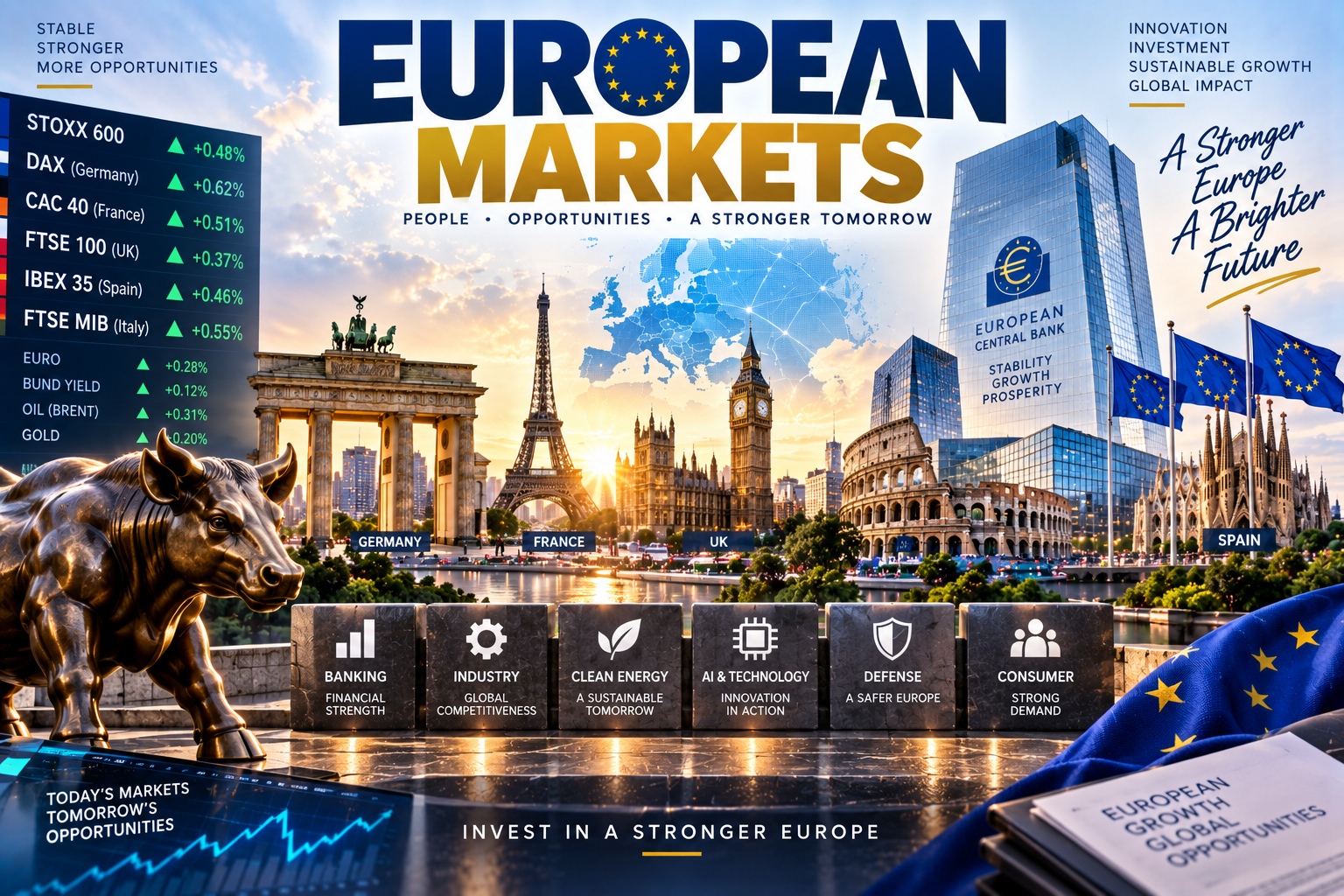
European markets are an important part of the global financial system, covering major stock exchanges, bond markets, currencies, commodities and financial institutions across the continent. From Germany's industrial companies and France's luxury brands to Britain's financial sector, Switzerland's healthcare businesses and Europe's growing technology and defense industries, European markets offer investors exposure to a diverse range of economies and sectors.
In 2026, European markets are being shaped by a complicated combination of economic growth, inflation, interest rates, energy prices, geopolitical tensions, defense spending, artificial intelligence investment and changing global trade patterns.
The European economy has faced significant challenges from higher energy prices and geopolitical instability. The European Central Bank's June 2026 projections put euro-area real GDP growth at 0.8% for 2026, followed by 1.2% in 2027 and 1.5% in 2028. The ECB also projected euro-area inflation at 3.0% in 2026 before declining to 2.3% in 2027 and 2.0% in 2028.
These figures highlight the difficult environment facing European investors: growth remains relatively modest while inflation and energy costs continue to influence monetary policy and corporate earnings.
What Are European Markets?
European markets include the financial markets of countries across Europe.
Major markets include:
Germany
France
United Kingdom
Switzerland
Italy
Spain
Netherlands
Sweden
Denmark
Norway
Poland
Greece
Europe has several major stock indexes that investors use to track market performance.
The STOXX Europe 600 is one of the most widely followed benchmarks because it provides exposure to companies across European countries and sectors.
Germany's DAX, France's CAC 40, the UK's FTSE 100, Italy's FTSE MIB and Spain's IBEX 35 are also major regional indexes.
European markets are not a single unified investment opportunity. Each country has its own economic structure, currency exposure, political environment and dominant industries.
European Stock Markets in 2026
European stocks have experienced increased volatility in 2026 as investors respond to changing energy prices, interest-rate expectations and geopolitical developments.
On September 9, European shares declined as Brent crude approached $100 per barrel and investors became increasingly concerned about inflation. The STOXX 600 fell around 0.4% in early trading, while Germany's DAX fell 0.5%, France's CAC 40 dropped 0.6% and the UK's FTSE 100 declined 0.2%. European energy stocks were among the areas benefiting from higher oil prices.
This illustrates how closely European equities remain connected to energy markets.
Higher oil prices can benefit energy producers, but they can hurt consumers, transportation companies and manufacturers by increasing operating costs.
Germany: Europe's Industrial Powerhouse
Germany remains one of Europe's most important economies and equity markets.
Its economy has historically relied heavily on manufacturing, automobiles, machinery, chemicals and industrial exports.
German companies therefore have significant exposure to global trade.
The country's stock market is represented by the DAX, which includes some of Europe's best-known industrial, financial, technology and healthcare companies.
However, Germany also faces structural challenges, including energy costs, global competition, industrial transformation and the transition toward electric vehicles.
At the same time, increased government spending on infrastructure and defense could provide new opportunities for German industrial companies.
The ECB has previously highlighted government spending on infrastructure and defense, particularly in Germany, as an important potential support for domestic demand.
France: Luxury, Aerospace and Financial Services
France has one of Europe's largest stock markets and a diverse corporate sector.
The CAC 40 includes major companies operating in luxury goods, aerospace, financial services, energy, pharmaceuticals, consumer products and industrials.
French luxury companies have significant exposure to international consumers, particularly in Asia and the United States.
This creates opportunities but also makes the sector sensitive to changes in global consumer spending, currencies and tourism.
France's domestic fiscal situation is another important issue for investors because government borrowing and bond yields can influence financial-market sentiment.
United Kingdom: A Distinct European Market
The United Kingdom remains one of Europe's most important financial markets despite being outside the European Union.
London is a major global center for banking, asset management, insurance and financial services.
The FTSE 100 has a significant weighting toward energy, financial companies, healthcare and consumer businesses.
This gives the index a somewhat different composition from many continental European benchmarks.
The British pound is also an important source of currency exposure for international investors.
Changes in UK interest rates, government finances, inflation and economic growth can influence both equities and bonds.
Switzerland: Defensive Strength
Switzerland has a distinctive position in European markets.
The country's stock market contains major healthcare, pharmaceutical, consumer and financial companies.
Swiss equities are often viewed as relatively defensive because of the international nature of many major Swiss corporations.
The Swiss franc can also act as a safe-haven currency during periods of global uncertainty.
However, international investors must consider the impact of currency movements because a stronger Swiss franc can affect the local-currency value of foreign investments.
Italy and Spain
Italy and Spain are two of Europe's major southern economies.
Italy's market includes banks, industrial companies, energy businesses and luxury brands.
Italian banks have received increasing investor attention as interest rates have changed and financial-sector profitability has evolved.
Spain has significant exposure to banking, utilities, infrastructure, tourism and consumer industries.
Both economies can benefit from European infrastructure spending and tourism, but investors must also consider government debt, political developments and broader euro-area economic conditions.
European Banks
Banks are one of the most important sectors in European markets.
Interest rates have a direct effect on bank profitability because they influence lending rates, deposit costs and the difference between what banks earn on loans and what they pay on deposits.
Higher rates can support bank margins, although prolonged high rates can eventually reduce borrowing demand and increase credit risks.
European bank stocks have attracted attention in 2026 as investors assess the possibility of higher interest rates. Similar trends have been observed across banking markets in Europe and other developed economies.
Banking activity is also connected to corporate dealmaking. Strong M&A activity, IPOs and capital-market transactions can increase investment-banking revenues.
European Defense Stocks
Defense has become one of the most important investment themes in European markets.
European governments are increasing attention on defense capabilities and strategic security.
This has created opportunities for companies involved in aerospace, military equipment, cybersecurity and defense technology.
The broader investment case extends beyond traditional weapons manufacturers. European defense spending can create demand for advanced electronics, communications systems, satellites, software and industrial equipment.
However, investors should remember that defense stocks can be highly sensitive to government budgets, geopolitical developments and valuation changes.
Artificial Intelligence and European Technology
Europe has historically had a smaller technology sector than the United States, but artificial intelligence is creating new opportunities.
European companies are involved in semiconductor equipment, industrial automation, cloud infrastructure, telecommunications and software.
The Netherlands is particularly important because of its role in advanced semiconductor manufacturing equipment.
AI is also increasing demand for data centers, electricity infrastructure and industrial equipment.
This means the AI investment theme is not limited to traditional technology companies. European industrial and utility companies can also benefit from the expansion of digital infrastructure.
European Energy Markets
Energy remains one of the biggest influences on European markets.
Europe has historically relied heavily on imported energy, meaning changes in oil and natural-gas prices can have significant effects on inflation and corporate costs.
The current geopolitical environment has increased these risks.
The ECB has warned that the Middle East conflict, energy-price volatility and supply-chain pressures have created substantial uncertainty for the euro-area economy.
Higher energy prices can increase inflation and reduce consumer purchasing power.
At the same time, European energy companies may benefit from higher commodity prices.
This creates a significant difference between energy producers and energy-intensive industries.
European Renewable Energy
Europe is also investing heavily in renewable energy and electricity infrastructure.
Solar, wind, battery storage and grid modernization are becoming increasingly important.
The energy transition creates opportunities for companies involved in:
Renewable power
Electricity networks
Battery technology
Energy storage
Grid equipment
Industrial automation
Clean technology
However, renewable-energy companies face challenges including financing costs, permitting delays, supply-chain constraints and changing government subsidies.
European Bond Markets
European markets extend well beyond stocks.
Government bonds are closely watched because borrowing costs influence government finances, banks and businesses.
German government bonds, commonly known as Bunds, are particularly important because Germany is the euro area's largest economy and its government bond market is a key benchmark.
Bond yields can rise when investors expect higher inflation or interest rates.
European bond markets have experienced increased pressure as energy-driven inflation concerns have pushed yields higher. German 10-year bond yields recently reached levels not seen since 2011 amid expectations for tighter monetary policy.
The ECB and European Markets
The European Central Bank plays a central role in euro-area markets.
Its decisions influence borrowing costs, bond yields, bank profitability, currencies and investor sentiment.
In June 2026, the ECB raised its three key interest rates by 25 basis points, citing inflationary pressure caused by the Middle East conflict. Its baseline forecast projected average inflation of 3.0% in 2026, declining to 2.3% in 2027 and 2.0% in 2028.
The direction of ECB policy remains one of the most important factors for European investors.
If inflation remains elevated, interest rates may stay higher for longer.
If inflation falls sustainably, monetary policy could eventually become more supportive of economic growth.
European Markets and the Euro
The euro is one of the world's most important currencies and is central to European financial markets.
Movements in the euro affect companies in different ways.
A weaker euro can benefit exporters because their products can become more competitive internationally.
However, a weaker euro can also make imported energy and raw materials more expensive.
A stronger euro can reduce the cost of imports but potentially make European exports less competitive.
International investors therefore need to consider both stock-market performance and currency movements.
European Markets and Global Trade
European companies are highly connected to international trade.
Major corporations generate substantial revenues outside their home countries.
This creates opportunities when global economic growth is strong but also exposes companies to tariffs, supply-chain disruptions and geopolitical tensions.
Trade relationships with the United States, China and other major economies remain particularly important.
European manufacturers and exporters must increasingly balance efficiency with supply-chain resilience.
Mergers and Acquisitions in Europe
European companies are also exploring mergers, acquisitions and strategic partnerships to increase scale.
There has been renewed discussion about creating larger European corporate champions that can compete more effectively with American and Chinese companies.
New EU merger guidelines introduced in 2026 place greater emphasis on scale, innovation and resilience, although regulatory and political barriers remain significant.
Potential consolidation could affect sectors including telecommunications, banking, energy, aerospace and technology.
For investors, M&A activity can create opportunities but also introduces risks around valuations, regulation and integration.
Key Risks for European Markets
Investors considering European markets should understand several major risks.
Energy Risk
Higher oil and gas prices can increase inflation and corporate costs.
Interest-Rate Risk
Higher rates can pressure valuations and borrowing-sensitive sectors.
Geopolitical Risk
Conflicts and trade tensions can quickly change market sentiment.
Political Risk
Elections, fiscal disputes and policy changes can affect bonds and equities.
Currency Risk
International investors can gain or lose from movements in the euro, pound, Swiss franc and other currencies.
Economic Growth
Weak economic growth can reduce corporate earnings and consumer demand.
Regulatory Risk
European companies operate within complex national and EU regulatory frameworks.
Opportunities in European Markets
Despite these risks, Europe offers several potential long-term opportunities.
Defense and security could benefit from higher government spending.
Infrastructure could gain from public and private investment.
Artificial intelligence and semiconductor equipment provide exposure to the global technology cycle.
Banks could benefit from changing interest-rate conditions and increased financial activity.
Healthcare and pharmaceuticals offer exposure to relatively defensive industries and long-term demographic trends.
Renewable energy and electrification could benefit from Europe's energy transition.
Luxury goods provide exposure to global consumer demand.
What Investors Should Watch in 2026
Several indicators will be particularly important for European markets.
ECB policy will remain central because interest rates influence bonds, banks, currencies and equity valuations.
Energy prices will remain a major inflation driver.
European economic growth will determine the strength of corporate earnings.
Defense spending could create opportunities across industrial and technology companies.
AI investment may provide new growth opportunities for European technology and industrial businesses.
Political developments in major economies such as Germany, France, Italy and the UK can influence investor confidence.
The Future of European Markets
Europe's financial markets are entering a period of significant transformation.
The region faces structural challenges, including relatively slow economic growth, demographic pressures, energy dependence and intense global competition.
However, Europe also has significant strengths.
It has sophisticated financial institutions, world-class industrial companies, advanced healthcare businesses, established infrastructure and strong consumer brands.
The transition toward digital infrastructure, artificial intelligence, renewable energy and greater defense spending could create new investment opportunities.
The biggest question is whether Europe can translate these strengths into stronger productivity and long-term economic growth.
Conclusion
European markets offer investors exposure to a diverse collection of economies, industries and financial assets.
Germany provides industrial strength, France offers global luxury and aerospace companies, the UK remains a major financial center, Switzerland provides exposure to defensive global corporations, while Italy and Spain contribute important banking, infrastructure, energy and consumer businesses.
In 2026, European markets are being shaped by inflation, energy prices, interest rates and geopolitical uncertainty. The ECB's latest projections point to modest euro-area growth and elevated inflation, highlighting the difficult balance policymakers face.
At the same time, important long-term themes are emerging.
Defense spending, artificial intelligence, infrastructure investment, renewable energy, healthcare and corporate consolidation could all create opportunities.
For investors, the European market is therefore not simply a single bet on economic growth. It is a collection of different countries and industries with different drivers, risks and opportunities.
Understanding those differences can help investors identify where Europe's next phase of growth may come from.
Frequently Asked Questions
What are European markets?
European markets include the stock, bond, currency and commodity markets across European countries, including Germany, France, the UK, Switzerland, Italy, Spain and the Nordic economies.
What is the main European stock index?
The STOXX Europe 600 is one of the most widely followed broad European equity indexes. National benchmarks include Germany's DAX, France's CAC 40 and the UK's FTSE 100.
Are European markets a good investment?
European markets can provide diversification and exposure to major industries such as banking, healthcare, energy, luxury goods, industrials and technology. However, investors should consider economic, political, currency and interest-rate risks.
What affects European markets?
Interest rates, inflation, energy prices, economic growth, geopolitical developments, corporate earnings, government policies and currency movements can all affect European markets.
Why are European defense stocks important in 2026?
Higher attention to European security and defense spending has created potential growth opportunities for defense, aerospace, cybersecurity and related industrial companies.
How does the ECB affect European markets?
ECB decisions influence interest rates, bond yields, bank profitability, the euro and investor expectations across the euro area.
What sectors are attractive in European markets?
Potential areas of interest include defense, banking, healthcare, infrastructure, renewable energy, AI-related technology, semiconductor equipment and luxury goods.
What are the biggest risks for European investors?
Major risks include energy-price shocks, inflation, higher interest rates, geopolitical tensions, weak economic growth, political uncertainty and currency volatility.