
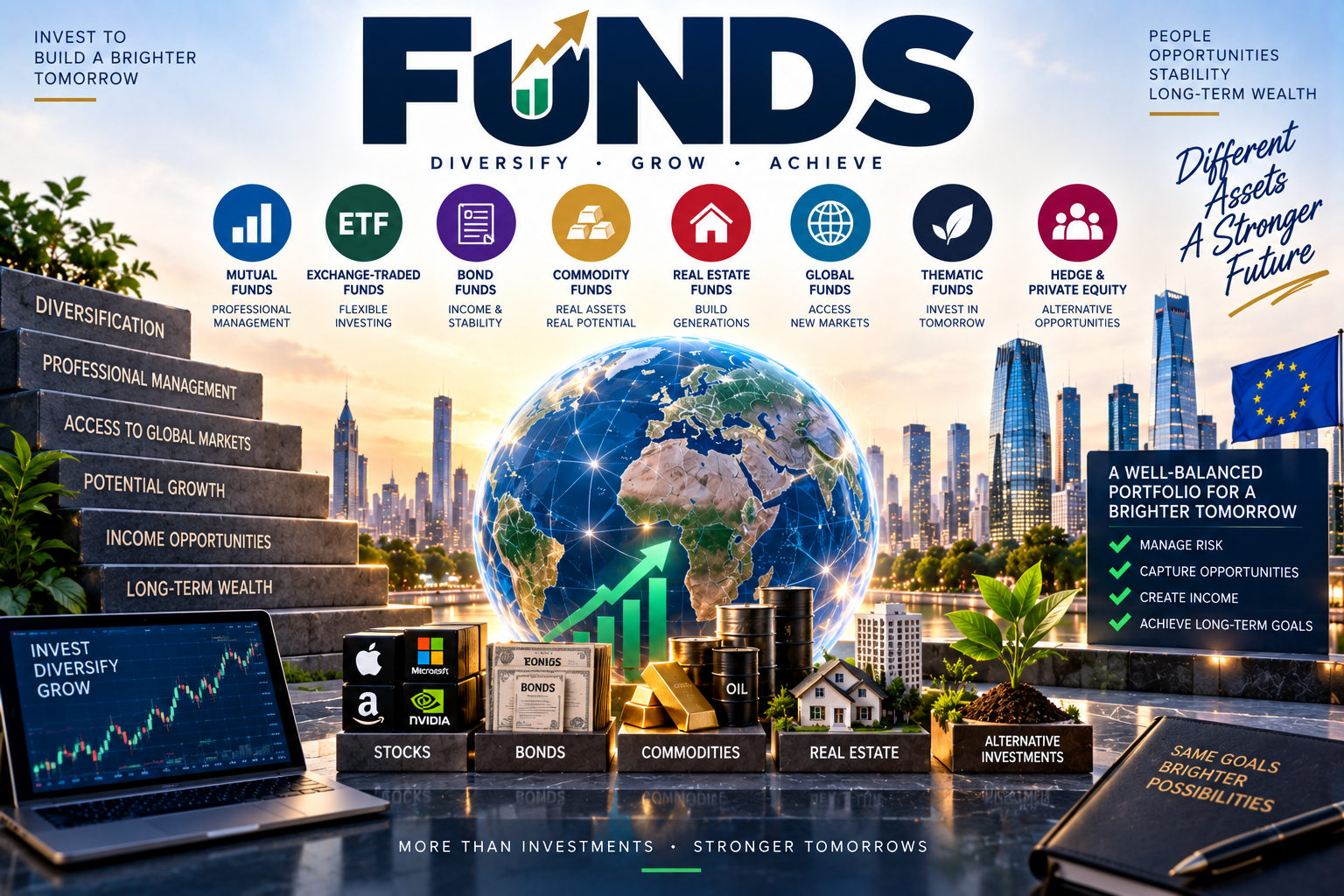
Funds are one of the most widely used investment vehicles in modern financial markets. They allow individuals, businesses, and institutions to pool money and invest it across a range of assets, including stocks, bonds, commodities, real estate, and other securities. Instead of selecting and managing every investment individually, investors can gain access to a professionally managed portfolio through a fund.
Funds play an important role in global markets because they provide diversification, professional management, liquidity, and access to investment opportunities that may otherwise be difficult for individual investors to reach. From mutual funds and exchange-traded funds to hedge funds, pension funds, and private equity funds, the industry covers a broad range of strategies and investor needs.
Understanding how funds work, the different types available, their potential advantages, and their risks can help investors make more informed financial decisions.
What Are Funds?
A fund is a pool of money collected from multiple investors and managed according to a specific investment strategy. The fund manager or investment team uses the pooled capital to purchase assets that match the fund's objectives.
For example, an equity fund may invest primarily in shares of companies, while a bond fund may focus on government and corporate debt. A commodity fund could provide exposure to assets such as gold, oil, or agricultural products.
When investors purchase shares or units of a fund, they generally receive an interest in the overall portfolio rather than directly owning every security held by the fund.
The value of a fund changes based on the performance of its underlying investments, market conditions, income generated by those assets, and expenses charged by the fund.
How Do Investment Funds Work?
Funds generally follow a structured investment process.
First, investors contribute capital to the fund. The money is then combined into a larger pool. A professional manager or management team determines how that capital should be allocated.
The fund may invest according to a predetermined strategy. Some funds attempt to track a market index, while others actively select investments based on economic analysis, company research, valuation, or market trends.
Investors may earn returns through increases in the value of their fund holdings, dividends, interest payments, or distributions.
For example, if a fund invests in 100 companies and the overall portfolio increases in value, the fund's net asset value may also rise. However, if the underlying investments decline, investors can lose money.
Major Types of Funds
The fund industry includes many different categories. Each type has a different structure, investment strategy, risk profile, and target investor.
Mutual Funds
Mutual funds pool money from investors and use it to purchase a diversified portfolio of securities. They can focus on stocks, bonds, money-market instruments, or combinations of different assets.
Equity mutual funds generally seek long-term capital growth, while bond funds may focus on income and capital preservation.
Mutual funds can be actively managed or designed to follow an index. Investors typically buy and sell mutual fund shares based on the fund's calculated net asset value.
Exchange-Traded Funds
Exchange-traded funds, or ETFs, hold portfolios of assets and trade on stock exchanges during market hours.
ETFs can track broad indexes such as major stock-market benchmarks or focus on particular sectors, countries, commodities, bonds, or investment themes.
Their exchange-traded structure gives investors flexibility because ETF shares can generally be bought and sold throughout the trading day.
Index Funds
Index funds are designed to replicate the performance of a particular market index rather than attempting to outperform it through frequent investment decisions.
A fund might track a broad stock index, a bond index, or a specific market segment.
Because index funds generally use a rules-based approach, they can have relatively low operating costs compared with some actively managed strategies.
Money Market Funds
Money market funds invest primarily in short-term, highly liquid instruments.
They are often used by investors seeking relatively stable returns and easy access to their money. However, they are still investment products and are not identical to bank deposits.
Their performance is closely linked to short-term interest rates and conditions in money markets.
Bond Funds
Bond funds invest in fixed-income securities issued by governments, corporations, municipalities, or other borrowers.
They can provide investors with exposure to income-generating assets without requiring them to purchase and manage individual bonds themselves.
However, bond funds are exposed to interest-rate risk, credit risk, inflation risk, and market fluctuations.
Hedge Funds
Hedge funds generally use more flexible investment strategies and are often designed for sophisticated investors.
Depending on their mandate, hedge funds may use leverage, derivatives, short selling, arbitrage, global macro strategies, or alternative investments.
Their strategies can potentially generate attractive returns, but they may also involve significantly higher risks and fees.
Private Equity Funds
Private equity funds invest in companies that are not publicly traded or acquire businesses with the goal of improving their value and eventually selling their investments.
These funds typically have long investment periods and may require investors to commit capital for several years.
Private equity can provide access to opportunities outside public stock markets but is generally less liquid and more complex than traditional public-market funds.
Real Estate Funds
Real estate funds invest in properties, real estate companies, or property-related securities.
They can provide exposure to commercial buildings, residential developments, industrial properties, infrastructure, or other real-estate assets.
Returns can come from rental income, property appreciation, or gains from selling investments.
Why Do Investors Use Funds?
One of the biggest advantages of funds is diversification.
Instead of putting all capital into one company or asset, an investor can gain exposure to dozens, hundreds, or even thousands of investments through a single fund.
Diversification can help reduce the impact of poor performance from an individual investment, although it cannot eliminate overall market risk.
Another advantage is professional management. Investors who do not have the time, expertise, or resources to research individual securities can rely on a fund's investment team.
Funds can also make investing more accessible. Some investment opportunities require substantial capital when approached directly, while a fund may allow investors to gain exposure with a much smaller amount.
Funds and Portfolio Diversification
Funds are frequently used as building blocks for diversified portfolios.
An investor could combine an equity fund with a bond fund to create exposure to both growth-oriented and income-producing assets. International funds can add exposure to foreign markets, while commodity or real estate funds can provide additional diversification.
The appropriate mix depends on factors such as investment goals, time horizon, financial circumstances, and tolerance for risk.
Younger investors with long investment horizons may emphasize growth assets, while investors approaching retirement may place greater emphasis on income and capital preservation.
There is no single portfolio structure that is suitable for everyone.
Active vs. Passive Funds
A major distinction in the fund industry is between active and passive investment management.
Active funds rely on managers to make investment decisions with the objective of outperforming a benchmark or achieving a particular investment goal.
Passive funds generally seek to track an index or predefined market strategy.
Active management can potentially provide opportunities to outperform markets, but it can also involve higher costs and the risk that the manager underperforms the benchmark.
Passive funds typically emphasize broad market exposure and lower operating costs, although they also carry the risk of following a declining market.
Understanding Fund Fees
Fees are an important consideration when evaluating funds because costs can reduce long-term investment returns.
Common fund expenses may include management fees, administrative expenses, trading costs, distribution fees, performance fees, or other charges depending on the fund structure.
Even relatively small annual differences in expenses can have a significant impact over long investment periods because fees compound alongside investment returns.
Investors should therefore compare the total cost of ownership rather than focusing only on a fund's historical performance.
Risks Associated With Funds
Although funds offer diversification and professional management, they are not risk-free.
Market Risk
The value of a fund can decline when financial markets fall. Equity funds are particularly sensitive to stock-market volatility.
Interest-Rate Risk
Bond funds can lose value when interest rates rise, particularly when they hold longer-duration bonds.
Credit Risk
Funds investing in corporate or lower-rated debt may be affected if borrowers experience financial difficulties or default.
Liquidity Risk
Some funds invest in assets that are difficult to sell quickly, particularly private-market funds and certain alternative investment strategies.
Currency Risk
International funds may be affected by changes in exchange rates. A foreign investment can rise in its local currency but produce weaker returns for an investor when converted back into their home currency.
Management Risk
Active funds depend heavily on the decisions of their managers. Poor investment decisions can lead to underperformance.
Funds and the Growth of Thematic Investing
The fund industry has increasingly expanded beyond traditional stocks and bonds.
Thematic funds allow investors to target long-term trends such as artificial intelligence, clean energy, cybersecurity, robotics, biotechnology, electric vehicles, infrastructure, and digital transformation.
These funds can offer concentrated exposure to industries expected to experience significant growth.
However, thematic investing can also create higher concentration risk. A popular investment theme may already be reflected in asset prices, and industries can experience periods of rapid growth followed by sharp corrections.
Technology Is Changing Fund Management
Technology is transforming the way funds are created, managed, and distributed.
Artificial intelligence and advanced data analytics are increasingly being used to analyze companies, identify patterns, assess risks, and support portfolio construction.
Automated investment platforms have also made fund-based investing more accessible to individual investors.
At the same time, technology introduces new challenges, including cybersecurity risks, data-quality problems, algorithmic errors, and concerns about the reliability of automated investment decisions.
Global Funds and Emerging Markets
Funds can provide investors with access to international and emerging markets.
Emerging-market funds may invest in countries experiencing rapid economic development, expanding consumer markets, growing infrastructure, and increasing corporate activity.
These investments can offer significant long-term opportunities, but they may also carry greater political, currency, regulatory, and economic risks than developed markets.
Global funds can help investors diversify geographically rather than relying entirely on the economy of a single country.
How to Choose the Right Fund
Investors should consider several factors before selecting a fund.
First, understand the fund's objective and investment strategy. A fund focused on technology stocks has a very different risk profile from a government bond fund.
Second, examine historical performance, but avoid assuming that past performance guarantees future returns.
Third, compare fees and expenses.
Fourth, evaluate diversification. A fund holding many assets may provide broader exposure, while a highly concentrated fund may carry greater volatility.
Investors should also consider liquidity, tax implications, the reputation of the fund manager, investment minimums, and the fund's overall risk level.
Most importantly, the fund should fit within the investor's broader financial plan rather than being selected solely because it recently performed well.
The Future of Funds
The fund industry is likely to continue evolving as investors seek lower costs, greater diversification, new investment themes, and easier digital access.
ETFs and other low-cost investment products are expected to remain important parts of the market, while active managers may increasingly use artificial intelligence and data analytics to improve investment research.
Alternative investments may also become more accessible to a wider range of investors, although regulatory requirements and liquidity considerations will remain important.
Sustainability, artificial intelligence, infrastructure, healthcare, energy transition, and emerging-market growth could remain important themes across the investment industry.
The future of funds will likely be defined by a combination of technology, transparency, diversification, cost efficiency, and changing investor preferences.
Conclusion
Funds provide investors with a convenient way to gain exposure to diversified portfolios and professional investment strategies. From mutual funds and ETFs to bond funds, hedge funds, private equity funds, and real estate funds, there are products designed for a wide range of objectives and risk profiles.
Their biggest advantages include diversification, professional management, accessibility, and exposure to different markets and asset classes. However, investors must also consider fees, market volatility, liquidity, currency movements, interest rates, and other risks.
As financial markets continue to evolve, funds are likely to remain a central part of global investing. Understanding how they work and selecting funds based on individual financial goals can help investors build more informed and diversified portfolios.
FAQs About Funds
What is a fund in finance?
A fund is a pool of money collected from investors and managed according to a specific investment strategy. The capital may be invested in stocks, bonds, commodities, real estate, or other assets.
Are funds a good investment?
Funds can be useful for diversification and professional management, but whether a particular fund is suitable depends on an investor's goals, time horizon, risk tolerance, and financial situation.
What is the difference between a mutual fund and an ETF?
Mutual funds are generally bought and sold through the fund provider at a calculated net asset value, while ETFs trade on stock exchanges throughout the trading day.
Can funds lose money?
Yes. Fund values can decline when their underlying investments fall in value. Diversification can reduce some risks but cannot eliminate investment losses.
What is an index fund?
An index fund is designed to track the performance of a particular market index rather than relying primarily on active security selection.
Why are fund fees important?
Fund fees reduce the amount of an investor's return. Over long periods, even small differences in annual expenses can have a meaningful impact on portfolio growth.
What should investors look for when choosing a fund?
Investors should consider the fund's objective, assets, diversification, fees, historical performance, liquidity, risk level, management approach, and how it fits into their overall investment strategy.