
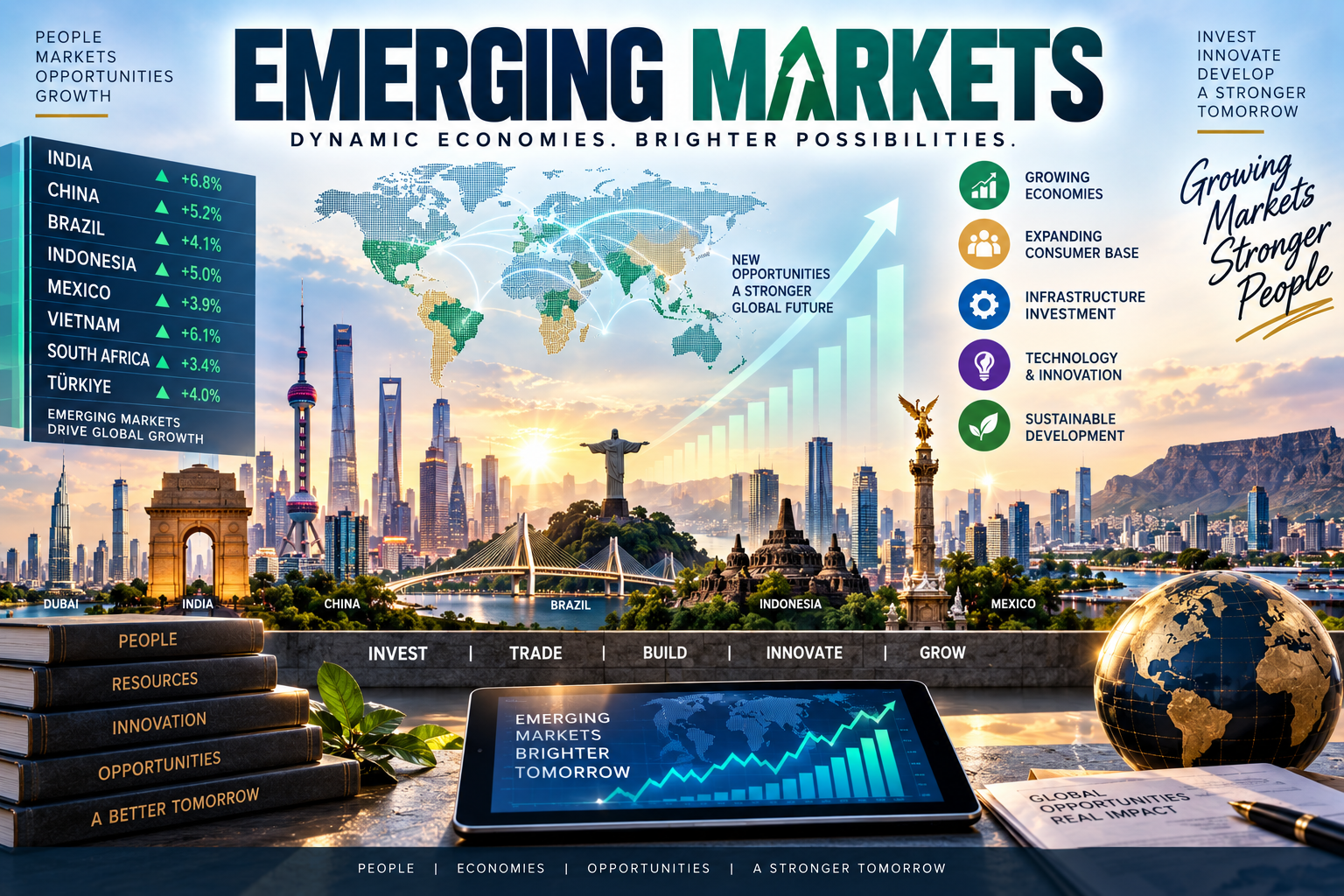
Emerging markets are becoming an increasingly important part of the global economy. From India and Indonesia to Brazil, Mexico, South Africa and countries across Africa, Asia, Latin America and the Middle East, emerging economies are attracting businesses, investors and policymakers looking for new sources of growth.
These markets combine significant opportunities with considerable risks. Rapid economic development, expanding consumer populations, digital transformation, infrastructure investment and increasing trade can create attractive opportunities for companies and investors. At the same time, emerging markets can be more exposed to inflation, currency volatility, commodity shocks, political uncertainty, high borrowing costs and global capital flows.
In 2026, the outlook is particularly mixed. The International Monetary Fund projects growth in emerging market and developing economies to slow to around 3.8–3.9% in 2026, depending on the forecast update, before strengthening in 2027. The World Bank has also highlighted the pressure from higher energy prices and geopolitical tensions, while identifying broader artificial-intelligence adoption as a potential source of upside for developing economies.
What Are Emerging Markets?
Emerging markets are economies that are developing rapidly but have not yet reached the income levels, financial-market depth or institutional maturity generally associated with advanced economies.
There is no single universal definition of an emerging market. Different index providers, financial institutions and investors use different classifications.
Some widely followed emerging economies include:
India
China
Brazil
Mexico
Indonesia
South Africa
Türkiye
Saudi Arabia
Vietnam
Thailand
Malaysia
Poland
Philippines
Egypt
These countries vary significantly in economic structure. Some are manufacturing centers, others are major commodity exporters, while others are increasingly driven by services, technology and domestic consumption.
Why Emerging Markets Matter
Emerging markets represent a large and growing share of the world's population and economic activity.
Many have young populations, expanding middle classes and rapidly developing cities. As incomes rise, demand for housing, transportation, healthcare, financial services, technology, consumer products and energy can increase.
For international companies, this creates opportunities to enter new markets.
For investors, emerging economies can offer exposure to faster-growing industries and economies that may develop significantly over the long term.
However, faster growth does not automatically mean higher investment returns. Investors must consider valuation, currency risk, political conditions, debt levels and the quality of institutions.
Emerging Markets in 2026
The emerging-market outlook has become more complicated because of geopolitical and energy shocks.
The IMF's July 2026 outlook projects emerging market and developing economies to grow about 3.8% in 2026, followed by a stronger 4.5% expansion in 2027.
The World Bank has warned that the Middle East conflict and resulting energy-price increases are creating particularly difficult conditions for many emerging economies. Economies that import large amounts of energy can face higher inflation and weaker household purchasing power when oil and gas prices rise.
At the same time, commodity exporters can benefit from higher prices, creating a very different outlook within the emerging-market universe.
This divergence is one of the most important features of emerging markets: not all emerging economies respond to global shocks in the same way.
Asia: A Major Emerging-Market Growth Engine
Asia remains one of the most important regions for emerging-market investors.
India, Indonesia, Vietnam, the Philippines and other economies are benefiting from expanding consumer markets, manufacturing investment and digital adoption.
The IMF expects growth in emerging and developing Asia to slow from 5.5% in 2025 to 4.9% in 2026, before easing slightly to 4.8% in 2027. China is projected to grow around 4.4% in 2026 in the IMF's April forecast.
India remains particularly important because of its large population, expanding services sector, infrastructure investment and growing digital economy.
Vietnam is also attracting attention as companies diversify manufacturing supply chains.
Indonesia benefits from its large domestic market and important natural resources, while the Philippines has strong exposure to services, remittances and domestic consumption.
India and Emerging-Market Opportunities
India has become one of the most closely watched emerging economies.
Its large domestic market provides a significant foundation for growth. Manufacturing investment, digital services, infrastructure development and consumer spending are important parts of the country's economic story.
However, India also demonstrates the risks facing emerging markets.
The Indian rupee has come under pressure in September 2026 as oil prices approached $100 per barrel and demand for dollars increased. India is one of the world's largest oil importers, making its economy particularly sensitive to energy-price shocks.
This highlights an important distinction between economic growth and financial-market performance. An economy can continue growing rapidly while its currency or stock market experiences periods of volatility.
China and the Emerging-Market Landscape
China occupies a unique position.
It is classified as an emerging market by many financial indexes, yet its economy and financial system are much larger and more developed than those of many other emerging economies.
China remains a major manufacturing center and plays a central role in global supply chains.
The country's economic outlook affects commodity demand, international trade, Asian currencies and global industrial companies.
The IMF's April 2026 forecast projected Chinese growth of around 4.4% for the year, with stimulus measures and changes in trade conditions partly offsetting external pressures.
For investors, China's importance means developments in the country can influence emerging-market assets far beyond its borders.
Latin American Emerging Markets
Latin America includes some of the world's most important emerging economies.
Brazil and Mexico are particularly significant.
Brazil has a large domestic market, major agricultural production, extensive natural resources and a large financial system.
Mexico benefits from its proximity to the United States and has attracted manufacturing investment linked to supply-chain diversification.
The Mexican peso has been unusually strong in 2026. Reuters reported that the currency had gained nearly 20% from January 2025 levels by August 2026, supported partly by a weaker U.S. dollar, domestic factors and increasing manufacturing activity.
However, the strong peso also creates challenges for exporters because a stronger currency can reduce the competitiveness of goods sold internationally.
Emerging Markets in Africa
Africa contains some of the world's fastest-growing populations and offers long-term opportunities in areas such as infrastructure, agriculture, energy, telecommunications and consumer services.
Countries including Nigeria, Kenya, Ghana, Egypt and South Africa have important roles in regional economies.
The IMF expects significant differences between African economies in 2026. Nigeria's growth is projected at around 4.1%, while South Africa's growth is expected to remain much slower at about 1.1%.
Commodity prices are especially important for many African economies.
Oil exporters can benefit from higher energy prices, while oil-importing countries can experience greater pressure on inflation and external balances.
Emerging-Market Currencies
Currencies are one of the biggest sources of both opportunity and risk in emerging markets.
Emerging-market currencies can appreciate when economic conditions improve and international investors increase capital flows into local assets.
However, they can weaken rapidly when investors become more cautious.
Higher U.S. interest rates can be particularly challenging because global investors may prefer dollar-denominated assets when yields are attractive.
Commodity prices also have a major influence.
A country that exports oil, copper or agricultural products may benefit from higher commodity prices, while an importer may face rising costs.
Recent market activity illustrates this sensitivity. The Indian rupee weakened as oil prices rose, while other emerging-market currencies including the Thai baht and South African rand also came under pressure.
Emerging Markets and Interest Rates
Interest rates are crucial for emerging economies.
When global interest rates are high, borrowing becomes more expensive and international investors may shift capital toward developed-market assets.
When global financial conditions become easier, emerging markets can receive stronger investment flows.
Domestic central banks also have to balance inflation against economic growth.
If inflation is too high, higher interest rates may be required. But higher borrowing costs can reduce investment and consumer spending.
This creates a difficult policy challenge for emerging-market governments.
Emerging Markets and Artificial Intelligence
Artificial intelligence could become one of the most important long-term opportunities for emerging economies.
AI can increase productivity, improve financial services, support education, enhance healthcare and help businesses operate more efficiently.
The World Bank's 2026 World Development Report argues that AI could provide developing economies with a pathway toward greater prosperity, although countries need the right infrastructure, skills, institutions and access to technology to benefit.
Countries that successfully adopt AI could potentially increase productivity without following exactly the same development path as earlier industrial economies.
However, countries with weak digital infrastructure, limited electricity supply or shortages of skilled workers may struggle to capture the benefits.
Infrastructure Investment
Infrastructure remains one of the biggest opportunities in emerging markets.
Many developing economies require investment in:
Roads
Railways
Ports
Airports
Electricity grids
Renewable energy
Water systems
Telecommunications
Data centers
Housing
Infrastructure investment can increase productivity and support long-term economic growth.
The World Bank has highlighted widespread infrastructure underinvestment, particularly in energy, transport and digital infrastructure across developing economies.
Private investment can play an important role in closing these gaps.
Emerging Markets and Commodities
Commodity markets have a particularly strong relationship with emerging economies.
Countries such as Brazil, South Africa, Indonesia, Chile and several African economies depend heavily on commodity exports.
Higher commodity prices can improve government revenues, trade balances and corporate profits.
But dependence on commodities can also create vulnerability.
When prices fall, exporters may experience weaker government revenues, lower investment and declining currencies.
This is why diversification is important for commodity-dependent emerging economies.
Risks in Emerging Markets
Emerging markets can offer attractive opportunities, but they also come with substantial risks.
Currency Risk
Exchange rates can move rapidly and reduce returns for international investors.
Political Risk
Changes in governments, elections, regulations and political instability can affect markets.
Inflation
Persistent inflation can reduce household purchasing power and increase borrowing costs.
Debt
High public or private debt can make economies vulnerable to rising interest rates.
Capital Outflows
International investors can quickly reduce exposure during periods of global uncertainty.
Commodity Dependence
Economies heavily dependent on oil, metals or agricultural exports can be vulnerable to commodity-price cycles.
Geopolitical Risk
Trade restrictions, sanctions and regional conflicts can disrupt investment and supply chains.
Emerging-Market Investment Opportunities
Investors can gain exposure to emerging markets through several approaches.
Emerging-Market Stocks
Investors can purchase shares of companies operating in emerging economies.
These businesses may benefit from rising domestic consumption, infrastructure development and technological adoption.
Emerging-Market Bonds
Government and corporate bonds can provide exposure to local interest rates and economic growth.
However, investors must consider credit and currency risks.
Exchange-Traded Funds
Emerging-market ETFs allow investors to diversify across multiple countries rather than relying on a single economy.
Individual Country Investments
Some investors choose specific markets based on their economic outlook.
This approach can provide greater potential upside but also increases country-specific risk.
What Investors Should Watch in 2026
Several factors will remain important for emerging markets.
Energy prices are critical, particularly for countries that import large quantities of oil and gas.
U.S. monetary policy can influence capital flows, currencies and borrowing costs.
China's economy remains important because of its role in Asian trade and global manufacturing.
AI investment could create new opportunities for economies that successfully integrate the technology.
Commodity prices will continue to affect exporters and importers differently.
Geopolitical developments can quickly change investor sentiment.
The Future of Emerging Markets
The long-term emerging-market story remains connected to demographics, urbanization, technology and rising incomes.
Millions of people are entering the middle class in developing economies, creating new demand for financial services, healthcare, consumer products, education, transportation and digital technology.
At the same time, governments face significant challenges.
They need to improve infrastructure, strengthen institutions, manage debt, create jobs and maintain economic stability.
The countries that successfully combine investment with sound economic policies could become some of the most important growth markets of the next decade.
Conclusion
Emerging markets are an essential part of the global economy and increasingly important to international investors.
Their potential comes from large populations, rising incomes, expanding consumer markets, natural resources, technology adoption and infrastructure needs.
But the opportunity comes with risk. Currency volatility, inflation, interest rates, political uncertainty, commodity shocks and capital flows can create significant market swings.
The 2026 outlook demonstrates this diversity clearly. Some emerging economies are benefiting from strong domestic growth or commodity exports, while others are facing pressure from higher energy costs and tighter financial conditions. The IMF expects emerging market and developing economies to grow more slowly in 2026 before strengthening in 2027.
For investors and businesses, the key is not simply identifying the fastest-growing economy. It is understanding the factors behind that growth and determining whether the opportunities justify the risks.
As technology, trade and investment continue to reshape the global economy, emerging markets are likely to remain at the center of the world's next phase of economic development.
Frequently Asked Questions
What are emerging markets?
Emerging markets are developing economies that are growing rapidly but generally have lower income levels and less-developed financial markets than advanced economies.
Which countries are considered emerging markets?
Commonly followed emerging markets include India, China, Brazil, Mexico, Indonesia, South Africa, Türkiye, Vietnam, Thailand and Saudi Arabia, although classifications differ among financial institutions.
Are emerging markets a good investment?
Emerging markets can provide diversification and exposure to long-term economic growth, but they also carry higher risks related to currencies, politics, inflation, debt and market volatility.
Why are emerging markets important?
They contain large populations, expanding consumer markets, major natural resources and significant opportunities for infrastructure, technology and industrial development.
What are the biggest risks in emerging markets?
Major risks include currency depreciation, inflation, political instability, high debt, capital outflows, commodity-price volatility and geopolitical uncertainty.
How does AI affect emerging markets?
AI could improve productivity, financial inclusion, healthcare, education and business efficiency. However, countries need strong digital infrastructure, electricity supply, skills and institutions to capture its benefits.
Which emerging markets are attracting attention in 2026?
India, China, Mexico, Indonesia, Vietnam, Brazil and several Middle Eastern and African economies remain important markets for investors, although their individual economic conditions differ significantly.