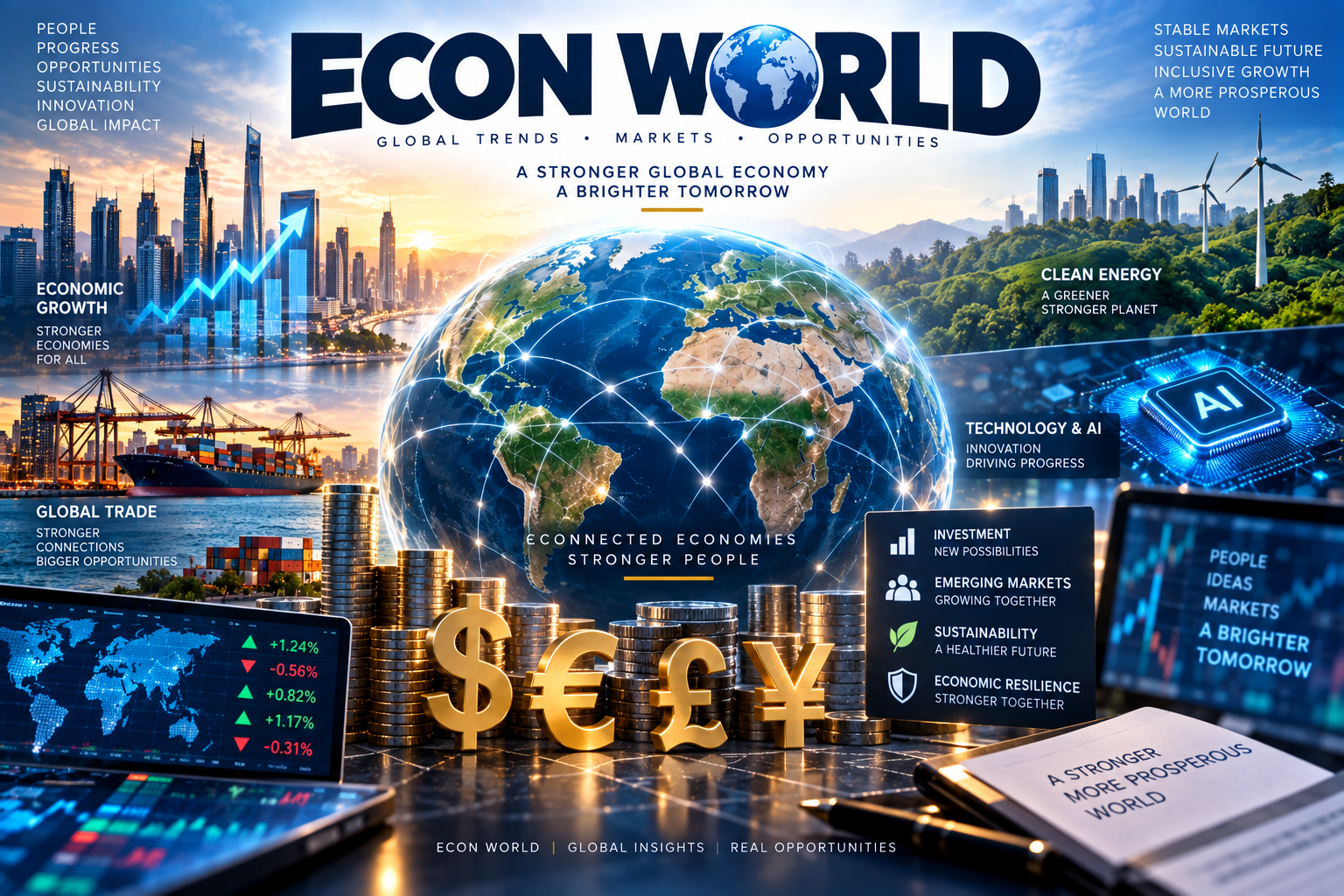
The global economy is constantly changing as countries respond to inflation, interest rates, trade, technology, energy prices, geopolitical developments, and shifting consumer demand. Understanding these forces is essential for businesses, investors, policymakers, and individuals trying to navigate an increasingly interconnected world.
In 2026, the world economy is facing a particularly complex environment. The International Monetary Fund projects global growth of 3.0% in 2026 and 3.4% in 2027, while warning that the outlook is uneven because energy shocks are weighing on some economies while technology investment, particularly around artificial intelligence, is supporting others.
The World Bank has a more cautious outlook, projecting global growth of 2.5% in 2026 amid higher energy prices, inflation pressures, and increased borrowing costs.
What Is Econ World?
Econ World represents the broad global economic landscape and the forces that influence economic activity across countries and regions. It includes everything from economic growth and employment to inflation, central-bank policy, international trade, currencies, commodities, investment, technology, and government finances.
No economy operates completely independently. A change in interest rates in one major economy can influence currencies and capital flows elsewhere. Higher oil prices can raise transportation and production costs around the world, while technological breakthroughs can create new industries and change the way businesses operate.
This interconnectedness makes the global economy both an important source of opportunity and a potential source of risk.
Global Economic Growth
Economic growth is one of the most important indicators of the health of the world economy. Gross domestic product, or GDP, measures the value of goods and services produced within an economy and is widely used to assess economic expansion or contraction.
Growth in 2026 is being influenced by several competing forces.
On one side, technology investment, resilient consumer demand, infrastructure spending, and productivity improvements can support economic activity. On the other, energy disruptions, geopolitical tensions, inflation, high government debt, and tighter financial conditions can slow growth.
The IMF expects global growth to recover toward 3.4% in 2027, but the path remains uneven across countries.
The World Bank, meanwhile, estimates that developing-economy growth will slow to 3.6% in 2026 before improving to 4.2% in 2027.
Inflation Remains a Major Economic Issue
Inflation occurs when the general level of prices rises over time, reducing the purchasing power of money.
Although inflation has declined from the extreme levels seen in many economies earlier in the decade, the global disinflation process has faced renewed challenges.
The IMF's July 2026 outlook projects global headline inflation at 4.7% for the year and notes that progress in reducing inflation has stalled.
Energy prices are an important part of this story. Higher prices for oil and other energy products can increase transportation, manufacturing, electricity, and food costs.
For consumers, persistent inflation can reduce household purchasing power. For businesses, it can increase operating costs and complicate pricing decisions.
Central banks therefore continue to monitor inflation closely when deciding whether to raise, maintain, or reduce interest rates.
Central Banks and Interest Rates
Central banks play a critical role in the global economy.
Institutions such as the U.S. Federal Reserve, European Central Bank, Bank of England, Bank of Japan, and other monetary authorities use interest rates and other tools to influence economic conditions.
When inflation is too high, central banks may keep interest rates elevated to slow demand and reduce price pressures. When economic growth weakens and inflation becomes more manageable, they may have greater room to reduce borrowing costs.
Interest-rate decisions influence mortgages, business loans, government borrowing, currencies, bonds, and stock markets.
For investors, changes in monetary policy can therefore be just as important as corporate earnings.
Energy and the Global Economy
Energy markets are deeply connected to economic growth.
Oil and gas remain important inputs for transportation, manufacturing, electricity generation, agriculture, and industrial production. At the same time, renewable energy is becoming increasingly important as countries seek greater energy security and lower emissions.
The 2026 global outlook demonstrates how quickly energy disruptions can affect the broader economy. The World Bank estimates that Brent crude could average around $94 per barrel in 2026 under its assumptions, with higher energy costs contributing to inflation.
Higher energy prices can benefit some energy-exporting countries while placing pressure on energy-importing economies.
This creates different economic outcomes across regions and highlights the importance of energy diversification.
Artificial Intelligence and Economic Transformation
Artificial intelligence has emerged as one of the most significant economic trends of the decade.
Companies are investing heavily in AI infrastructure, semiconductors, cloud computing, data centers, software, robotics, and automation.
The economic impact could extend far beyond the technology sector. AI can potentially increase productivity in finance, healthcare, manufacturing, logistics, education, agriculture, and professional services.
The IMF has highlighted the contrast between the negative effects of the energy shock and the positive effects of technology-driven investment, particularly for economies integrated into global technology supply chains.
However, AI also creates challenges. Workers may need new skills, some occupations could be disrupted, and countries without adequate digital infrastructure may struggle to capture the benefits.
For developing economies, improving access to digital infrastructure, skills, reliable electricity, and investment could be particularly important.
Global Trade
International trade connects producers and consumers across borders.
Countries export goods and services in exchange for imports, allowing businesses to access larger markets and consumers to purchase products that may not be produced domestically.
Global trade also supports complex supply chains. A smartphone, automobile, computer, or industrial machine may involve components manufactured in several different countries.
Trade tensions, tariffs, sanctions, geopolitical conflicts, and supply-chain disruptions can therefore have global consequences.
Businesses are increasingly considering supply-chain diversification and resilience alongside traditional cost considerations.
Emerging Markets and Developing Economies
Emerging markets remain an important part of the global economy.
Countries across Asia, Latin America, Africa, the Middle East, and other developing regions have large populations, expanding consumer markets, natural resources, and opportunities for infrastructure development.
South Asia remains one of the faster-growing regions. The World Bank projects regional growth of 6.3% in 2026 and 6.9% in 2027.
However, developing economies face challenges including higher borrowing costs, currency volatility, debt burdens, energy prices, political uncertainty, and limited fiscal capacity.
The World Bank has also warned that weak growth is slowing progress in narrowing income gaps between developing and advanced economies.
The Role of Governments
Governments influence economic conditions through fiscal policy, taxation, public spending, regulation, infrastructure investment, and social programs.
During periods of economic weakness, governments may increase spending to support demand and employment. During periods of high inflation or rising debt, they may face pressure to control spending and improve fiscal sustainability.
Infrastructure is particularly important because investments in transportation, electricity, telecommunications, water systems, and digital networks can support productivity over many years.
Well-designed public investment can also encourage private-sector investment and create employment.
Currencies and Global Finance
Currencies are another central component of the global economy.
Exchange rates influence international trade, investment returns, inflation, tourism, and corporate profits.
A weaker currency can make a country's exports more competitive but can also make imported goods and energy more expensive. A stronger currency can reduce import costs while creating challenges for exporters.
Currency markets are influenced by interest-rate differences, economic growth, inflation expectations, capital flows, commodity prices, and political developments.
For multinational companies and investors, currency movements can significantly affect financial results.
Commodities and Food Security
Commodities such as oil, natural gas, copper, gold, wheat, corn, and fertilizer play an important role in the global economy.
Commodity prices can influence inflation and economic growth because they are often inputs into production and consumption.
Agricultural commodities are especially important for food security. Disruptions to fertilizer supplies, energy markets, transportation networks, or weather patterns can increase food prices.
The World Bank has warned that conflict-related fertilizer pressures could contribute to higher food prices.
This makes agricultural productivity, resilient supply chains, and investment in modern farming increasingly important.
Global Investment Opportunities
Economic changes create investment opportunities across different asset classes and regions.
Equities can benefit from corporate earnings growth, while bonds can provide income and diversification. Commodities can offer exposure to energy and raw-material markets, while real estate and infrastructure can provide access to long-term economic development.
Technology is another major investment theme, particularly around AI, semiconductors, cloud infrastructure, cybersecurity, and automation.
However, investors should avoid assuming that every major economic trend automatically creates a profitable investment opportunity. Valuations, competition, regulation, interest rates, and execution remain important.
Diversification across assets, sectors, and geographic regions can help manage portfolio risk.
Risks Facing the World Economy
The global economy faces several significant risks in 2026.
Geopolitical Conflict
Wars and geopolitical tensions can disrupt energy markets, trade routes, supply chains, and financial markets.
Inflation
A renewed increase in energy, food, or commodity prices could slow the process of monetary easing.
High Debt
Governments, businesses, and households in many countries carry substantial debt, making them more sensitive to borrowing costs.
Trade Fragmentation
Tariffs, sanctions, and protectionist policies can increase costs and disrupt international supply chains.
Financial Market Volatility
Rapid changes in interest rates, currencies, or investor sentiment can produce significant market movements.
Technology Risks
AI may increase productivity, but cybersecurity threats, workforce disruption, regulatory uncertainty, and unequal access could create new economic challenges.
What to Watch in the Global Economy
Businesses and investors should monitor several major indicators throughout 2026 and beyond.
These include inflation data, central-bank decisions, employment figures, GDP growth, oil prices, bond yields, currency movements, manufacturing activity, consumer spending, and corporate earnings.
Technology investment is another important indicator. Strong demand for AI infrastructure could support capital spending and productivity, while a sharp slowdown could affect technology companies and related industries.
Global trade policy will also remain important as businesses adjust their supply chains and governments reassess economic relationships.
The Future of Econ World
The global economy is likely to become increasingly defined by technology, energy transformation, demographic changes, geopolitical competition, and shifting trade relationships.
Artificial intelligence could improve productivity and create new industries, while renewable energy and electrification could transform energy markets.
At the same time, countries will need to manage debt, inflation, inequality, climate-related risks, and workforce transitions.
Developing economies have significant opportunities to accelerate growth through infrastructure, education, digital technology, manufacturing, and private investment. The World Bank's 2026 development research highlights AI as a potential pathway to greater prosperity for developing economies, provided countries can build the infrastructure and capabilities needed to use it effectively.
The countries and companies that adapt quickly to these structural changes may be better positioned for long-term growth.
Conclusion
Econ World reflects the interconnected nature of the global economy, where developments in energy, technology, trade, finance, and geopolitics can influence countries and markets far beyond their original source.
The 2026 economic environment is characterized by competing forces. Energy and geopolitical shocks are creating inflation and growth challenges, while technology investment and AI are generating new opportunities. The IMF expects global growth of 3.0% in 2026 and 3.4% in 2027, while the World Bank offers a more cautious 2.5% growth forecast for 2026.
For investors, businesses, and policymakers, understanding these global connections is increasingly important. The future economy will depend not only on traditional measures such as GDP and inflation but also on technological innovation, energy security, productivity, trade resilience, and the ability of economies to adapt to rapid change.
FAQs About Econ World
What does Econ World mean?
Econ World refers broadly to the global economic environment, including growth, inflation, interest rates, trade, currencies, employment, investment, commodities, and economic policy.
What are the biggest factors affecting the global economy?
Major factors include interest rates, inflation, energy prices, geopolitical developments, international trade, government spending, technology investment, and consumer demand.
What is the global economic outlook for 2026?
The outlook varies by institution. The IMF projects global growth of 3.0% in 2026, while the World Bank projects 2.5%. Both highlight significant risks from geopolitical and energy developments.
How does AI affect the global economy?
AI can increase productivity, support investment, create new industries, and transform existing businesses. It may also disrupt certain jobs and create challenges related to skills, regulation, and inequality.
Why are energy prices important to economic growth?
Energy is a major input for transportation, manufacturing, electricity, and agriculture. Higher energy prices can increase production costs and inflation while benefiting some energy-exporting economies.
Why are emerging markets important?
Emerging markets represent large populations, expanding consumer demand, growing businesses, natural resources, and significant infrastructure opportunities, although they can also carry higher economic and financial risks.