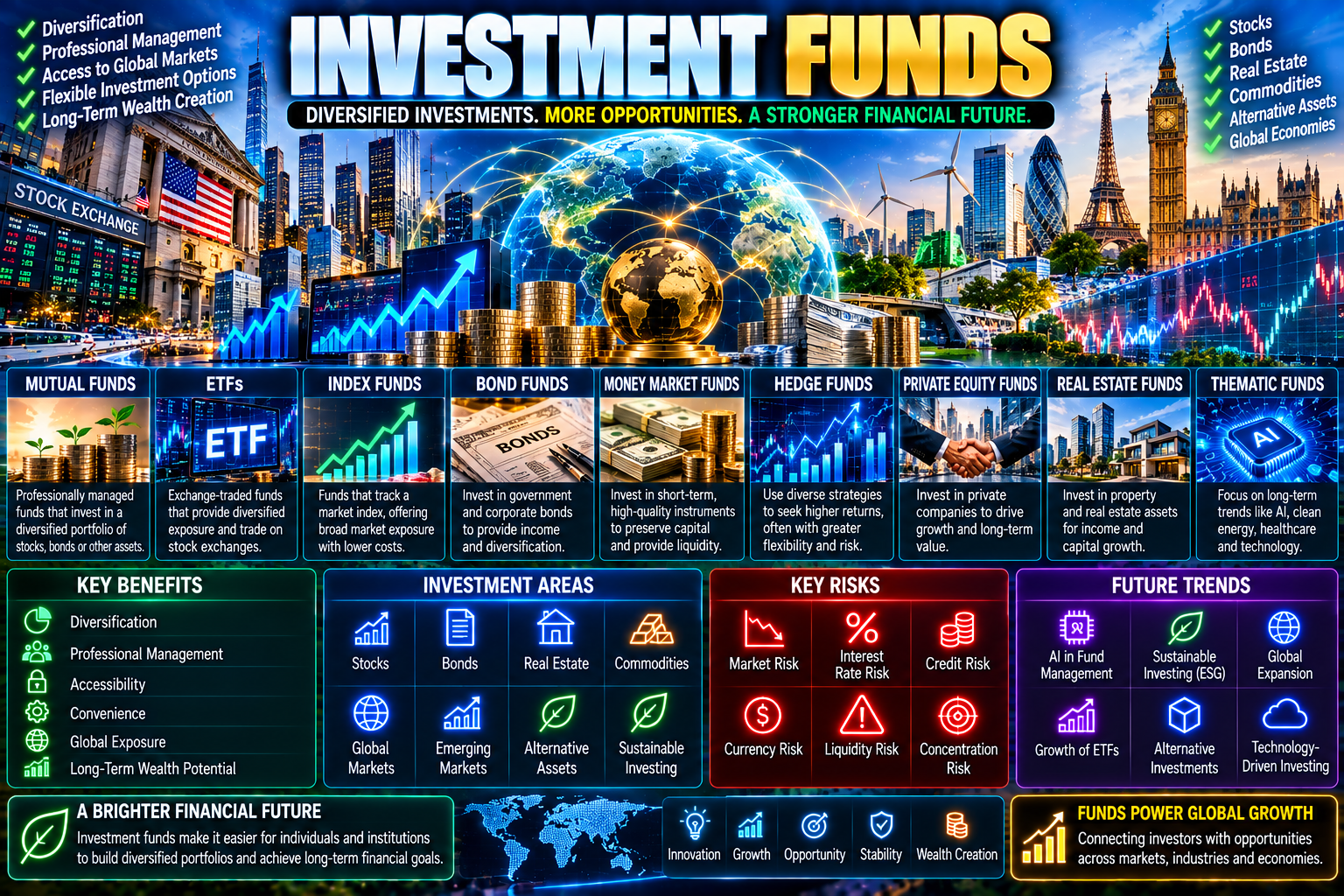
Investment funds are a major part of the global financial system. They allow individuals, institutions, and other investors to pool money and gain exposure to portfolios of stocks, bonds, commodities, real estate, and other assets.
Instead of selecting and purchasing every investment individually, an investor can buy shares or interests in a fund that owns a diversified portfolio. Depending on the fund, investments may be selected by professional managers or automatically tracked according to a particular index or strategy.
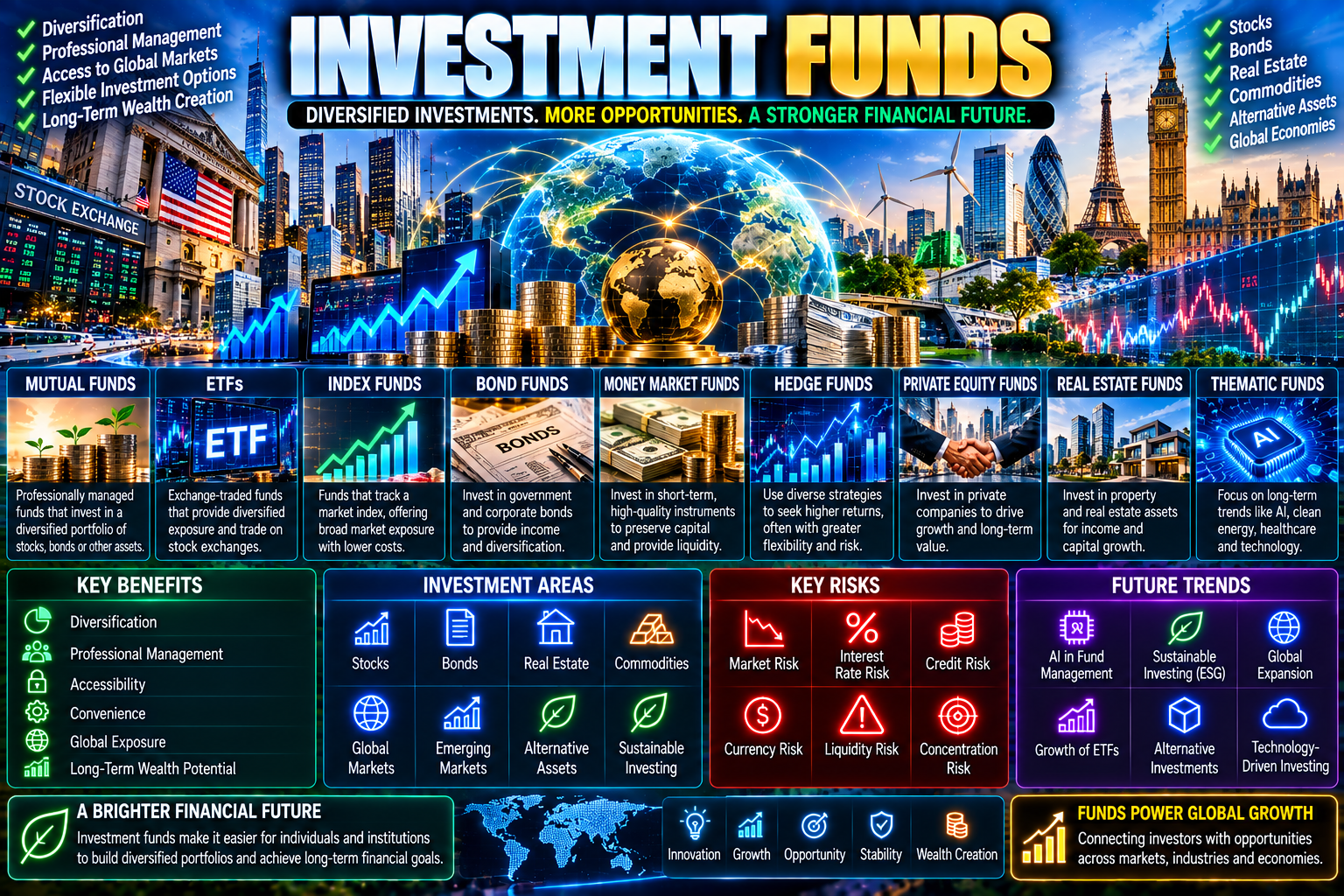
The modern fund industry includes mutual funds, exchange-traded funds (ETFs), index funds, money market funds, bond funds, target-date funds, hedge funds, private equity funds, venture capital funds, real estate funds, and fund-of-funds structures.
The U.S. Securities and Exchange Commission explains that investment products include mutual funds, ETFs, closed-end funds, alternative investments such as private equity and hedge funds, and other investment vehicles. Each has its own characteristics, costs, liquidity, and risks.
What Is an Investment Fund?
An investment fund is a pooled investment vehicle that collects money from multiple investors and uses that capital to purchase a portfolio of assets according to a defined investment objective.
Depending on the fund, the portfolio can contain:
Stocks
Government bonds
Corporate bonds
Money-market instruments
Commodities
Real estate
Private companies
Other investment funds
Cash and cash equivalents
Alternative assets
The investors generally own shares, units, or another form of interest in the fund rather than directly owning every security held inside the portfolio.
For example, instead of purchasing shares in 100 individual companies, an investor might purchase shares in a fund that already owns those companies.
How Do Investment Funds Work?
The basic structure of an investment fund involves several participants.
Investors
Individuals or institutions provide capital to the fund.
Fund Manager
Depending on the fund, an investment manager may determine which assets to buy and sell.
Portfolio
The fund invests its capital according to its stated objective and strategy.
Custodian and Service Providers
Funds generally rely on custodians, administrators, auditors, brokers, and other service providers to operate the investment structure.
Fund Shares or Units
Investors receive shares or units representing their interest in the fund.
A mutual fund, for example, pools money from investors and invests it in stocks, bonds, money-market instruments, other securities, or combinations of these assets.
Why Do Investors Use Funds?
Funds can provide several important features.
Diversification
A fund can hold many securities instead of relying on a single company or asset.
Diversification can help reduce the impact of poor performance from one investment, although it cannot eliminate investment losses.
Professional Management
Actively managed funds employ investment professionals who research markets and make portfolio decisions.
Accessibility
Funds can allow investors to obtain exposure to markets that might otherwise require substantial capital or specialist knowledge.
Convenience
Instead of monitoring dozens or hundreds of securities individually, investors can use a single fund to obtain exposure to a defined investment strategy.
Liquidity
Some funds, particularly ETFs and open-end mutual funds, provide relatively convenient ways to buy or sell investments.
However, liquidity varies significantly between different types of funds.
Major Types of Investment Funds
The fund industry contains many different structures.
1. Mutual Funds
Mutual funds are pooled investment vehicles in which investors purchase shares representing an interest in the fund's portfolio.
They can invest in:
Stocks
Bonds
Money-market instruments
Commodities or commodity-related securities
Other funds
Mixed portfolios
Mutual fund shares are generally purchased from and redeemed with the fund itself or through an intermediary, with transactions typically based on the fund's calculated net asset value (NAV).
Mutual funds can be actively managed or passively managed.
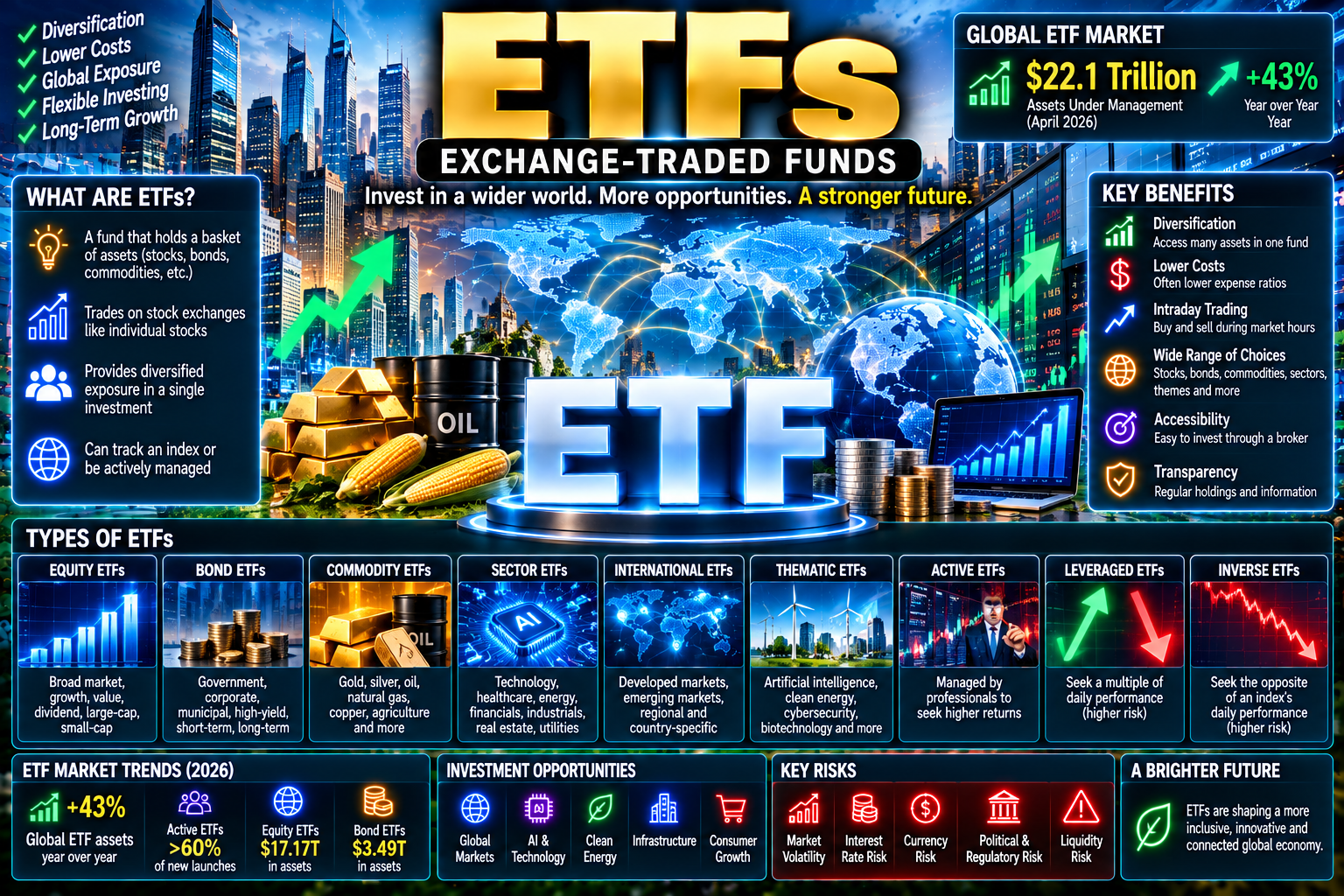
2. Exchange-Traded Funds
Exchange-traded funds, or ETFs, are funds whose shares trade on stock exchanges.
Like mutual funds, ETFs pool investors' money and can invest in stocks, bonds, money-market instruments, and other assets. However, retail investors generally buy and sell ETF shares in market transactions during exchange trading hours.
ETF prices can move throughout the trading day and may trade at a premium or discount to the fund's NAV.
Common ETF categories include:
Stock ETFs
Bond ETFs
Commodity ETFs
International ETFs
Sector ETFs
Thematic ETFs
Dividend ETFs
Active ETFs
Leveraged ETFs
Inverse ETFs
3. Index Funds
Index funds are designed to follow a specific market index.
Examples of index strategies may track:
Large-cap stocks
Global equities
Government bonds
Corporate bonds
Emerging markets
Specific industries
An index fund can be structured as a mutual fund, ETF, or certain other fund vehicle.
The goal is generally to approximate the performance of its chosen index before fees and expenses rather than to actively select investments to outperform it.
4. Money Market Funds
Money market funds invest in liquid, short-term debt securities, cash, and cash equivalents.
They are often used by investors seeking relatively stable exposure to short-term instruments or as a place to hold cash within an investment portfolio.
However, money market funds are investments rather than bank deposits and can carry risks.
5. Bond Funds
Bond funds invest primarily in debt securities.
They can focus on:
Government bonds
Corporate bonds
Municipal bonds
Investment-grade bonds
High-yield bonds
Short-term bonds
Long-term bonds
International bonds
Bond funds can provide income and diversification, but their value can change as interest rates, credit conditions, and bond prices change.
6. Stock Funds
Stock funds invest primarily in equities.
They can be categorized by:
Company size
Industry
Geography
Growth
Value
Dividend characteristics
Investment style
Stock funds generally have greater exposure to equity-market fluctuations than many conservative fixed-income funds.
7. Target-Date Funds
Target-date funds are designed around a specific future date, often associated with retirement.
They generally hold a mixture of stocks, bonds, and other funds and may gradually shift toward a more conservative asset allocation as the target date approaches.
These funds are designed to simplify long-term asset allocation, but investors should still examine the fund's fees, holdings, glide path, and investment strategy.
8. Fund of Funds
A fund of funds invests primarily in other investment funds rather than directly purchasing individual securities.
This structure can provide diversification across multiple underlying funds.
However, investors should understand that fees may exist at both the main fund and underlying-fund levels.
9. Hedge Funds
Hedge funds are alternative investment vehicles that may use more complex strategies than traditional mutual funds and ETFs.
Strategies can include:
Long/short investing
Arbitrage
Event-driven investing
Global macro strategies
Relative-value strategies
Derivatives
Leverage
Hedge funds may have higher minimum investment requirements, limited liquidity, and more complex fee structures.
10. Private Equity Funds
Private equity funds generally invest in privately held businesses or acquire public companies with the goal of improving their value and eventually exiting the investment.
Strategies can include:
Buyouts
Growth equity
Operational improvements
Business restructuring
Strategic acquisitions
Private equity investments typically have longer holding periods and less liquidity than publicly traded funds.
11. Venture Capital Funds
Venture capital funds invest in startups and early-stage companies.
They typically target businesses with significant growth potential.
Investment areas can include:
Artificial intelligence
Software
Biotechnology
Fintech
Cybersecurity
Climate technology
Robotics
Healthcare
Because many startups fail while a smaller number can generate very large returns, venture capital portfolios can carry substantial risk.
12. Real Estate Funds
Real estate funds invest in properties or real-estate-related securities.
They may focus on:
Residential property
Commercial property
Industrial real estate
Offices
Hotels
Warehouses
Data centers
Infrastructure-related property
Some real-estate funds provide exposure to publicly traded real estate companies, while others invest directly in physical properties.
Active Funds vs. Passive Funds
One of the most important distinctions in fund investing is between active and passive management.
Active Funds
An active fund has a manager or investment team that selects securities according to a defined strategy.
Managers may attempt to:
Outperform a benchmark
Identify undervalued investments
Reduce downside risk
Change sector exposure
Respond to economic conditions
Take advantage of market opportunities
Active performance depends significantly on the investment process and decisions of the manager.
Passive Funds
Passive funds generally attempt to replicate an index.
Rather than deciding which stocks will outperform, the fund follows predetermined rules associated with its benchmark.
Passive management can involve less portfolio trading and may have lower fees than some actively managed funds.
How Funds Make Money
Investors can potentially earn returns from funds in several ways.
Capital Appreciation
If the value of the assets held by a fund increases, the value of the investor's interest may increase.
Dividends
Stock funds may receive dividends from companies and distribute income to investors.
Interest Income
Bond funds can receive interest from bonds and other debt securities.
Capital Gains
A fund may sell investments for more than their purchase price and distribute capital gains according to the applicable rules.
Investor.gov identifies dividends, capital-gains distributions, and increases in NAV as potential sources of mutual-fund returns.
Fund Fees and Expenses
Fees are an important part of evaluating any fund.
Expense Ratio
The expense ratio represents ongoing fund operating expenses relative to assets.
Even relatively small differences in fees can have a meaningful effect on long-term returns.
Management Fees
Actively managed funds may charge management fees for portfolio management and research.
Trading Costs
Funds can incur costs when buying and selling securities.
Sales Charges
Some mutual funds can have purchase or redemption charges depending on their structure and share class.
Performance Fees
Some alternative funds may use performance-based fees.
Underlying Fund Expenses
A fund of funds can involve fees from both the main fund and underlying funds.
Investors should evaluate total costs rather than looking at one fee in isolation.
Fund Risk
All investment funds involve some level of risk.
The specific risks depend on the fund's strategy and underlying assets.
Market Risk
The value of stocks, bonds, commodities, or other assets can decline.
Interest-Rate Risk
Bond funds can be affected by changes in interest rates.
Credit Risk
A bond issuer may fail to meet its financial obligations.
Currency Risk
International funds can be affected by foreign-exchange movements.
Liquidity Risk
Some assets may be difficult to sell quickly without affecting their price.
Concentration Risk
A narrowly focused fund can be heavily exposed to one sector, country, industry, or company.
Leverage Risk
Some alternative and specialized funds use borrowing or derivatives, which can amplify gains and losses.
Manager Risk
Active funds depend partly on the investment decisions of their managers.
The SEC emphasizes that all investments involve risk and that investors can lose some or all of their invested capital.
Funds and Diversification
Diversification is one of the primary reasons investors use funds.
A diversified equity fund might own hundreds of companies across different industries.
A balanced fund might combine:
Stocks
Bonds
Cash
Other assets
A global fund might invest across several countries and regions.
However, diversification has limits. A fund focused on one sector or country may still be highly concentrated.
Investors should examine the actual holdings rather than assuming that every fund provides broad diversification.
Funds and Asset Allocation
Funds can play different roles in a portfolio.
An investor might use:
Equity funds for growth exposure
Bond funds for fixed-income exposure
Money market funds for short-term liquidity
International funds for geographic diversification
Commodity funds for commodity exposure
Alternative funds for specialized strategies
Asset allocation refers to how capital is distributed across different asset classes.
The appropriate allocation depends on factors such as investment objectives, time horizon, financial circumstances, and risk tolerance.
Funds and ETFs: What's the Difference?
ETFs are themselves a type of fund, but they differ from traditional mutual funds in important ways.
Feature | Mutual Funds | ETFs |
|---|---|---|
Trading | Usually priced once daily | Trade throughout market hours |
Pricing | Generally based on NAV | Market price can differ from NAV |
Purchase | Through fund or intermediary | Through exchange/broker |
Management | Active or passive | Active or passive |
Diversification | Available | Available |
Liquidity | Depends on fund | Depends on trading market |
Fees | Vary | Vary |
Tax treatment | Depends on jurisdiction/account | Depends on jurisdiction/account |
The SEC notes that both mutual funds and ETFs pool investor money, but ETFs are generally bought and sold by retail investors through exchange transactions while mutual-fund shares are bought from or redeemed with the fund.
How to Evaluate an Investment Fund
Before investing in a fund, investors should examine several factors.
1. Investment Objective
Understand what the fund is designed to accomplish.
2. Holdings
Review the assets held by the fund.
3. Fees
Compare expense ratios and other applicable costs.
4. Performance History
Historical performance can provide useful information about volatility and consistency, but it does not guarantee future results.
5. Risk Level
Consider market, credit, currency, liquidity, concentration, and other risks.
6. Liquidity
Determine how easily the investment can be purchased or sold.
7. Fund Manager
For active funds, examine the manager's experience and investment approach.
8. Benchmark
Understand which index or benchmark the fund uses, if applicable.
9. Fund Size
Fund size can influence liquidity, operating economics, and trading characteristics, although size alone does not determine suitability.
10. Prospectus
Read the fund's prospectus and shareholder information before investing.
The SEC specifically recommends reviewing a fund's prospectus and shareholder reports to understand its objectives, strategies, fees, risks, and other important information.
Funds and Technology
Technology is changing how funds operate.
Investment managers increasingly use technology for:
Portfolio analytics
Risk management
Automated trading
Data analysis
Market research
Compliance
Fraud detection
Customer service
Artificial intelligence can process large volumes of financial information and assist investment teams with research and portfolio analysis.
However, technology does not eliminate investment risk. Models can produce incorrect results, data can be incomplete, and market conditions can change unexpectedly.
The Rise of Thematic Funds
Thematic funds focus on specific long-term trends.
Popular themes include:
Artificial intelligence
Robotics
Cybersecurity
Clean energy
Electric vehicles
Semiconductors
Cloud computing
Biotechnology
Digital infrastructure
Aging populations
Emerging markets
Thematic funds can provide targeted exposure but may be more concentrated than broad-market funds.
Global Investment Funds
Funds make it easier for investors to access international markets.
Global and international funds can provide exposure to:
North America
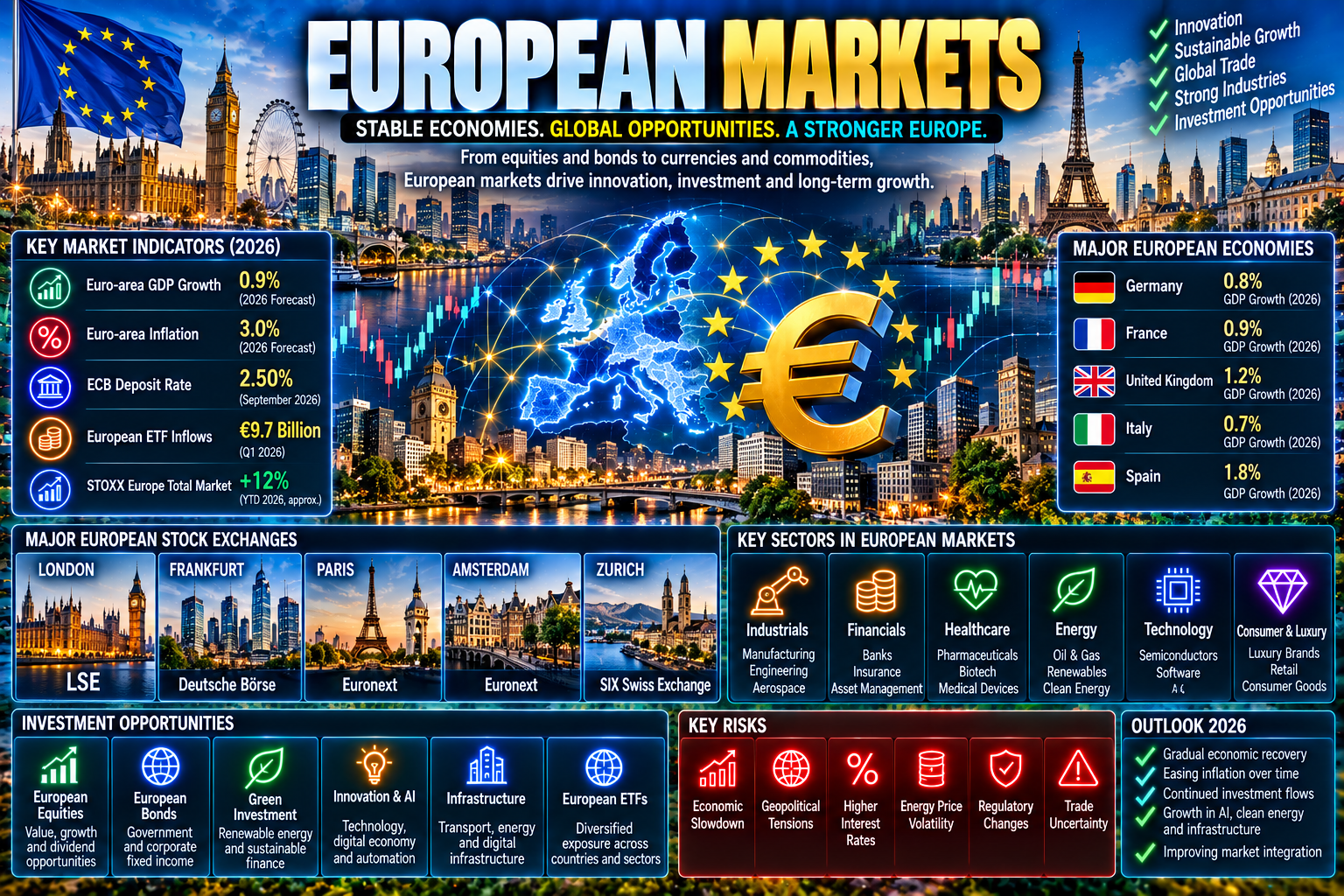
Europe
Asia
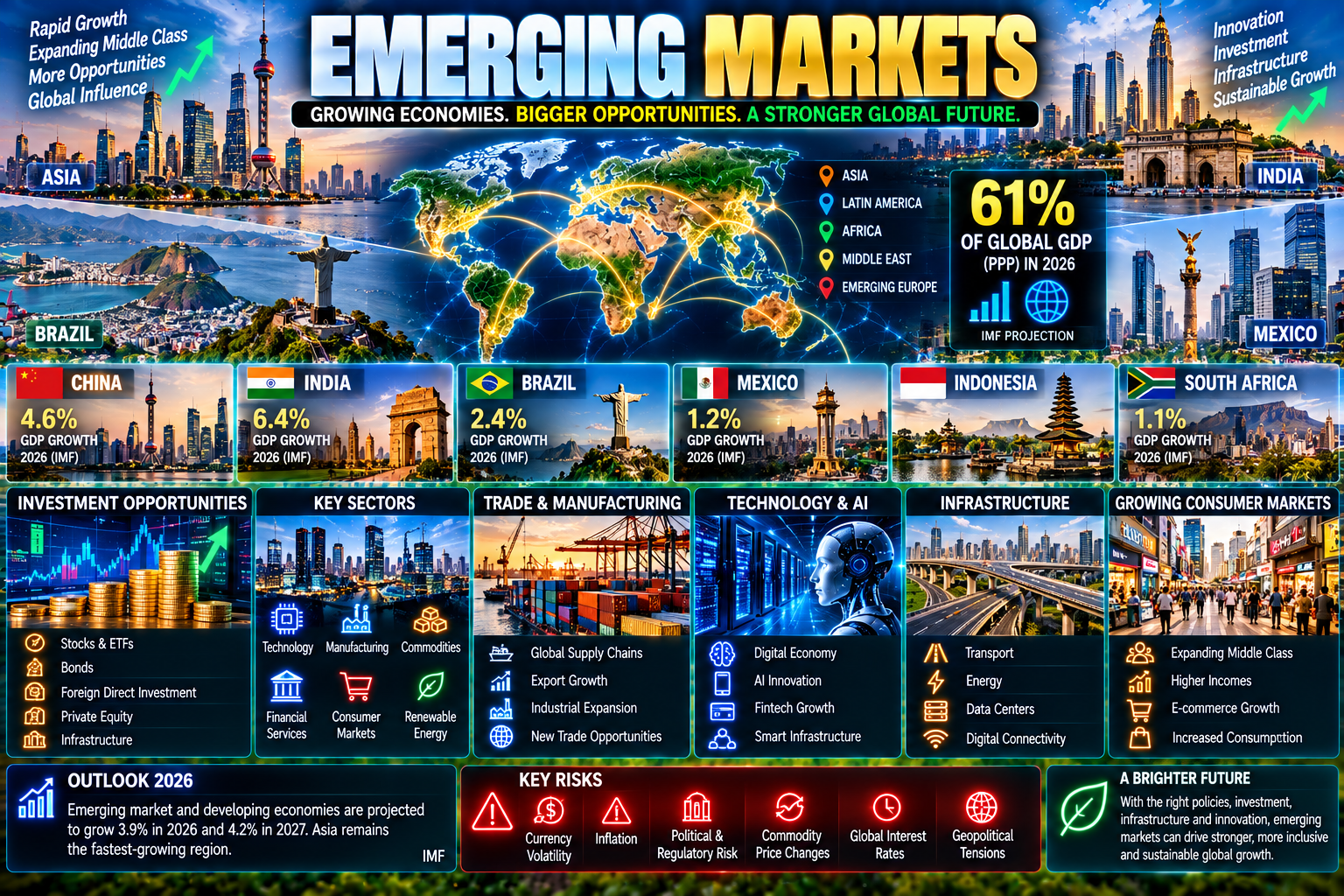
Emerging markets
Latin America
Africa
Middle Eastern economies
International diversification can spread exposure across different economies and currencies.
However, international investing introduces additional risks, including currency movements, political developments, regulatory differences, and differences in market liquidity.
Funds and Sustainable Investing
Sustainable investment funds focus on environmental, social, governance, or other sustainability-related objectives.
Common themes include:
Renewable energy
Climate technology
Clean transportation
Sustainable agriculture
Water management
Green infrastructure
Low-carbon businesses
Investors should examine the actual methodology of a sustainability fund because labels can cover very different investment approaches.
The Future of Investment Funds
The fund industry continues to evolve as technology, markets, regulation, and investor preferences change.
Growth of ETFs
ETFs continue to expand across equities, bonds, commodities, active management, and specialized strategies.
Active ETFs
The distinction between traditional active funds and ETFs is becoming less pronounced as more active strategies adopt an exchange-traded structure.
AI-Powered Fund Management
AI and advanced analytics may increasingly support investment research, portfolio construction, risk monitoring, and operational processes.
Alternative Investments
Private equity, venture capital, private credit, infrastructure, and real estate funds are becoming increasingly important components of institutional portfolios.
Personalized Investment Products
Technology may allow fund providers to create increasingly customized portfolios based on investor objectives and risk preferences.
Digital Distribution
Online investment platforms are making fund information, research, and trading increasingly accessible.
Funds in the Modern Global Economy
Funds connect individual and institutional investors with financial markets.
They provide capital to companies, governments, infrastructure projects, real estate markets, and other economic activities.
For example:
Investor capital → Fund → Portfolio assets → Companies, governments, and markets
This process makes funds an important link between savings and investment.
Conclusion
Investment funds are among the most widely used structures for accessing financial markets. By pooling capital from multiple investors, funds can provide diversification, professional management, market access, and investment strategies across a wide range of assets.
The fund universe extends far beyond traditional mutual funds. ETFs, index funds, money market funds, bond funds, target-date funds, hedge funds, private equity funds, venture capital funds, real estate funds, and fund-of-funds structures serve different purposes.
However, funds are not automatically safe or profitable. Every fund has its own risk profile, fees, liquidity characteristics, investment objective, and underlying assets.
Investors should therefore look beyond a fund's name or historical returns and examine its strategy, holdings, costs, risks, liquidity, manager, benchmark, and prospectus before investing.
As financial markets become more global and technology-driven, funds are likely to remain a central part of the investment ecosystem. The continued development of ETFs, active management, AI-powered investment tools, alternative assets, sustainable strategies, and digital investment platforms is likely to make the fund industry even more diverse in the years ahead.
Frequently Asked Questions About Funds
What is an investment fund?
An investment fund pools money from multiple investors and invests that capital in a portfolio of assets such as stocks, bonds, commodities, real estate, or other investments.
What are the main types of funds?
Major types include mutual funds, ETFs, index funds, money market funds, bond funds, stock funds, target-date funds, hedge funds, private equity funds, venture capital funds, real estate funds, and fund-of-funds.
Are ETFs funds?
Yes. ETFs are investment funds whose shares generally trade on stock exchanges throughout the trading day.
Are investment funds safe?
No investment fund is automatically safe. Risk depends on the fund's underlying investments, strategy, structure, leverage, liquidity, and other factors.
How do funds make money?
Funds can generate returns through increases in the value of their holdings, dividends, interest income, and capital gains.
What is an index fund?
An index fund is a fund designed to approximately track a particular market index before fees and expenses.
What is a money market fund?
A money market fund invests primarily in liquid, short-term debt securities, cash, and cash equivalents.
What is a fund of funds?
A fund of funds primarily invests in other investment funds rather than directly investing in individual securities.
What are fund fees?
Fund fees can include management expenses, operating expenses, transaction costs, sales charges, and other applicable costs. Fees reduce the return available to investors over time.
What should investors check before buying a fund?
Investors should examine the fund's investment objective, holdings, fees, risks, liquidity, historical performance, management approach, benchmark, and prospectus.
What is the future of investment funds?
The future of funds is likely to be shaped by ETFs, active management, artificial intelligence, alternative investments, sustainable investing, digital distribution, and increasingly specialized investment strategies.