
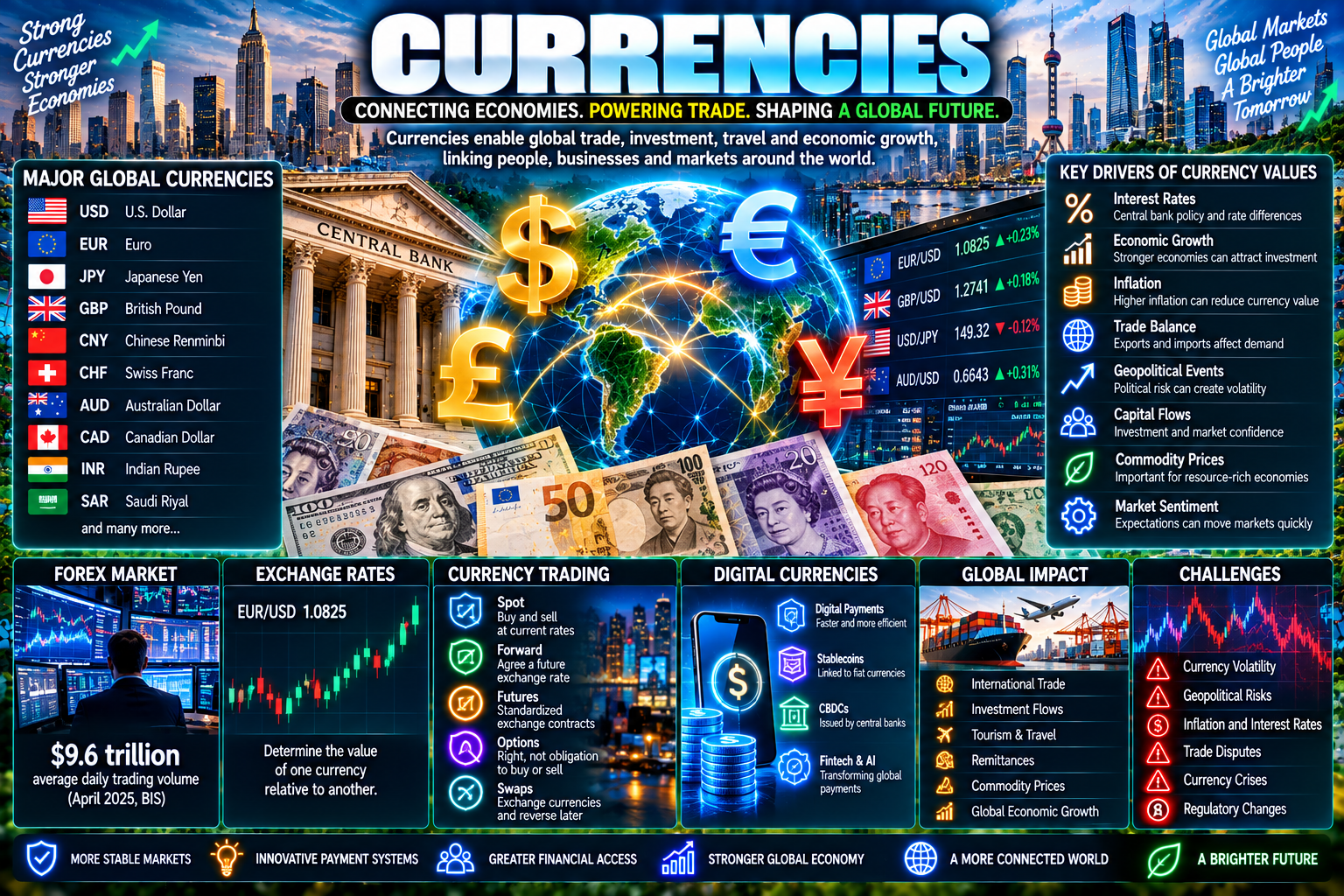
Currencies are the foundation of the modern international economy. They allow people to buy goods and services, businesses to conduct international trade, governments to collect taxes and make payments, and investors to move capital across borders.
From the U.S. dollar and euro to the Japanese yen, British pound, Chinese renminbi, Swiss franc, Indian rupee, Saudi riyal, and Pakistani rupee, currencies connect national economies with the global financial system.
Currency markets are also among the world's largest financial markets. The Bank for International Settlements (BIS) reported that global foreign-exchange trading averaged $9.6 trillion per day in April 2025, up 28% from 2022. The U.S. dollar was on one side of 89% of all foreign-exchange transactions.
In 2026, currencies are being influenced by interest rates, inflation, economic growth, trade policy, geopolitical developments, central-bank decisions, technology, digital payments, stablecoins, and changing international capital flows.
What Is a Currency?
A currency is a form of money issued or recognized by a country or monetary authority and used as a medium of exchange, unit of account, and store of value.
Examples include:
U.S. dollar (USD)
Euro (EUR)
Japanese yen (JPY)
British pound sterling (GBP)
Chinese renminbi (CNY)
Swiss franc (CHF)
Canadian dollar (CAD)
Australian dollar (AUD)
Indian rupee (INR)
Saudi riyal (SAR)
Pakistani rupee (PKR)
Currencies can exist in physical forms such as banknotes and coins, as well as electronically through bank accounts and payment systems.
The value of one currency relative to another is expressed through an exchange rate.
For example:
USD/PKR represents the exchange relationship between the U.S. dollar and Pakistani rupee.
Why Currencies Matter
Currencies affect almost every part of the global economy.
They influence:
International trade
Imports and exports
Tourism
Foreign investment
Inflation
Interest rates
Commodity prices
Corporate profits
Government debt
Remittances
Personal purchasing power
Cross-border payments
A business importing products from another country may need to convert its domestic currency into the seller's currency.
Likewise, exporters receive foreign currencies and may convert them back into their domestic currency.
This creates continuous demand for foreign exchange.
Major Global Currencies
Some currencies have much greater international importance than others.
U.S. Dollar
The U.S. dollar is the dominant currency in global foreign exchange, international payments, financial markets and official reserves.
The Federal Reserve said in July 2026 that the dollar remained the most widely used currency in foreign-exchange transactions and cross-border payments, the leading currency in official reserves, and the dominant currency for international debt securities and loans.
The IMF reported that the dollar accounted for 57.13% of global official foreign-exchange reserves in the first quarter of 2026, up from 56.42% in the fourth quarter of 2025.
Euro
The euro is the common currency used by members of the euro area.
It is one of the most important currencies in:
International trade
Banking
Foreign-exchange markets
Global reserves
Financial markets
The euro accounted for 20.25% of global official foreign-exchange reserves in Q4 2025, according to the IMF.
Japanese Yen
The Japanese yen is one of the world's major currencies and an important currency in foreign-exchange markets.
It is also heavily involved in global financial markets because of Japan's large economy and financial system.
British Pound
The British pound is another major international currency and one of the most actively traded currencies.
Chinese Renminbi
The Chinese renminbi has become increasingly important in international trade and foreign-exchange markets.
BIS data show that the renminbi represented 8.8% of global FX turnover in April 2025, making it the fifth most traded currency overall.
Swiss Franc
The Swiss franc is an important international currency and is frequently used in global financial markets.
Australian and Canadian Dollars
The Australian and Canadian dollars are important commodity-linked currencies because their economies have significant exposure to natural resources and international trade.
Currency vs. Money
The terms money and currency are related but are not exactly identical.
Money is a broader economic concept that includes assets used for payment, accounting, and storing value.
Currency generally refers to the monetary unit used within an economy and often specifically to physical notes and coins.
For example, a country's currency may be the U.S. dollar, while money in the economy can also include bank deposits and other highly liquid assets.
Modern economies therefore operate with much more money than physical cash.
How Exchange Rates Work
An exchange rate tells you how much of one currency is required to purchase another.
For example:
EUR/USD
shows the value of the euro relative to the U.S. dollar.
If EUR/USD rises, one euro buys more dollars than before.
If EUR/USD falls, one euro buys fewer dollars.
Exchange rates are constantly influenced by financial-market expectations and changes in supply and demand.
Floating Exchange Rates
Under a floating exchange-rate system, the currency's value is primarily determined by market forces.
Factors include:
Interest rates
Inflation
Economic growth
Trade flows
Capital flows
Investor expectations
Political developments
Central-bank policy
Many major currencies operate under floating or predominantly market-determined exchange-rate systems.
Fixed Exchange Rates
Under a fixed or pegged exchange-rate system, a currency is maintained at or around a specified value relative to another currency or reference system.
A central bank may intervene in foreign-exchange markets to maintain the desired exchange rate.
The Saudi riyal, for example, has a long-standing peg to the U.S. dollar.
Fixed systems can provide exchange-rate stability but require appropriate monetary and foreign-reserve management.
Managed Exchange Rates
Some currencies operate under systems where market forces play a role but authorities may intervene to reduce excessive volatility or influence exchange-rate conditions.
This creates a middle ground between completely fixed and completely floating systems.
Foreign Exchange Markets
The foreign-exchange market, commonly called forex or FX, is where currencies are bought and sold.
It is a global decentralized market involving:
Banks
Central banks
Investment firms
Corporations
Governments
Hedge funds
Asset managers
Brokers
Other financial institutions
Unlike many stock exchanges, the global FX market does not operate from one central exchange.
Transactions take place through a global network of financial institutions and electronic trading systems.
The Size of the Forex Market
Foreign exchange is enormous.
According to the BIS 2025 Triennial Central Bank Survey, FX turnover reached approximately $9.6 trillion per day in April 2025.
The largest financial centers included:
United Kingdom
United States
Singapore
Hong Kong SAR
Together, these four locations accounted for approximately 75% of global FX trading in April 2025.
Major Forex Instruments
Currency markets include several types of transactions.
Spot
A spot transaction involves exchanging currencies at the current market rate, with settlement generally occurring shortly afterward.
Forward
A forward contract allows two parties to agree today on an exchange rate for a future transaction.
Businesses often use forwards to manage currency risk.
Futures
Currency futures are standardized contracts traded through organized exchanges.
Options
Currency options provide rights, but not obligations, to buy or sell currencies at specified terms.
Swaps
FX swaps involve exchanging currencies and reversing the transaction at a later date.
BIS data show that FX swaps remained the most heavily traded FX instrument in April 2025, with average daily turnover of about $4 trillion.
What Determines Currency Values?
Currency prices are affected by numerous factors.
Interest Rates
Interest-rate differences can influence international capital flows.
If investors expect higher returns in one currency, demand for that currency may increase.
Inflation
Countries with persistently high inflation can experience pressure on their currency, although the relationship depends on monetary policy, economic conditions and expectations.
Economic Growth
Strong economic growth can attract investment and increase demand for a country's assets and currency.
Trade Balance
Exports create demand for a country's currency, while imports can create demand for foreign currencies.
Capital Flows
Foreign investment can create substantial demand for a currency.
Government Debt
Investors monitor fiscal conditions because concerns about debt sustainability can influence currency expectations.
Central-Bank Policy
Central banks can have a major influence through interest rates, asset purchases, foreign-exchange intervention and communication.
Geopolitical Developments
Wars, sanctions, political uncertainty and trade disputes can cause rapid currency movements.
Central Banks and Currencies
Central banks are among the most important institutions in currency markets.
Their responsibilities vary by country, but commonly include:
Monetary policy
Interest-rate decisions
Inflation management
Financial stability
Currency issuance
Foreign-exchange reserves
Payment-system oversight
Major central banks include:
Federal Reserve
European Central Bank
Bank of Japan
Bank of England
People's Bank of China
Reserve Bank of India
Swiss National Bank
Central-bank announcements can create significant volatility in currency markets.
Inflation and Currency Values
Inflation affects currencies through purchasing power and monetary policy.
Suppose a country experiences persistently high inflation while another country maintains low inflation.
Over time, the first country's currency may lose purchasing power relative to the second, although exchange rates are influenced by many other factors.
Central banks may raise interest rates to control inflation.
Higher rates can influence currency demand by changing the returns available on domestic financial assets.
Currency and Interest Rates
Interest-rate expectations are among the most important drivers of major currency markets.
Consider two countries:
Country A: 4% interest rate
Country B: 2% interest rate
If investors expect the difference to persist and other risks are similar, financial assets denominated in Country A's currency may become more attractive.
However, currencies cannot be analyzed using interest rates alone.
Investors also consider:
Inflation
Economic growth
Fiscal policy
Risk
Political stability
Expected future rates
Reserve Currencies
A reserve currency is a currency held by central banks and monetary authorities as part of their foreign-exchange reserves.
Reserve currencies are generally supported by:
Large economies
Deep financial markets
Liquidity
International trade
Stable institutions
Accessible financial assets
Confidence in the monetary system
The IMF's COFER database tracks the currency composition of official foreign-exchange reserves.
The U.S. dollar remains the largest component of global official reserves.
The euro is the second-largest major reserve currency.
Other currencies, including the Japanese yen, British pound, Canadian dollar, Australian dollar, Swiss franc and Chinese renminbi, also appear in official reserves.
The International Role of the U.S. Dollar
The dollar has a particularly important position in the international financial system.
It is widely used for:
International trade
Foreign-exchange transactions
Global payments
Debt issuance
Banking
Commodity pricing
Foreign reserves
The Federal Reserve's 2026 analysis says the dollar's role is supported by the size of the U.S. economy, deep and liquid financial markets, and the availability of dollar-denominated assets.
At the same time, the international currency system is evolving.
The growing use of other currencies in trade and finance, along with digital payment technologies and stablecoins, is creating new questions about the future structure of international money.
Emerging-Market Currencies
Emerging-market currencies include currencies from economies such as:
India
China
Brazil
Mexico
Indonesia
South Africa
Türkiye
Thailand
Malaysia
These currencies can experience greater volatility than major developed-market currencies.
BIS data show that emerging-market currencies collectively accounted for 29% of global FX turnover in April 2025, up from 26% in 2022.
The increase was driven particularly by the Chinese renminbi and other emerging Asian currencies.
Asian Currencies
Asia contains some of the world's most important emerging and developed currencies.
These include:
Chinese renminbi
Japanese yen
Indian rupee
South Korean won
Singapore dollar
Hong Kong dollar
Indonesian rupiah
Malaysian ringgit
Thai baht
Philippine peso
BIS data show that the renminbi was the fifth most traded currency globally in April 2025, while the Hong Kong dollar accounted for 3.8% of global turnover, the Singapore dollar 2.4%, and the Indian rupee 1.9%.
Currencies and International Trade
Currencies are essential for international trade.
Imagine a Pakistani company purchasing machinery from Japan.
The Pakistani company may earn revenue in Pakistani rupees but need Japanese yen or another internationally accepted currency to pay its supplier.
This creates foreign-exchange exposure.
The company therefore needs to consider:
Exchange rates
Payment timing
Hedging
Currency conversion costs
Bank fees
Settlement risk
Large multinational companies manage currency exposure across many countries simultaneously.
Currency Risk
Currency risk occurs when exchange-rate movements change the value of an investment, payment, revenue stream or liability.
For example, a company expecting to receive €1 million may find that the value of that revenue in its domestic currency changes before payment arrives.
Currency risk is particularly important for:
Exporters
Importers
Multinational companies
International investors
Airlines
Commodity companies
Tourism businesses
Global manufacturers
Currency Hedging
Businesses and investors can use financial instruments to reduce currency risk.
Common tools include:
Forward contracts
Futures
Options
Currency swaps
For example, an importer expecting to pay a foreign supplier in three months could use a forward contract to lock in an exchange rate.
This can make future costs more predictable.
Hedging can reduce risk, but it also has costs and may prevent a company from benefiting from favorable exchange-rate movements.
Currency Speculation
Currency traders may take positions based on expectations about future exchange rates.
They analyze:
Central-bank policy
Economic data
Inflation
Interest rates
Employment
Trade data
Political events
Market sentiment
Technical indicators
Forex trading can involve substantial leverage.
Leverage can amplify both gains and losses, making risk management particularly important.
Currency Pairs
Forex trading generally occurs through currency pairs.
Examples include:
EUR/USD
USD/JPY
GBP/USD
USD/CHF
AUD/USD
USD/CAD
USD/CNY
USD/INR
USD/PKR
The first currency is the base currency.
The second is the quote currency.
For example, in EUR/USD, the euro is the base currency and the U.S. dollar is the quote currency.
Major, Minor, and Exotic Currency Pairs
Currency pairs are often grouped into categories.
Major Pairs
Major pairs generally involve highly traded currencies and often include the U.S. dollar.
Examples:
EUR/USD
USD/JPY
GBP/USD
USD/CHF
Minor Pairs
Minor pairs involve major currencies but exclude the U.S. dollar.
Examples include:
EUR/GBP
EUR/JPY
GBP/JPY
Exotic Pairs
Exotic pairs combine a major currency with a less frequently traded currency.
Examples can include:
USD/PKR
USD/THB
USD/TRY
Exotic currencies can have wider spreads and greater volatility.
Currency Markets and Commodities
Currencies and commodities are closely connected.
Commodity-exporting countries can receive substantial foreign revenue from:
Oil
Gas
Metals
Agriculture
Commodity prices can therefore affect their trade balances and currencies.
At the same time, many commodities are priced in U.S. dollars.
This creates an important relationship between the dollar and global commodity markets.
Currency Markets and Global Stocks
Currency movements can affect international stock markets.
For an exporter, a weaker domestic currency can sometimes make products cheaper for foreign buyers.
But imported inputs may become more expensive.
For multinational companies, currency movements can change the value of overseas revenue when it is converted into the company's reporting currency.
This means currency fluctuations can affect corporate earnings even when the underlying business has not changed dramatically.
Digital Currencies
Technology is changing the way currencies and payments operate.
Modern digital money includes:
Bank-account balances
Electronic payments
Mobile money
Digital wallets
Stablecoins
Central bank digital currencies
Tokenized deposits
These technologies can make payments faster and potentially reduce certain transaction costs.
However, they also introduce new questions about:
Regulation
Cybersecurity
Privacy
Financial stability
Consumer protection
Cross-border payments
Central Bank Digital Currencies
A Central Bank Digital Currency (CBDC) is a digital form of central-bank money.
CBDCs can be designed for:
Retail payments
Wholesale financial transactions
Cross-border payments
Government transfers
Financial infrastructure
CBDCs are different from cryptocurrencies because they are issued by central banks.
Their design varies considerably between countries.
Stablecoins
Stablecoins are digital assets designed to maintain a relatively stable value, often by referencing a fiat currency or other assets.
Dollar-linked stablecoins are particularly significant.
The Federal Reserve noted in 2026 that stablecoins have become an important part of discussions about the international role of the U.S. dollar and digital payments.
Stablecoins may be used for:
Digital payments
Trading
Transfers
Settlement
Cross-border transactions
Their growth has also raised questions about regulation, reserves, financial stability and their relationship with traditional banking.
Cryptocurrency and Currencies
Cryptocurrencies such as Bitcoin operate differently from conventional national currencies.
Traditional currencies are generally issued within government-backed monetary systems.
Cryptocurrencies can operate through decentralized networks.
Important differences include:
Feature | Traditional Currency | Cryptocurrency |
|---|---|---|
Issuer | Central bank/government monetary system | Often decentralized network |
Legal framework | Established national framework | Varies by jurisdiction |
Price stability | Usually managed through monetary systems | Can be highly volatile |
Payment infrastructure | Banks and regulated payment systems | Blockchain networks |
Monetary policy | Central-bank policy | Depends on protocol |
Examples | USD, EUR, JPY | Bitcoin, Ether |
Cryptocurrencies therefore represent a distinct category of digital assets rather than simply another form of national currency.
Currencies and AI
Artificial intelligence is increasingly being used in financial markets.
AI can support:
Currency forecasting
Fraud detection
Payment monitoring
Risk management
Algorithmic trading
Compliance
Customer service
Financial analysis
Financial institutions can analyze enormous quantities of market data using machine-learning systems.
However, AI models can make incorrect predictions and can amplify market risks when many institutions respond to similar signals.
Human oversight and strong risk-management systems remain important.
Cross-Border Payments
International payments can involve multiple banks, currencies and settlement systems.
Traditional cross-border transactions can be affected by:
Processing time
Currency conversion
Bank fees
Compliance requirements
Settlement arrangements
Digital payment technologies are increasingly being developed to make international transactions faster and more efficient.
This is one of the major areas where currencies, fintech and digital assets intersect.
Currency and Remittances
Remittances are another major part of international currency flows.
Workers living abroad send money to family members in their home countries.
For developing economies, remittances can represent an important source of household income and foreign exchange.
The cost and speed of converting and transferring money can therefore have significant economic consequences.
Digital wallets and fintech platforms are increasingly competing with traditional remittance channels.
Currency Markets and Inflation
Currencies can influence inflation through import prices.
Suppose a country's currency depreciates significantly.
Imported goods priced in foreign currency can become more expensive in domestic-currency terms.
This can affect:
Fuel
Food
Machinery
Electronics
Medicines
Raw materials
The impact depends on how dependent the economy is on imports and how businesses pass higher costs through to consumers.
Currency Crises
A currency crisis occurs when confidence in a currency deteriorates sharply and the currency loses significant value or faces severe pressure.
Potential causes include:
Persistent fiscal problems
Large external deficits
Political instability
Loss of foreign reserves
High inflation
Excessive foreign-currency debt
Sudden capital outflows
Banking-sector problems
Currency crises can create severe economic consequences because imported goods become more expensive and foreign-currency debt becomes harder to service.
Currency Reserves
Central banks hold foreign-exchange reserves to support financial stability and international payments.
Reserve assets can include:
Foreign currencies
Government securities
Deposits
Other qualifying reserve assets
The IMF's COFER database tracks official foreign-exchange reserves by currency and publishes global aggregate data quarterly.
In the first quarter of 2026, total official foreign-exchange reserves reported through COFER were approximately $13.10 trillion.
The Future of Global Currencies
The global currency system is evolving.
Several trends are likely to remain important:
Digital Payments
Instant and mobile payments are becoming increasingly common.
Stablecoins
Stablecoins could play a larger role in digital payments and cross-border settlement, subject to regulation.
CBDCs
Central banks continue to investigate different CBDC designs and applications.
Alternative Payment Systems
Countries and financial institutions are developing additional cross-border payment infrastructure.
Renminbi Internationalization
China's currency has increased its role in global FX markets and international trade.
AI in Finance
AI will increasingly be used for market analysis, risk management and payment monitoring.
Cybersecurity
As financial systems become more digital, cybersecurity becomes increasingly important.
Currency Trends in 2026
The international currency system in 2026 combines established financial structures with rapid technological change.
The U.S. dollar continues to dominate global FX trading and official reserves.
At the same time, emerging-market currencies are becoming more important in FX trading. BIS data show their collective share reached 29% of global turnover in April 2025, with the renminbi playing a major role in that increase.
Digital currencies and stablecoins are also becoming increasingly relevant to discussions about payments and international monetary systems. The Federal Reserve's 2026 conference on the international role of the dollar specifically examined stablecoins, digital payments and their implications for the global monetary system.
The result is a financial system in which traditional currencies remain dominant while digital payment technologies create new ways to transfer and use money.
How to Understand Currency Markets
A useful framework for analyzing a currency is:
1. Interest rates
What is the central bank doing?
2. Inflation
Is purchasing power rising or falling?
3. Economic growth
How strong is domestic economic activity?
4. Trade
What are the country's export and import conditions?
5. Capital flows
Are foreign investors moving money into or out of the country?
6. Fiscal policy
What are government spending and debt conditions?
7. Foreign reserves
Does the country have sufficient reserves?
8. Political and geopolitical conditions
Are there major risks affecting confidence?
9. Commodity exposure
Is the economy dependent on oil, gas, metals or agricultural exports?
10. Global monetary conditions
What are major central banks doing?
This framework can help explain why currencies move rather than relying on a single indicator.
Major Currency Markets Compared
Currency | Country/Region | Major Characteristics |
|---|---|---|
USD | United States | Dominant global reserve and trading currency |
EUR | Euro area | Major reserve and international trade currency |
JPY | Japan | Major FX currency and financial-market currency |
GBP | United Kingdom | Major international financial currency |
CNY | China | Major emerging-market currency and fifth-largest by FX turnover in 2025 |
CHF | Switzerland | Major international financial currency |
CAD | Canada | Commodity-linked developed-market currency |
AUD | Australia | Commodity-linked currency |
INR | India | Major emerging Asian currency |
SGD | Singapore | Important Asian financial-center currency |
SAR | Saudi Arabia | Currency of a major energy-exporting economy |
PKR | Pakistan | Emerging-market currency influenced by trade, inflation, reserves and external financing |
The economic characteristics of each currency are different, so exchange rates should be analyzed within their specific economic context.
Conclusion
Currencies are the infrastructure through which the global economy conducts trade, investment, payments and financial transactions.
The foreign-exchange market is enormous, with BIS data showing approximately $9.6 trillion in average daily turnover in April 2025.
The U.S. dollar remains the central currency of the international financial system, while the euro, yen, pound, renminbi and other currencies play important regional and global roles.
At the same time, the currency landscape is changing.
Digital payments, stablecoins, CBDCs, fintech, AI and new cross-border payment technologies are creating new possibilities for how money moves internationally.
Understanding currencies therefore requires more than watching exchange-rate charts. It requires understanding interest rates, inflation, economic growth, trade, capital flows, central banks, geopolitics, financial technology and global investor behavior.
As the international financial system evolves, currencies will remain central to the global economy while their infrastructure and methods of use continue to change.
Frequently Asked Questions
What is a currency?
A currency is a monetary unit used as a medium of exchange, unit of account and store of value within an economy or monetary system.
What is forex?
Forex, or foreign exchange, is the global market where currencies are bought, sold and exchanged.
What is an exchange rate?
An exchange rate is the price of one currency expressed in another currency.
What is the world's most traded currency?
The U.S. dollar is the most traded currency. It was on one side of 89% of global FX transactions in April 2025, according to the BIS.
What is a reserve currency?
A reserve currency is a currency held by central banks and monetary authorities as part of their official foreign-exchange reserves.
Which currency has the largest share of global reserves?
The U.S. dollar has the largest share. The IMF reported a 57.13% dollar share of global official foreign-exchange reserves in Q1 2026.
What affects currency prices?
Interest rates, inflation, economic growth, trade, capital flows, central-bank policy, geopolitical developments and investor expectations can all affect exchange rates.
What is a CBDC?
A central bank digital currency is a digital form of central-bank money.
What are stablecoins?
Stablecoins are digital assets designed to maintain relatively stable value, often by referencing a fiat currency or other assets.
Is currency trading risky?
Yes. Exchange rates can change rapidly, and leverage can significantly increase both potential gains and losses. Currency markets can also be affected by unexpected economic and geopolitical events.