
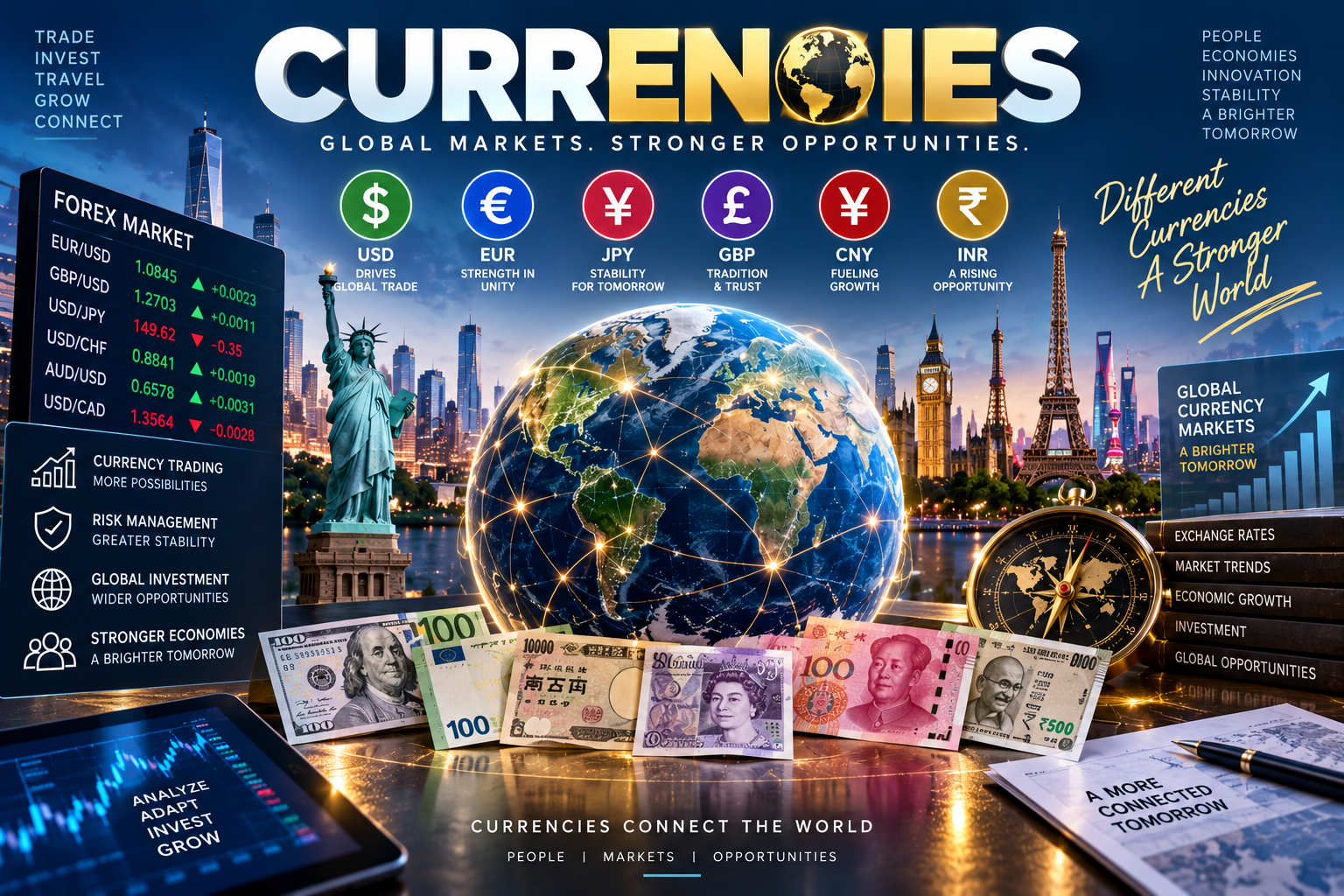
Currencies are the foundation of international trade and finance. Every time a company imports goods, a traveler exchanges money, an investor buys an overseas asset or a government makes an international payment, currencies are involved.
The global currency market, commonly known as the foreign exchange or forex market, is also one of the world's largest financial markets. According to the Bank for International Settlements (BIS), global foreign-exchange trading reached approximately $9.6 trillion per day in April 2025, up around 28% from 2022. The U.S. dollar remained the dominant currency, appearing on one side of roughly 89% of all FX transactions.
Currency movements can have a major impact on inflation, imports, exports, interest rates, corporate profits and investment returns. Understanding how currencies work is therefore essential for businesses, investors and anyone following the global economy.
What Are Currencies?
A currency is a medium of exchange issued and regulated by a country or monetary authority.
Examples include:
U.S. dollar (USD)
Euro (EUR)
Japanese yen (JPY)
British pound (GBP)
Chinese renminbi (CNY)
Swiss franc (CHF)
Canadian dollar (CAD)
Australian dollar (AUD)
Indian rupee (INR)
Pakistani rupee (PKR)
Currencies allow people and businesses to purchase goods and services within an economy and conduct transactions internationally.
Because different countries use different currencies, international transactions require one currency to be exchanged for another. This creates the global foreign-exchange market.
What Is the Foreign Exchange Market?
The foreign exchange market, or FX market, is where currencies are bought and sold.
Unlike traditional stock exchanges that operate during specific hours, the global FX market operates almost continuously during the business week because financial centers around the world open and close at different times.
Major FX trading centers include London, New York, Singapore, Hong Kong and Tokyo.
The BIS reported that the United Kingdom, United States, Singapore and Hong Kong together accounted for about 75% of global FX trading in April 2025.
Currency trading is conducted by banks, companies, investment funds, governments, institutional investors, brokers and individual traders.
How Currency Exchange Rates Work
An exchange rate tells you how much one currency is worth compared with another.
For example, a currency pair such as EUR/USD compares the euro with the U.S. dollar.
If EUR/USD rises, it generally means the euro has strengthened relative to the dollar. If the pair falls, the euro has weakened relative to the dollar.
Exchange rates constantly change because the supply and demand for currencies are constantly changing.
Factors such as interest rates, inflation, economic growth, political developments and investor confidence can all influence currency values.
Major Global Currencies
Some currencies play a much larger role in international finance than others.
U.S. Dollar
The U.S. dollar remains the world's dominant currency in foreign-exchange markets.
According to the BIS, the dollar was involved in approximately 89% of all FX transactions in April 2025.
The dollar's importance comes from the size of the U.S. economy, deep financial markets, its role in international trade and the widespread use of dollar-denominated assets.
Many commodities, including oil, are also priced internationally in U.S. dollars.
Euro
The euro is the second most traded currency globally and is used by numerous European economies.
It plays an important role in international trade, investment and financial markets.
In April 2025, the euro was on one side of approximately 28.9% of global FX transactions, according to the BIS.
Japanese Yen
The Japanese yen is one of the world's major currencies and is heavily traded in global financial markets.
Japan's economy, monetary policy and interest-rate decisions can influence the yen and broader currency markets.
The yen accounted for approximately 16.8% of global FX turnover in April 2025.
British Pound
The British pound remains an important international currency and is heavily traded against the dollar and euro.
The United Kingdom is also one of the world's most important financial centers, helping support the pound's role in international markets.
Chinese Renminbi
China's renminbi has become increasingly important in global currency trading.
BIS data shows that the renminbi accounted for approximately 8.5% of global FX turnover in April 2025, up from 7.0% in 2022. It became the fifth most traded currency globally.
The growing role of the renminbi reflects China's importance in global trade and investment.
What Determines Currency Values?
Currency values are influenced by several major economic and financial factors.
Interest Rates
Interest rates are among the most important drivers of currency movements.
When a country's central bank raises interest rates, its financial assets may become more attractive to international investors. This can increase demand for the country's currency.
Lower interest rates can have the opposite effect, although the actual market response depends on economic conditions and investor expectations.
Inflation
Inflation can influence the purchasing power of a currency.
Countries with persistently high inflation may experience pressure on their currencies, particularly if their central bank cannot maintain confidence in monetary stability.
However, exchange rates also depend on relative inflation between countries rather than inflation in isolation.
Economic Growth
Strong economic growth can attract investment and increase demand for a country's currency.
When investors expect a country to experience stronger growth, they may increase purchases of its stocks, bonds and other assets.
Weak economic conditions can reduce foreign investment and put pressure on a currency.
Political Stability
Currencies can react quickly to political uncertainty.
Elections, government policy changes, geopolitical conflicts and trade disputes can all influence investor confidence.
Countries viewed as politically stable often attract more international investment, which can support demand for their currencies.
Currency Pairs
Currencies are traded in pairs rather than individually.
Some of the most important currency pairs include:
EUR/USD
USD/JPY
GBP/USD
USD/CHF
AUD/USD
USD/CAD
USD/CNY
These are often called major currency pairs because they involve the world's most heavily traded currencies.
Other combinations are known as minor or exotic currency pairs.
Emerging-market currencies can offer greater potential for movement but may also involve higher volatility and lower liquidity.
Emerging-Market Currencies
Emerging-market currencies have become an increasingly important part of the global FX system.
The BIS reported that emerging-market currencies collectively represented approximately 29% of global FX turnover in April 2025, up from 26% in 2022 and less than 10% in the 2000s.
The increase has been driven partly by growing international use of currencies such as the Chinese renminbi, Hong Kong dollar, Singapore dollar and Indian rupee.
However, emerging-market currencies can be more sensitive to capital flows, commodity prices, inflation, political developments and changes in global interest rates.
Currencies and International Trade
Currency movements have a direct impact on international trade.
Suppose a country's currency becomes weaker. Its exports may become cheaper for international buyers because foreign customers need fewer units of their own currency to purchase the goods.
However, imports become more expensive for domestic consumers and businesses.
A stronger currency can have the opposite effect.
This creates an important relationship between exchange rates and trade competitiveness.
Export-oriented companies therefore often pay close attention to currency markets when planning prices, investments and international expansion.
Currencies and Inflation
Currency movements can influence domestic inflation.
When a country's currency weakens significantly, imported goods may become more expensive.
For countries that rely heavily on imported energy, food, machinery or raw materials, currency depreciation can increase costs throughout the economy.
A stronger currency can reduce the domestic price of imported products, potentially helping to control inflation.
This is one reason central banks and governments closely monitor exchange rates.
Central Banks and Currency Markets
Central banks play a major role in currency markets.
Institutions such as the U.S. Federal Reserve, European Central Bank, Bank of Japan and Bank of England use monetary policy to influence inflation, employment and economic activity.
Their decisions can have major effects on currencies.
For example, an unexpected interest-rate increase can cause a currency to rise if investors believe domestic assets will become more attractive.
Central-bank communication is also important. Markets often react not only to current interest rates but also to expectations about future policy.
Currency Trading and Hedging
Currency markets are not used only for speculation.
Businesses frequently use FX markets to hedge currency risk.
For example, a European company purchasing goods from a U.S. supplier may need to pay in dollars several months later. If the euro weakens against the dollar during that period, the purchase could become more expensive.
The company can use financial instruments such as forwards or options to reduce this uncertainty.
The BIS reported that FX forwards and options saw significant increases in activity in the 2025 survey, reflecting the growing importance of managing currency exposures.
Spot, Forward and Swap Markets
Currency transactions can take several forms.
Spot Market
A spot transaction involves exchanging currencies at the current market rate, generally with settlement shortly afterward.
Forward Market
A forward contract allows two parties to agree on an exchange rate for a transaction at a future date.
Businesses commonly use forwards to manage currency risk.
FX Swaps
An FX swap combines currency transactions involving different settlement dates.
FX swaps remain one of the most heavily traded instruments in the global currency market. In April 2025, average daily FX swap turnover was around $4 trillion.
Currency Markets and Investors
Currency movements can influence investment returns even when an investor does not directly trade forex.
Consider an investor from Pakistan buying U.S. assets. The investor faces two potential sources of return: the performance of the U.S. investment and the movement of the Pakistani rupee against the U.S. dollar.
If the foreign currency strengthens relative to the investor's home currency, the currency movement can increase the local-currency value of the investment.
If the foreign currency weakens, the opposite can happen.
This is known as currency risk.
Digital Payments and the Future of Currencies
Technology is changing how money moves around the world.
Digital banking, instant payments, mobile wallets and blockchain-based systems are transforming payment infrastructure.
Central banks are also exploring central bank digital currencies (CBDCs), which could potentially change how digital money is issued and transferred.
However, traditional currencies remain dominant in international finance, and changes to the global monetary system are likely to occur gradually.
Key Risks in Currency Markets
Currency markets offer opportunities but also significant risks.
Exchange-Rate Volatility
Currencies can move sharply following economic announcements or geopolitical events.
Interest-Rate Risk
Unexpected changes in central-bank policy can produce significant currency movements.
Political Risk
Elections, conflicts and government policy can affect investor confidence.
Economic Risk
Recessions, high inflation or financial instability can weaken a currency.
Liquidity Risk
Some emerging-market currencies may have lower liquidity than major currencies, making them more difficult to trade during periods of market stress.
What to Watch in Currency Markets in 2026
Several themes are likely to remain important for currency markets.
Central-bank policy will remain one of the biggest drivers. Investors will closely follow interest-rate decisions and guidance from major central banks.
The U.S. dollar will remain central to global financial markets because of its dominant role in international FX trading.
The Chinese renminbi is another currency to watch as China's role in global trade continues to evolve. Its share of FX turnover has already increased significantly in recent years.
Emerging-market currencies could continue gaining importance, although their performance will depend heavily on global economic conditions and capital flows.
Geopolitical developments may also create periods of increased currency volatility as investors move toward or away from perceived safe-haven assets.
The Future of Global Currencies
The global currency system is constantly evolving.
The U.S. dollar remains dominant, but international currency markets are becoming more diversified. The increasing participation of emerging-market currencies demonstrates that global financial activity is expanding beyond traditional major currencies.
At the same time, technological innovation could change how currencies are transferred and used.
Digital payments, faster settlement systems and potential central-bank digital currencies may make international transactions more efficient.
However, the fundamentals of currency markets are unlikely to disappear. Economic strength, interest rates, inflation, trade, political stability and investor confidence will continue to determine how currencies perform.
Conclusion
Currencies are much more than the money people use to buy goods and services. They are a critical part of international trade, investment, monetary policy and global economic activity.
The foreign-exchange market is enormous, with billions of dollars changing hands every day. The latest BIS data shows that global FX trading reached around $9.6 trillion per day in April 2025, highlighting the enormous scale and importance of the market.
The U.S. dollar continues to dominate global trading, while the euro, yen, pound, renminbi and other major currencies remain important players. Emerging-market currencies are also gaining a larger share of international FX activity.
For businesses, understanding currencies is essential for managing international payments and reducing exchange-rate risk. For investors, currency movements can significantly influence portfolio performance.
As global trade, technology and financial markets continue to evolve, currencies will remain at the center of the international economy.
Frequently Asked Questions
What are currencies?
Currencies are forms of money issued by countries or monetary authorities and used to conduct domestic and international transactions.
What is the forex market?
The forex market is the global marketplace where currencies are exchanged. It is one of the world's largest financial markets.
Which is the world's most traded currency?
The U.S. dollar is the world's most traded currency. It was involved in about 89% of global FX transactions in April 2025.
What affects currency prices?
Interest rates, inflation, economic growth, trade flows, political stability, central-bank policy and investor sentiment can all affect currency values.
Why is the U.S. dollar so important?
The dollar is widely used in international trade and finance and remains the dominant currency in global foreign-exchange markets.
What are emerging-market currencies?
Emerging-market currencies are currencies from developing or rapidly growing economies. Examples include the Indian rupee, Chinese renminbi, Indonesian rupiah and Brazilian real.
Why do businesses hedge currencies?
Businesses hedge currency exposure to reduce the financial impact of unexpected exchange-rate movements on international payments and revenues.