Emerging markets have become an increasingly important part of the global economy. From India and China to Brazil, Indonesia, Mexico, South Africa, and other developing economies, these markets influence global trade, commodities, manufacturing, technology, capital flows, and investment.
The term emerging markets generally refers to economies that are developing rapidly and becoming more integrated into global financial and economic systems but have not reached the institutional depth, income levels, or market characteristics of advanced economies. Different organizations use different classification systems, so there is no single universal list of emerging-market countries.
In 2026, emerging markets are navigating a complicated environment. Global economic growth remains positive, but geopolitical tensions, energy prices, inflation, interest rates, trade policies, currency movements, and changing technology investment are creating very different conditions across countries.
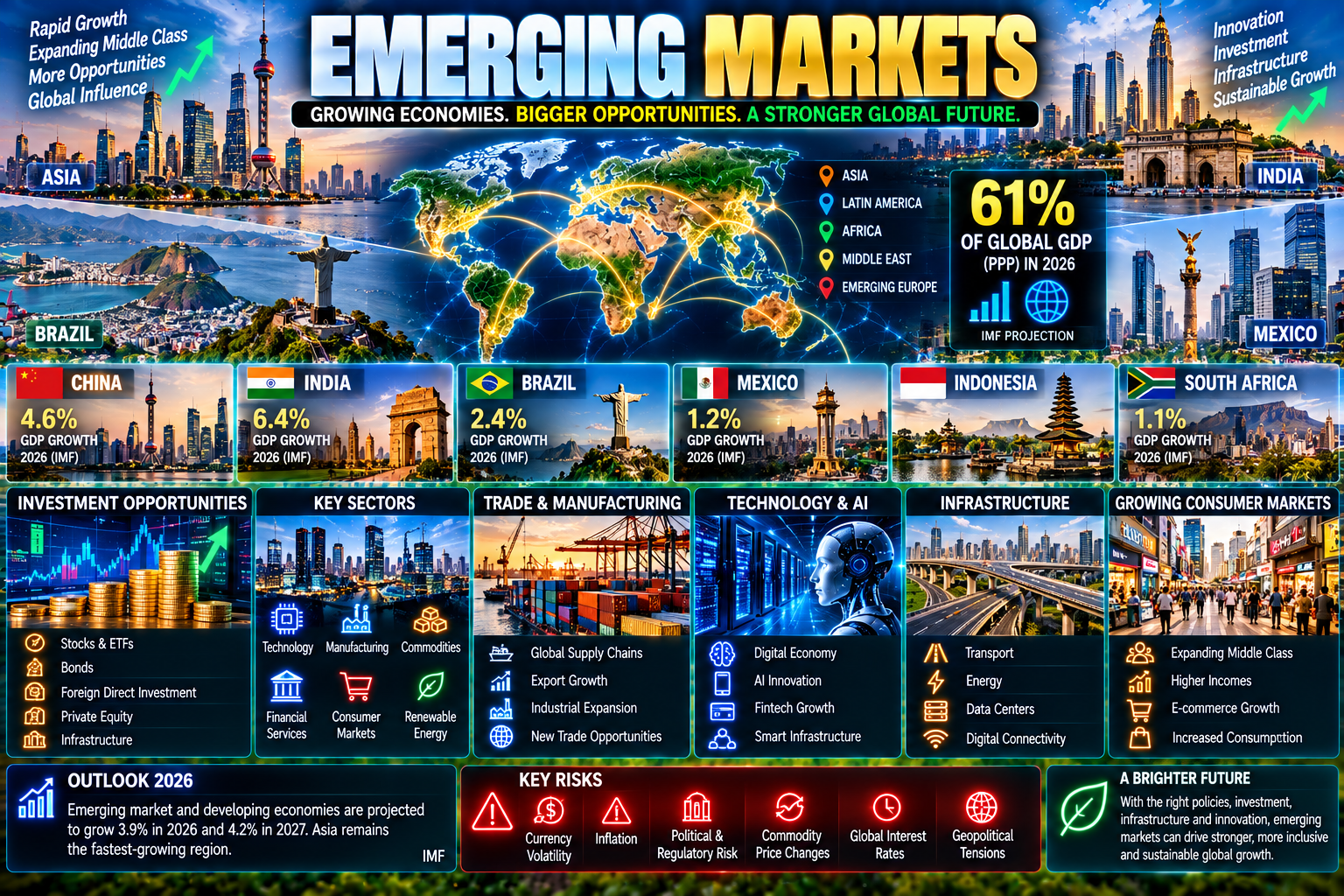
The International Monetary Fund (IMF) projects growth in emerging market and developing economies at 3.9% in 2026, rising to 4.2% in 2027. Emerging and developing Asia is expected to grow faster than several other emerging regions, while Latin America, emerging Europe, the Middle East, and Africa face different combinations of opportunities and challenges.
What Are Emerging Markets?
Emerging markets are economies that are transitioning toward greater industrialization, financial development, international trade, and higher levels of economic integration.
They can have characteristics such as:
Rapid economic growth
Expanding middle classes
Growing consumer markets
Increasing foreign investment
Developing capital markets
Large young populations
Rising technology adoption
Expanding manufacturing capacity
Growing infrastructure investment
Increasing international trade
Emerging markets can be found across Asia, Latin America, Africa, the Middle East, and parts of Europe.
The classification can differ between index providers and international institutions. For example, the MSCI Emerging Markets Index is designed to represent large- and mid-cap companies across emerging-market countries and covers approximately 85% of the free-float-adjusted market capitalization in each included country. As of August 31, 2026, the index had 1,178 constituents and approximately $12.33 trillion in market capitalization.
Emerging Markets vs. Developed Markets
The main difference between emerging and developed markets involves the maturity of their economies and financial systems.
Factor | Emerging Markets | Developed Markets |
|---|---|---|
Economic growth | Often faster but more volatile | Generally more stable |
Income levels | Generally lower or middle-income | Generally higher |
Financial markets | Developing and expanding | More mature |
Infrastructure | Often rapidly developing | More established |
Currency volatility | Can be higher | Usually lower |
Foreign investment | Important source of capital | More diversified |
Consumer growth | Often strong | Generally slower |
Technology adoption | Rapidly increasing | Highly developed |
Political/regulatory risk | Can be higher | Generally more predictable |
Commodity exposure | Often significant | Varies |
These differences do not mean every emerging market has the same characteristics. Some emerging economies have highly sophisticated financial sectors, while others remain heavily dependent on commodities or agriculture.
Major Emerging Markets
Some of the world's most economically significant emerging markets include:
China
China is one of the largest economies in the world and plays a major role in manufacturing, exports, technology, commodities, infrastructure, and global supply chains.
The IMF's July 2026 outlook projected China's growth at 4.6% in 2026 and 4.0% in 2027. The IMF has also highlighted structural challenges including subdued domestic demand and weaker productivity growth.
China's importance to emerging markets extends beyond its domestic economy because changes in Chinese demand can influence commodity exporters, manufacturers, shipping markets, and neighboring Asian economies.
India
India has become one of the most important growth engines among emerging economies.
The IMF projected India's fiscal-year 2026–27 growth at 6.4%, with growth expected to rise to 6.7% in 2027. The IMF has pointed to reforms, domestic activity, manufacturing, and supply-chain diversification as important factors.
India is also benefiting from increasing electronics manufacturing and export activity. The IMF reported that India's electronics exports rose 24% in fiscal year 2025–26.
Brazil
Brazil is Latin America's largest economy and an important emerging-market economy because of its agricultural production, energy resources, mining sector, manufacturing base, and large domestic consumer market.
The IMF projected Brazil's economy to grow 2.4% in 2026, with structural reforms and energy production supporting medium-term growth.
Mexico
Mexico is deeply integrated with North American manufacturing and supply chains.
Its proximity to the United States, industrial base, automotive sector, electronics production, and trade relationships make it an important emerging market.
The IMF's July 2026 forecast projected Mexican growth of 1.2% in 2026 and 1.9% in 2027, while noting uncertainty surrounding trade relations and the USMCA review.
Indonesia
Indonesia is one of Southeast Asia's largest economies and has important positions in commodities, manufacturing, digital services, consumer markets, and energy.
Its large population and expanding middle class make domestic consumption an important economic driver, while its natural-resource base gives it significance in global commodity supply chains.
South Africa
South Africa is an important financial and industrial hub for Africa and has developed equity and bond markets alongside significant mining, manufacturing, and services sectors.
The IMF's July 2026 outlook projected South African growth at approximately 1.1% in 2026, with structural reforms and policy frameworks influencing the medium-term outlook.
The Economic Importance of Emerging Markets
Emerging economies represent a major share of global economic activity.
The IMF's April 2026 data placed emerging market and developing economies at approximately 61% of global GDP on a purchasing-power-parity basis in 2026.
Their importance comes from several areas.
1. Manufacturing
Emerging economies are major manufacturing centers for:
Electronics
Automobiles
Machinery
Textiles
Chemicals
Consumer products
Semiconductors
Industrial equipment
Companies increasingly diversify supply chains across multiple countries to manage costs, resilience, tariffs, and geopolitical risks.
2. Consumer Growth
Emerging markets contain enormous populations of consumers whose incomes and purchasing power are expanding.
Growing demand for:
Smartphones
Financial services
Healthcare
Education
Travel
E-commerce
Automobiles
Digital entertainment
can create new markets for multinational companies.
3. Natural Resources
Many emerging economies are major producers of:
Oil
Natural gas
Copper
Iron ore
Lithium
Gold
Agricultural products
Critical minerals
This creates both economic opportunities and exposure to commodity-price cycles.
4. Technology
Digital technology is transforming emerging economies.
Mobile banking, fintech, e-commerce, cloud computing, artificial intelligence, digital payments, and online services can allow businesses to expand without requiring the same physical infrastructure that developed economies historically needed.
The World Bank's World Development Report 2026 identifies artificial intelligence as a potential pathway toward greater prosperity for developing economies, while emphasizing that countries need the infrastructure, skills, business environment, and institutions necessary to capture those benefits.
Emerging Market Stock Markets
Emerging-market equities provide exposure to companies operating in developing economies.
Major sectors represented in emerging-market stock markets include:
Technology
Financial services
Energy
Materials
Consumer goods
Telecommunications
Industrials
Healthcare
Real estate
Emerging-market stock markets can experience significant volatility because company earnings may be affected by currency movements, interest rates, commodity prices, political developments, and international capital flows.
The MSCI Emerging Markets Index is one widely followed benchmark for emerging-market equities. Its August 2026 data showed a market capitalization of approximately $12.33 trillion.
Emerging Market Bonds
Emerging-market bonds are another important part of global capital markets.
They can be issued in:
Local currencies
U.S. dollars
Euros
Other major currencies
Local-currency bonds can provide exposure to domestic interest rates and currencies, while hard-currency bonds can reduce some currency exposure but introduce other risks.
Investors and institutions closely monitor:
Government debt
Fiscal deficits
Inflation
Central-bank policy
Currency stability
Credit ratings
Foreign-exchange reserves
External debt
Emerging Market Currencies
Currencies are particularly important in emerging economies.
Emerging-market currencies can experience larger movements than major reserve currencies because they may be more sensitive to:
U.S. interest rates
Dollar strength
Commodity prices
Foreign capital flows
Political uncertainty
Current-account balances
Inflation
Central-bank policy
A stronger U.S. dollar can increase the burden of dollar-denominated debt for some emerging-market borrowers.
Conversely, a weaker dollar and easier global financial conditions can support capital flows into emerging-market assets.
Interest Rates and Emerging Markets
Global interest rates have an important influence on emerging markets.
When interest rates in major developed economies rise, investors may shift toward safer or higher-yielding assets in developed markets. This can reduce capital flows into emerging economies.
Higher global rates can also increase borrowing costs for governments and companies with foreign-currency debt.
When global financial conditions become more supportive, emerging-market economies may benefit from:
Lower financing costs
Stronger capital inflows
Improved currency conditions
Higher investment
Greater access to international financing
Trade and Supply-Chain Diversification
Global supply-chain restructuring is creating new opportunities for emerging markets.
Businesses are increasingly considering multiple manufacturing locations rather than relying on a single country.
India, Southeast Asia, Mexico, and other emerging economies can benefit when companies diversify production.
The IMF reported in July 2026 that supply-chain diversification was already benefiting India, particularly in electronics manufacturing.
This trend can support:
Foreign direct investment
Factory construction
Employment
Export growth
Infrastructure development
Technology transfer
Emerging Markets and Artificial Intelligence
Artificial intelligence is becoming an increasingly important factor in emerging-market economies.
AI can influence emerging markets through two different channels.
AI as an Opportunity
AI can improve:
Manufacturing productivity
Healthcare
Financial services
Agriculture
Education
Logistics
Customer service
Government services
Software development
Countries integrated into technology supply chains can also benefit from investment in data centers, semiconductors, electronics, power infrastructure, and cloud computing.
AI as a Challenge
AI can also create disruption.
Economies dependent on routine service jobs could face employment pressures if automation replaces certain activities.
Countries that lack:
Digital infrastructure
Skilled workers
Reliable electricity
Computing capacity
Investment capital
may struggle to capture the benefits of AI.
The IMF's July 2026 outlook specifically noted that AI-driven demand was supporting economies integrated into global technology value chains.
Infrastructure and Emerging Markets
Infrastructure remains one of the most important long-term development opportunities.
Emerging economies require investment in:
Roads
Railways
Ports
Airports
Electricity grids
Renewable energy
Water systems
Telecommunications
Data centers
Broadband networks
Housing
Infrastructure investment can increase productivity and improve the ability of companies to participate in international markets.
The World Bank has also identified widespread underinvestment in physical, digital, and energy infrastructure, particularly in parts of Sub-Saharan Africa.
Key Risks in Emerging Markets
Emerging markets can provide opportunities for growth, but they also face significant risks.
Currency Risk
Currency depreciation can increase the cost of imports and foreign-currency debt.
Inflation
Higher food, fuel, and commodity prices can put pressure on households and businesses.
Political and Regulatory Risk
Changes in regulation, taxation, trade policy, or government policy can affect businesses and investors.
Commodity Dependence
Commodity exporters can benefit from high prices but suffer when global demand or prices decline.
Debt Risk
High government or corporate debt can make economies more vulnerable to higher interest rates.
Capital-Flow Risk
Rapid inflows of international capital can reverse quickly during periods of global financial stress.
Geopolitical Risk
Trade disputes, wars, sanctions, shipping disruptions, and regional tensions can affect investment and supply chains.
The IMF's 2026 outlook emphasizes that geopolitical fragmentation, renewed trade tensions, financial repricing, and energy shocks remain important downside risks.
Regional Outlook for Emerging Markets in 2026
Emerging markets are not moving in the same direction.
Region | 2026 Outlook | Major Drivers |
|---|---|---|
Emerging & Developing Asia | 4.9% | Technology, domestic demand, trade |
South Asia | 6.3% | India-led growth, domestic demand |
Latin America & Caribbean | 2.4% | Consumption, commodities, investment |
Emerging & Developing Europe | 1.9% | Trade, energy, geopolitical conditions |
Sub-Saharan Africa | 4.3% | Reforms, commodities, domestic investment |
Middle East & Central Asia | 0.7% | Energy shock and geopolitical disruption |
These figures come from the IMF's July 2026 World Economic Outlook update and illustrate the large differences between emerging-market regions.
The World Bank's June 2026 outlook similarly projected South Asia to remain the fastest-growing emerging-market and developing region, although growth was expected to slow from 7% in 2025 to 6.3% in 2026.
Emerging Markets and Foreign Direct Investment
Foreign direct investment, or FDI, is particularly important for emerging economies.
International companies may invest in emerging markets to access:
New consumers
Lower-cost production
Natural resources
Skilled workers
Export platforms
Technology ecosystems
Regional markets
Successful FDI can bring capital, technology, management expertise, supply-chain connections, and employment.
However, countries compete for investment by improving infrastructure, regulatory certainty, workforce skills, taxation systems, and market access.
Emerging Markets and Financial Technology
Fintech is transforming financial services across emerging economies.
Digital financial services can provide access to:
Mobile payments
Digital wallets
Online banking
Digital lending
Insurance technology
Investment platforms
Remittance services
This is particularly important where traditional banking infrastructure has historically been limited.
Mobile technology can allow consumers and small businesses to participate in formal financial systems without requiring extensive physical bank branches.
The Role of Commodities
Commodities remain central to many emerging economies.
For exporters, higher commodity prices can increase:
Export revenues
Government revenues
Foreign-exchange reserves
Investment
Economic activity
However, commodity dependence can also increase volatility.
The World Bank noted that about two-thirds of developing economies—and nearly 90% of low-income countries—are commodity exporters.
Diversification into manufacturing, services, technology, and higher-value industries can therefore be important for long-term economic resilience.
Emerging Markets and Sustainable Development
Emerging economies face the challenge of expanding economic activity while managing environmental pressures.
Investment opportunities increasingly include:
Solar power
Wind energy
Battery storage
Electric vehicles
Green hydrogen
Sustainable agriculture
Water infrastructure
Energy-efficient buildings
Climate-resilient infrastructure
The transition to cleaner energy can also create demand for critical minerals and new manufacturing capabilities.
At the same time, developing countries need affordable and reliable energy to support industrialization and job creation.
What Drives Emerging-Market Growth?
Several factors can contribute to sustained emerging-market growth:
Young and growing populations
Urbanization
Rising household incomes
Infrastructure investment
Manufacturing expansion
Technology adoption
Foreign investment
Trade integration
Financial-sector development
Education and workforce skills
Domestic entrepreneurship
Regulatory and institutional reforms
Countries that combine these factors with macroeconomic stability can potentially create stronger foundations for long-term development.
Emerging Markets in 2026: Major Trends
1. Technology-Led Growth
AI, cloud computing, semiconductors, fintech, and digital services are becoming increasingly important.
2. Supply-Chain Diversification
Companies are expanding production networks across multiple countries.
3. Infrastructure Investment
Energy, transportation, telecommunications, and digital infrastructure remain major priorities.
4. Expanding Consumer Markets
Growing middle classes are increasing demand for financial services, healthcare, retail, travel, and digital products.
5. Greater Financial Integration
Emerging economies continue to deepen their equity, bond, banking, and digital-finance markets.
6. Energy Transition
Renewables, electric mobility, storage, and critical minerals are creating new investment and industrial opportunities.
7. Geopolitical Fragmentation
Trade barriers, sanctions, regional conflicts, and strategic competition are changing global investment and supply-chain decisions.
8. AI Infrastructure
Data centers, electricity generation, semiconductor production, and connectivity are becoming strategically important for countries seeking to participate in the AI economy.
Future of Emerging Markets
The long-term outlook for emerging markets will depend on whether economies can translate population growth, technology, capital investment, and natural resources into sustainable productivity gains.
The World Bank has warned that developing economies face a difficult growth environment, with weak per-capita income growth compared with historical averages. At the same time, it identifies infrastructure, private investment, technology, education, and business-environment reforms as important areas for improving development outcomes.
AI could become particularly significant. Countries that successfully develop digital infrastructure, skills, electricity capacity, data ecosystems, and competitive businesses could benefit from the next wave of technological investment.
Emerging markets are also likely to remain central to global supply chains. Manufacturing diversification, critical minerals, renewable energy, and expanding consumer markets can all create new opportunities.
However, growth will not be uniform. Countries with strong institutions, sustainable debt levels, reliable infrastructure, skilled workforces, and stable macroeconomic policies may be better positioned to manage global shocks.
Conclusion
Emerging markets are a fundamental part of the modern global economy. They account for a substantial share of global economic activity and are increasingly important in manufacturing, technology, commodities, consumer markets, financial services, and international trade.
In 2026, the emerging-market landscape is being shaped by several competing forces: AI investment, supply-chain diversification, infrastructure development, commodity prices, interest rates, inflation, currency movements, geopolitical tensions, and energy-market disruptions.
Asia remains a major source of emerging-market growth, while Latin America, Africa, the Middle East, and emerging Europe offer different combinations of resources, demographics, industrial capabilities, and development opportunities.
For businesses and investors, understanding emerging markets requires looking beyond headline GDP growth. Currency stability, inflation, debt, regulation, demographics, infrastructure, technology adoption, trade relationships, and institutional quality can all influence economic outcomes.
As global economic and technological networks continue to evolve, emerging markets are likely to remain central to discussions about growth, investment, trade, innovation, and the future of the global economy.
Frequently Asked Questions About Emerging Markets
What are emerging markets?
Emerging markets are economies that are developing rapidly and becoming increasingly integrated into global financial and economic systems while generally remaining less mature than advanced economies.
Which countries are considered emerging markets?
Examples include China, India, Brazil, Mexico, Indonesia, South Africa, and numerous economies across Asia, Latin America, Africa, the Middle East, and Europe. Exact classifications differ by institution and index provider.
Why are emerging markets important?
They are important because of their economic growth, large populations, manufacturing capacity, natural resources, consumer markets, technology industries, and increasing participation in international trade and finance.
Are emerging markets risky?
Emerging markets can have higher exposure to currency volatility, inflation, political and regulatory changes, commodity cycles, capital-flow reversals, debt pressures, and geopolitical events. Risk varies significantly by country and asset.
What is an emerging-market stock market?
An emerging-market stock market is an equity market located in, or providing exposure to, an emerging economy. Major sectors can include technology, banking, energy, materials, consumer goods, and industrial companies.
What is the difference between emerging and developing markets?
The terms are sometimes used differently by institutions. "Emerging markets" often refers specifically to economies and financial markets transitioning toward greater development and international integration, while "developing economies" can be a broader economic classification.
How does the U.S. dollar affect emerging markets?
The dollar can influence emerging markets through exchange rates, foreign debt, commodity prices, international capital flows, and global financial conditions. A stronger dollar can increase pressure on some economies with substantial dollar-denominated liabilities.
How will AI affect emerging markets?
AI can improve productivity and create opportunities in technology, manufacturing, healthcare, finance, agriculture, and services. However, countries without sufficient digital infrastructure, electricity, investment, and skilled workers may capture fewer benefits.
What is the future of emerging markets?
The future will depend on productivity growth, technology adoption, infrastructure, human capital, trade integration, investment, macroeconomic stability, and institutional development. Emerging markets are expected to remain important participants in global economic growth and financial markets.